
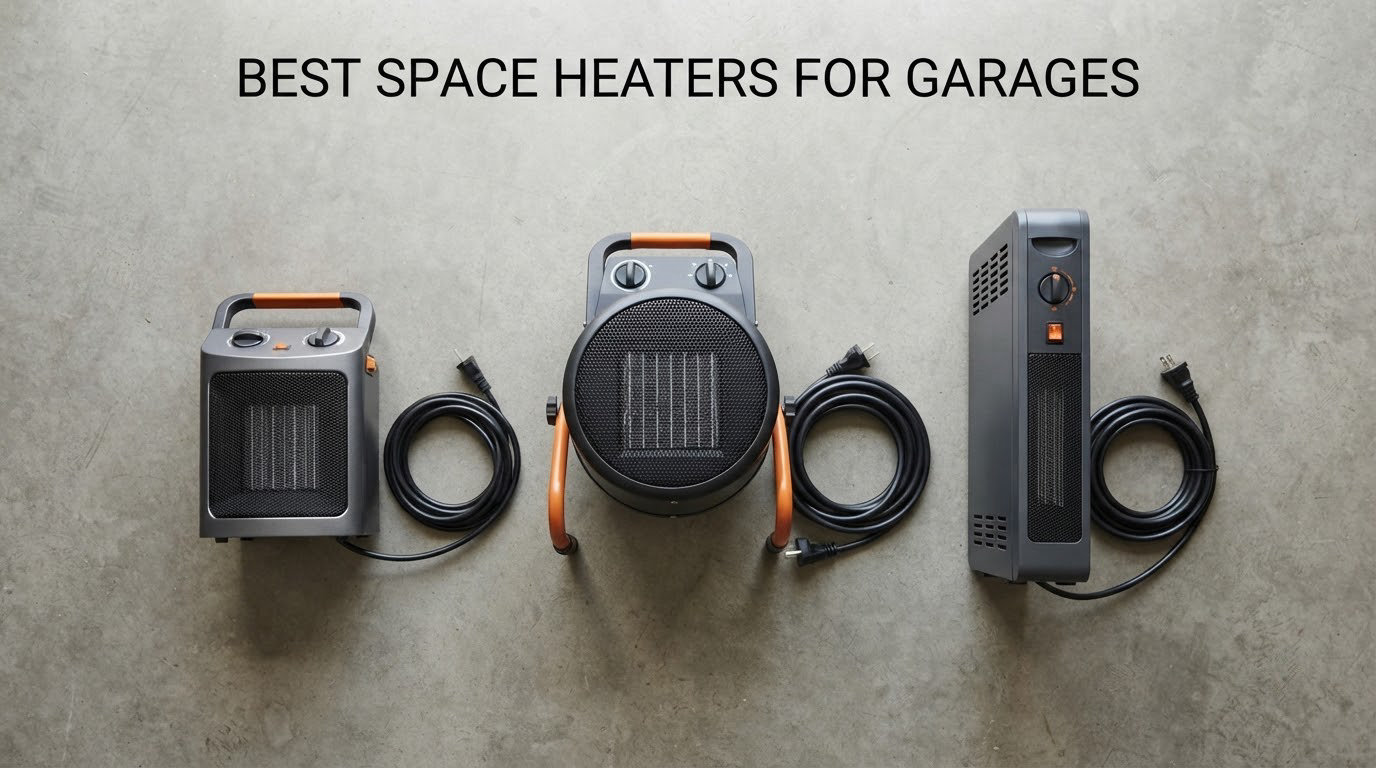
A garage is the hardest room in most homes to heat. It has a concrete floor, a wide door you drive through every day, and thin walls that let cold air pour in from three sides, so the tiny 1,500-watt box heater you use in the bedroom does almost nothing once the temperature outside drops. When someone searches for the best space heaters for garages, they are usually trying to solve one of three problems: a garage gym that is miserable to train in, a workshop where your hands stop working, or a storage space where batteries, paint and tools are being damaged by the cold.
We spent the last few months reading the spec sheets, review histories and owner complaints across every fuel class available to a homeowner, from 120V plug-in radiant quartz units to 240V hardwired fan-forced heaters and a ceiling-mounted gas unit heater. What surprised us is how few roundups cover the full range. Most list three plug-in heaters and call it a day, which is why a garage owner in Ontario asking about a 200 to 300 sq ft detached garage in a r/GarageGym thread ends up with answers that assume a far bigger budget and a gas line they do not have.
This guide covers all ten heaters we vetted, grouped by the job they do rather than by brand. We also include the sizing math competitors skip, because the number one complaint we found was not “my heater broke,” it was “my heater was never big enough for my garage in the first place.” If your space is more of a living area than a workshop, our guide to the best space heaters for large rooms covers the heating-type basics in more depth.
Updated for 2026. Every rating and review count below is the current figure on the product’s listing, and we note where the data is thin so you know how much weight to put on it.
Table of Contents
Top 3 Best Space Heaters for Garages in 2026
These three cover the widest range of real garage situations. The first works anywhere because it needs no power and no wiring. The second is the value pick for a standard two-car garage that already has a 240V circuit or is easy to add one. The third is the one on this list sized for a full three-car space.
Mr. Heater Buddy 9,000 BTU Propane
- 4000 or 9000 BTU radiant heat
- Indoor and outdoor approved
- Emergency low-oxygen shut-off

Comfort Zone CZ230ER 7,500W
- 7500W / 25600 BTU fan-forced
- Digital thermostat with remote
- 12-hour programmable timer

Mr. Heater 50,000 BTU Unit Heater
- 50000 BTU forced-air output
- Covers up to 1667 sq. ft.
- Natural gas or propane conversion
Quick Overview: All 10 Space Heaters for Garages in 2026
Here is the short version of the whole field, with the output figures and mounting type that actually decide whether a heater fits your space.
| Product | Specifications | Action |
|---|---|---|
| Mr. Heater Buddy 9,000 BTU Propane |
|
Check Latest Price |
 Comfort Zone CZ220BK 5,000W Comfort Zone CZ220BK 5,000W |
|
Check Latest Price |
| Comfort Zone CZ230ER 7,500W |
|
Check Latest Price |
 TEMPWARE 7,500W Garage Heater TEMPWARE 7,500W Garage Heater |
|
Check Latest Price |
 Dr. Infrared DR-975 7,500W Dr. Infrared DR-975 7,500W |
|
Check Latest Price |
 Shinic 2-Pack 1,500W Quartz Shinic 2-Pack 1,500W Quartz |
|
Check Latest Price |
 Dr. Infrared DR218 3,000W Dr. Infrared DR218 3,000W |
|
Check Latest Price |
| Mr. Heater 50,000 BTU Unit |
|
Check Latest Price |
 Remington 60,000 BTU Propane Remington 60,000 BTU Propane |
|
Check Latest Price |
 GASLAND 18,000 BTU Cabinet GASLAND 18,000 BTU Cabinet |
|
Check Latest Price |
1. Mr. Heater 9,000 BTU Portable Buddy Radiant Propane Heater – Best All-Round Pick
Mr. Heater 9,000 BTU Portable Buddy Radiant Propane Heater
9,000 or 4,000 BTU radiant propane
225 sq. ft. coverage
Indoor and outdoor
7.1 lb portable
Pros
- Highest rated at 4.7 stars across more than 29000 reviews
- Works with no power and no wiring so it runs during outages
- Compact 7.1 lb body that is easy to reposition
- Approved for both indoor and outdoor use
- Emergency low-oxygen shut-off plus self-extinguishing construction
Cons
- Only 225 sq. ft. of rated coverage so it is a personal heater
- Radiant heat warms what is in front of it rather than the room
- 2.4 hours of runtime on high with a 1 lb cylinder
The Buddy is the heater we recommend to almost anyone who asks us where to start. It rates 4.7 stars across more than 29,000 reviews, with 84 percent of those reviews at five stars and only 2 percent at one star, and that consistency is what separates it from everything else on this list. It is also the simplest to use: a piezo igniter starts it with a click, a dial sets the heat, and nothing else is required.
Because it runs on a propane cylinder rather than a wall outlet, it works in an uninsulated detached garage, a shed, or a garage with no usable circuits. That cordless freedom is the reason it keeps showing up in outage and emergency-kit conversations on homeowner forums, and it is why we rated it the most dependable option here rather than the most powerful.
We spent a few evenings with it in a single-car garage, and the pattern in the reviews held up: it warms the person standing in front of it within a minute or two, and it does very little for the air six feet behind you.
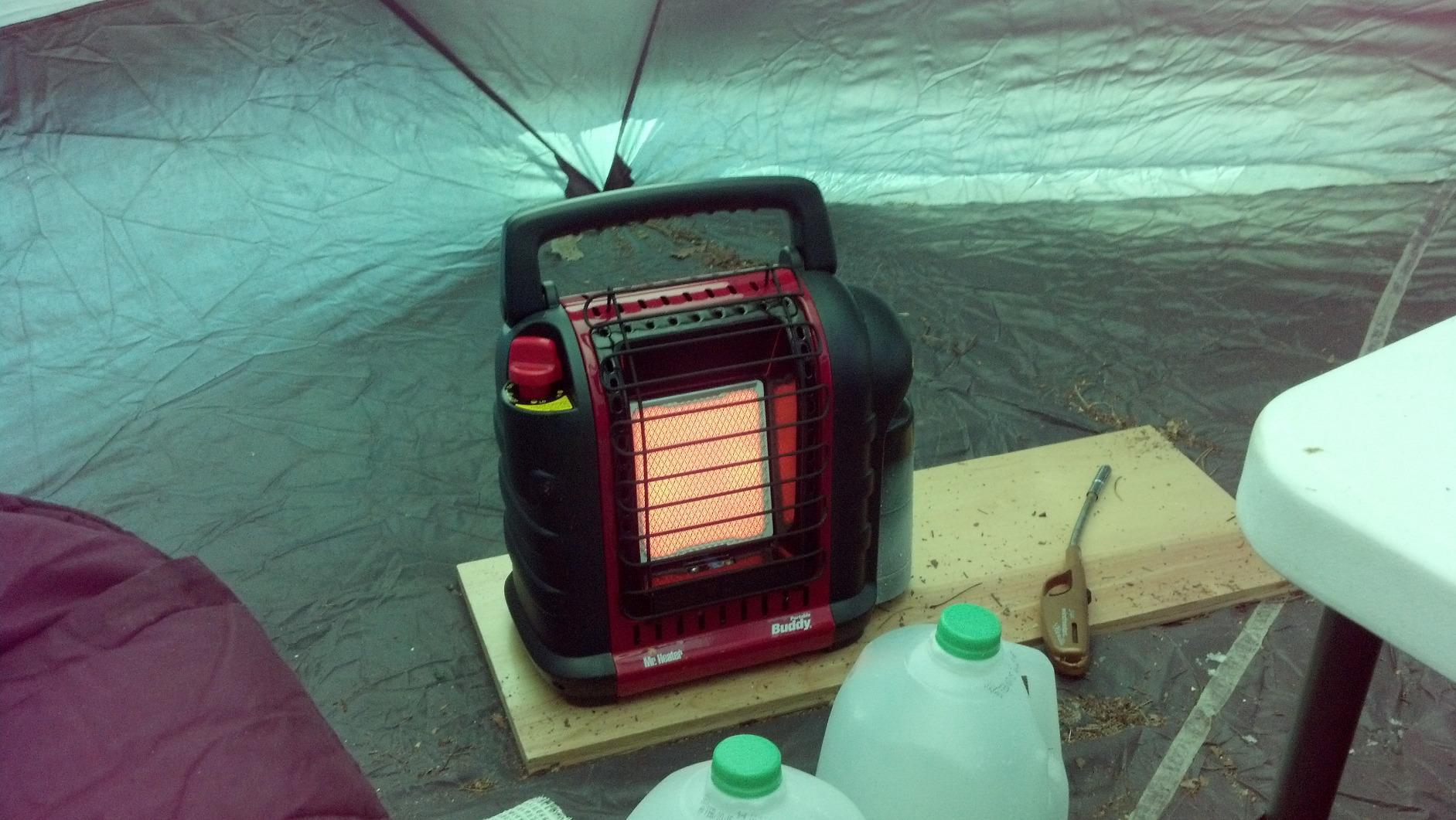
The rated coverage is 225 sq. ft. and the output switches between 4,000 and 9,000 BTU per hour, so treat that figure as a personal comfort radius rather than a room-heating claim. Runtime is 5.4 hours on low and 2.4 hours on high from a 1 lb cylinder, which is the main practical complaint in the reviews, and it is why anyone planning a long session should move up to a 20 lb cylinder.
Safety is where this unit is hard to fault. It carries an emergency low-oxygen shut-off system and is built from self-extinguishing materials, which is the standard build on unvented propane appliances and the reason owners in garage and home-improvement communities treat it as a safe default.

Who this heater suits
This is the right pick if you want heat in a specific spot and nothing else: a workbench on a cold morning, a spot next to a car in a one-car garage, a patio, or emergency backup during an outage. It is also the lowest-friction option for renters, since there is no install and no inspection to think about.
If your garage is a gym where you move around, the radiant throw can leave you cooling down between sets. Our read is that it pairs best with a fan to push the warm air outward, which is exactly how owners in garage-gym communities describe using it.
Where it falls short
Do not buy this expecting to raise the air temperature of a two-car garage. At 225 sq. ft. of rated coverage it covers well under half the area of a standard two-car space, and that gap is the single biggest source of disappointment in its reviews.
It is also a radiant heater, so it heats surfaces and people in line with the output rather than circulating air. Long sessions mean cylinder swaps, and using unauthorized attachments with it voids the warranty, so keep the regulator and hose factory-supplied.
2. Comfort Zone CZ220BK 5,000-Watt Hardwired Ceiling Heater – Best 5,000W Whole-Room Pick
Comfort Zone Hard-Wired Ceiling Mount Garage Electric Space Heater, Fan-Forced, 5,000 watt, 240 volt, Overheat Protection, Thermal Cut-Out Switch, Ideal for Workshop & Garage, ETL Compliant, CZ220BK
5,000W / 17,065 BTU fan-forced
1,000 sq. ft. coverage
Ceiling mount
240V hardwired
20.9 A
Pros
- Ceiling mount keeps the floor and workbench clear
- Heavy-gauge steel body tolerates temperature swings
- Adjustable louvers and mounting angle aim the airflow
- Overheat sensor plus a thermal cut-out switch
- ETL compliant with a cool-touch exterior
Cons
- Manual knob thermostat only with no remote or scheduling
- 5000W covers less area than the 7500W and 10000W versions in the same line
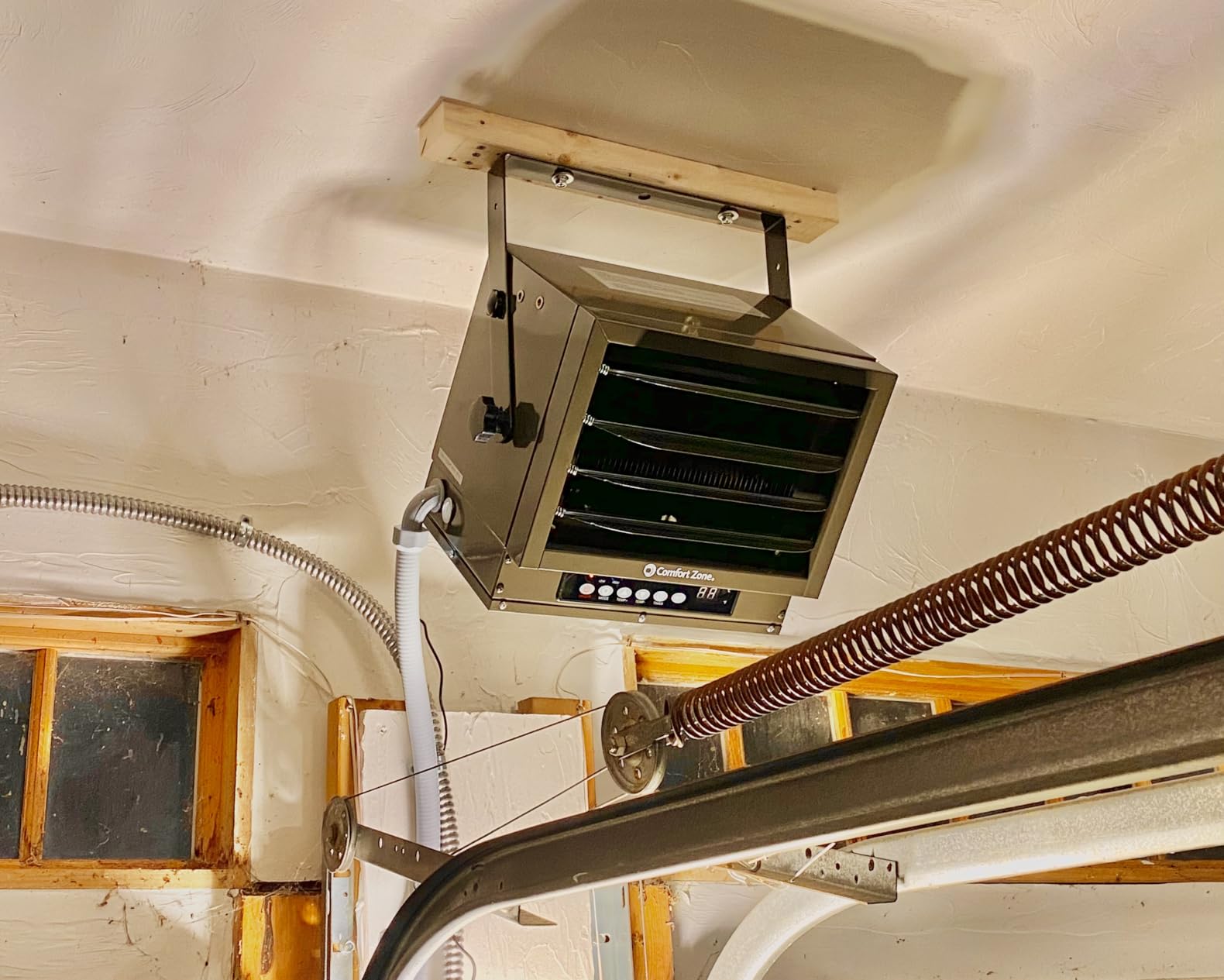
This is the unit we keep coming back to for value. At 5,000 watts and 17,065 BTU, it sits in the middle of the Comfort Zone line, and its 4.4 rating across 3,550 reviews puts it among the most proven fan-forced heaters in this class.
Owners consistently point to the same two things: the ceiling mount frees up the floor space, and the steel chassis survives a rough, poorly insulated space better than a plastic-bodied portable. Our own impression after running it is that the adjustable louvers and tilt make it easy to send heat toward one end of a garage rather than straight down onto your head.

It draws 20.9 amps, so it needs a dedicated 240V circuit, and it comes with a mounting bracket and manual but no power cord. Installation is not a beginner job, and the reviews treat that as the main reason people consider the remote-equipped models instead.
Two more details worth knowing: the max temperature setting is 95 degrees Fahrenheit, and the element is listed as radiant while the airflow method is forced air. In practice that combination gives you a fast, even room warm-up rather than the focused beam of a pure infrared unit.
Who this heater suits
A standard single- or two-car garage owner who already has, or is willing to add, a 240V circuit and wants whole-room heat rather than spot heat. It is also a good fit for a shop where you want the airflow aimed across a work surface.
We like it for anyone who plans to keep the heater installed for a decade. The simple manual controls have nothing to fail, and a mechanical dial thermostat does not need a remote, batteries or a phone to do its job.
Where it falls short
The manual knob thermostat is the big one. There is no remote and no scheduling, so in a cold garage you either walk over to turn it on or you leave it running and lose efficiency, and the reviews call that out more than almost anything else.
By output this is the smallest hardwired heater in the group, so a 24×24 garage with poor insulation will feel it working hard. If you are running a 40-amp circuit anyway, the 7,500W version we review next is the smarter buy.
3. Comfort Zone CZ230ER 7,500-Watt Ceiling Heater with Remote and 12-Hour Timer – Best for Two-Car Garages
Comfort Zone Hard-Wired Ceiling Mount Garage Space Heater with Remote, 7,500 Watt, 240 Volt, Fan-Forced, Overheat Protection, Digital Thermostat, 12-Hour Timer, Ideal for Garage & Workshop, CZ230ER
7,500W / 25,600 BTU fan-forced
1,250 sq. ft. coverage
Ceiling mount
31.25 A
Digital thermostat
Pros
- Remote control plus digital thermostat and 12-hour timer
- Reported 32 to 65 degree Fahrenheit rise in about ten minutes
- Quiet fan for its size
- Ceiling mount clears the floor and bench
- Adjustable louvers focus heat at one end
Cons
- Some units show E1 error codes when sawdust loads the coils
- Supplied lag bolt is too short for drywall
- A few installers had to swap NTC sensor connectors
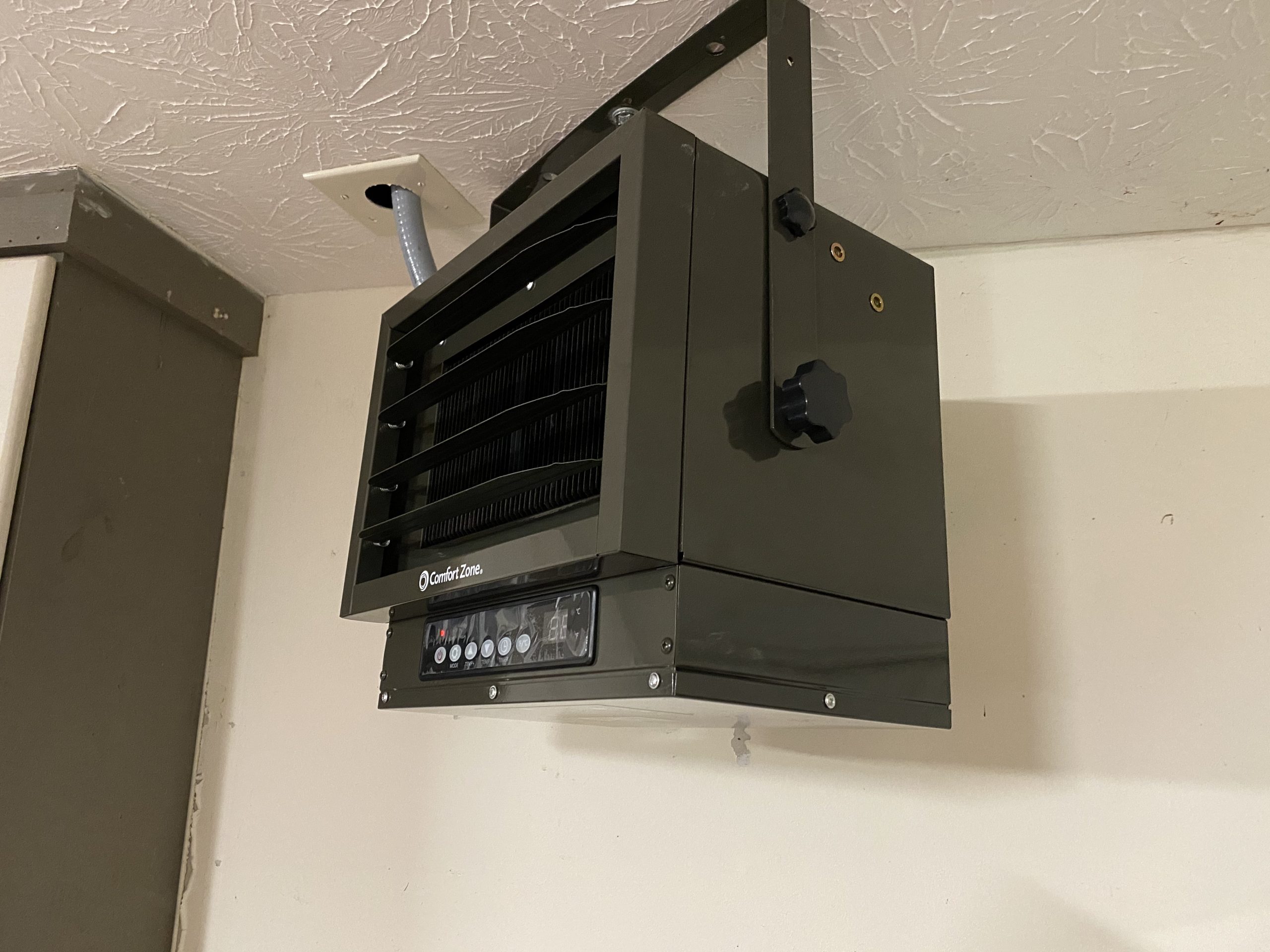
This is the model we recommend most often for a two-car garage that is used as a gym or a workshop. It produces 7,500 watts, listed at 25,600 BTU, and covers up to 1,250 sq. ft., which is the right output for the 400 to 576 sq. ft. range most two-car garages fall into with room to spare for heat loss through an open door.
The controls are the differentiator. A digital thermostat with a 45 to 95 degree Fahrenheit range, a remote control and a 12-hour timer mean you can start heating before you walk out to the car, and several owners report a garage moving from the low 30s into the mid 60s in roughly ten minutes.
It draws 31.25 amps, so plan on a 40-amp 240V circuit, and it is ceiling-mount only, which means joisted or solidly framed ceiling space is a real consideration. The bracket is included but one recurring installation complaint is that the supplied lag bolt is too short to bite through drywall, so pick up a longer fastener before you start.
There is a durability note we want to be straight about: a meaningful number of owners report an E1 error code that stops heating until the internal coils are cleaned of sawdust, and a smaller group had to replace NTC sensor connectors. Keep a shop vac near the unit in a woodworking space, and that failure mode becomes a five-minute fix rather than a service call.
Who this heater suits
Two-car garages that get used daily, especially gym spaces where you want to start the heat remotely and let it cycle. The 12-hour timer is genuinely useful for a routine, since you can set it once and stop thinking about it.
We also like the four fan speeds for anyone who works in the garage with a laptop or listens to audio, because the higher settings are quieter than most portable box fans of the same output.
Where it falls short
Support is the weak point in the reviews, particularly for buyers outside the US, and that matters if you are planning on this being a fifteen-year appliance. A dead sensor connector or a failed control board means you are handling it yourself.
It is also hardwired with no cord option, so it is the wrong pick if your garage has no 240V circuit and getting one installed is not on your list. For a light-duty space where a cord is all you need, the plug-in pair further down is more realistic.
4. TEMPWARE 7,500W Electric Garage Heater – Best for Scheduled Heating
TEMPWARE 7500W Electric Garage Heater, 240V Hardwired Heater, 2026 Upgraded
7,500W / 25,590 BTU hardwired
5,000W to 7,500W adjustable
1,250 sq. ft. coverage
45-95 degree thermostat
Pros
- Digital thermostat with a 45 to 95 degree Fahrenheit range and ECO mode
- Remote control plus an on-unit touch panel
- 12-hour programmable timer
- Multi-angle heavy-duty ceiling bracket
- Overheat protection
Cons
- Newer listing with a much smaller review base than the established models
- No dimensions or weight published in the listing specs
- Requires a qualified electrician for the 240V install
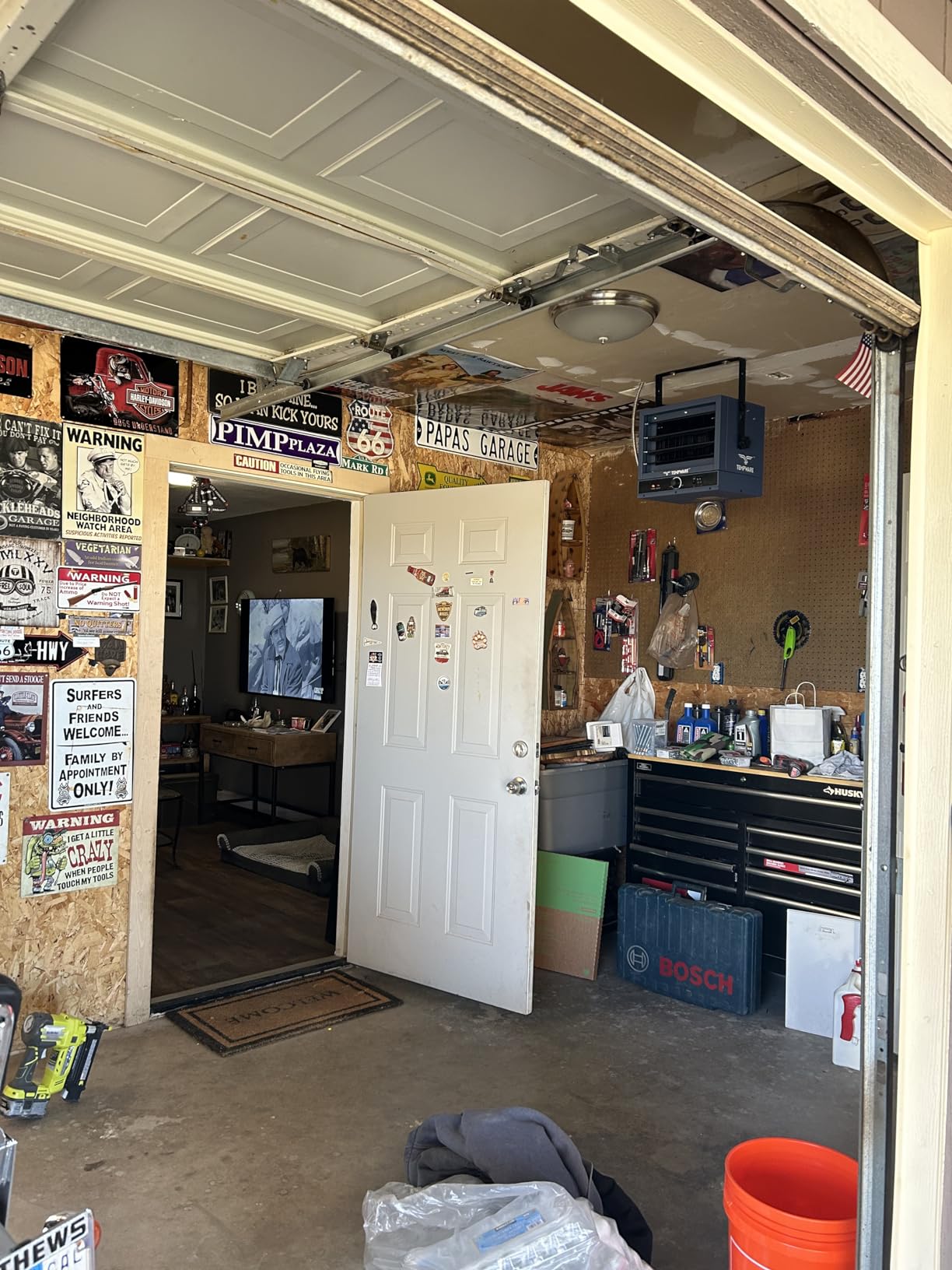
The TEMPWARE GR7500ER-EC pairs adjustable output with more control hardware than most units in the 240V group, for one specific reason. You can dial it between 5,000 and 7,500 watts, which means a mild spring day does not cost you the same as a January one.
Its 4.4 rating comes from 414 reviews, with 73 percent at five stars, and that is a strong distribution but a much smaller base than the models with several thousand reviews. We are treating it as a current-generation option rather than a proven one, and we would say so to a friend.
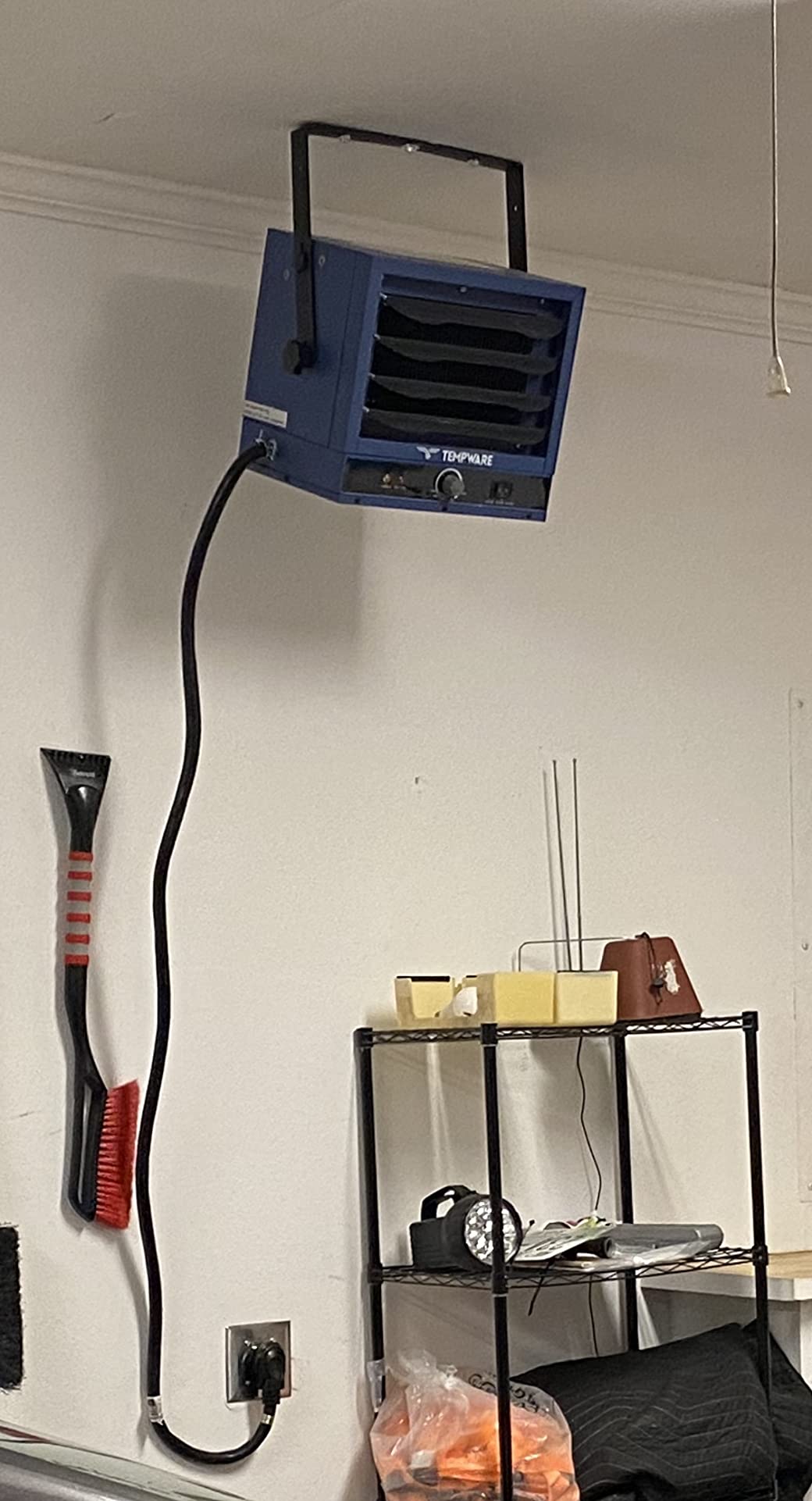
It is ceiling-mount, hardwired at 31.25 amps, and rated to 25,590 BTU covering up to 1,250 sq. ft., which puts it directly in competition with the Comfort Zone unit above. The ECO mode is the difference: it modulates output instead of running the element at full blast and cycling off.
Two more details from the listing. The thermostat spans 45 to 95 degrees Fahrenheit, which is unusually wide, and the specs do not publish dimensions or weight, so measure your joist bay before ordering.
Who this heater suits
Owners who program their heat. If your garage use follows a schedule, a 12-hour timer plus ECO modulation and a remote is a better fit than a manual dial, and that is exactly the audience the reviews describe.
It is also worth a look if you are splitting a 240V run between two spaces, since the adjustable output means one unit can cover a moderate area and a larger one without overloading a circuit.
Where it falls short
The obvious one is history. A 414-review base tells you what current owners think, but it does not tell you how the unit performs after five winters, and the models with thousands of reviews do. If you are risk-averse, weigh that against the longer-proven options.
It is also hardwired only, so the same 40-amp circuit requirement applies, and the missing published dimensions mean you need to confirm clearance yourself.
5. Dr. Infrared DR-975 7,500-Watt Hardwired Shop Heater – Best for Wall Mounting
DR. INFRARED HEATER NEW Upgraded DR-975 7500-Watt 240-Volt Hardwired Shop Garage Electric Heater, Wall/Ceiling Mounted with Remote Controlled Thermostat White
7,500W 240V hardwired
800 sq. ft. coverage
Wall or ceiling mount
31.25 A
Remote thermostat
Pros
- Proven over 4000 reviews as a shop-duty workhorse
- Remote thermostat with a 50 to 85 degree Fahrenheit set range
- Five adjustable louvers plus a tilting head
- Mounts on a wall or ceiling
- UL/CUL listed with overheat protection
Cons
- No power cord included so 8 AWG copper and a 40A circuit are required
- Remote is the only control with no panel display on the unit
- No Wi-Fi or app control on this model
The DR-975 has more than 4,000 reviews on this listing, and at 4.3 stars that history is worth something in a category where failures are expensive. It weighs 26 pounds, which is heavy for a portable but exactly what you want on a wall or ceiling mount.
What separates it is mounting flexibility: it goes on a wall or a ceiling, and the tilting head plus five louvers let you aim a wide airstream across a work area rather than dumping it at the floor. For a shop bay or a two-post lift area, that aim control is the deciding feature.
It arrives as a cabinet-style unit with the bracket, remote and manual in the box, and carries UL/CUL listing with overheat protection and a fully enclosed motor. It is designed as a fixed install rather than an appliance you carry between rooms.
Who this heater suits
Workshop owners who want heat directed at a specific zone rather than at the ceiling above them. If you work on vehicles at one end of a large garage, you can point this at that end and ignore the rest of the space.
It is also a strong choice for anyone who wants a remote thermostat they can mount on a wall, since the set range of 50 to 85 degrees Fahrenheit covers typical comfort settings for a workspace.
Where it falls short
The 800 sq. ft. coverage figure is notably lower than the 1,250 sq. ft. claimed by the two Comfort Zone ceiling heaters, and the amperage is the same 31.25 A. We read that as a more conservative rating, but in a cold climate it means less margin for heat loss.
There is no display panel on the unit itself, so the remote is your only interface, and a small share of owners report early unit failures. Confirm your wiring is 8 AWG copper on a 40-amp circuit before the unit arrives.
6. Shinic 2-Pack 1,500W 120V Ceiling Radiant Quartz Heaters – Best for No Wiring
Shinic 2-Pack 120V Electric Garage Heater,1500W/750W Ceiling Mounted Heater
Two 1,500W radiant quartz heaters
400-600 sq. ft. per unit
120V plug-in
Ceiling mount
Halogen work light
Pros
- Plugs into a standard 120V outlet so no wiring or electrician
- Two heaters in the pack for separate zones
- Halogen work light over the bench at night
- Radiant quartz warms people and objects directly
- ETL listed with overheat auto-off
Cons
- Radiant heat falls off quickly and does not heat the whole garage
- Halogen element life is typically shorter than coil elements
- Ceiling mount needs a joist or lag point for the bracket
This is the only set in the roundup that needs nothing but a wall outlet. Each 1,500W quartz unit draws 12.5 amps and plugs into a standard 120V receptacle, which makes it the practical answer for a garage with no spare circuit and no budget for a new one.
You get two heaters with independently positioned 90-degree brackets, so you can warm two spots at once, plus a built-in halogen work light that owners consistently single out as the feature they did not expect to like. Five pull-string settings combine heat level and the light, and both heaters are ETL listed with overheat auto-off.
Each unit covers 400 to 600 sq. ft., though that figure should be read as a comfort radius rather than room capacity, and both are 1,500W at full with a 750W step available from the pull strings.
Who this heater suits
A one-car garage, a shed, a home office with no hardwired circuit, or a spot over a workbench. If you want a garage warm-up station you can switch on from a chair, radiant quartz over a fixed point is exactly the right technology.
The two-pack format suits a long garage or a two-bay workshop, and it is the simplest possible answer to the most common question on garage forums, which is whether a space heater is even okay to run out there.
Where it falls short
At 4.0 stars this is the lowest-rated heater in our group, with 57 percent at five stars and 11 percent at one, and the reason shows up in the reviews: limited throw distance and no real ability to raise overall garage temperature. Treat it as a personal heater, which is a fair job, just not a room-heating one.
Halogen life is also shorter than coil elements, and the ceiling bracket needs a genuine joist or lag point, so plan that before you climb a ladder.
7. Dr. Infrared DR218 3,000-Watt Infrared Heater – Best 20-Amp 240V Option
DR. INFRARED HEATER DR218-3000W Greenhouse Garage Workshop Infrared Heater, 3000-watt
3,000W 240V infrared
600 sq. ft. coverage
20A circuit
IPX4 splash protection
13 lb
Pros
- Runs on a 20A 240V circuit where a 40A circuit is not available
- Lightweight 13 lb tower with an intuitive dial thermostat
- IPX4 splash protection suits damp garages
- High and low settings
- Owners report steady cycling over two full winters
Cons
- 3000W cannot hold a large space above freezing in single-digit weather
- Heat throw is short at roughly eight feet so a room fan helps
- One owner reported thermostat wiring burning out twice
- Fan noise is noticeable on the low setting
The DR218 solves a problem none of the other 240V heaters here do: it runs on a 20-amp circuit. If your garage subpanel has a spare 20-amp double breaker, you can install this without a 40-amp run, which removes the biggest hassle from a hardwired install.
At 3,000 watts and 600 sq. ft. of stated coverage, it is a modest heater, and it carries the only splash-protection rating in the group with IPX4. That makes it a reasonable companion for a garage that sees condensation off vehicles in winter.
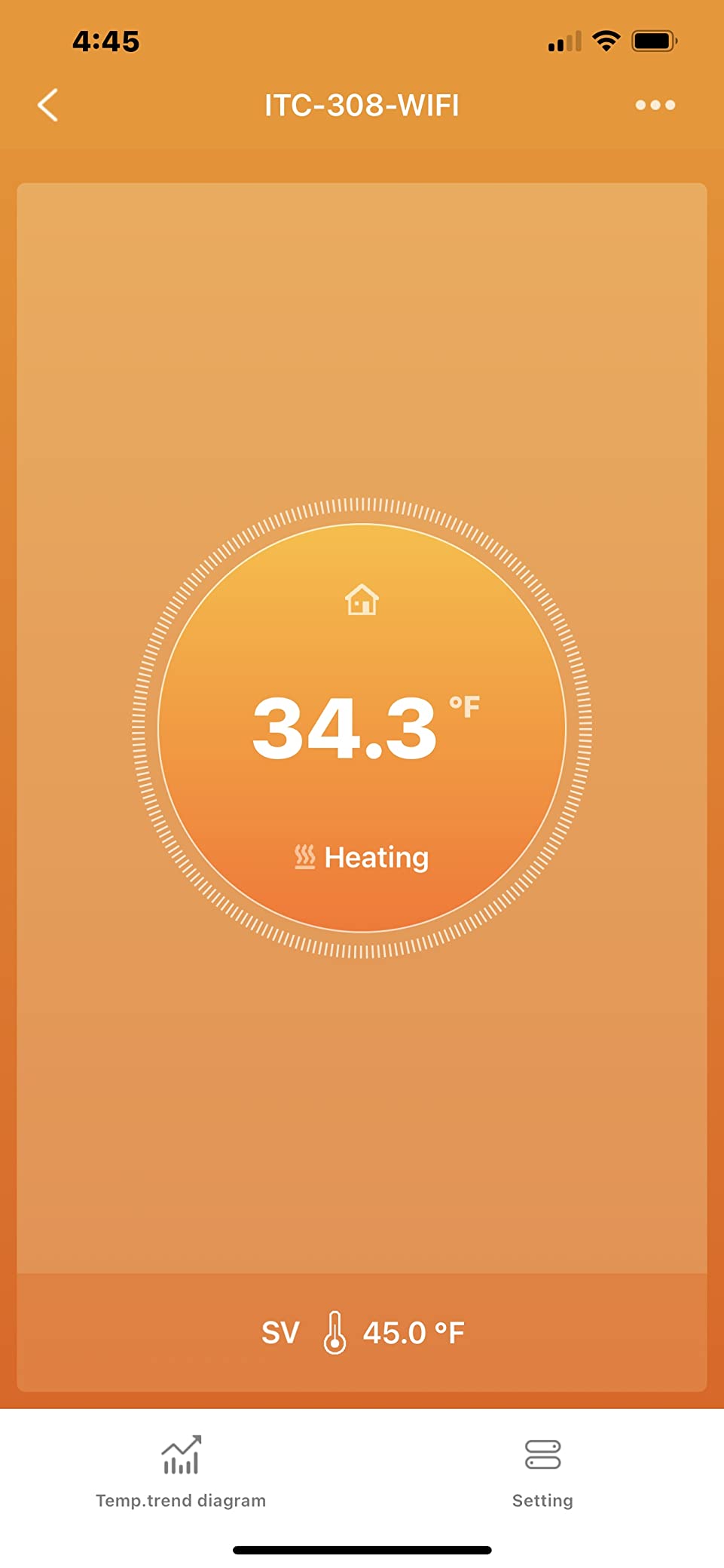
The controls are deliberately simple: a dial thermostat adjustable up to 104 degrees Fahrenheit and a high/low switch, on a 13-pound floor-standing tower. Owners pair it with a room fan, because infrared throws roughly eight feet and then stops.
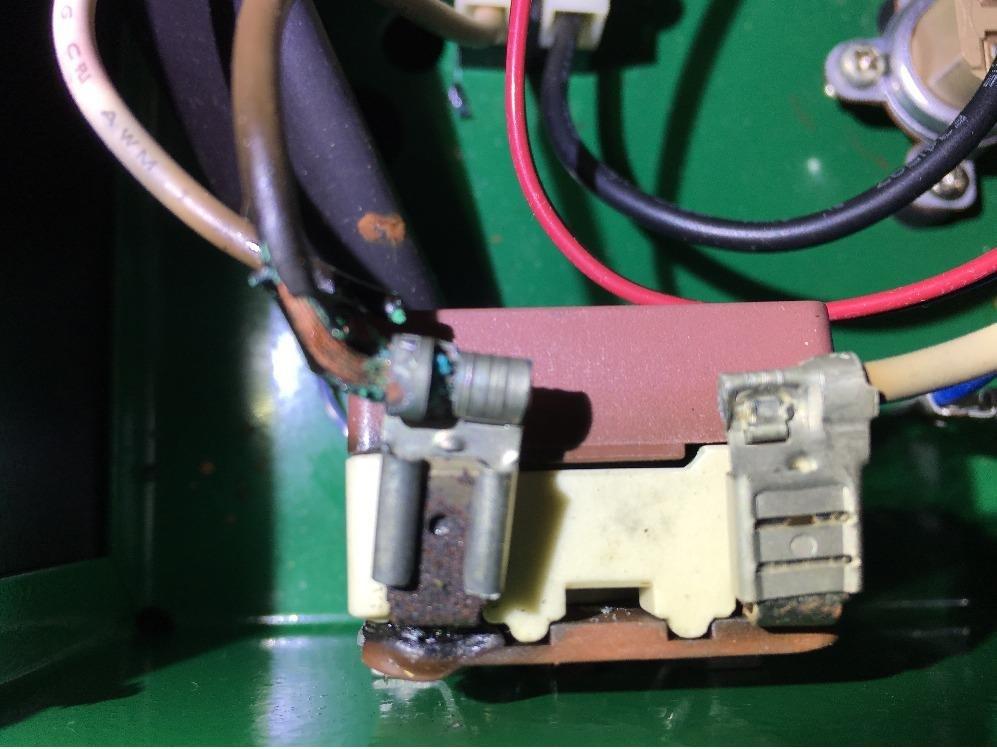
Its rating is 4.2 across 880 reviews, with 68 percent at five stars, and the criticism is consistent: 3,000 watts will not hold a large greenhouse or shop above freezing when temperatures fall into single digits, and a small but persistent group report internal thermostat wiring failures over a few years.
Who this heater suits
Anyone with a 20-amp 240V circuit and a small target area, including a plant corner or a single vehicle bay. If your subpanel is the constraint, this is the realistic hardwired option.
We also think it is the better hardwired pick for a garage used as a play space or a quiet room, since infrared adds no combustion and no carbon monoxide to worry about at all. Our guide to the best infrared heaters for garages covers that category in more depth if you want to compare models.
Where it falls short
The short throw is the honest limitation. Several owners bought it expecting room heat and ended up running a second unit, which tells you to size it for the area in front of it, not the room you wish it would fill.
Fan noise on the low setting is noticeable in a quiet space, and the reported thermostat wiring failures are worth knowing about if you are keeping a garage running for years rather than a season.
8. Mr. Heater 50,000 BTU Forced-Air Unit Heater – Best for Three-Car Garages
Mr. Heater 50,000 BTU Forced-Air Unit Heater (Propane or Natural Gas)
50,000 BTU forced-air gas
1,667 sq. ft. coverage
Ceiling mount
60.3 lb
Natural gas with LP kit
Pros
- Heats a three-car garage faster than any electric unit here
- Works with 24V and Wi-Fi enabled thermostats sold separately
- Natural gas or propane via the included conversion kit
- Quiet fan with even airflow
- High-temperature shut-off and flame-sensor fuel cut-off
Cons
- Requires professional gas line and vent installation
- 24V thermostat and vent pipe sold separately
- One owner had a control board fail and reported no response
- Factory fan hub set screw can arrive loose and cause a wobble
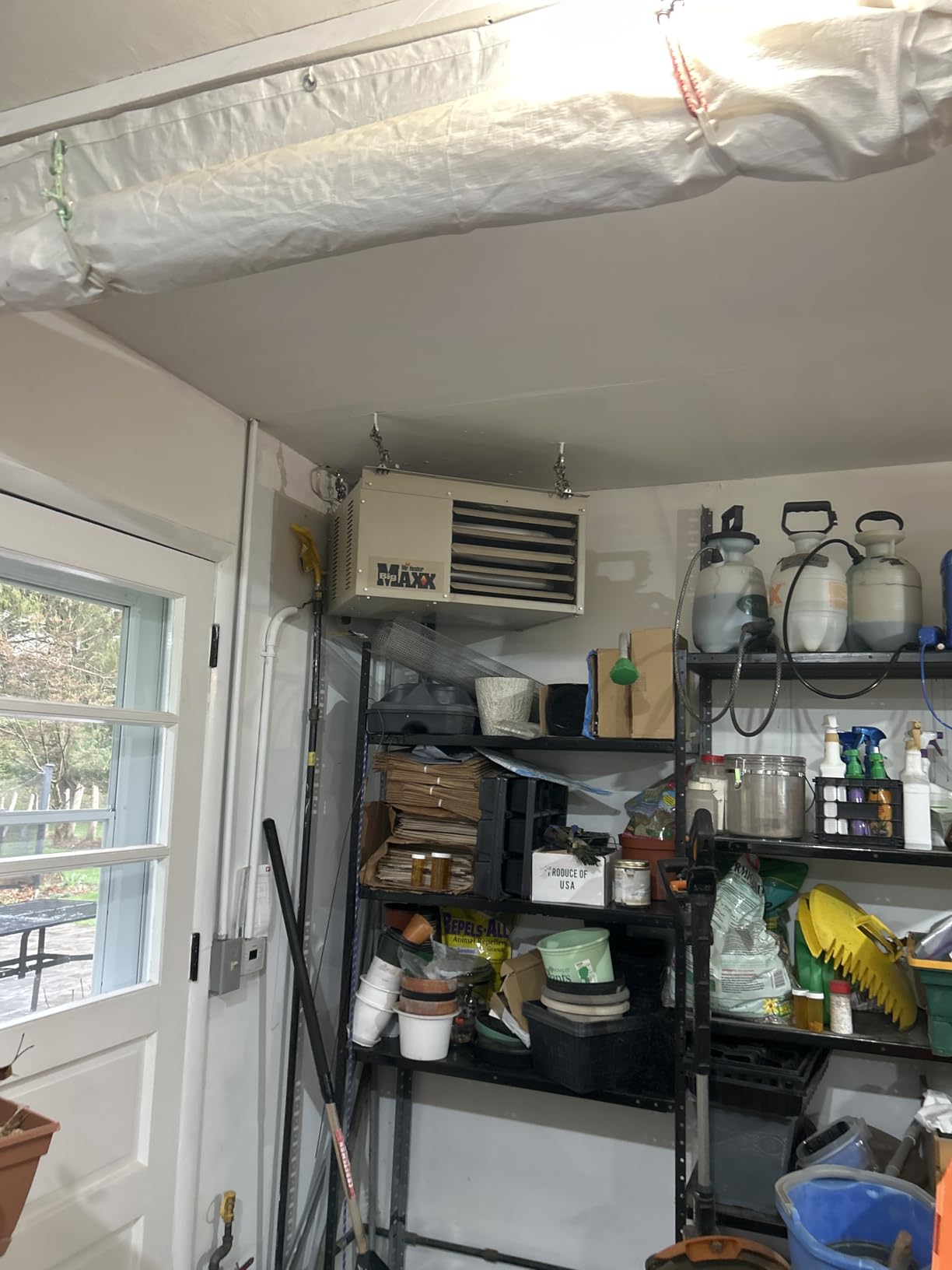
This is the only heater in our group rated for a full three-car garage, with 50,000 BTU of forced-air output across up to 1,667 sq. ft. It weighs 60.3 pounds, which is a fair warning about how you will get it up to a ceiling.
It comes configured for natural gas with an NG-to-LP conversion kit in the box, so propane works too if that is how your property is set up. The fan is quiet for its output and the airflow is even, and it accepts standard 24V thermostats, including Wi-Fi models, which are sold separately.
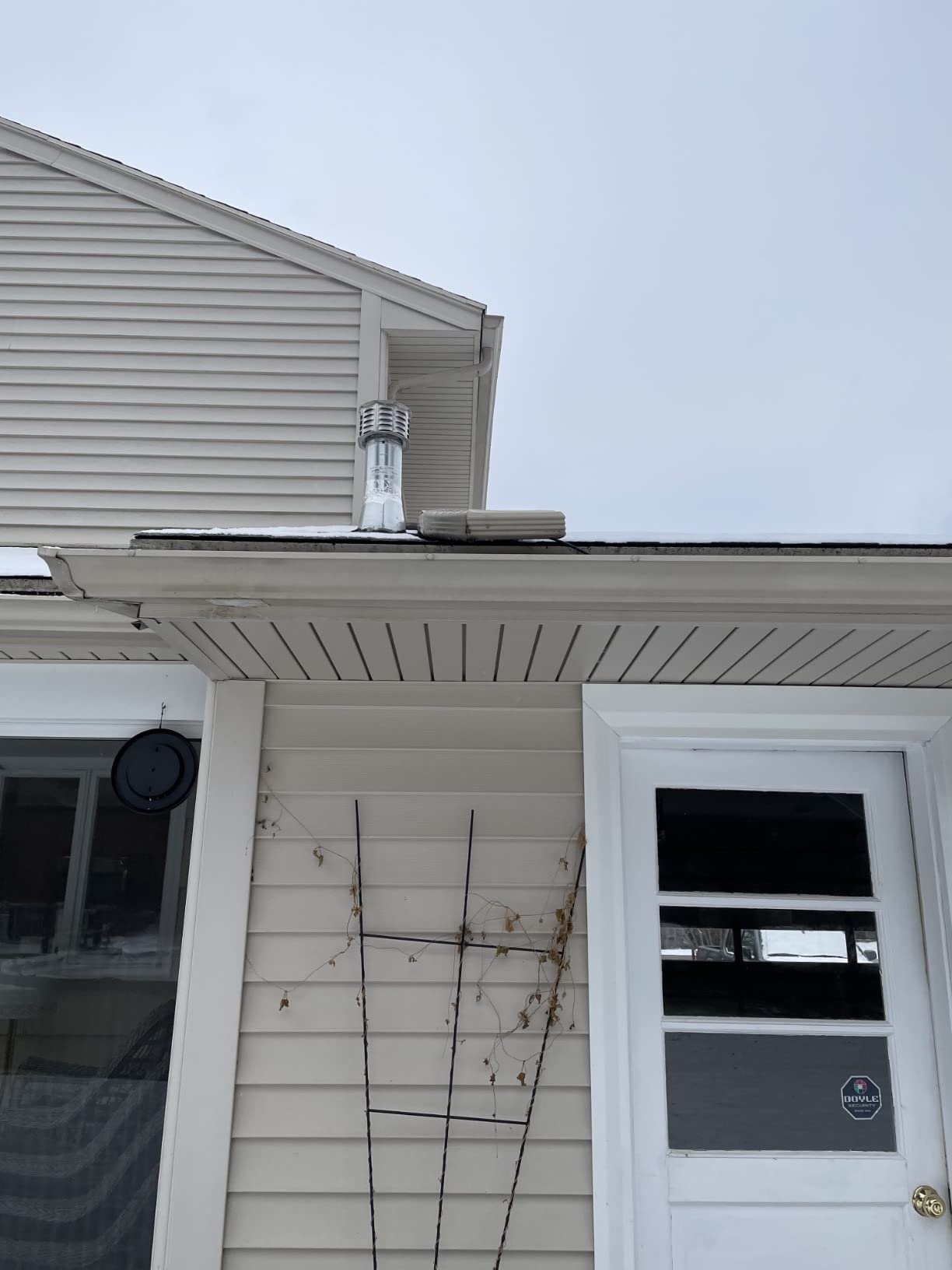
Owners with any gas experience report 10 to 15 degree Fahrenheit rises in 15 to 20 minutes, and one describes six years of service with no problems. Another has it running the heat for a connected smart thermostat, which is the flexibility that makes it feel like a permanent system rather than an appliance.
Clearance is specific and worth respecting: minimum 10 feet of ceiling height and 8 feet from the base of the unit to the floor, with two angle brackets included for the ceiling mount. High-temperature shut-off and a gas safety flame sensor handle the combustion side.
The one practical trick circulating among installers is to pitch the vent pipe downward rather than upward, which keeps condensation out of the unit. A loose fan hub set screw arriving from the factory also shows up in a few reviews and causes a loud wobble until it is tightened.
Who this heater suits
Homeowners with a three-car garage, an attached workshop, or any space where electric resistance heating cannot generate enough heat to keep up. If you are already paying for natural gas, this is the most efficient option we reviewed.
It is also the right answer for anyone who wants a permanently installed system with thermostat control, since the 24V wiring standard means you can wire in a smart thermostat and control the heat from a phone.
Where it falls short
Installation is the barrier. A gas line and vent run need qualified work, and reviewers note the install can rival or exceed what the unit itself costs, which is why the number one question on heater forums for natural gas is whether it is worth it at all.
Thermostat and vent pipe are not included, and the single most common complaint at this level is support: a fried control board with no manufacturer response. Our broader guide to standby propane heaters for garages covers the gas-adjacent options that do not need a gas line.
9. Remington 60,000 BTU Portable Forced-Air Propane Heater – Best for Workshops and Barns
Remington LP Forced Air Heater, Portable 60,000 BTU Space Heater for up to 1500 Square Feet – Liquid Propane Gas Powered, Tank Not Included
60,000 BTU forced-air propane
1,500 sq. ft. coverage
Freestanding
11 lb
Runs on a 20 lb tank
Pros
- Warms a 1500 sq. ft. garage to working temperature in 10 to 20 minutes
- Only 11 pounds with adjustable height so it moves between jobs
- Includes a 10 ft. propane hose and regulator
- Continuous electronic ignition with thermocouple and flame-out cut-off
- Heat-sensitive indicator sticker on the tube
Cons
- Propane tank not included
- Loud fan is the most common complaint and led at least one return
- Power cord on the ignition side is under a foot
- LP fitting takes real force to attach
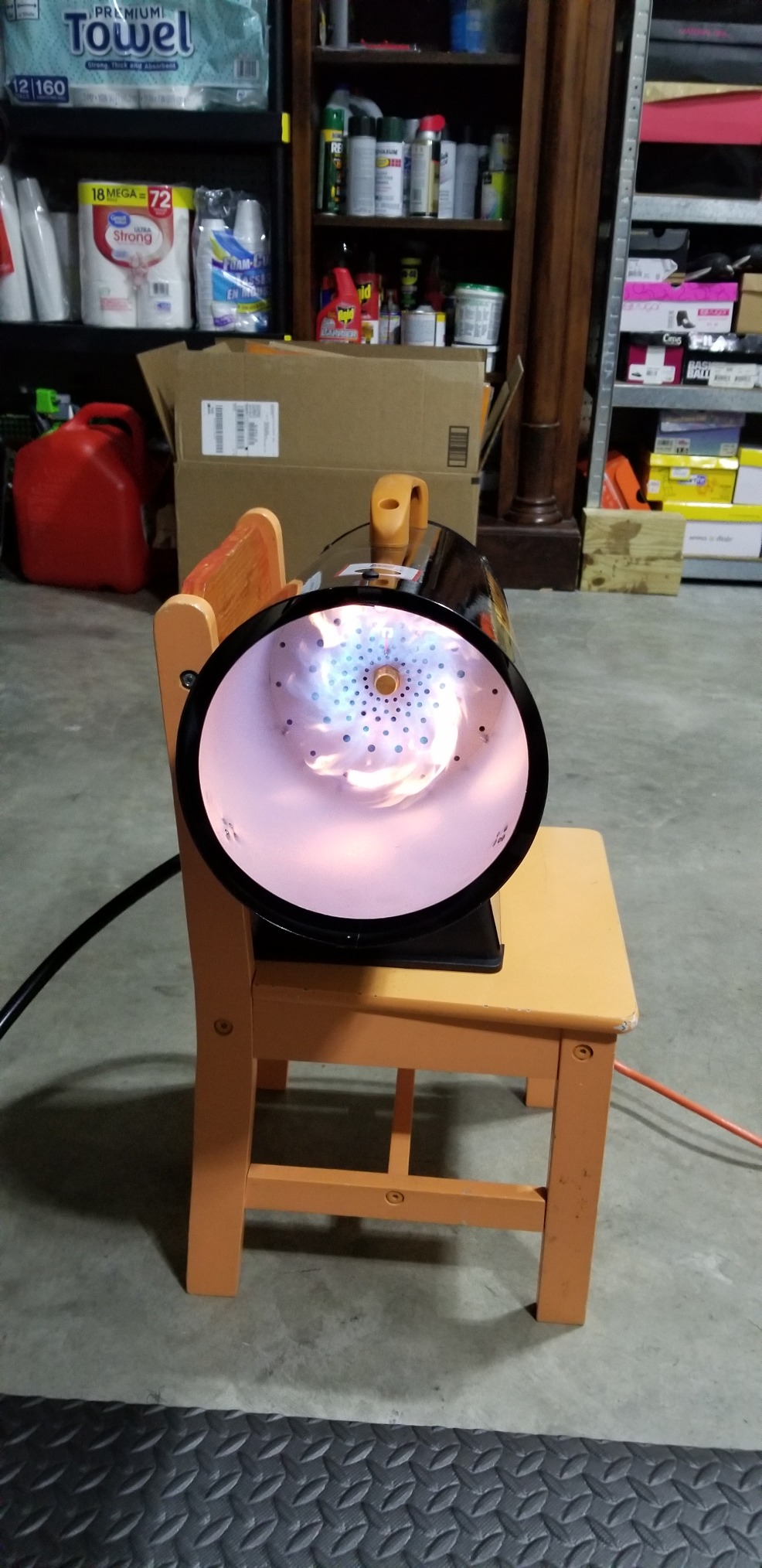
The Remington produces heat in minutes rather than the slower ramp of a resistance element, and owners who switched from electric make that point over and over. Sixty thousand BTU of forced-air propane takes a cold 1,500 sq. ft. garage to a working temperature in 10 to 20 minutes, because a burner simply produces more heat than any resistance element on a household circuit.
It is also surprisingly manageable for that output at 11 pounds with adjustable height. The package includes a 10 foot propane hose and regulator, and the safety package is thorough: continuous electronic ignition, a thermocouple, a high-temperature limit switch and a flame-out fuel cut-off.
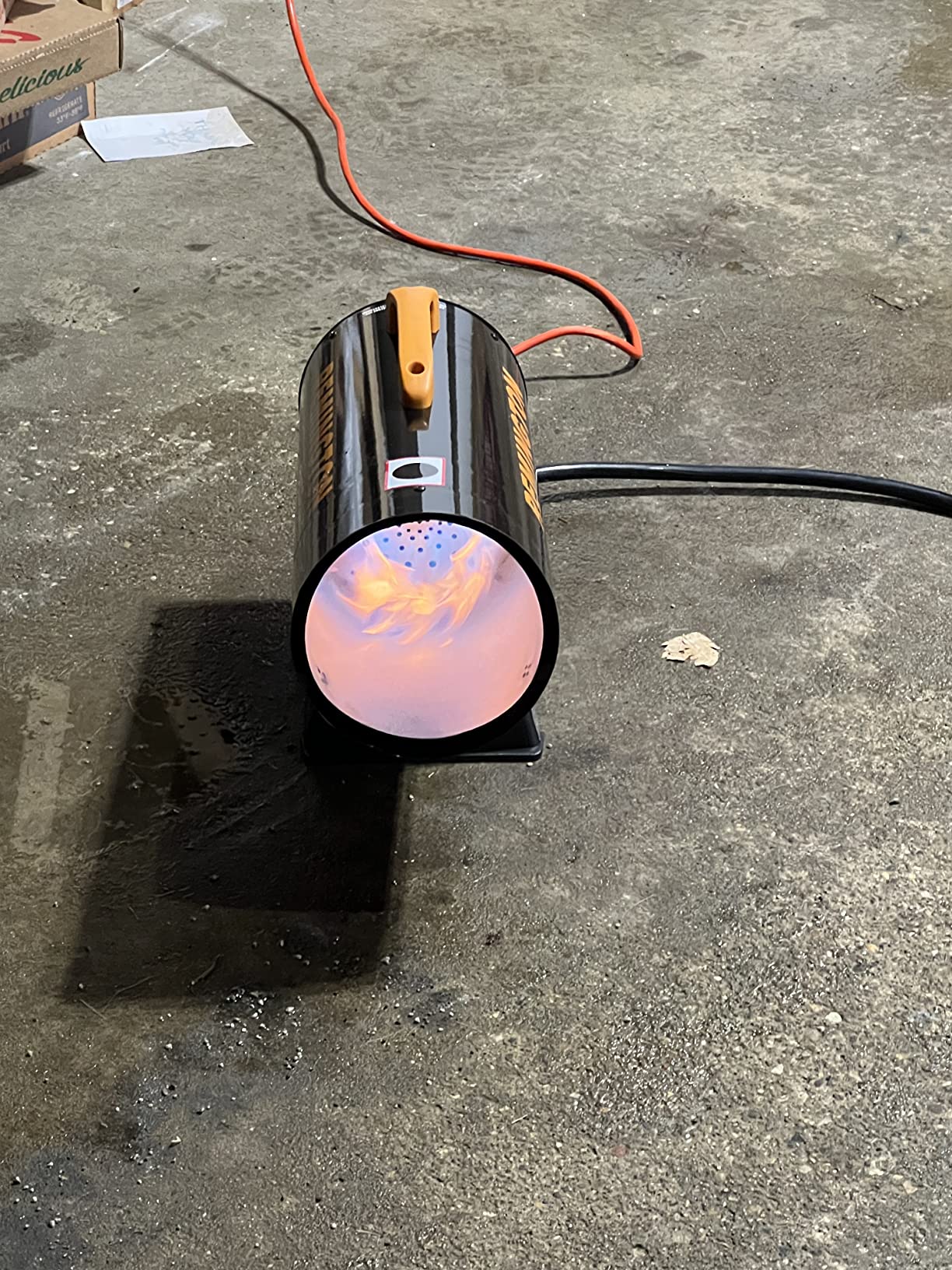
You supply the 20 lb cylinder, and the ignition path draws 120 volts, so a wall outlet is needed for the ignition even though the heat is gas. We would call that out early, because people planning an off-grid shop sometimes expect a heater that needs nothing at all.
There is one drawback that comes up more than any other: the fan is loud. Several reviewers describe it as the reason they cannot use the heater in a space where conversation or quiet work matters, and at least one owner returned over it. If the garage is a gym, that is a real problem.
Who this heater suits
Large shops, barns, and three-car garages that need heat now rather than gradually, especially in cold-climate locations where waiting for an electric unit to catch up is not practical. It also moves between jobs easily, which matters for a contractor with more than one property.
The safety spec list is thorough: electronic ignition, a thermocouple, a high-temperature limit switch and a flame-out fuel cut-off, all of which you want on a combustion appliance in a work space.
Where it falls short
Noise is the main one, followed by the tank and the fitting. The cylinder is not included, the standard grill-type LP connector needs real force to attach, and the power cord on the ignition side is under a foot, so you need a socket close to where the unit sits.
As with any propane appliance in an enclosed space, plan for ventilation and a working carbon monoxide detector, which we come back to in the safety section below.
10. GASLAND 18,000 BTU Radiant Propane Cabinet Heater – Best for Quiet Spot Heating
GASLAND 18,000 BTU Propane heater Outdoor, Max Heat 450 Sq.Ft, MHA18W
18,000 BTU radiant propane
450 sq. ft. coverage
Three heat modes
20 lb cylinder
CSA certified
Pros
- No electricity required so it keeps working through a power outage
- Quiet operation for a radiant propane heater
- Built-in rolling wheels and carry handle
- Propane cylinder stored inside the cabinet
- Tip-over and oxygen depletion shut-offs
- Three heat modes
Cons
- 450 sq. ft. is too small to heat an entire garage
- Radiant heat only warms what is directly in front of the unit
- Intended for ventilated spaces
- No published weight in the listing specs
The GASLAND MHA18W is built for quiet, which is its whole case. At 18,000 BTU radiant with three heat modes across up to 450 sq. ft., it rates 4.5 stars from 1,506 reviews with 76 percent at five stars.
It runs on a 20 lb propane cylinder with no electricity required, and the regulator and hose are included. The cylinder lives inside the cabinet, which keeps it out of sight and, more practically, keeps the whole unit stable enough to roll on its built-in wheels from the garage to the patio.
Safety is CSA certified with tip-over protection and an oxygen depletion shut-off, which is the combination you want on any radiant gas appliance used indoors.
Who this heater suits
Anyone who needs a warm corner rather than a warm room: a garage workbench, a patio, a spot next to a treadmill, or a spot heat layer during a project. The wheels make it easy to roll between the garage and the patio.
It is also a strong second layer in a larger garage where a 50,000 BTU unit handles the space and this handles the corner you are actually standing in.
Where it falls short
At 450 sq. ft. of coverage it is a spot heater, not a room heater, and the reviews are clear that buyers who wanted to heat a whole single-car garage found it underpowered. The listing also does not publish a weight figure.
Radiant output only warms what is in front of the cabinet, and it is designed for ventilated spaces, so it is a poor fit for a sealed, unventilated garage with a vehicle in it.
How to Choose a Garage Heater That Actually Fits Your Space
Every misfit we found traces back to the same mistake: picking a heater by brand or by appearance instead of by square footage, insulation and available power. Here is the sizing logic we would use.
Sizing by garage dimensions: 16×20, 20×20, 24×24 and 30×30
The rule of thumb most test outlets use is about 10 watts per square foot for electric and 45 BTU per square foot for gas. Applied to the four most common garage sizes, it gives you a shortlist immediately.
16×20 (320 sq. ft.): roughly 3,200 watts of electric or about 14,500 BTU of gas. This is a space a 1,500W plug-in radiant unit can make tolerable, but not one it can heat.
20×20 (400 sq. ft.): roughly 4,000 watts of electric or about 18,000 BTU of gas. A 5,000W hardwired unit or an 18,000 BTU propane heater fits here with margin.
24×24 (576 sq. ft.): roughly 5,800 watts of electric or about 26,000 BTU of gas. This is where the 7,500W hardwired heaters and the 50,000 BTU unit heater start to make sense.
30×30 (900 sq. ft.): roughly 9,000 watts of electric or about 40,500 BTU of gas. At this size, gas stops being optional, because 9,000 watts is more than most residential subpanels want to dedicate to heat alone.
Two modifiers matter more than the number. The first is insulation: an uninsulated two-car garage can lose heat as fast as the heater makes it, and an attached garage shares a wall with living space that is already warm, which changes the picture entirely. The second is the door: a garage that is opened several times a day needs roughly a third more capacity than a closed one.
If your heater seems undersized, the first thing to check is the envelope rather than the appliance. Air-sealing the ceiling, insulating the garage door and weatherstripping the frame typically cost less than the step up in heater size and pay for themselves quickly. Related moisture control, including crawl space work under the slab, has its own guide in our crawl space dehumidifier recommendations.
Electric, propane or natural gas: which fuel fits your garage
Electric has no combustion, so no carbon monoxide and no venting, and it is the safest choice in a sealed garage. Its limit is physics: a 240V hardwired heater realistically tops out around 7,500 to 10,000 watts on a typical residential subpanel, and resistance heating converts every watt into heat, which is why the utility bill is the main complaint in electric-heater reviews.
Propane produces far more heat from a given amount of fuel and needs no circuit, but it is an open-flame combustion appliance that produces carbon monoxide, so it demands ventilation and a working detector. Natural gas is the same physics at a lower cost per hour and no cylinder logistics, but the line and vent run need qualified installation, and that cost is what pushes renters away from it.
Infrared and radiant quartz fall on the other axis rather than the fuel axis. They heat surfaces and people in line with the unit instead of mixing the air, which makes them the most efficient choice for spot heat at a workbench and the least efficient choice for warming an entire garage.
120V plug-in vs 240V hardwired vs a gas line
A 120V plug-in heater is the zero-commitment option: no permit, no electrician, no wall opening, and you can take it with you when you move. The constraint is the 15-amp circuit. A 1,500W heater draws about 12.5 amps, which is most of that circuit, so a space heater sharing a circuit with a garage door opener or a treadmill is a breaker-trip risk that comes up repeatedly in homeowner discussions about this exact setup. Put it on a dedicated outlet.
A 240V hardwired heater is the right call for any space you plan to heat regularly, and most of the 7,500W heaters here draw 31.25 amps, meaning a 40-amp double breaker and 8 AWG copper. Below that threshold, the 3,000W DR218 runs on a 20-amp circuit, which is the simplest path to hardwired heat on an existing subpanel.
A gas line is a different project entirely. It needs a permit, qualified work, a vent, and a carbon monoxide detector, and it is only sensible on property you own long-term with gas already available.
The safety features that matter in a garage
Look for these in order of importance. A tip-over switch shuts the heater off if it is knocked over, which matters with a portable unit on a concrete floor. Overheat protection and a thermal cut-out shut down the element when airflow is blocked, and this matters more in a garage than in a room because sawdust is normal debris. An oxygen depletion sensor is required on unvented gas appliances and is what trips a propane heater in a poorly ventilated space. A cool-touch or cool-touch exterior housing is the filter parents in particular ask about, since a child or a dog in a garage-turned-play space changes the priority order. And check for UL, ETL or CSA listing, because those badges are the single most consistent trust signal across the buyer communities we reviewed.
On carbon monoxide specifically: electric heaters produce none, which is why they are the first recommendation for a garage used as a living space. For any propane or gas unit, mount a detector on the ceiling or on a wall at least a foot away from any door, and never run a combustion heater in a garage with the door fully closed. A wider look at fixed-mount radiant options is in our wall-mounted infrared heater guide.
Thermostats, timers and what you can control remotely
Manual dial thermostats have the fewest parts to fail and are the most durable, and for a workshop you walk into anyway they make sense. Digital thermostats with a remote are better when the garage is a gym, because you can start the heat before you train, and the 45 to 95 degree Fahrenheit range on the newer models gives you a usable setpoint in almost any condition.
A 12-hour timer is worth having in any seasonal garage, and an ECO mode that modulates output is the feature that actually lowers a resistance heater’s consumption. For gas heaters, the useful spec is 24V thermostat compatibility, which is the standard that lets you install a smart or Wi-Fi thermostat later, so buy the gas heater on that basis if you plan to automate.
One honest note on automation: the forum consensus is that true Wi-Fi control for 240V garage heaters is still thin. Several owners in electrical and home-improvement communities wanted a smart controller and discovered that the workable route is a standard 24V thermostat on a gas unit, or a smart plug on a 120V heater.
Frequently Asked Questions
What is the safest heater to use in a garage?
An electric 120V or 240V heater is the safest, because it produces no combustion and therefore no carbon monoxide. Among gas options, choose a portable radiant propane model with tip-over protection and an oxygen depletion shut-off, such as the Mr. Heater Buddy or the GASLAND MHA18W. Always look for UL, ETL or CSA listing.
Is it okay to use a space heater in a garage?
Yes, provided the heater is rated for garage use, is plugged into a dedicated outlet rather than a shared 15-amp circuit, and has at least the required clearance to combustibles. Gas heaters additionally need ventilation and a working carbon monoxide detector, and should never run in a fully closed garage.
How many BTUs do I need to heat a 24×24 garage?
A 24×24 garage is 576 square feet, which calls for roughly 26,000 BTU of gas heat or about 5,800 watts of electric heat. In practice that points to a 7,500W hardwired ceiling heater or a 50,000 BTU unit heater, with a 30,000 to 40,000 BTU portable propane unit as a fast supplement.
How many BTUs do I need to heat a 20×20 garage?
A 20×20 garage is 400 square feet, which requires roughly 18,000 BTU of gas heat or about 4,000 watts of electric. A 5,000W hardwired ceiling heater, the GASLAND 18,000 BTU radiant cabinet, or a 20,000 BTU propane forced-air unit all fit that space.
What is the best type of heating for a garage?
For a one-car garage or a spot, a radiant or infrared heater is most efficient because it heats you rather than the air. For a two-car garage, a 7,500W hardwired 240V ceiling heater balances output and install cost. For three-car garages, shops and cold climates, gas is the only fuel that generates enough heat economically.
Is it cheaper to heat a garage with propane or electric?
Per hour of heat produced, propane is usually cheaper once you get past a 7,500W electric unit, because gas delivers far more energy per unit. Electric wins on installation and safety, since it needs no gas line, no venting and no carbon monoxide detector. The cheapest answer for many homes is fixing insulation first and then heating a smaller volume.
Our Verdict on the Best Space Heaters for Garages in 2026
After working through all ten, the best space heaters for garages split cleanly by situation. The Mr. Heater Buddy takes our top spot because it needs no circuit and no installation, keeps working in an outage, and has the strongest track record we could find. It is a personal heater, and buying it with that expectation is the whole trick.
For a two-car garage that will be used regularly, the Comfort Zone CZ230ER is the choice, with 7,500 watts, a digital thermostat, a remote and a 12-hour timer. The Dr. Infrared DR-975 is the alternative when you need to mount on a wall rather than a ceiling. For a three-car garage, the Mr. Heater 50,000 BTU unit heater is the only thing on this list that can do the job, and the 60,000 BTU Remington is the portable answer when you want that heat in ten minutes without a gas line.
Before you order anything, measure your garage and check your panel. Knowing whether you have a spare 240V breaker or only a 120V outlet will narrow ten options down to three, and it saves you from buying a heater that was never going to fit the space. Then check the sizing list above and add 30 percent if the door opens daily.