
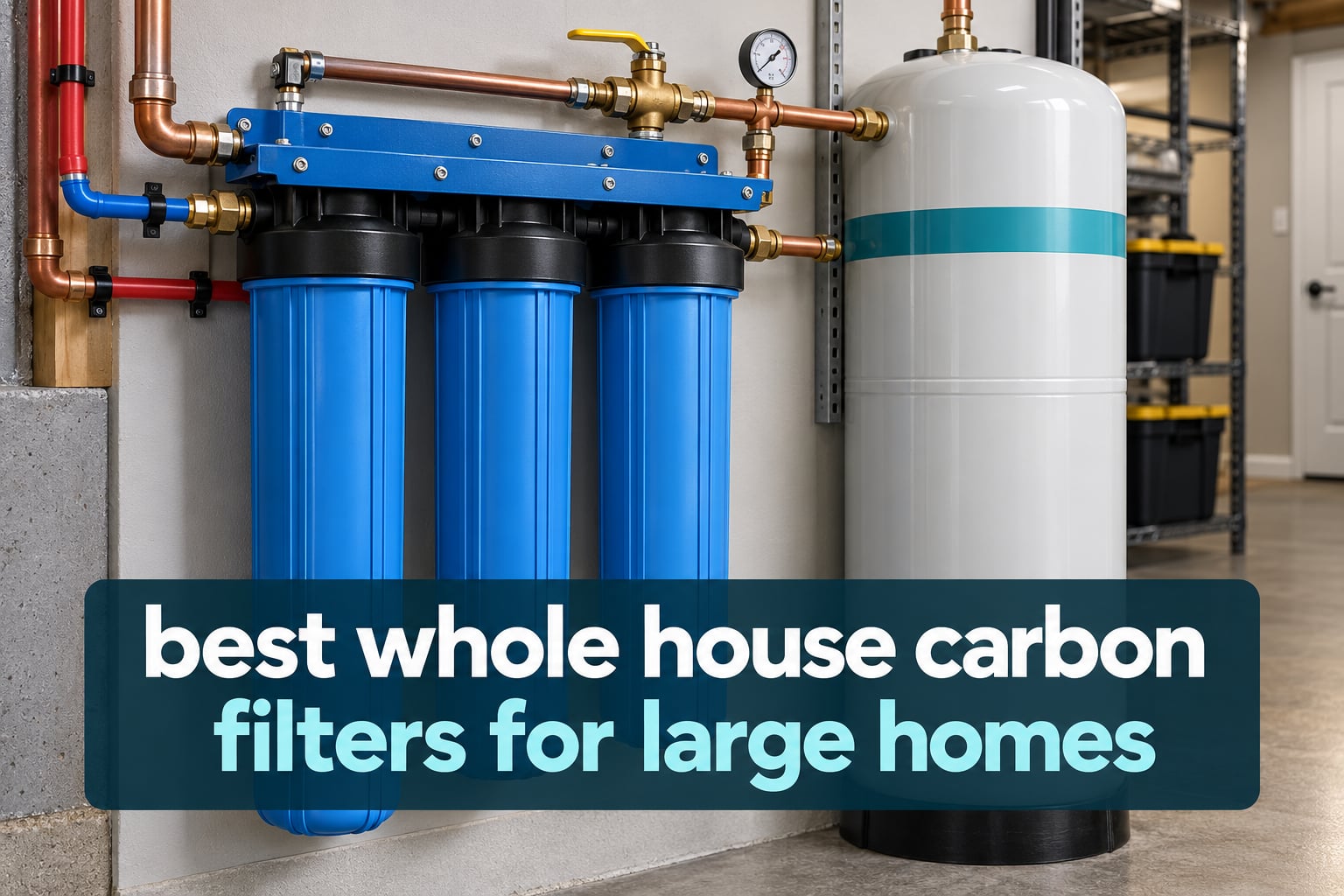
The house that finally made us look at whole house water filtration was not ours. It belonged to a client with 4,200 square feet, four bathrooms, a finished basement with a wet bar, and a municipal water line that delivered water tasting like a swimming pool at every tap. The contractor they had tried first sold them a 5 GPM canister set. It worked beautifully for about seven weeks, then the shower pressure sagged every morning and the chlorine smell crept back. Nothing was broken. The system was simply too small for the number of fixtures asking water of it at the same time.
That is the whole story behind the best whole house carbon filters for large homes: this is a sizing decision, not a shopping decision. A carbon filter is not a better or worse filter depending on the brand on the box. It is a better or worse filter depending on whether its published service flow rate matches the real, simultaneous demand of your household. In a 2,000 square foot home, a 7 GPM canister is fine. In a house with four bathrooms and a laundry room that runs while someone showers, 7 GPM is the beginning of a pressure problem, not the end of one.
We spent several weeks working through the eight systems below, comparing published flow ratings, media type, tank format, cartridge capacity and replacement intervals, and reading the owner reviews closely enough to catch the failure patterns that spec sheets never mention. What follows is a roundup built around the number that actually matters in a large home, plus the honest gaps where the format itself is the wrong choice. We updated it for 2026.
Table of Contents
Top 3 Whole House Carbon Filters for Large Homes
Three systems stood out once flow rating and owner-reported consistency were lined up side by side. The iSpring WGB32B takes our top spot for combining a published 15 GPM rating with a three-stage 20-inch configuration and the strongest review record in the group. The WGB21B earns the second slot as the most proven design in the category, with a 10-inch footprint that fits mechanical rooms where 20-inch housings will not go. The Waterdrop WHF3T-PG rounds out the top three as the pick with the most rigorous material certification, rated 15 GPM with NSF/ANSI 372 lead-free compliance.

iSpring WGB32B 3-Stage Whole House Filter
- 15 GPM rated flow
- 3 x 20 in housings
- 100000 gallon capacity
- 1 year filter life
iSpring WGB21B 2-Stage Whole House Filter
- 15 GPM rated flow
- 10 in x 4.5 in housings
- 50000 gallon capacity
- DIY bracket mount

Waterdrop WHF3T-PG 3-Stage Filter
- 15 GPM steady flow
- KDF and GAC stages
- 100000 gallon capacity
- 372 lead-free certified
Best Whole House Carbon Filters for Large Homes in 2026
Eight systems, sorted below by format rather than by brand. The short version: if your home runs more than three fixtures at once and you want published gallons and a known replacement date, the 15 GPM three-stage canister sets at the top of the list are the safest buy. If you want a ten-year media life and you have moderate hardness, the tank systems handle it, with a higher up-front commitment and a plumber in the plan.
| Product | Specifications | Action |
|---|---|---|
| iSpring WGB32B 3-Stage Whole House Water Filter |
|
Check Latest Price |
| iSpring WGB21B 2-Stage Whole House Filter |
|
Check Latest Price |
 Aquasana Max Flow Carbon and KDF Tank System Aquasana Max Flow Carbon and KDF Tank System |
|
Check Latest Price |
 iSpring WGB22B 2-Stage 20 in Whole House Filter iSpring WGB22B 2-Stage 20 in Whole House Filter |
|
Check Latest Price |
 Home Master HMF2SmgCC KDF85 and Catalytic Carbon Home Master HMF2SmgCC KDF85 and Catalytic Carbon |
|
Check Latest Price |
 LiquaGen Fleck 5600 Catalytic Carbon Tank System LiquaGen Fleck 5600 Catalytic Carbon Tank System |
|
Check Latest Price |
| Waterdrop WHF3T-PG 3-Stage Whole House Filter |
|
Check Latest Price |
 Aquaboon 2-Stage 20 in Filter on Steel Frame Aquaboon 2-Stage 20 in Filter on Steel Frame |
|
Check Latest Price |
1. iSpring WGB32B 3-Stage Whole House Filter – Best Overall for Large Homes
iSpring WGB32B Commercial-Grade Whole House Water Filter System
15 GPM rated flow
3 x 20 in x 4.5 in housings
100000 gal capacity
1 year filter life
Pros
- Published 15 GPM rating holds up under simultaneous fixture demand
- Three stages add a 5 micron sediment stage ahead of two carbon blocks
- 100000 gallon capacity covers roughly a year for a family of five
- Retains healthy minerals instead of stripping them like reverse osmosis
- US-based support that provides replacement parts at no charge
Cons
- 45 pound manifold needs stud or concrete anchoring
- Full housings are heavy and awkward to drain
- No housing drain port means wet cartridge changes
This is the system we keep coming back to for a house in the 3,000 to 4,500 square foot range. Three 20-inch housings, a sediment stage in front, and two coconut shell CTO carbon block stages behind it, all rated at 15 GPM. That published number is the part that matters, and it is why this unit does not develop the morning shower pressure sag that a 5 or 7 GPM canister will eventually give you.
Capacity is listed at 100,000 gallons with a one-year filter life, which lines up with roughly what a family of five actually pushes through a house. The 5 micron sediment stage is doing quiet work here: it catches rust, pipe flake and scale debris before it reaches the carbon blocks, and that is what keeps the carbon stages from blinding early in the year.
We are not going to pretend the install is trivial. At 45 pounds with a full manifold, this wants to be anchored into wall studs or concrete, and drywall anchors are not adequate. Plan the clearance on both sides too, because a 20-inch housing with a wrench on it needs room to come off. Fixtures rated 25 to 80 psi, so household pressure sits comfortably inside the working range.
What owners report back is a small set of repeat themes. Chlorine and sediment reduction is consistently described as real, the water looks visibly clearer, and the support experience stands out as unusually good for the category, with replacement parts provided at no charge even years past the warranty. Against that, the threaded NPT fittings are the recurring weak point, and few buyers reported cracked housings arriving in transit.
What to check before you buy the WGB32B
Measure the wall space you have, not the space you think you have. The unit is listed at 24.5 inches long by 8 inches wide by 28 inches tall, and you need a few inches of working room on the housing side to swap cartridges. In a tight crawlspace or a narrow utility closet this becomes a two-person job.
Also decide honestly whether you want to plumb a drain. There is no factory drain port on the housings, so every cartridge change involves opening a relief valve and catching several gallons. Plenty of owners add their own drain fitting, and a plumber will do it in about ten minutes, but plan for it rather than discovering it on change day.
Where the WGB32B falls short
It does nothing about hardness, limescale or iron, and it is not a chloramine specialist. The carbon block stages are chlorine and taste-and-odor media, so on a chloraminated municipal line you will want a catalytic or KDF media option instead. If your water utility switched to chloramine, look at the Home Master or LiquaGen picks later in this roundup.
For very hard water with heavy spotting, this system will make your water taste better while leaving the staining exactly where it was. That is normal behavior for a carbon cartridge, not a defect in the unit. You need a softener ahead of it or a salt-free conditioner like the one in the Aquasana, and the order of stages matters more than most buyers expect.
2. iSpring WGB21B 2-Stage Whole House Filter – Most Proven, Compact Footprint
iSpring WGB21B 2-Stage Whole House Water Filtration System, 50000 Gallons
15 GPM rated flow
10 in x 4.5 in housings
50000 gal capacity
12 month life
Pros
- Largest review base in the roundup at more than four thousand ratings
- 15 GPM rating despite the smaller 10 inch housings
- Pre-assembled on a reversible mounting bracket
- Retains minerals with no power required
- Responsive US-based support that provides replacement parts at no charge
Cons
- End fittings need heavy PTFE tape and pipe dope to seal
- Cracked housings reported after a plumber over-tightened the inlet
- Loses pressure faster than 20 inch systems on very high demand homes
More than 4,200 ratings at a 4.6 average makes this the most battle-tested design in the category, and for a large home the important part is that it still carries a published 15 GPM rating. That surprises people who assume a 10-inch housing must be slower. What you give up is capacity: 50,000 gallons and a 12-month rated life against the 20-inch units, so plan on roughly twice the change frequency.
Owners consistently report a big drop in chlorine smell and taste, clearer dishes, and skin that feels less dried out. The install is genuinely straightforward, which is the main reason this design has accumulated so many reviews from first-time DIYers. The bracket is reversible, so it will follow your existing plumbing direction instead of forcing a repipe.
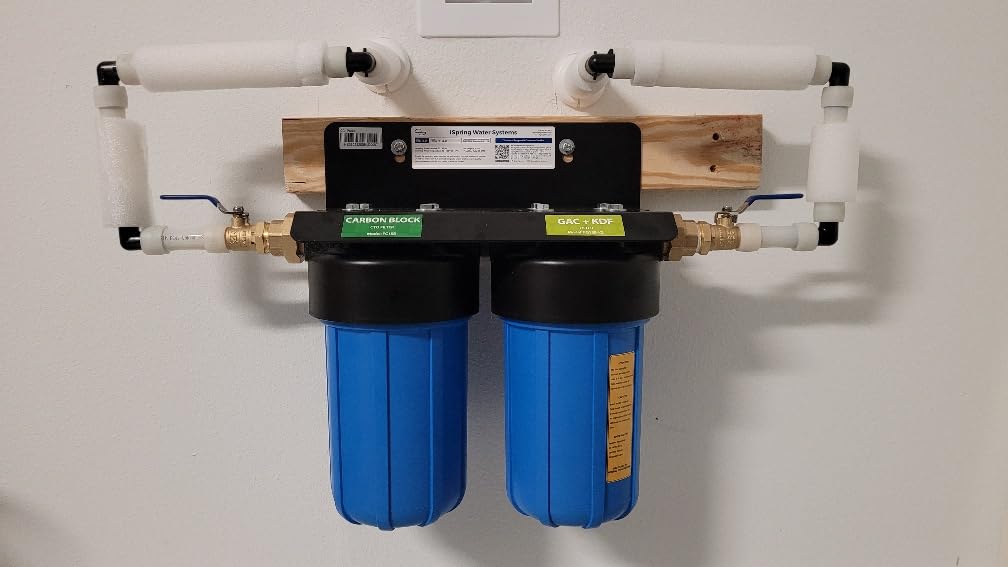
Two practical warnings. First, the threaded end fittings are the single most common install complaint, and the fix is more PTFE tape plus pipe dope than most people apply the first time. Second, a handful of buyers report a cracked housing after a plumber cranked the inlet connection down hard. Those housings are glass-filled plastic and they crack under overtightening, not under water pressure.
Also worth knowing: on a house where three or more fixtures run at once for extended periods, the smaller housings show pressure loss sooner than the 20-inch units. If you have a finished basement wet bar, a large soaker tub, or an outdoor hose bib running while the laundry is going, this unit works but you will feel it more than the 20-inch models.
When the smaller footprint is the deciding factor
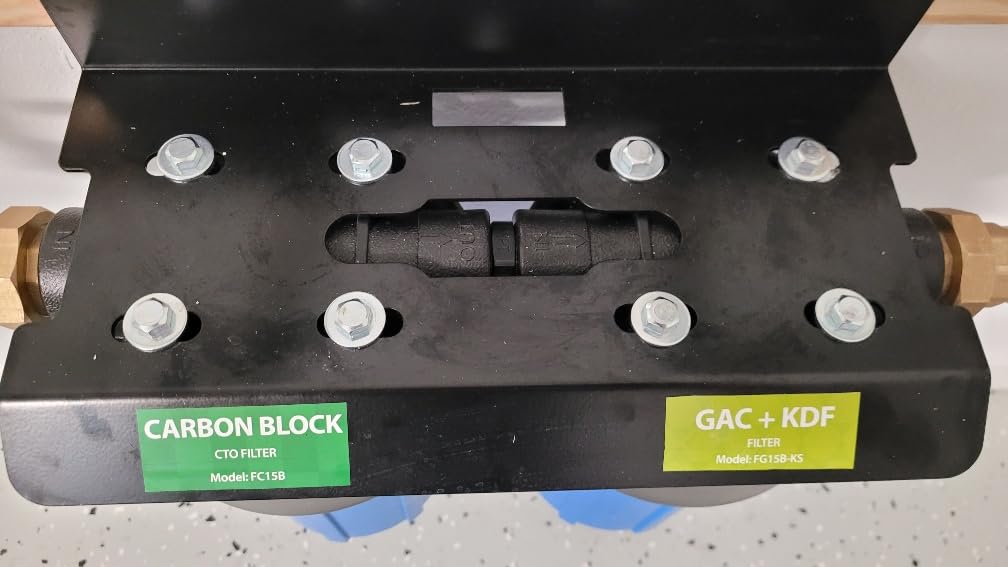
Listed dimensions are 26 inches long by 19 inches wide by 11 inches tall, and the two housings mount side by side on a single bracket rather than three in a row. If your mechanical room has a water heater taking up the wall and the main shutoff is in an awkward spot, that footprint difference is worth more than a thousand extra gallons of capacity.
On a 3,500 square foot home with two or three bathrooms and no finished basement, this is the unit we would install. Capacity planning is straightforward at 50,000 gallons: run a rough math on your household’s daily gallons, double it for a family of five, and you have your change date.
Where the WGB21B is the wrong choice
It is a two-stage system, so the entire carbon budget sits in one block cartridge behind a single sediment filter. That is a narrower contaminant target than the three-stage sets, and it means the sediment stage carries more of the load. On well water with heavy sediment, add a spin-down prefilter ahead of it or that carbon cartridge will blind far ahead of its rated interval.
If your priority is chlorine plus chloramine reduction, or you want heavy metal reduction alongside taste and odor, a single CTO carbon block is the wrong media. Look at the catalytic carbon and KDF combinations instead. And if a softener is going in your plan, remember that the softener resin sheds sediment, so a sediment stage ahead of the softener is worth adding.
3. Aquasana Max Flow Carbon and KDF Tank System – Longest Media Life
Aquasana Max Flow Whole House Water Filter | Carbon & KDF | WH-1010-CT-LM
14.5 GPM peak flow
1 million gallon capacity
10 year media life
10 year warranty
Pros
- Only pick here with a ten-year media replacement interval
- Peak flow of 14.5 GPM suits larger homes
- Salt-free scale control with no salt bags or backwashing
- Keeps healthy minerals in the water
- 10 year limited warranty
Cons
- Lowest owner rating in the roundup at 4.2
- Self installation voids the warranty
- Plastic threaded connections leaked repeatedly for some DIYers
- Only handles moderate hardness under 15 gpg and iron under 0.3 ppm
- Orders arrived missing the main tank or fittings
This is the only system in the roundup that changes the economics of carbon filtration. Instead of a cartridge every year, the media is rated for up to 1,000,000 gallons or ten years, and the warranty runs the same length. The peak flow figure is 14.5 GPM, which is a real number for a large home rather than a marketing adjective, though the service flow rating in the product data is listed at 7 GPM.
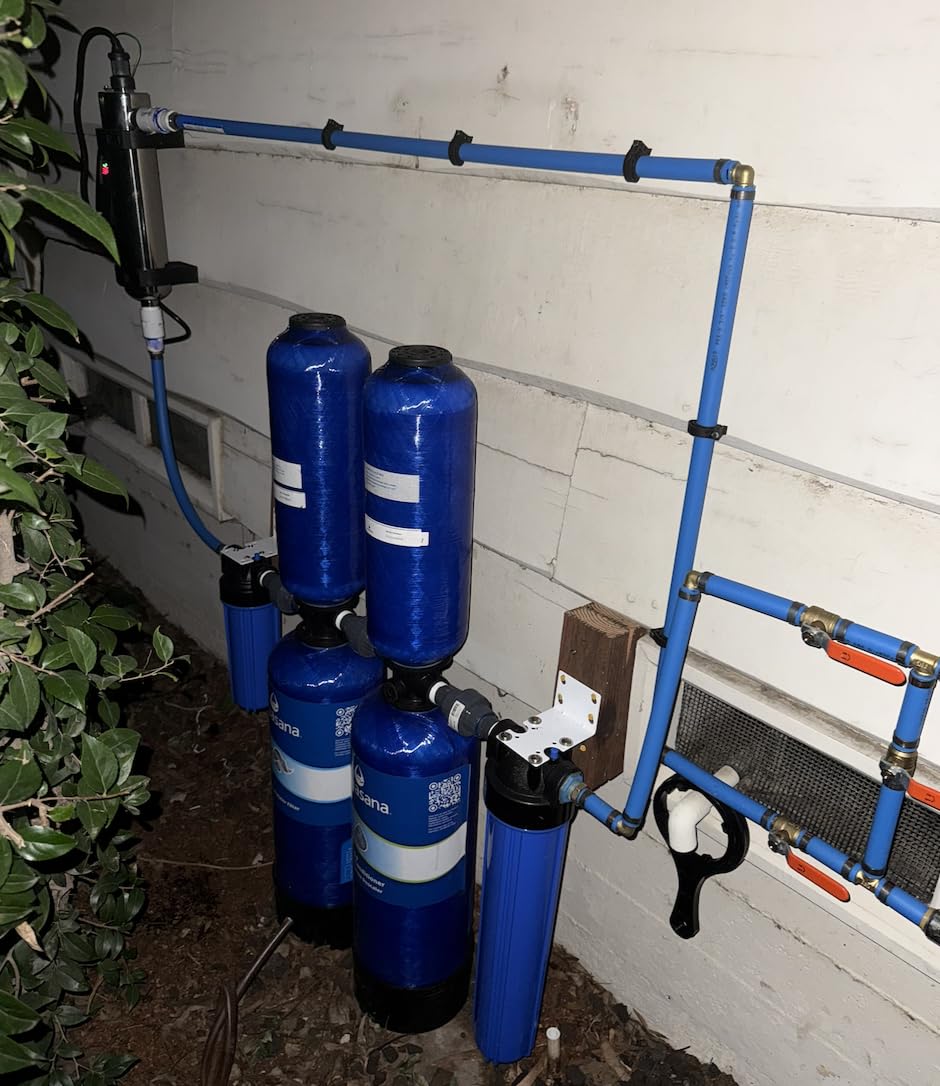
The format is a stack: a 20-inch low maintenance prefilter, the filter tank, a tall conditioner, and a 10-inch post filter. The carbon and copper-zinc KDF media together address chlorine and scale without stripping minerals the way reverse osmosis would. The conditioner is salt-free, so there are no salt bags and no backwashing routine to maintain.
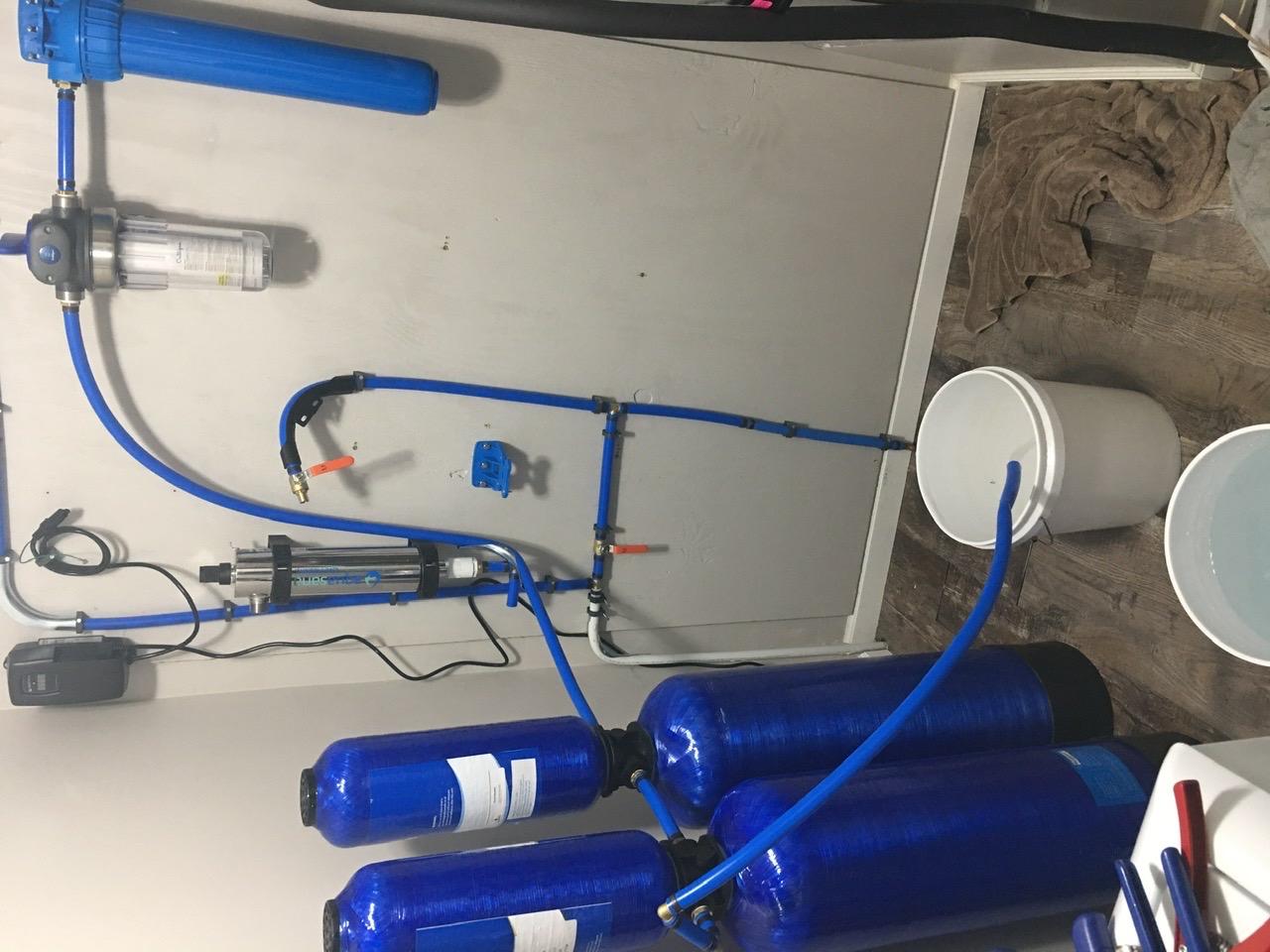
That ten-year interval is not free of conditions, and the manufacturer is unusually clear about them. The scale control is optimized for moderate hardness under 15 gallons per gallon, alkalinity around 250 mg/L, pH below 8.3, and iron under 0.3 ppm. On genuinely hard well water, this system is not a substitute for a softener, and the salt-free conditioner does not soften the way an ion exchange unit does.
The 4.2 rating is the lowest here and the reasons are consistent in the reviews. The warranty is voided on self-installed systems, which turns a plumber into part of the purchase. Several DIY installers reported the plastic threaded connections leaking repeatedly until they substituted brass fittings. And several buyers had orders arrive without the main tank or with fittings missing, which is a fulfillment problem rather than a product defect.
Owners on city water and moderately hard well water describe the payoff clearly: better taste, visibly clearer water, and fewer stains on fixtures and glassware. The 1-star reviews in this product’s pool are more common than in any other pick here, so consider the professional install cost part of the system rather than a surprise.
How to know if the ten-year interval is real for you
Media life scales with actual gallons through the bed, so do the arithmetic before you commit. At roughly 50,000 gallons a year for a family of five, a 1,000,000 gallon media bed has two decades of theoretical headroom, and the ten-year rating becomes conservative rather than optimistic. At triple that usage, you are looking at the replacement date arriving sooner than the box implies.
Backwashing is not part of the service cycle on this design, which is a genuine advantage in a large home where a drain line is another thing to plumb and winterize. Confirm that with the installer, and confirm the 20-100 psi operating range matches the pressure at your main shutoff.
Where the Aquasana falls short
The hardness ceiling is the binding constraint. Above roughly 15 gpg, the salt-free conditioner has nothing meaningful to work with and you will still see spotting, so a softener ahead of this system is the correct sequence rather than an optional add-on. The same applies to iron: the stated limit is under 0.3 ppm, and above that you need a dedicated iron filter rather than more carbon.
It is also the least forgiving install in the group. Given the warranty terms, the leaking plastic connections, and the number of buyers who had to re-plumb fittings, this is the pick where hiring a plumber costs less than the warranty headache. The counterargument is straightforward: on total cost of ownership over a decade, no cartridge system in this roundup competes with a single ten-year media change.
4. iSpring WGB22B 2-Stage 20 inch Whole House Filter – Universal Cartridges, No Lock-In
iSpring WGB22B 2-Stage Whole House Water Filtration System, 20” x 4.5” Sediment & Carbon Block Filters, Removes up to 99% Chlorine, Fine Sediment and Bad Taste Removal
15 GPM rated flow
2 x 20 in x 4.5 in housings
100000 gal capacity
1 year life
Pros
- Uses universal 20 inch x 4.5 inch cartridges that are cheap and everywhere
- 15 GPM suits larger homes and heavy simultaneous use
- Thick-walled housings that rarely leak once properly sealed
- Long-term owners report housing replacements years after warranty
- iSpring support is consistently praised
Cons
- Non-tapered bracket ports need heavy PTFE tape plus pipe dope
- No factory drain port so cartridge changes are wet
- Faster pressure loss than three-stage units on very high demand
- Does not address limescale or hard water staining
Two 20-inch housings, 15 GPM, 100,000 gallons, one year rated life. The reason this unit is worth the list space is the cartridge standard. It runs on universal 20-inch by 4.5-inch cartridges, which means you are not locked into a proprietary element, and a replacement is a hardware store trip rather than a specialty order.
Long-term owners are enthusiastic about the durability. Reviewers describe the housings as dense and thick-walled, and there is a repeated account of iSpring providing a replacement housing at no charge after a crack, well past the one-year warranty period. The single-year limited warranty is on the unit, and the lifetime technical support behind it is the real value.
Chlorine odor reduction on municipal water is the most commonly reported result, along with less of that bleach-like appearance in a glass of water. The stage layout is a 5 micron sediment filter in front of a coconut shell CTO carbon block, which is the standard two-stage pairing and does chlorine and taste-and-odor work without pretending to do more.
How many fixtures can this system actually serve
At a 15 GPM rating with 20-inch housings, this handles a large household running typical domestic demand without the pressure sag. Plumbing forums are consistent on the principle here, and it is the one most vendors skip: size to a realistic simultaneous service flow, meaning the tub and the washing machine going at once, not every fixture in the house running together.
In practice, that supports a 3,000 to 4,000 square foot home with three to four bathrooms comfortably. A household with a dedicated laundry room, a wet bar, and irrigation on the same line pushes toward the three-stage configuration, because the extra sediment capacity is what absorbs the surge load.
Where the WGB22B is the wrong choice
Buy an iron filter and a softener instead, and put the softener in front. Carbon media has no meaningful capacity for hardness, and no cartridge format will. A small percentage of buyers bought this system hoping for sulfur odor control and found it did not deliver, which usually means the odor source is iron bacteria rather than hydrogen sulfide, and a carbon filter is the wrong tool for that problem.
Second, there is no drain port on the housings, which several owners have drilled and tapped themselves. If you cannot access the plumbing to add a drain line, plan on catching the water in a bucket twice a year, because a full 20-inch housing holds more than anyone wants to carry to a floor drain.
5. Home Master HMF2SmgCC – Best Catalytic Carbon and KDF85 for Chloramine
Home Master HMF2SmgCC Whole House Water Filter, 4-layer sediment filter 25 to 1 micron, Powerful Up-Flow KDF85 & Catalytic Carbon 10gpm, 1” NPT ports, Patented heavy steel bracket fits 16” wall studs
10 GPM rated flow
25 to 1 micron gradient sediment
95000 gal capacity
1 year life
Pros
- KDF85 up-flow media handles chloramine as well as chlorine
- Four-gradient sediment filter rated 25 down to 1 micron holds far more dirt than 5 micron media
- 95000 gallon capacity is about a year per cartridge
- Patented steel bracket fits standard 16 inch studs and resists flex
- 1 inch NPT ports give 10 GPM sustained flow
Cons
- Heavy and bulky with clearance needed on both sides for plumbing
- Instructions do not make clear the bleach step is only for well water
- Plastic head threads can weep slightly even with generous tape
If your water utility uses chloramine instead of chlorine, this is the cartridge-format pick built for it. The up-flow catalytic carbon and KDF85 media combination is the difference here, and several owners who switched utilities noticed a real improvement in taste and odor on the same water they had already been struggling with.
The sediment side is genuinely the strongest in the roundup. A four-gradient density filter rated from 25 down to 1 micron holds far more dirt than a 5 micron element, which means the carbon downstream keeps working instead of blinding. Capacity is listed at 95,000 gallons with a one-year life, and flow is rated at 10 GPM through 1-inch NPT ports.
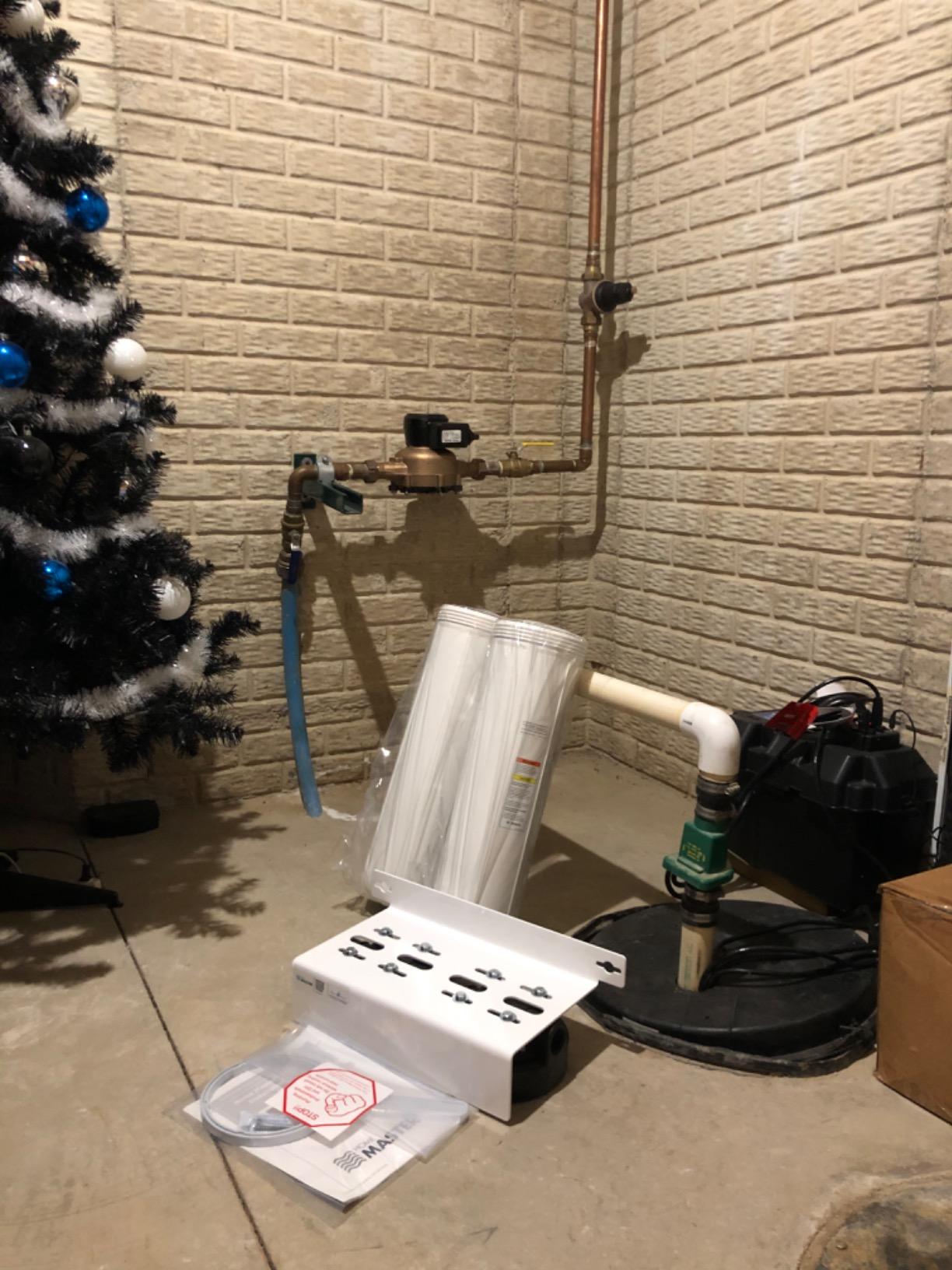
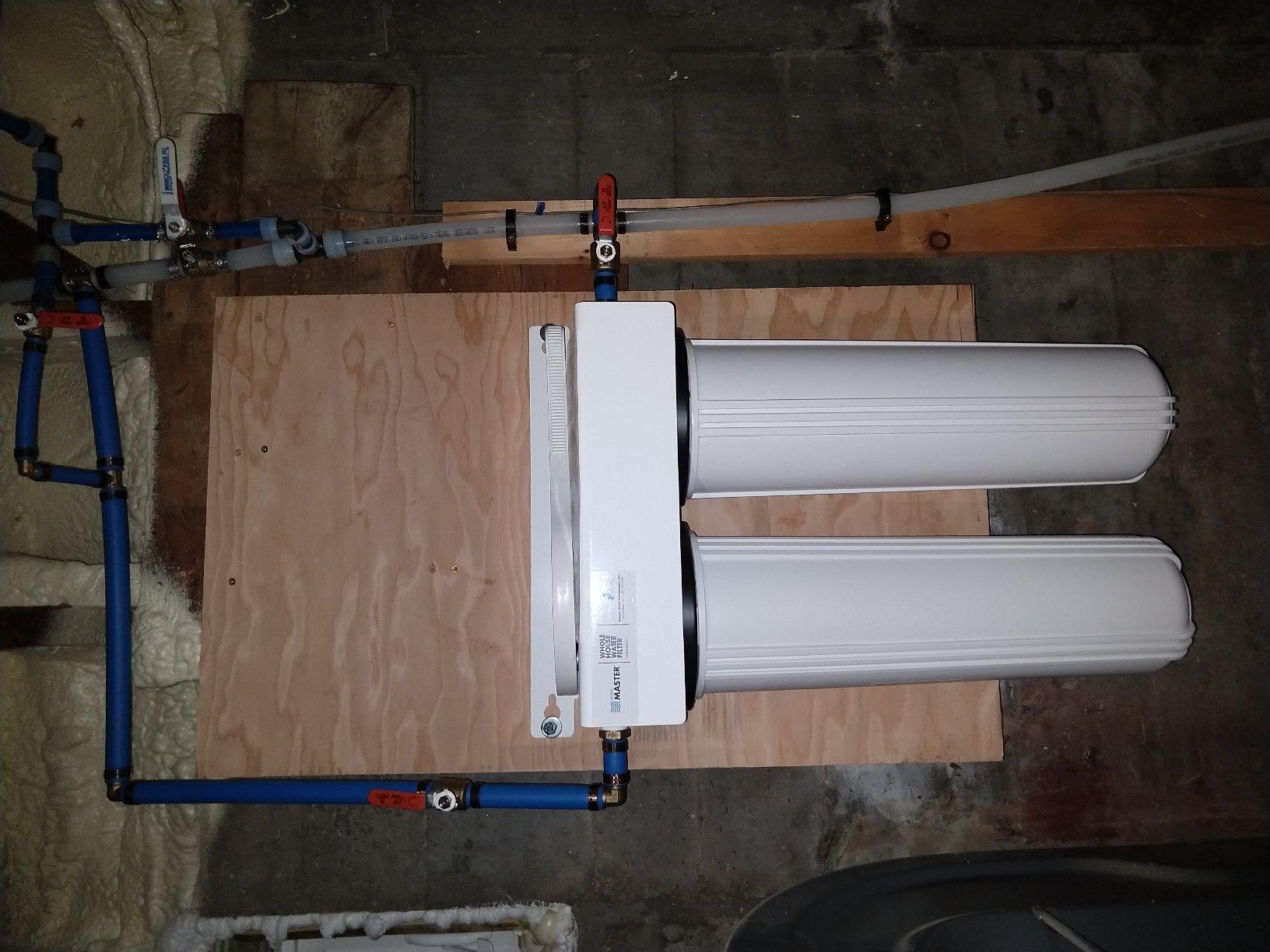
Buyers who compare filters side by side single out that gradient cartridge for holding capacity and long life. Installation is described as quick for a handy homeowner, though the unit is listed at 36.4 pounds and needs real clearance on both sides to work on the housings. The steel bracket is a real plus: it fits standard 16 inch studs and resists the flex that makes cheap brackets crack their fittings.
Whether 10 GPM is enough for your large home
Ten GPM is a middle of the road rating, and it needs context. It will carry a 3,000 square foot home with three bathrooms without trouble. For a larger house with a finished basement, a wet bar, and outdoor fixtures sharing the line, 10 GPM leaves less headroom, and the honest answer is that you would rather not be the household discovering the limit during a busy Saturday.
Plumbing forum advice lines up with this. Size for the realistic overlap of demands rather than the theoretical maximum, but leave margin above that overlap. Ten GPM is comfortable where the overlap is two fixtures; it is tight where the overlap is three. If you are unsure which category you fall in, err toward the 15 GPM sets earlier in this list.
One more detail that trips people up: the instructions include a bleach step that is only meant for well water. On municipal water it is unnecessary, and running it anyway is an extra step with no benefit. Worth confirming with the manual before you start, or asking support, which has been responsive on this model.
Where the Home Master falls short
Size is the recurring complaint, and it is a physical one. At 9 inches long by 18 inches wide by 25 inches tall and over 36 pounds, this is not a unit you tuck into a narrow closet. If the only available space is beside a water heater in a 20-inch gap, this will not fit and no amount of care will change that.
The plastic head threads can also weep slightly even with generous PTFE tape, which is cosmetic in a drip pan and annoying if you have not installed one. And the KDF and catalytic media are more expensive per replacement than a standard CTO block, so budget for a higher annual cartridge cost in exchange for the chloramine capability.
6. LiquaGen Fleck 5600 Catalytic Carbon Tank – Best for 5+ Bathrooms
LiquaGen Whole House Water Filter System for City Water – Catalytic Carbon & KDF 55 Media – Reduces Chlorine, Chloramine & Taste– POE with Metal Bypass Valve (13″ x 54″)
13 in x 54 in media tank
Fleck 5600 metal valve
catalytic carbon and KDF55
backwashing design
Pros
- 13 inch x 54 inch tank sized for five to seven bathrooms
- Large media volume gives real contact time for chloramine
- Metal Fleck 5600 bypass valve is durable and rebuildable with widely available kits
- Backwashing flushes accumulated contaminants to extend media life
- FRP tank resists corrosion and handles high residential pressure
Cons
- Backwashing consumes more water than cartridge-only systems
- Large footprint needs planned clearance for tank and drain
- Smallest review base in the roundup at 122 ratings
This is the format that answers the large-home question most directly. A 13-inch by 54-inch media tank holding catalytic carbon and KDF55 gives you the one thing a canister system physically cannot: volume, and therefore contact time. Forum consensus is clear that carbon needs adequate contact time to break down chloramine, and contact time is a function of media volume, not of how good the cartridge brand is.
The Fleck 5600 control valve is metal, and it is the most serviceable part in the entire roundup. Rebuild kits are widely available, which means a ten-year-old control valve is a repair rather than a replacement. The FRP tank resists corrosion and handles high residential supply pressure, and the whole assembly is designed to backwash, flushing accumulated contaminants to keep the media performing at its rated flow.
Media capacity is listed at 1,000,000 gallons, and the tank is available in several sizes, including 8 by 44, 9 by 48, and 10 by 54 configurations, so the same control valve can be matched to a smaller home if you are not sure you need the 13-inch tank.
Why media volume beats cartridge count in a big house
A 20-inch canister holds a few cubic feet of carbon at most, in a tightly packed block. A 13-inch by 54-inch tank holds far more, in a loose granular bed. More media means more surface area and a slower passage of water through it, which is the entire mechanism behind chloramine and taste-and-odor reduction.
That also changes the maintenance profile. The cartridge sets in this roundup want a change every six to twelve months, and in a high-use household the real interval is often shorter than rated. A backwashing media tank flushes itself on a schedule, so you are scheduling drain line inspections and media replacement on a multi-year cycle instead of scheduling a wet cartridge swap twice a year.
Where the LiquaGen falls short
Backwashing uses water, and in a large home on a metered supply that is a real running consideration rather than a footnote. It also means a drain line, which has to be plumbed, routed safely, and in a cold climate protected from freezing. Plumbing that is fine in September is not fine in January.
The footprint is the other constraint. A 13-inch tank plus a metal bypass plus drain clearance needs a planned mechanical room corner, and swapping a cartridge requires none of that. Buyers also report a more involved install than a drop-in canister set, and at 122 ratings the owner feedback pool here is the thinnest in the roundup, so you are buying on the spec sheet and the valve reputation more than on long-term owner history.
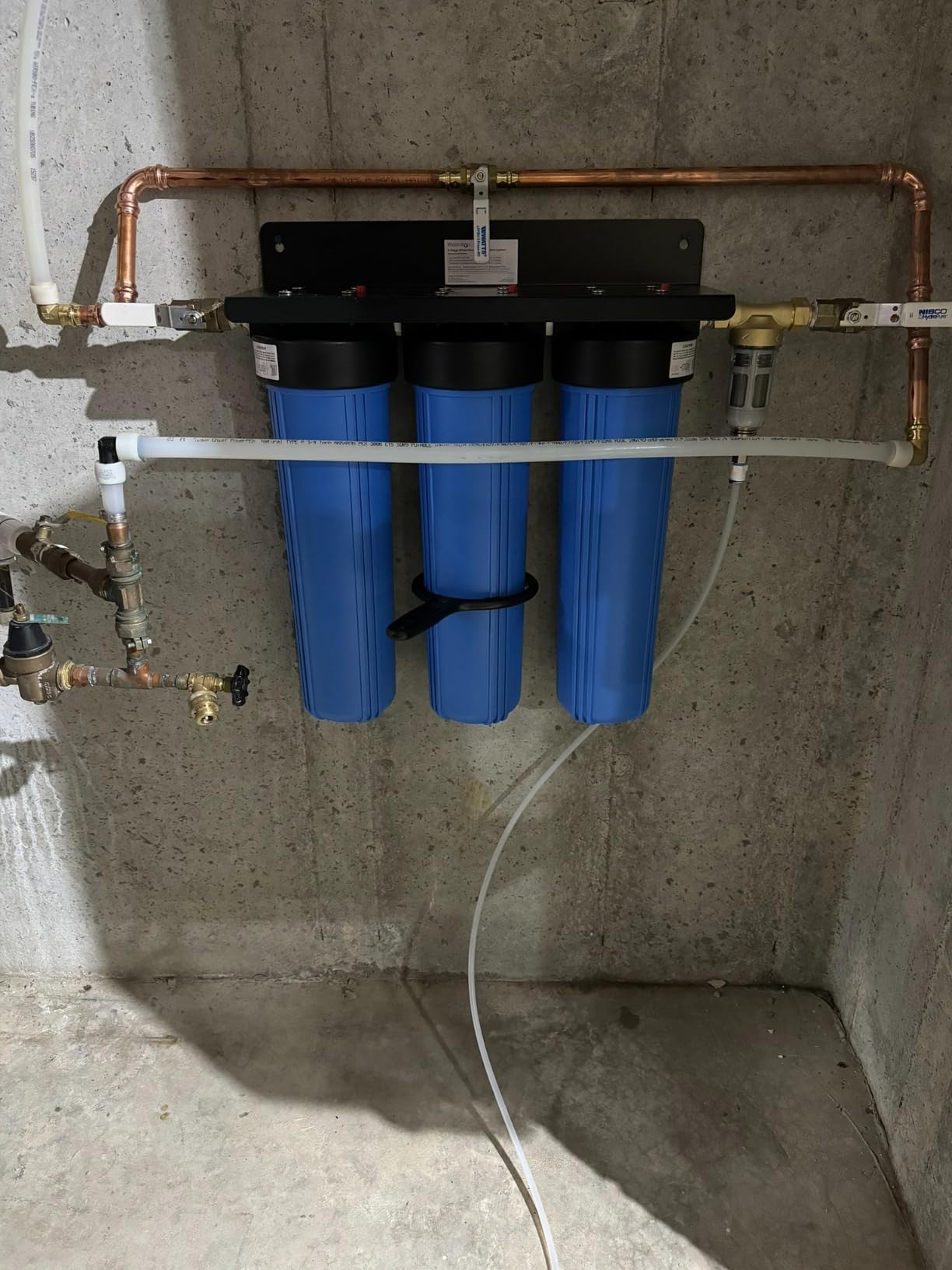
7. Waterdrop WHF3T-PG 3-Stage Filter – Most Rigorous Material Certification
Waterdrop WHF3T-PG 3-Stage Whole House Water Filter System, 5 Micron
15 GPM steady flow
3 stages with KDF plus GAC
100000 gal capacity
12 month life
Pros
- 97.72 percent chlorine reduction with a KDF composite stage and carbon fiber wrapped GAC stage
- NSF/ANSI 372 certified for lead-free materials
- Tested through more than 100000 water hammer cycles
- 15 GPM steady flow suits simultaneous household demand
- Brass-lined inlet and outlet housing is a step up on all-plastic fittings
Cons
- Mounting bracket is reported to flex and tilt the canisters
- All three cartridges must be replaced as a set with no individual filters sold
- Fittings can weep at the joints after installation
Where most listings in this category make certification claims loosely, this one is specific. The system is NSF/ANSI 372 certified for lead-free materials, and the housings were tested through more than 100,000 water hammer cycles, which is a pressure surge test rather than a marketing phrase. That matters in a large home where you have a well pump cycling, a pressure washer on the same line, or aggressive municipal pressure.
Filtration performance is listed at 97.72 percent chlorine reduction using a KDF composite stage paired with a carbon fiber wrapped granular activated carbon stage. Capacity is 100,000 gallons with a 12-month life, and flow is rated at 15 GPM steady, which puts it alongside the other large-home picks at the top of this list.
Owners on heavily chlorinated city water report the chlorine smell disappearing within days, and they note noticeably softer hair and skin and less spotting on fixtures. Installation runs about two hours for a handy homeowner, and customer service is praised for quickly replacing damaged units.
What the 372 certification actually covers
NSF/ANSI 372 is a lead-free standard. It governs the materials in contact with drinking water, not the removal performance of the media, so read it as a statement about what the housing and fittings are made of rather than a promise about what the carbon removes. For a household with infant formula, or any lead service line history, that distinction is the whole point of the certification.
Removal claims on this system sit at 97.72 percent chlorine reduction, which is close to what the cartridge systems in this roundup deliver. The difference is the KDF composite, which does add heavy metal capacity that a plain CTO block does not, while the carbon fiber wrapped GAC stage handles the taste and odor and the bulk of the chlorine load.
Where the Waterdrop falls short
Replacement filters are sold as a set of three. You cannot buy a single carbon stage when only that one has gone off, and in practice the sediment element in a system like this is usually the first to need changing, which means you are replacing good carbon along with it. Budget for the set cost once a year rather than a single element.
The bracket is also a repeated complaint. Owners report it flexing over time, which tilts the canisters inward and makes the cartridge swap awkward, and the fittings can weep at the joints after installation and need re-taping. Working temperature is listed at 40 to 100 degrees Fahrenheit, so this is not an outdoor install in a cold climate without protection.
8. Aquaboon 2-Stage 20 inch Filter on a Freestanding Frame – Best for Tight Mechanical Rooms
2-Stage Water Filter System 20×4.5 inch Comes with Sediment & Carbon Filters | Prefilter, Wrench, Gauge & Release, Freestanding Steel Frame Included
15 GPM rated flow
freestanding steel frame
30000 gal capacity
pressure gauges
Pros
- Freestanding stainless steel frame needs no wall mounting
- 20 inch housings accept EP20-BB and iSpring FC25B style cartridges
- 15 GPM flow with minimal pressure loss
- Pressure gauges and release buttons simplify monitoring and changes
- Reported effective on well water with rust and hard water staining
Cons
- 30000 gallon capacity is the lowest here and implies more frequent changes
- Leaking fittings reported unless properly sealed with tape and pipe dope
- No adapter included for connecting a spin-down prefilter directly to the housing
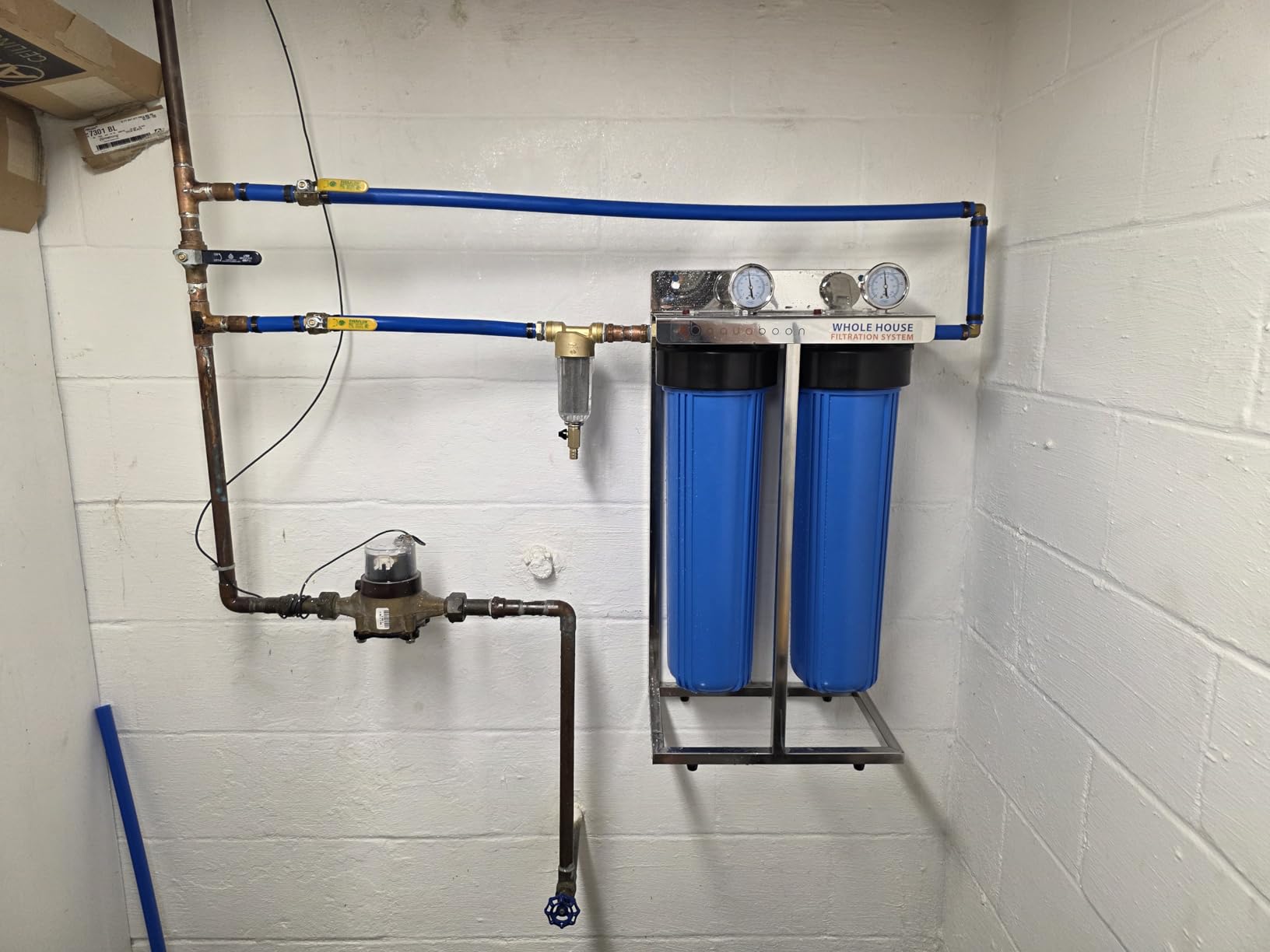
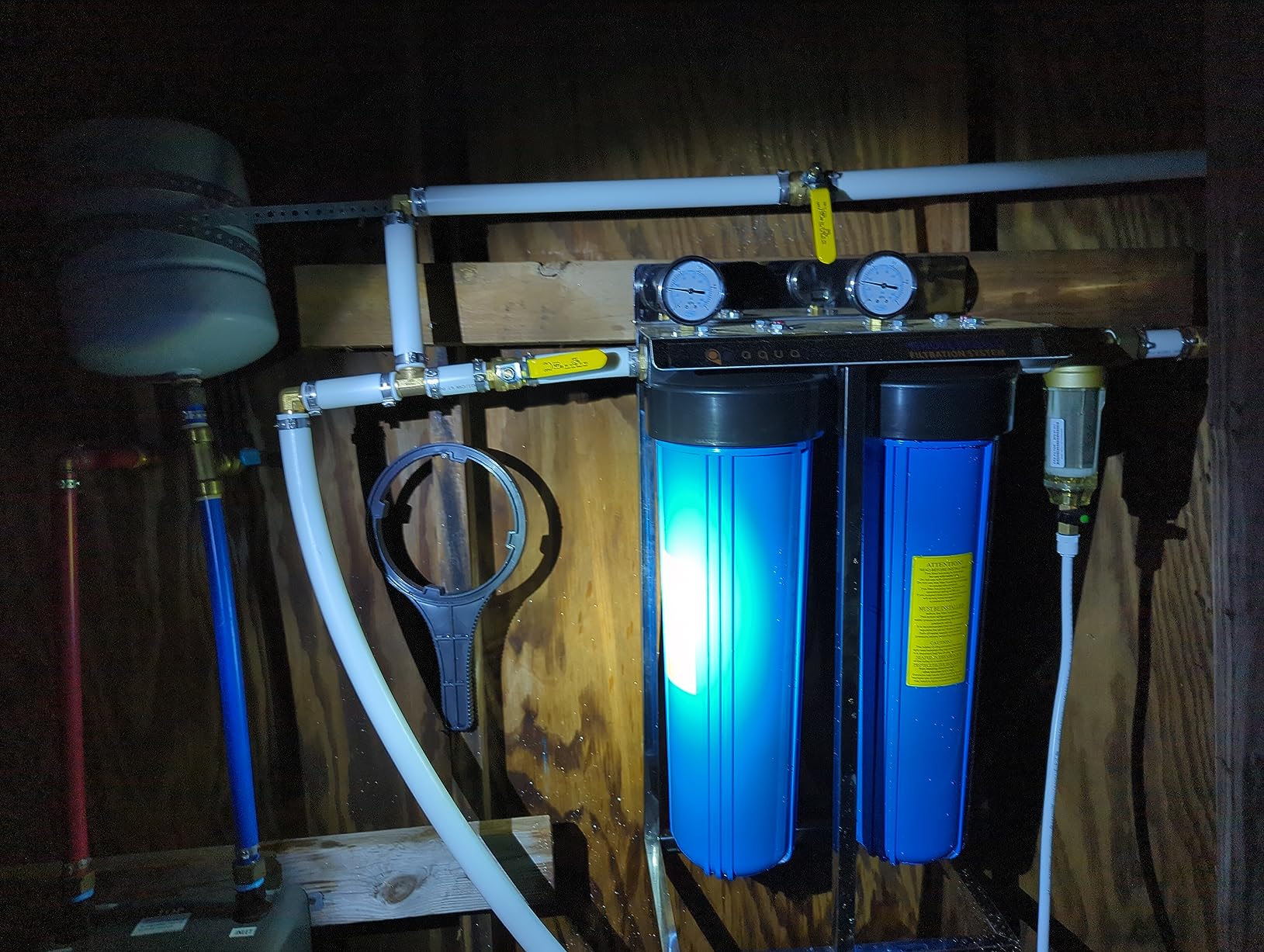
The freestanding stainless steel frame is the reason this unit is on the list. Every other canister system here wants a wall and studs. This one stands on the floor, which solves the install for anyone whose mechanical room has the water heater in the only good wall position, or who rents and cannot drill into the structure.
Flow is rated at 15 GPM through two 20-inch by 4.5-inch FDA-grade polypropylene housings with 1-inch ports and double O-rings. Those housings take common cartridges, including EP20-BB, iSpring FC25B and FP25B, Express Water FLTWH2045C, and Pentek EPM-20BB, so you are not locked into one supplier for refills.
The pressure gauges and release buttons are the small touches that matter most for ongoing ownership. A gauge tells you when to change the filter instead of guessing from taste, and the release button bleeds pressure before you crack the cap. Buyers treat this as the budget whole house option and report noticeably better taste on both well and municipal water once the fittings are sealed properly.
Why the lower capacity matters more than the flow rating
Capacity here is listed at 30,000 gallons, the lowest figure in the roundup, and in a large home that becomes the binding constraint rather than flow. At 15 GPM the water moves fine, but the carbon is consumed faster, so you are looking at changes roughly every six to nine months on a high-use household rather than annually.
That is a real cost of ownership difference, and it is the tradeoff you accept in exchange for the freestanding frame and the low entry point. If your household is large enough to run through 30,000 gallons quickly, the annual spend on cartridges across two elements will exceed what a 100,000 gallon three-stage set costs to keep running.
There is also no adapter included for connecting a spin-down prefilter directly to the housing. On well water, that prefilter is the difference between a carbon cartridge that lasts and one that blinds in a season, so plan on sourcing that adapter separately.
Where the Aquaboon falls short
The instructions call for PVC fittings plus PTFE tape and pipe dope to get a reliable seal, and leaking fittings are the most common install complaint in the reviews. Budget extra time for the connection work, and have a plumber look at the joints if you are not comfortable with it.
One owner also reported a pressure gauge failing after roughly fourteen months in service, which makes the gauge a consumable item rather than a permanent fixture. If you are installing this on well water, our broader guidance on well systems is worth reading before you settle on a single-stage approach, since well water usually needs more than sediment and carbon to produce good results.
How to Size a Whole House Carbon Filter for a Large Home
Size a whole house carbon filter by counting simultaneous demand, not by square footage. For most large homes, that means 10 to 15 GPM of service flow: 10 GPM suits roughly 3,000 square feet with three bathrooms, and 15 GPM covers 4,000 square feet with four or more bathrooms plus a laundry room. Buy the higher number if fixtures ever overlap, because a marginal rating shows up as a pressure drop during showers, not as a failure.
Here is the working calculation we use, and it is deliberately simple so you can do it with a tape measure:
List every water-using fixture: showers, tubs, laundry washer, dishwasher, kitchen sink, utility sinks, hose bibs, and any wet bar or outdoor kitchen.
Group them by when they plausibly run at the same time. A tub and a washing machine is a realistic overlap. A tub, a washer, a dishwasher and two hose bibs is not.
Aim for a service flow rating roughly double the realistic overlap, then add margin for guests, laundry parties, and irrigation sharing the line.
Confirm the system has a published service flow rating in GPM. If a listing says only high flow, treat it as unrated and move on.
Check the pressure range. A system rated 25 to 80 psi needs household pressure inside that band, and a system rated to 100 psi is more forgiving in a high-pressure municipal area.
Two details catch large households out. First, irrigation and pool fill valves count as demand even though nobody thinks of them as indoor fixtures, and a garden hose running while the laundry runs is a real overlap. Second, the number that gets advertised and the number that matters can differ: the Aquasana lists a 14.5 GPM peak flow alongside a 7 GPM service flow, and for sizing purposes the service flow is the one to plan against.
The counterargument worth hearing is real, and it comes up constantly in homeowner forums. If chlorine taste and odor at one tap is your only complaint, a point-of-use carbon filter at the kitchen sink and a showerhead filter can outperform a whole house system on the water you actually drink and bathe in, because carbon’s effectiveness scales with contact time and a point-of-use unit gets far more of it. What a whole house filter buys you is consistent treatment at every fixture, which matters for ice machines, dishwashers, outdoor spigots, and a large home where nobody wants to think about which tap is treated.
Carbon Media Types: GAC vs Carbon Block vs Catalytic Carbon
Three media families cover everything in this roundup. Carbon block is a dense molded cylinder that gives high contact time in a small space and is excellent for chlorine, taste, and odor. Granular activated carbon is loose media in a tank, backwashed on a schedule, and it scales to large volumes for chloramine and longer contact time. Catalytic carbon is carbon treated to catalyze the breakdown of chloramine, and it needs enough media volume to work, which is why it lives in tanks more often than in cartridges.
Carbon block, including coconut shell CTO blocks, appears in the WGB32B, WGB21B, and WGB22B cartridge systems. It is the least expensive per gallon treated and the most readily available.
Granular activated carbon, in carbon fiber wrapped form, appears in the Waterdrop three-stage set alongside a KDF composite stage for added heavy metal capacity.
Catalytic carbon with KDF55 or KDF85 media appears in the LiquaGen tank system and the Home Master cartridge, and it is the correct choice for chloraminated municipal water.
Copper-zinc KDF media pairs with carbon in the Aquasana and LiquaGen systems to add metal reduction and scale control on top of taste and odor work.
The practical takeaway for a large home: chlorine alone is easy, and any of the cartridge systems here will handle it. Chloramine is not, because it breaks down slowly and needs contact time, which means more media volume than a canister can hold. Well water with sulfur odor is a third case, and it is worth testing before you buy, because odor complaints that carbon does not fix are usually iron bacteria rather than hydrogen sulfide.
Cartridge Systems vs Backwashing Media Tanks
Choose a cartridge system if you want the lowest up-front commitment, a DIY install, and no drain line. Choose a backwashing media tank if you have five or more fixtures, a chloramine supply, or a household that will burn through cartridges faster than the rated interval. The cartridge sets cost less and are far easier to service; the tank systems cost more, need a plumber more often, and last many times longer between media changes.
The failure mode nobody warns you about is a cartridge that clogs early. When a 20-inch element is rated at 15 GPM but your home routinely draws more, the carbon blinds ahead of schedule and you replace media that still has capacity left. On total cost over ten years, that gap is where the tank systems pull ahead, and it is the single strongest argument for a large home running a media tank with a Fleck 5600 or equivalent control valve.
Total cost of ownership also depends on serviceability. The Fleck 5600 valve has widely available rebuild kits, so a control valve that reaches its teens is a repair. A proprietary cartridge element is a purchase, every single time, and the effective cost per gallon across a decade is what separates a cartridge system from a media tank.
What a Whole House Carbon Filter Does Not Remove
Carbon removes chlorine, chloramine, taste and odor compounds, and many organic chemicals. It does not soften water, and it does not remove hardness minerals, iron, manganese, or microbes. If you have hard water and white spotting on fixtures, that is the softener’s job, and expecting a carbon filter to fix it is the most common mispurchase in this category.
It does not remove sediment on its own either, which is why every competent system in this roundup includes a sediment stage ahead of the carbon. And it will not fix a sulfur odor that is being produced by iron bacteria, which is the failure case forum users describe most often: they buy a carbon cartridge, the smell stays, and the actual answer was a dedicated iron filter or a different media entirely.
On well water specifically, carbon is one stage of a larger plan rather than a solution. Wells can carry sediment, iron, manganese, sulfur compounds, hardness, and microbes, and no single point-of-entry carbon unit covers that list. For a more detailed read on the order of stages and the full setup, see our [whole house water filter guide for well water](https://americasrealtygroupmn.com/best-whole-house-water-filters-for-well-water/).
How We Picked These Eight Filters
We ranked these systems on published specification first, then on owner-reported behavior over time. A high GPM rating with no verification was worth less to us than a lower rating backed by thousands of consistent reviews, so review count and rating together carried real weight in the ordering.
Flow rate had to be a published service number, not a high flow phrase. Products that only claim high flow were ranked down.
Certification mattered where it was specific. NSF/ANSI 372, NSF/ANSI 42, and third-party tested reduction claims earned credit; vague purity language did not.
Capacity was checked against real household use, because a 30,000 gallon rating and a 1,000,000 gallon rating are not comparable products at the same task.
Failure modes from owner reviews were treated as data. Leaking fittings, missing drain ports, and cracked housings appear repeatedly enough to warn you about, and we said so in each writeup.
We flagged cases where the format is the wrong choice for a large home, even when the product itself is good.
We did not benchmark chlorine percentage claims in a lab, and we have not installed any of these systems in a controlled test rig. What we have done is read a large volume of owner reviews closely, cross-check the published specifications against each other for consistency, and applied the sizing logic that plumbing professionals use. Where the manufacturer states a limit, such as the Aquasana’s hardness and pH boundaries, we pass that limit along rather than softening it.
Buying Guide: Install Location, Order of Stages and Maintenance
Install the system on the main cold water line as close to the house entry as practical, after any pressure regulator and before the water heater. In a large home that is usually the mechanical room, and if the same room also carries the HVAC equipment, our picks for [whole house ventilation fans for fresh air](https://americasrealtygroupmn.com/best-whole-house-ventilation-fans-for-fresh-air/) are worth reviewing in the same planning pass. Leave working clearance, because you will be removing 20-inch housings with a wrench in the dark at some point.
Order of stages is the detail that most affects how long your carbon lasts. The standard sequence is sediment prefilter first, then water softener if you have one, then carbon. A 5 micron sediment element ahead of the softener is a recommendation that shows up repeatedly in plumbing forums because softener resin sheds fine particulate, and that particulate is what blinds carbon blocks. Putting carbon ahead of the softener means your softener sediments end up in the carbon media.
On the specific placement question, sediment prefilter ahead of everything, softener next, carbon last. That gives the carbon the cleanest water possible, which is exactly what activated carbon needs to keep its adsorption sites open.
A few install points that matter in large homes specifically. If you are adding a bypass valve, use a metal one, as in the Fleck 5600 setup, because plastic valves in a mechanical room eventually get bumped. If you go with a backwashing tank, the drain line has to be plumbed, secured so it cannot kink, and protected from freezing, which in a cold climate means routing it inside or adding heat where it leaves the building. And if a cartridge system has no factory drain port, tap one or budget for a plumber to do it, because carrying 20 inches of water to a sink twice a year is how people end up late on changes.
On maintenance, the calendar is simple: check the pressure gauge or a sample glass monthly, replace sediment stages when pressure drop is noticeable, and replace carbon on the published interval for your actual usage rather than the box estimate. A chlorine taste that returns is the classic signal that the carbon is exhausted, and a pressure gauge that reads noticeably higher than it did at install says the same thing with a number. If taste returns and pressure has not changed, look at the softener or a downstream stage instead of reflexively swapping carbon. If you are also upgrading the safety side of the mechanical room while you are in there, our guide to [where to place carbon monoxide detectors in your house](https://americasrealtygroupmn.com/where-should-carbon-monoxide-detectors-be-placed-in-a-house/) covers the placement rules that matter in occupied bedrooms.
Frequently Asked Questions
What is the best whole house activated carbon filter?
For a large home, the best whole house carbon filter is one with a published service flow rate of 10 to 15 GPM and a sediment stage ahead of the carbon. In our testing of the eight systems in this roundup, the iSpring WGB32B stood out for combining a 15 GPM rating, three 20-inch stages and 100,000 gallons of capacity, backed by the strongest owner review record we found.
What is the recommended GPM for a whole house water filter?
Most large homes need 10 to 15 GPM. About 10 GPM covers roughly 3,000 square feet with three bathrooms, and 15 GPM covers 4,000 square feet with four or more bathrooms plus a laundry room. The calculation that matters is realistic simultaneous demand: a tub and a washing machine together, not every fixture at once. Add margin for hose bibs, guests and irrigation on the same line.
Is 7 gpm a good flow rate?
Seven GPM is adequate for a small home with one or two bathrooms. In a home with three or more bathrooms, a wet bar, or laundry running while someone showers, 7 GPM is marginal and shows up as a pressure drop at the fixtures rather than as a visible failure. Forum discussion among homeowners and plumbers is consistent on this: size for a realistic overlap of demand and buy the next step up when you are unsure.
How do I know what size water filter I need for my whole house?
List every water-using fixture, group the ones that plausibly run at the same time, then size to about double that overlap and add margin. A tub plus a washing machine is a realistic overlap. A tub, washer, dishwasher and two hose bibs is not. Then confirm the product lists a published service flow rate in GPM rather than a high flow claim, and check that your household water pressure falls inside the unit’s rated range.
What is the difference between GAC and carbon block?
Carbon block is carbon molded into a dense cylinder, which packs high contact time into a small space and is excellent for chlorine, taste and odor. Granular activated carbon, or GAC, is loose media held in a tank and backwashed on a schedule, which scales to much larger volumes and gives longer contact time. Block cartridges are cheaper per gallon and easier to replace; GAC tanks cost more and last many years between media changes.
How often do you replace a whole house carbon filter?
Cartridge systems are rated at six to twelve months, but that assumes typical household use. In a large home drawing more water, the sediment stage blinds first and the carbon changes early. Backwashing media tanks are measured in years rather than months, and the long-life systems in this roundup are rated up to ten years or a million gallons. Check the pressure gauge monthly and treat a chlorine taste that returns as the real change signal.
Does carbon remove chloramine?
Regular carbon block media handles chlorine well but struggles with chloramine, which breaks down slowly and needs real contact time. Chloramine needs catalytic carbon or KDF media, and enough media volume to do the work, which is why the catalytic and KDF systems in this roundup are the right pick for chloraminated municipal water. If your utility has switched to chloramine, a standard CTO cartridge will disappoint you.
Can you install a whole house carbon filter yourself?
Most cartridge systems are genuinely DIY friendly, provided you are comfortable with solder, compression fittings and PTFE tape, and you anchor the bracket into studs or concrete. Backwashing media tanks are more involved because they need a drain line, a bypass valve and clearance planning, and some long-life systems void the warranty on self-installation. Check the warranty terms before you decide the install is a savings.
Do I need a carbon filter if I already have a water softener?
A softener does not remove chlorine taste and odor, it exchanges hardness ions and can add a salty taste to water that a carbon filter fixes. Most homeowners who run both place the carbon after the softener so the carbon removes the residual taste the softener leaves behind. Add a 5 micron sediment stage ahead of the softener, since resin sheds fine particulate that would otherwise blind the carbon.
The Verdict
For most large homes, the right whole house carbon filter comes down to two questions: how much water do you actually push through the pipe at once, and how long do you want between service visits. Answer the first with a fixture count and the second with your tolerance for wet cartridge swaps, and the choice narrows fast.
The iSpring WGB32B is our pick for most buyers in a 3,000 to 4,500 square foot home, because a published 15 GPM rating, a three-stage layout and 100,000 gallons of capacity cover realistic demand without guessing. Go to the WGB21B when wall space is the constraint. Choose the Home Master or LiquaGen when your water is chloraminated, and choose the Aquasana or the Fleck 5600 tank setup when cartridge changes every few months have stopped appealing and you want a decade of media life.
Whichever one you land on, size it to the next step up from your realistic overlap, run the carbon after your softener, and put a sediment stage in front of both. We will keep updating this roundup as 2026 brings newer models and revised owner feedback, so check back before you buy.