
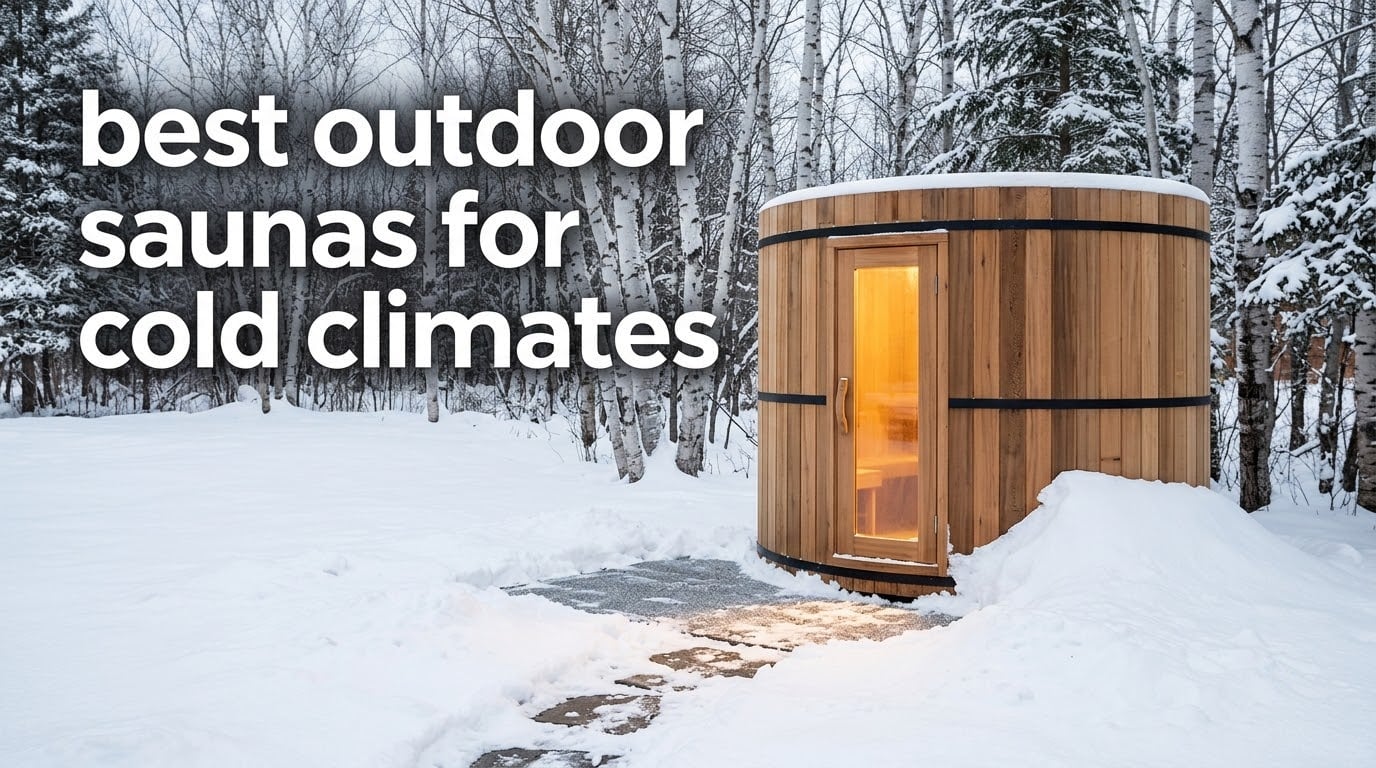
Traditional barrel and cabin saunas with thick solid-wood walls, an oversized electric stove and a pitched roof outperform infrared cabinets and portable tent designs once the thermometer drops below freezing. That is the short answer to the question buyers in the Upper Midwest, Mountain West, Northeast and northern Canada keep asking us: the best outdoor saunas for cold climates are built like a small building, not like a piece of patio furniture. You can absolutely use an outdoor sauna in the winter. The gap between a sauna that reaches a real 175°F in February and one that gets abandoned at 120°F comes down to wall thickness, roof pitch, heater output and the base it stands on.
Our team compared ten outdoor saunas sold for four-season backyard use, then scored every one of them against the criteria that actually decide winter performance rather than summer comfort. We cross-checked published heater output, wall material and thickness, roof construction, electrical demands, warranty length and the honest complaints in owner reviews, because those are the numbers that decide whether you still want to walk out to the sauna in February.
Three build styles showed up in almost every cold-weather recommendation we found. Traditional steam barrels hold the highest temperatures and throw löyly off real sauna stones, and they are the category that handles the most severe winters. Electric infrared cabins heat in minutes and cost far less to run, but they cap out well below 200°F, which is fine for recovery and a poor substitute for a real hot room. Portable tent saunas are the cheapest way to try the habit, though they are the least tolerant of sustained freeze-thaw cycles. Our barrel sauna roundup covers the geometry in more depth.
Everything below is written for someone who lives where January is a real event. We note the honest disqualifier for each model, because a sauna that is wrong for your climate is a very expensive sauna cover. If you already know you want a specific heater output, our guide to the best sauna heaters for home saunas is worth a read before you commit to a cabin.
Table of Contents
Top 3 Best Outdoor Saunas for Cold Climates in 2026
These three earned the top spots after we weighted cold-weather heat retention, wall construction, heater output, warranty coverage and the consistency of owner feedback. Two are traditional steam barrels that reach genuine sauna temperatures, and one is a low-cost infrared cabin that gets you a usable session for a fraction of the outlay.

OUTEXER 4-5 Person Barrel
- 4.5KW 240V electric stove
- Carbonized Finnish spruce
- Heats in 25-35 minutes
- 581 owner reviews

KUNSANA 2-Person Infrared
- 1750W far-infrared and ceramic
- Usable in 10-20 minutes
- Wood rated to -5F
- Two-year warranty

SALUSHEAT Full Spectrum
- Near mid and far infrared
- 660nm and 850nm red light
- 1950W on a 20A circuit
- Reclining seats
The OUTEXER barrel took the top slot because it pairs a real 4.5KW stove with carbonized spruce rated for permanent outdoor exposure and the deepest owner review base in the group. The KUNSANA cabin earns its place as the value pick for anyone who wants a ten-minute warm-up in a below-freezing yard rather than a full sauna session. The SALUSHEAT full spectrum cabin rates 4.8 across 133 reviews, and it is the only model in the group that adds red light therapy alongside the heat.
All 10 Cold-Climate Saunas at a Glance in 2026
Here is the full lineup with the specs that matter once snow is on the roof. Every model below runs on electricity except the last one, which burns wood, and most of them need a dedicated circuit rather than a household wall outlet.
| Product | Specifications | Action |
|---|---|---|
| OUTEXER 4-5 Person Barrel Sauna |
|
Check Latest Price |
| KUNSANA 2-Person Low EMF Infrared |
|
Check Latest Price |
| SALUSHEAT Full Spectrum Sauna |
|
Check Latest Price |
 Albott 4-Person Shingle Roof Sauna Albott 4-Person Shingle Roof Sauna |
|
Check Latest Price |
 HOSAUNA 4-6 Person 9KW Barrel Sauna HOSAUNA 4-6 Person 9KW Barrel Sauna |
|
Check Latest Price |
 Breezestival 4-6 Person Barrel Sauna Breezestival 4-6 Person Barrel Sauna |
|
Check Latest Price |
 Breezestival 4-6 Person Glass Barrel Breezestival 4-6 Person Glass Barrel |
|
Check Latest Price |
 INFRADELUX 4-Person Vertical Barrel INFRADELUX 4-Person Vertical Barrel |
|
Check Latest Price |
 AURGOD 2-Person Canadian Red Cedar AURGOD 2-Person Canadian Red Cedar |
|
Check Latest Price |
 ZONEMEL 8-Person Wood-Burning Barrel ZONEMEL 8-Person Wood-Burning Barrel |
|
Check Latest Price |
Read the heater column first. A 4.5KW stove handles a small barrel, a 6KW stove handles a mid-size barrel, and a 9KW stove handles a cabin that seats six. Anything below 2kW on an infrared cabinet is a session warmer than a sauna, and that is a legitimate choice as long as you know it going in.
1. OUTEXER 4-5 Person Barrel Sauna – Best Overall for Winter
OUTEXER Outdoor Traditional Sauna 4-5 Person 240V 4.5KW 6’x6’ Steam Saunas
4.5KW 240V electric stove
Carbonized Finnish spruce
Heats in 25-35 minutes
Seats 4-5
Pros
- Reaches temperature in 25-35 minutes
- Carbonized spruce rated for permanent outdoor exposure
- 581 reviews gives you a deep evidence base
- Complete kit with stones bucket gauges and lamp
- Multiple safety protection systems
Cons
- 800 pounds makes setup a multi-person job
- Needs a large level base that will not heave
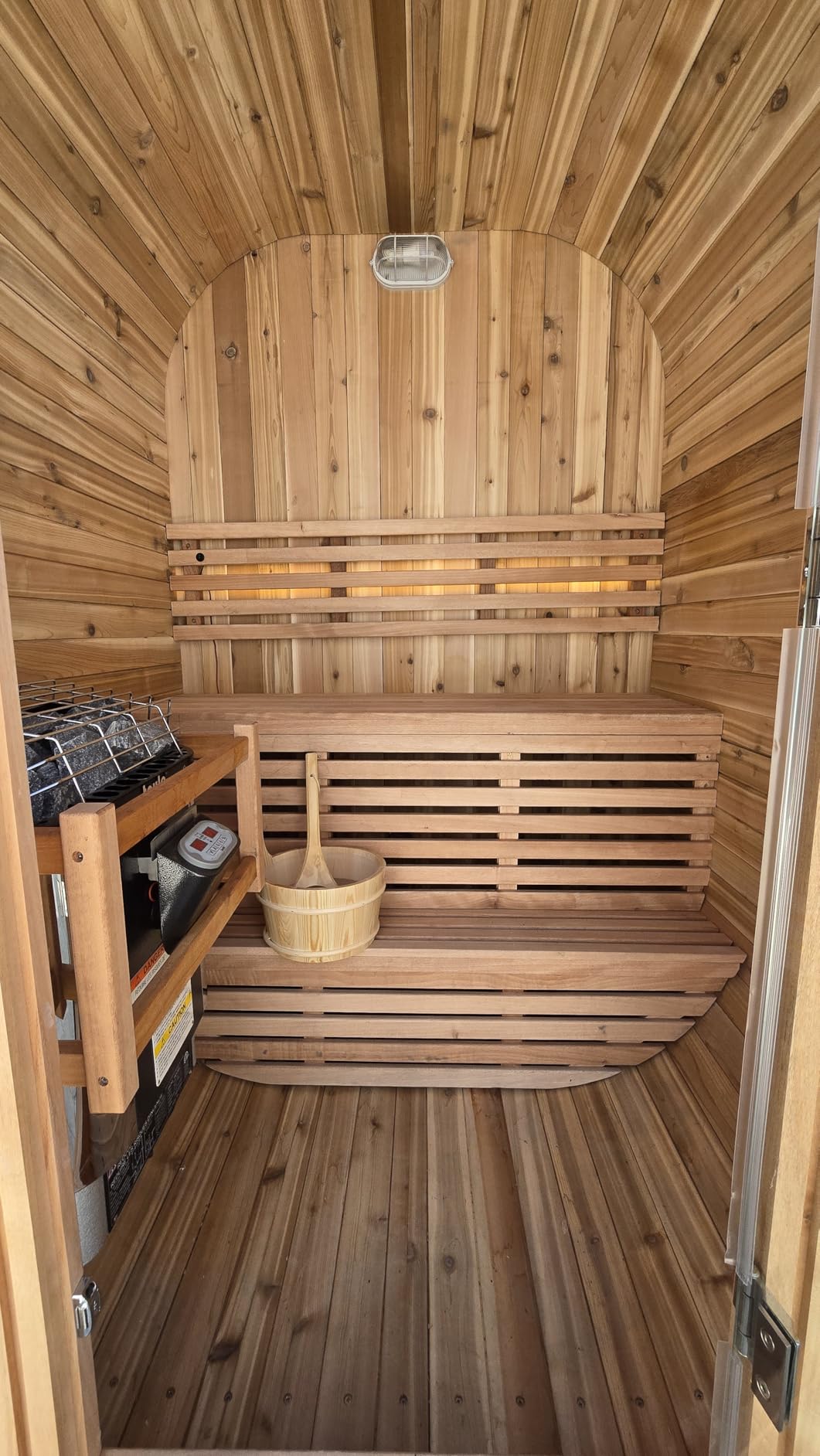
This is the sauna we recommend to anyone who wants a genuine hot room in a hard winter. The HY9 is a round barrel built from natural carbonized Finnish spruce at roughly 59 by 71 by 71 inches, and the carbonized treatment is the detail that matters most here. It is described by the manufacturer as rot, weather and insect resistant, which is exactly the combination you want when moisture freezes inside wall cavities every March.
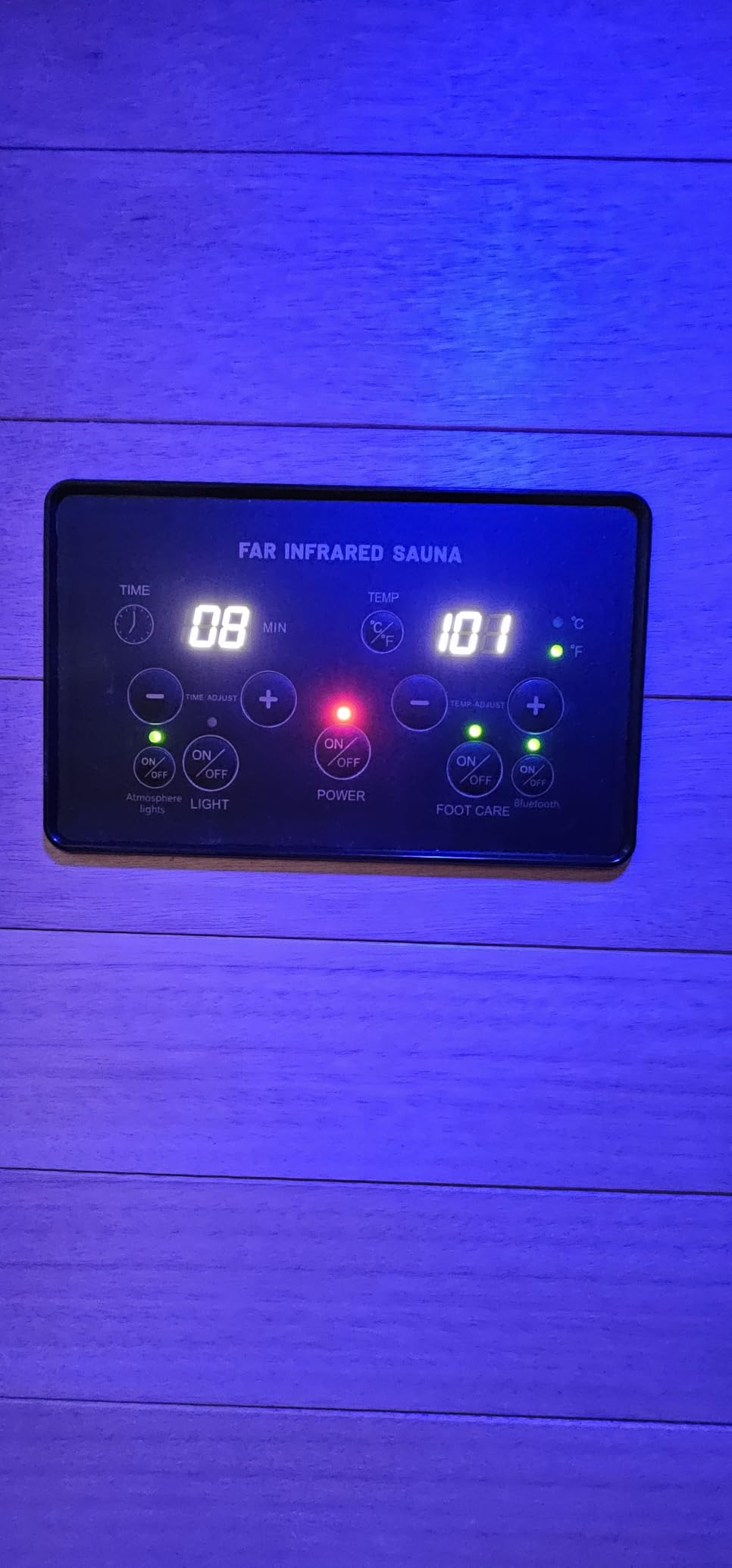
The 4.5KW heating furnace reaches working temperature in 25 to 35 minutes according to the published spec, and reviewers consistently report that this holds up when the cabin has been sitting cold. The included kit is unusually complete for this category: an LED explosion-proof lamp, a wooden cover, stove frame, bucket, spoon, thermometer, hygrometer, hourglass, volcanic stones and teacup holders all arrive with the unit. The timer, power adjustment and the temperature, system and hardware protection cycles are all on the control panel.
Where we would push a buyer: at 800 pounds, this is not a weekend project. The single most common theme across the 581 reviews is that the weight and the footprint are the real costs, not the money. You need a base that will not move under it and at least three people for the lift, which is why we would not recommend this as a first outdoor sauna for someone renting or working alone.
Owner feedback is also unusually positive on the service side, with a 7-year after-sales commitment and 81 percent of reviews landing at five stars. Our read is that the barrel shape helps here too: a cylinder has no corner seams for heat to escape through, so the 4.5KW stove is working against less surface area than a square cabin of the same volume would demand.
How it holds up when the temperature drops below freezing
The carbonized spruce is the reason this barrel earns the winter slot. Carbonizing heat-treats the wood, which reduces its tendency to absorb moisture and improves dimensional stability across freeze-thaw cycles, so the same wall that would swell and check in a untreated softwood cabin stays tight. The cylindrical shell also sheds snow and rain off itself, which means there is no flat plane for a drift to sit on and push the frame sideways.
The 4.5KW output sits in a sensible range for the interior volume. A rule of thumb that works well in cold regions is roughly 1kW per 1.0 to 1.3 cubic meters of cabin space, and this barrel falls near the middle of that band. Warm-up will stretch beyond the published 25 to 35 minutes on a deep-cold morning, and owners report the difference is additive rather than dramatic.
Who should skip this barrel
Skip it if your yard cannot take a footprint of roughly 71 inches across with clear working room on three sides, or if you are installing alone. The 800-pound shipping weight means the delivery moment, not the assembly, is usually the hard part. It is also the wrong pick for anyone who wants to lie flat, since a barrel this diameter seats you rather than reclines you.
And skip it if you are on a 20A household circuit without budget for a dedicated 240V line. A 4.5KW stove does not belong on an extension cord or a shared outlet, and the electrical work is the one part of this purchase we would never advise skipping.
2. KUNSANA 2-Person Low EMF Infrared Sauna – Best Value
KUNSANA Outdoor Sauna 2 Person Low EMF Ceramic Infrared Saunas for Home
1750W far-infrared and ceramic
77-149F range
Wood rated to -5F
Warm in 10-20 minutes
Pros
- Usable in 10 to 20 minutes
- Wood rated from -5F to 120F
- Bluetooth speakers and interior plus exterior controls
- Simple two-person assembly
- Two-year limited warranty
Cons
- Temperature capped well below 180F
- Seated use only with no standing room
- Oversized freight delivery
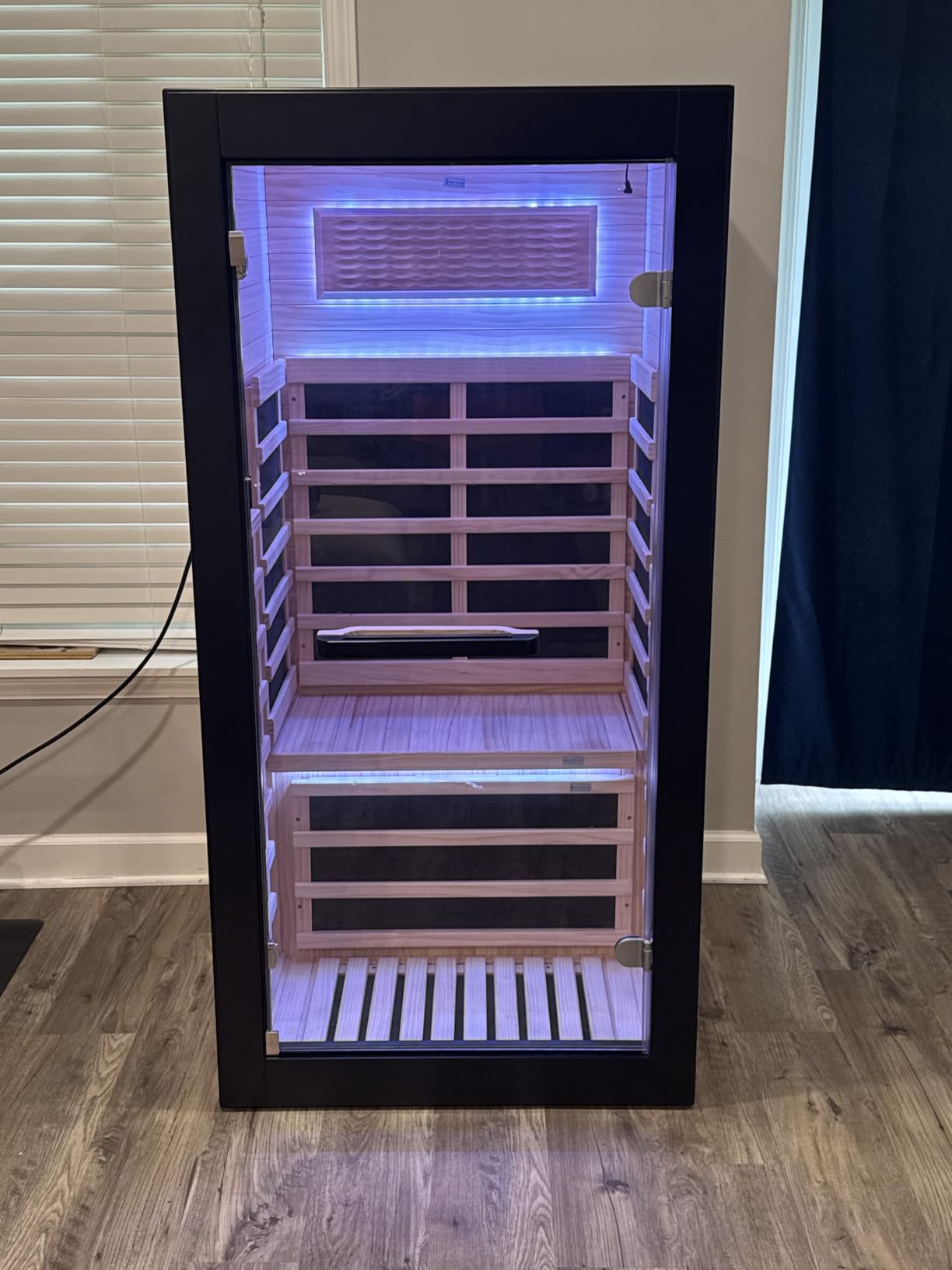
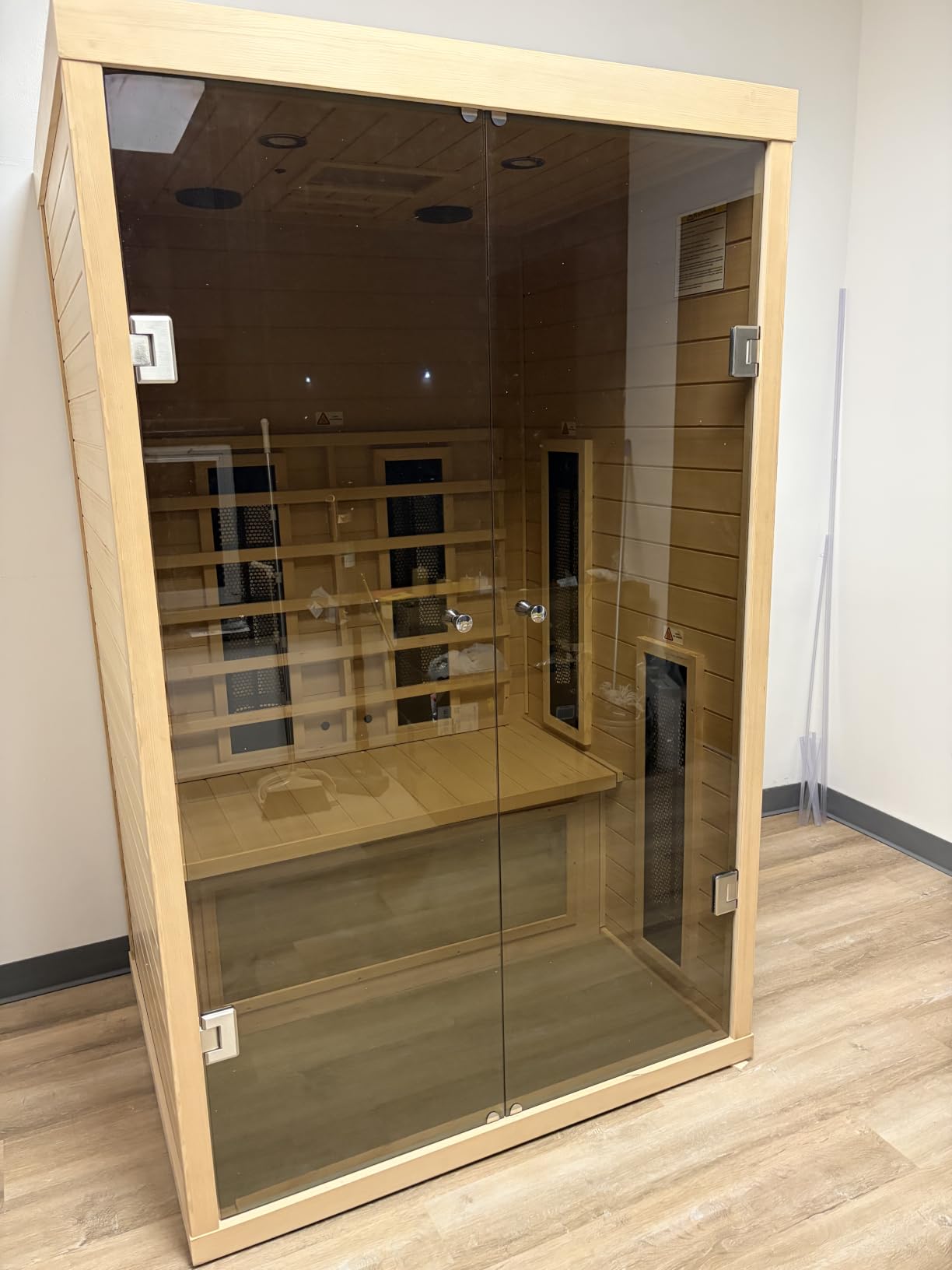
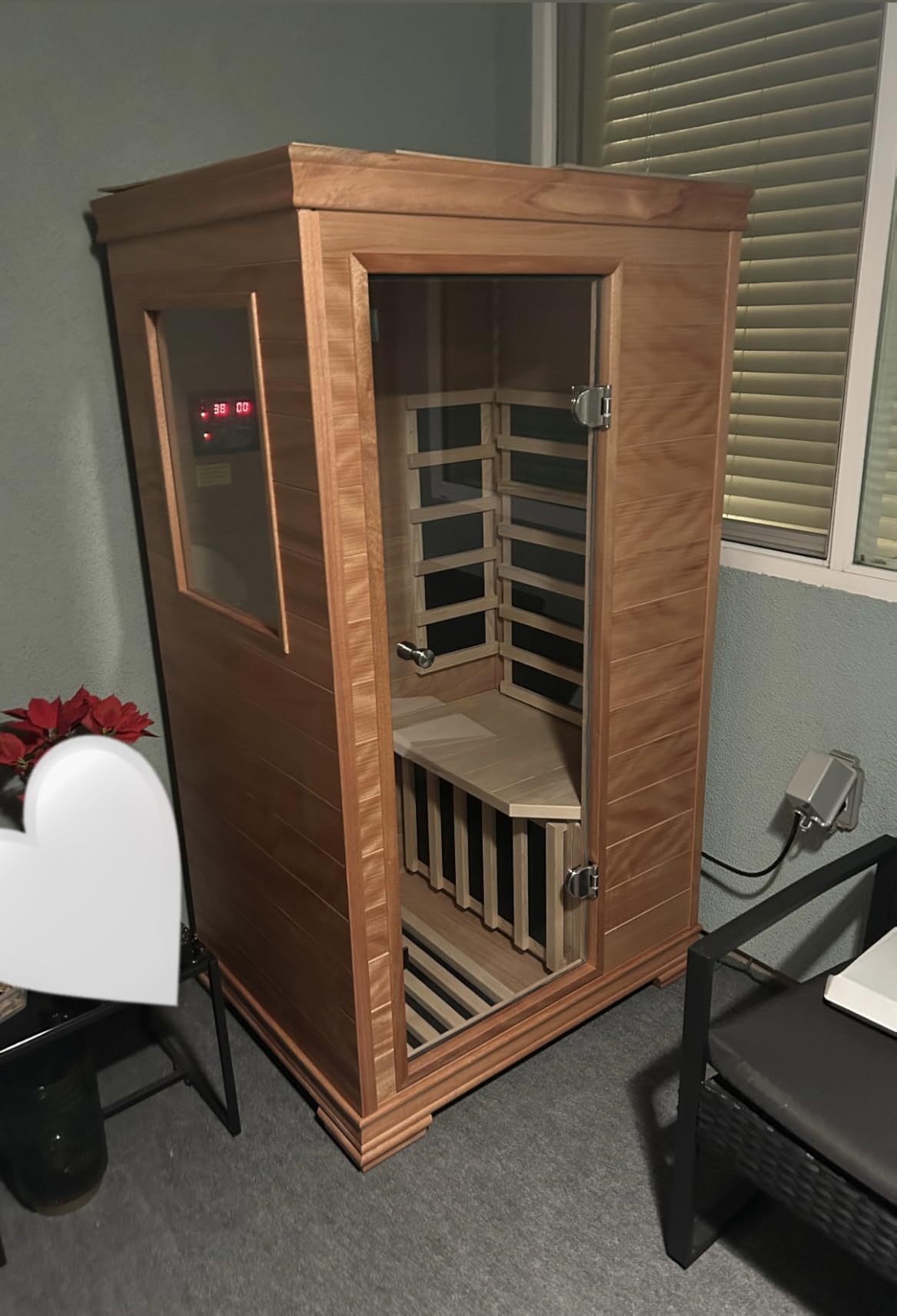
If your goal is a warm recovery session rather than a 190°F steam room, this is the most sensible money in the group. The KUN-902VTD uses 1,750W of carbon crystal far-infrared panels paired with ceramic heating cubes and reaches a usable temperature in 10 to 20 minutes, which is a genuine advantage when you are standing outside in a parka waiting for it.
The construction detail that matters for cold climates is the wood rating: African Khaya mahogany rated from -5F to 120F. That is the only manufacturer-published low-temperature rating in this entire lineup, and while -5F is milder than northern Minnesota, it covers a real share of winter sessions in the northern tier of the country. The 2026 model adds 23 percent more far-infrared intensity and a spread of near-infrared waves on top.
It is a small cabin, measuring 58 by 41 by 81 inches, and 135 owners rate it at 4.7 with 84 percent at five stars. Reviews highlight better sleep, lower resting heart rate and reduced chronic pain, plus the fact that assembly takes 30 to 60 minutes. The 660-pound seat load rating is generous for two adults, and the 6mm glass door with a ceiling vent handles moisture reasonably well.
The honest limitation is the temperature. The manufacturer caps the range at 149°F, which is 25 to 65C, and reviewers repeatedly point out the gap between that figure and the higher numbers implied by some infrared marketing. For contrast-therapy pairing after a cold plunge, that ceiling is completely fine. For löyly and a genuine hot room, it is not.
Where an infrared cabin actually works in winter
Infrared wins on speed and running cost, not on temperature. A 1,750W panel array brings this cabin to a comfortable working range in a fraction of the time a 4.5KW stove needs on a barrel, and it does that without a 240V circuit. That makes it the better choice for a weekday evening session, a post-workout reset, or a home where a 20A circuit is all you have.
It also loses nothing on recovery. Owners report improvements in sleep quality and chronic pain relief that come from the sustained mild heat rather than from extreme temperature. For a person who wants the habit rather than the trophy, that trade is usually worth making, and the -5F wood rating means the cabinet is not the weak link in a below-freezing yard.
Who should skip this cabin
Skip it if you want to lie flat, stand up, or host more than one other person. At 58 by 41 inches the interior is seated-only, and owners describe it as snug for two adults and better suited to a single user or a couple. It is also a poor fit under a low covered patio, since it needs outdoor-rated clearance around the panels.
And skip it if you are buying for a real steam tradition. You cannot throw water on these panels to make löyly, so if your idea of a sauna includes a bucket of water and a shovel, this is the wrong box.
3. SALUSHEAT Full Spectrum Sauna – Top Rated With Red Light Therapy
SALUSHEAT Full Spectrum Sauna, Outdoor Sauna w/Red Light Therapy, 1950W 20A
Full spectrum near mid far infrared
660nm and 850nm red light
1950W on 20A 120V
Reaches 149F
Pros
- 90 percent of reviews are five star
- Reclining seats allow lying sessions
- Red light therapy adds a second wellness mode
- Runs on a standard 20A circuit
- Solid old fir resists cracking
Cons
- 83.5 inch height will not fit under a low overhang
- Cold-weather warm-up stretches to 40-60 minutes
- Arrives in three heavy packages
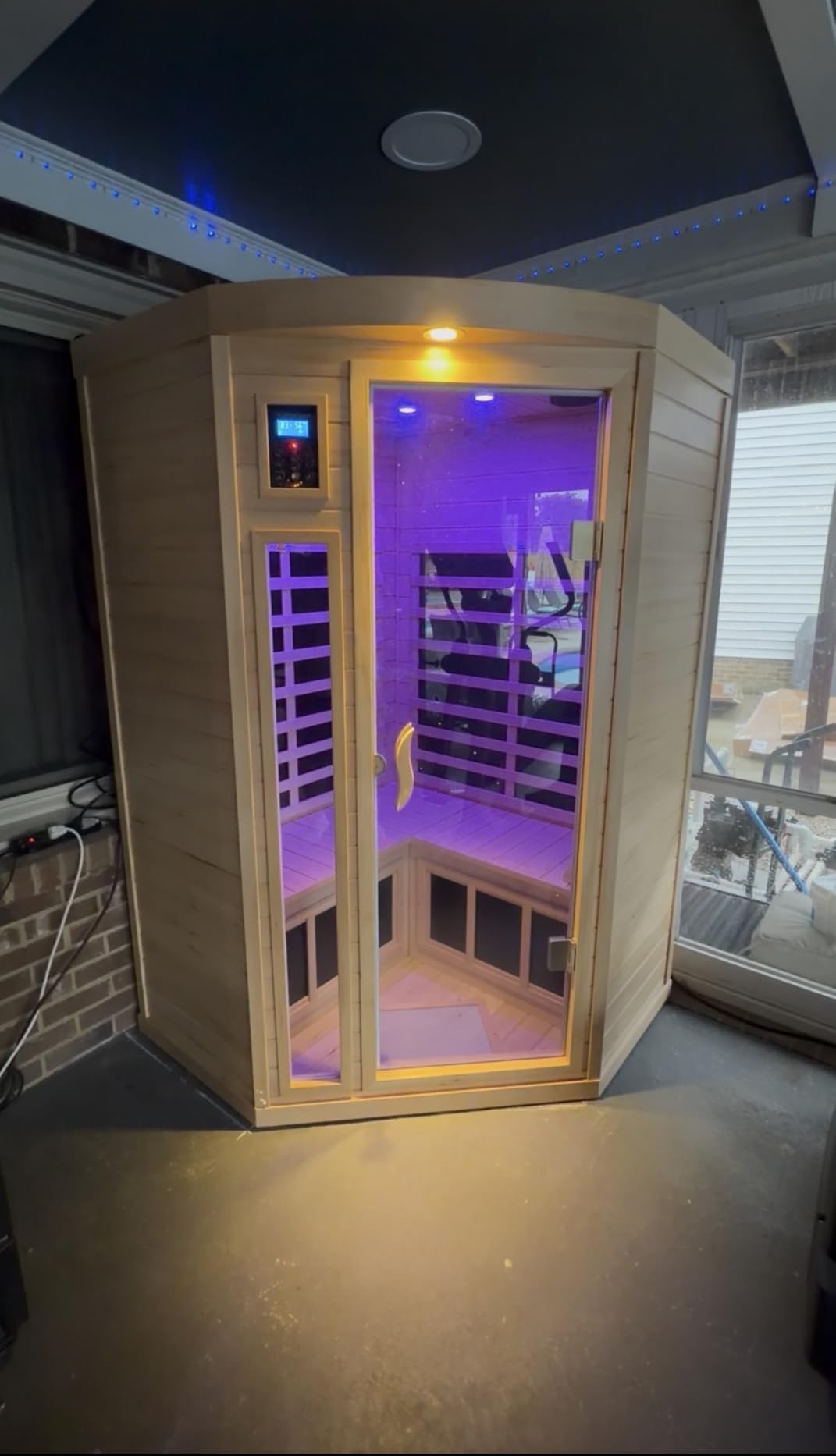
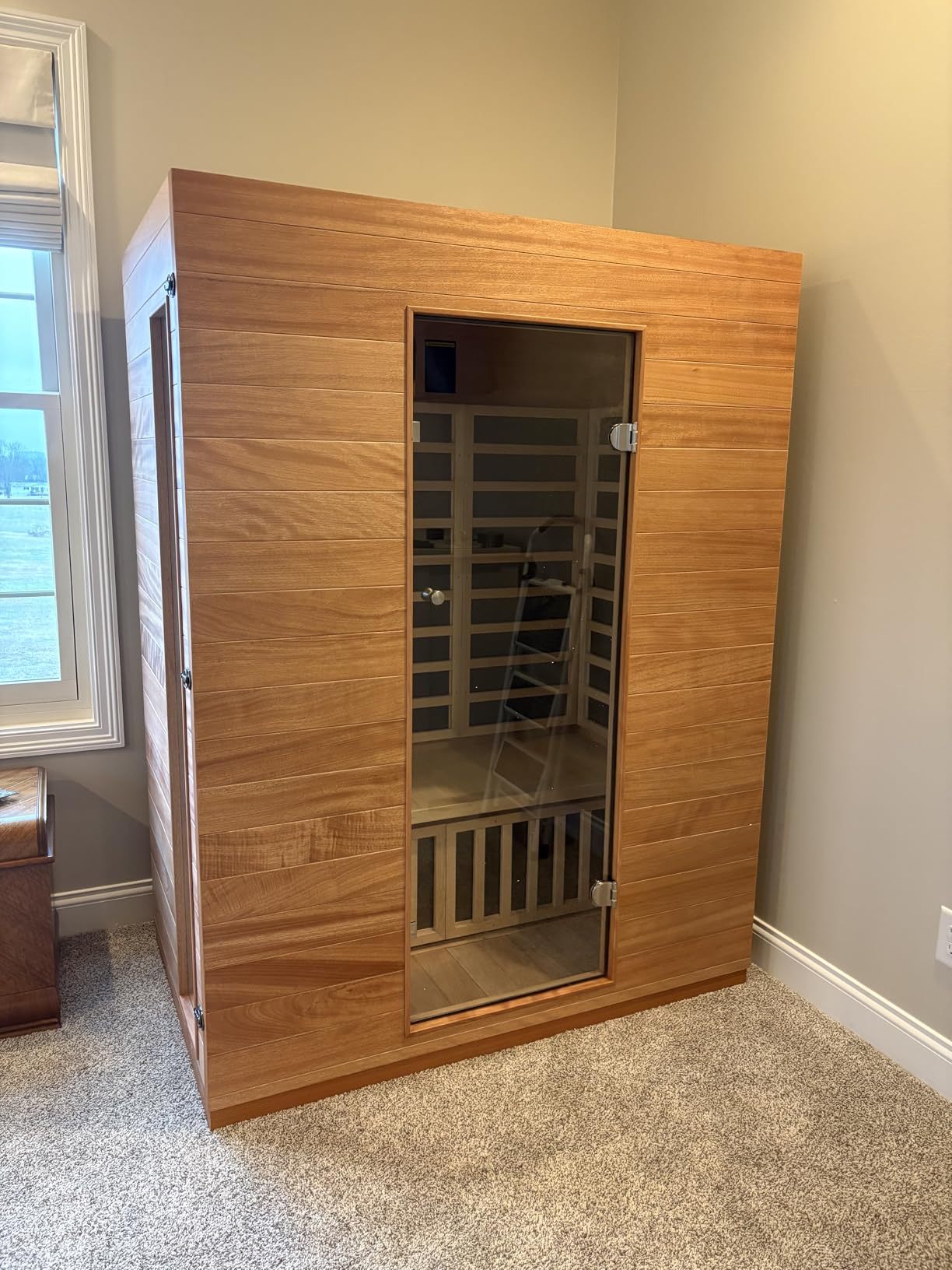
This is the most technically interesting cabin in the group, rated 4.8 across 133 reviews with 90 percent at five stars. The KM-903VS runs seven far-infrared panels but adds near and mid-infrared wavelengths, so it sits in the full-spectrum category rather than the single-wavelength far-infrared category. It also carries dual-wavelength red light therapy LEDs at 660nm and 850nm, which is a genuinely different mechanism from heat alone.
For winter, the published cold-weather figure matters more than the headline rating. The manufacturer states it reaches 131 to 140°F in 40 to 60 minutes when ambient temperature is below 32°F, and up to 149°F at maximum. That is an unusually honest specification because it is stated as a sub-freezing result rather than a laboratory figure, and it tells you exactly what to expect on a January evening.
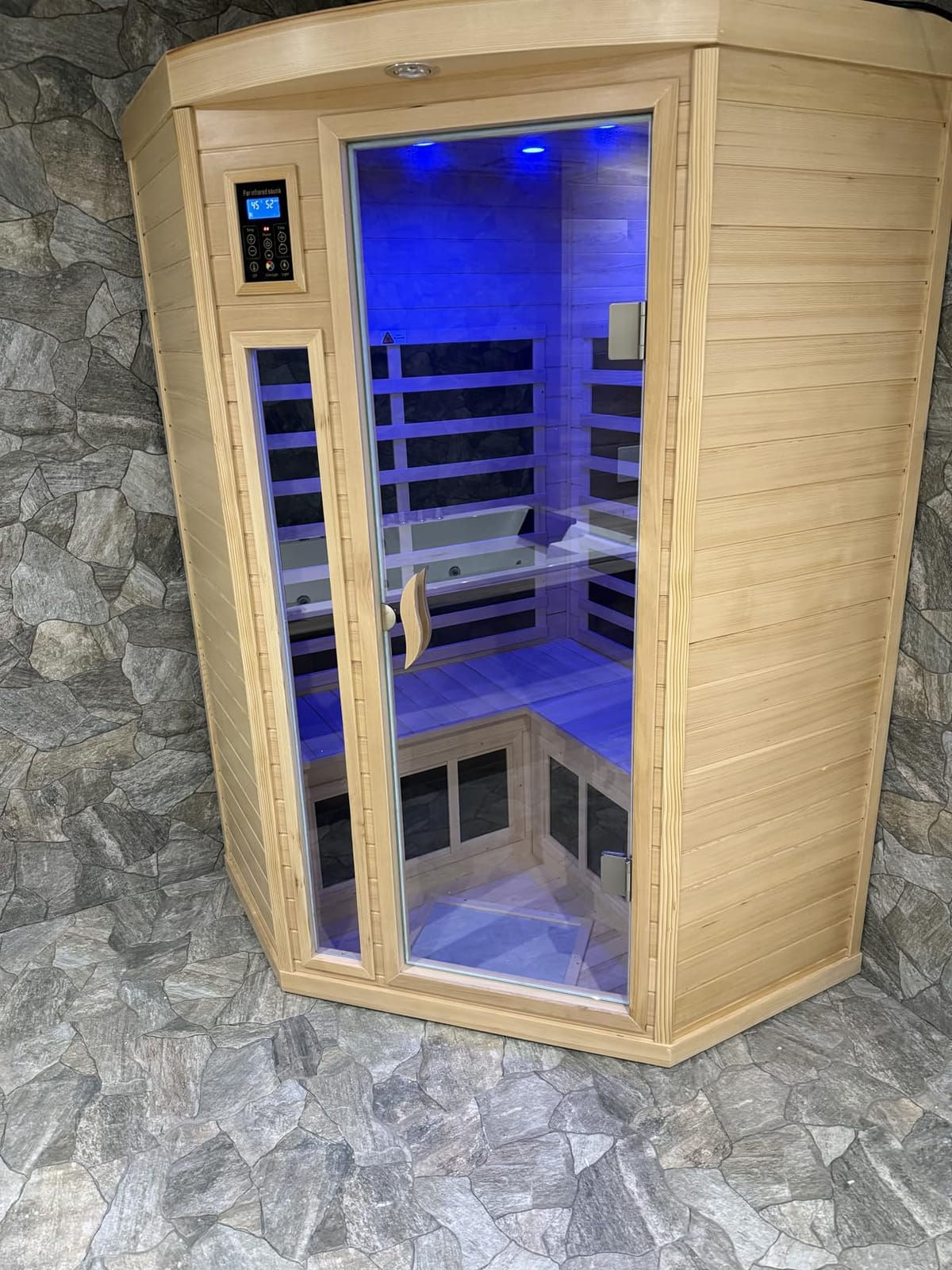
The reclining seats are the sleeper feature here. You can sit upright or lie flat, and at 81.1 by 45.2 by 83.5 inches the footprint is tall rather than wide, which is a problem in some yards and an advantage in others. Solid old fir is the material, and reviewers single out the fact that it is hard and aromatic and resists cracking, plus the fact that it runs on a standard 20A 120V circuit with a NEMA 5-20R socket.
The 2-year comprehensive warranty is on the short side for a permanent outdoor structure, and the cabin arrives in three separate heavy packages, which is a real scheduling consideration if you are installing alone. Bluetooth speakers and reading lights are included, and the 6mm tempered glass door is rated for outdoor or indoor use.
Whether a full spectrum cabin earns its premium in cold weather
It does, for a specific reason. Full spectrum coverage means you are not relying on a single long wavelength to carry the whole session, and the reclined position plus red light therapy combination makes long sessions genuinely restful rather than merely warm. The 40 to 60 minute cold-weather warm-up is roughly double a far-infrared cabin’s best case, so plan your preheat accordingly.
On running cost, a 1,950W load on a 20A circuit is modest. Even at a rough three kWh for a long session including the preheat, the electricity cost of a weekly winter session stays small next to the construction of a wood-fired setup. The tradeoff is capacity: three people is the realistic ceiling here.
Who should skip this cabin
Skip it if your site has a low overhang, a deck roof, or a fence height that conflicts with an 83.5-inch cabin. That measurement is the single most reported practical limit across its reviews, and it is not something you can work around after delivery.
Also skip it if you want 180°F or löyly, and skip it if you need to seat more than three. This is a wellness cabin at a very high standard, not a steam room, and treating it as either of those will disappoint you.
4. Albott 4-Person Shingle Roof Sauna – Best Chromotherapy Lighting
Albott 4 Person Outdoor Sauna, Asphalt Shingle Roof, Low EMF 2850W/240V/20A
Asphalt shingle roof with underlayment
12 infrared panels plus foot heat
2850W on 240V 20A
Reaches 149F
Pros
- Shingle roof is a real upgrade over canvas or tarp
- 12 panels plus tourmaline foot heating
- 7-color chromotherapy lighting
- Roof vent and oxygen bar for airflow
- Dual Bluetooth speakers and windows
Cons
- 4.4 average with 6 percent one-star reviews
- Needs a dedicated 240V 20A outlet
- Longer preheat in cold weather
- 98.4 inch height limits placement
The Albott SNF002 pairs infrared heat with the most traditional roof construction in this lineup, and for a snow climate that pairing is the feature that matters. It uses premium asphalt shingles with a ridge cover, a top cover and an integrated waterproof layer, which sheds snow instead of holding it. Most of the infrared cabins in this price band ship a fabric tarp rather than a shingled roof, and a tarp is the part we would expect to fail first.
Heat comes from 12 low EMF carbon infrared panels plus tourmaline stone foot heating, drawing 2,850W on a 240V 20A circuit with a dedicated outlet required. Maximum output is 149°F or 65C, and the manufacturer is candid that preheat takes longer in winter. Finnish spruce carries the structure, with safety-tempered glass and a door seal strip at the entry.
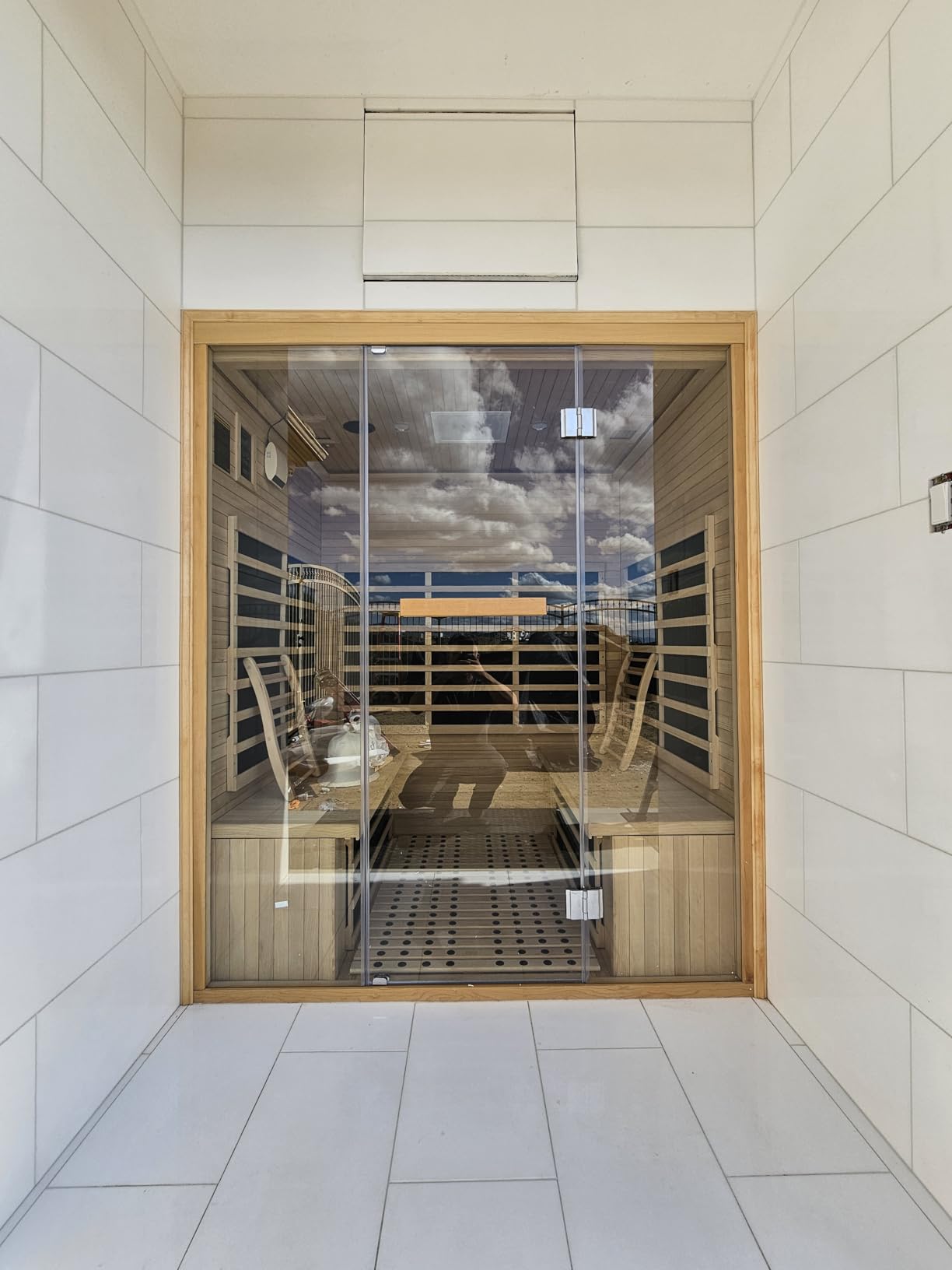
That profile is the most polarized here, at 4.4 with 74 percent five-star but a full 6 percent one-star. That pattern almost always points at installation and electrical setup rather than at the product itself. Owners love the roofing and the lighting, while winter heat-up time and the need for 240V wiring generate the complaints.
Comfort features are unusually complete: 7-color chromotherapy LEDs with surrounding light strips, dual built-in Bluetooth speakers, an LED reading light, an LCD control panel, a placement rack and two windows. A roof vent and oxygen bar handle airflow and condensation, which is one of the more important cold-climate details because trapped moisture in a sealed cabin is what causes rot.
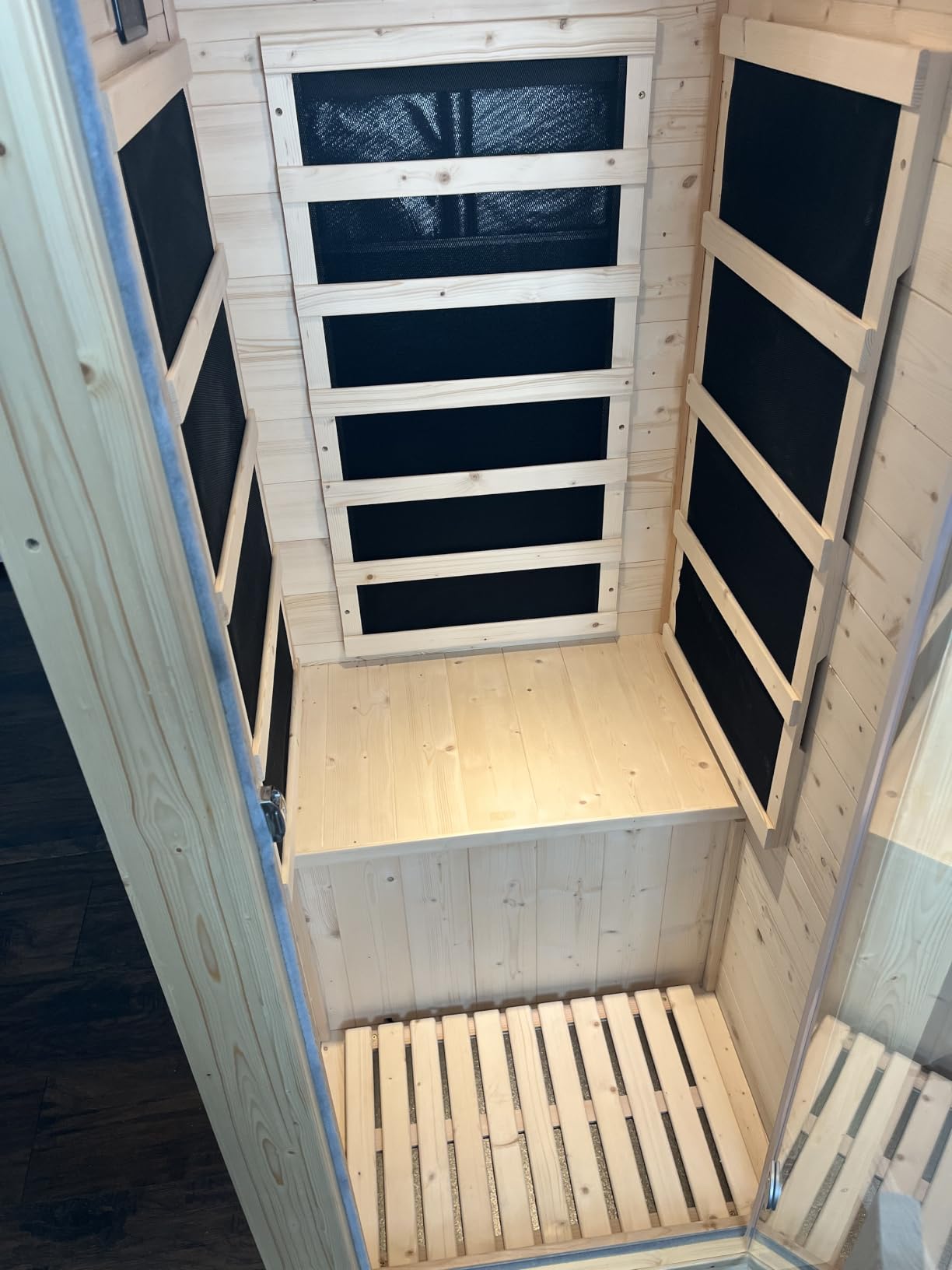
Why the roof is the deciding spec for heavy snow
A pitched shingle roof with a ridge cover handles snow in a way that a flat tarp roof cannot. Snow slides, the load stays off the ceiling insulation, and the roof structure is not being asked to hold a hundred pounds of wet snow above your head. The integrated waterproof layer also stops meltwater from tracking back under the shingles and into the wall framing during a January thaw.
Combine that with the roof vent and oxygen bar and you get a cabin that can dry out after a session even in freezing air, which is the failure mode behind most outdoor sauna decay. Our only reservation on this model is heat output, because 2,850W of infrared on a four-person interior is on the modest side once the ambient temperature is well below freezing.
Who should skip this sauna
Skip it if you do not have a 240V 20A circuit available and the budget for an electrician to run one. The 6 percent one-star share in its reviews centers on that conversation rather than the sauna itself, and the surprise cost of a long electrical run is a recurring regret in owner reviews.
Skip it if your site is under a roof or between fences, because the 98.4-inch profile is tall for an outdoor unit, and skip it if you need a real steam room. The 4.4 rating is still perfectly adequate, but it is the lowest average in this set and worth factoring into your confidence.
5. HOSAUNA 9KW 4-6 Person Barrel Sauna – Best for Larger Groups
HOSAUNA Outdoor Traditional Sauna 4-6 Person 9KW Steam Saunas Barrel
9KW UL-certified sauna stove
Thermally treated Finnish spruce
Seats 4-6
Volcanic stones included
Pros
- 9KW stove reaches therapeutic temperature faster than smaller heaters
- Thermally treated spruce built for permanent outdoor exposure
- Real steam capability with included volcanic stones
- Panoramic glass door and window
- Efficient cylindrical heat circulation
Cons
- 80 inch footprint needs substantial yard space
- Installation is a multi-person job
- 7 percent one-star share is the highest among barrels
Heater output is the whole argument for this sauna. The 9KW UL-certified stove is roughly double the power of the entry barrels, and in a sub-zero climate that margin is the difference between a 30-minute warm-up and an hour of waiting in a cold room. When you are heating a space that seats six, undersized heaters come up repeatedly in owner reviews of the category.
The HY11 uses thermally treated carbonized Finnish spruce described as rot, insect and weather resistant, in a cylindrical barrel at 80 by 80 by 80 inches with a 76 by 70 by 66 inch interior. The curved shape is functional rather than decorative: a cylinder circulates heated air with fewer dead zones, so the top bench and the floor see comparable temperature.
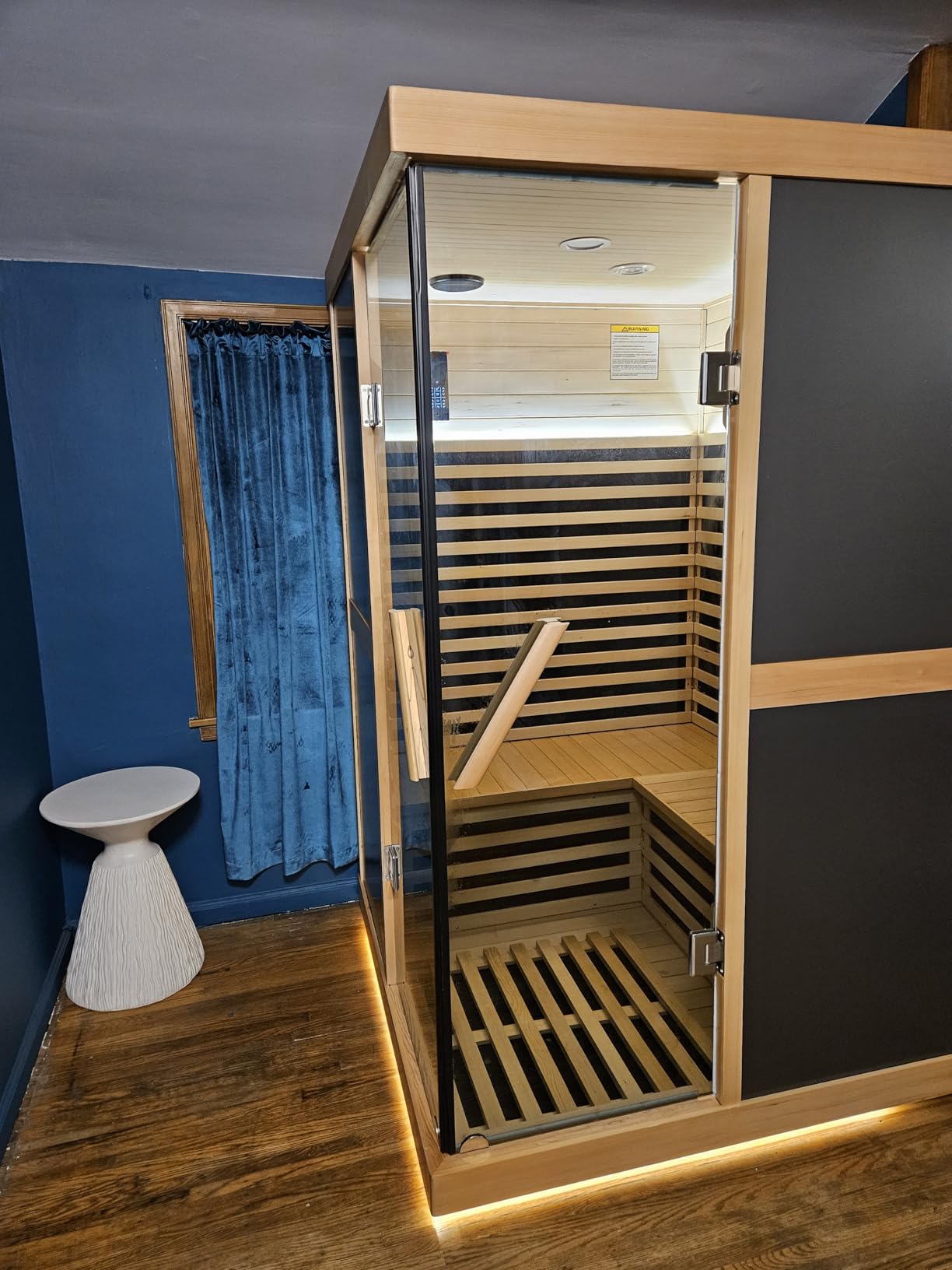
It is a genuine steam sauna, not a warm room, because high-density volcanic stones are included and the stove is built for löyly. A curved panoramic tempered glass door and window cut down on the claustrophobia that barrels are sometimes criticized for, and Bluetooth waterproof speakers plus multi-zone LED chromotherapy lighting handle the ambience. An LED control panel handles temperature and session time.
The 4.5 rating across 54 reviews comes with 73 percent five-star but a 7 percent one-star tail, the highest negative share among the barrels we reviewed. Owners attribute most of the friction to underestimating assembly complexity and winter heat-up time, both of which are reasonable complaints for a 9KW system in a large shell.
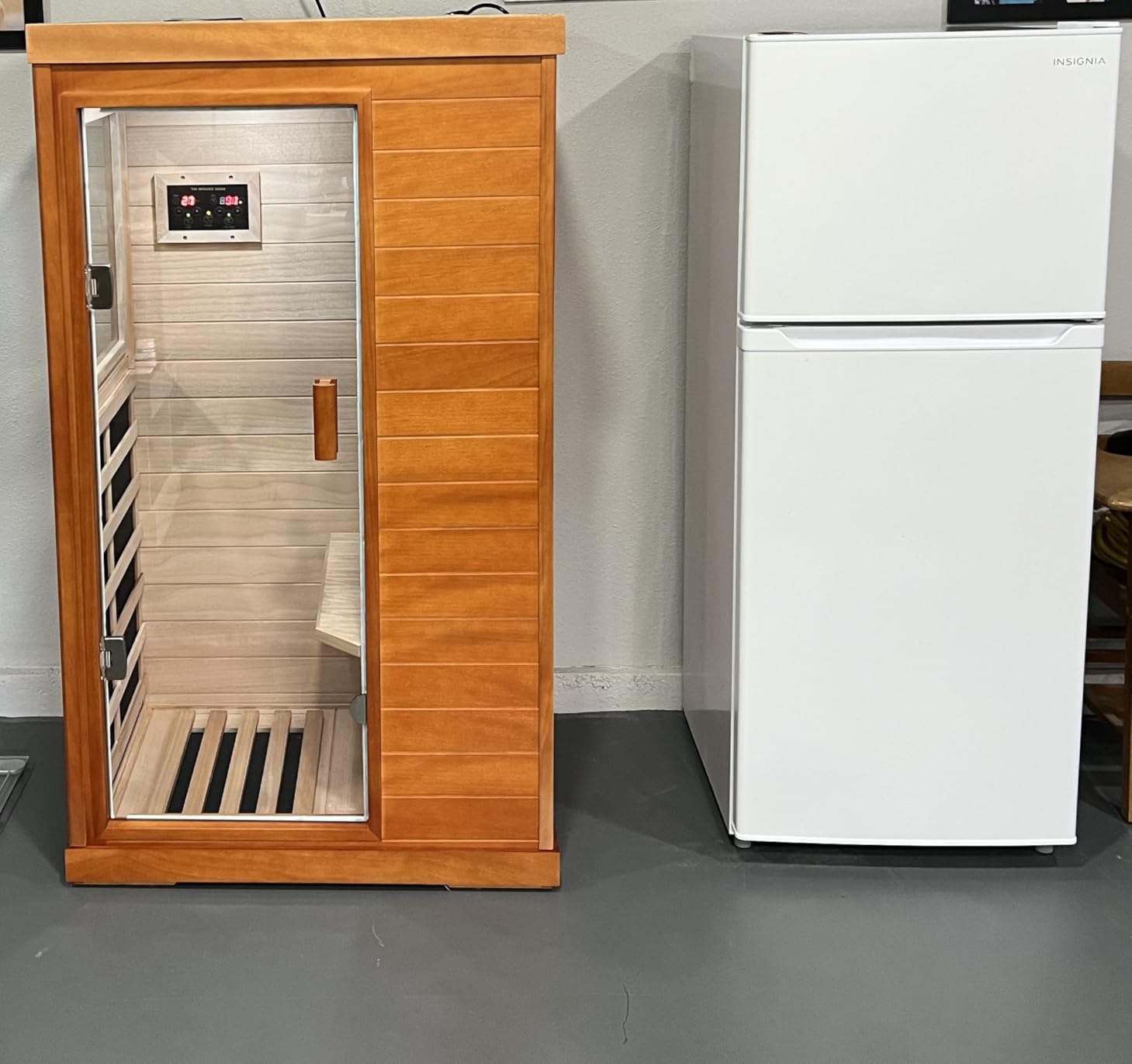
How to check whether 9KW is right for your cabin
Start with volume rather than seats. A common sizing rule is about 1kW per 1.0 to 1.3 cubic meters of interior space, and in cold regions builders typically aim at the upper end so that a start at minus 10°F does not turn into an hour. The interior dimensions on this barrel put it firmly in the range where 6kW would be adequate and 9kW is comfortable.
The payoff is a session that behaves. A stronger stove also recovers temperature faster after you open the door or throw water on the stones, and it holds löyly properly because the stone bed stays far above the water flash point. A dedicated high-amperage circuit and a properly sized breaker are not optional at this output.
Who should skip this barrel
Skip it if your yard is small, because 80 inches in every direction is a genuine footprint and it needs clearance on at least one side. Skip it if you are a two-person household, because you will be paying for capacity you never use and paying in electricity for it every session.
Also skip it if assembly is a solo project. This is a heavy build, and the reviews that go negative are largely about the install rather than the finished sauna.
6. Breezestival 4-6 Person Dry and Steam Barrel – Best for Flexible Sessions
Breezestival Outdoor Sauna, 4-6 Person Tradition Wood Dry&Steam Sauna with Sauna Stone, 220V/6KW Electric Heater
6KW heater on 220V AC
Dry or steam modes
Roof tarp included
8mm tempered glass
Pros
- Works as a dry sauna or a traditional steam sauna
- Roomy 4-6 person barrel with panoramic glass
- Complete accessory kit with heater stones tarp and step
- Simple press-button controller and timer
- 90 percent of reviews at five stars
Cons
- Only 17 reviews so the rating is provisional
- No external power cord included
- Professional electrical installation recommended
- One-year warranty is the shortest here
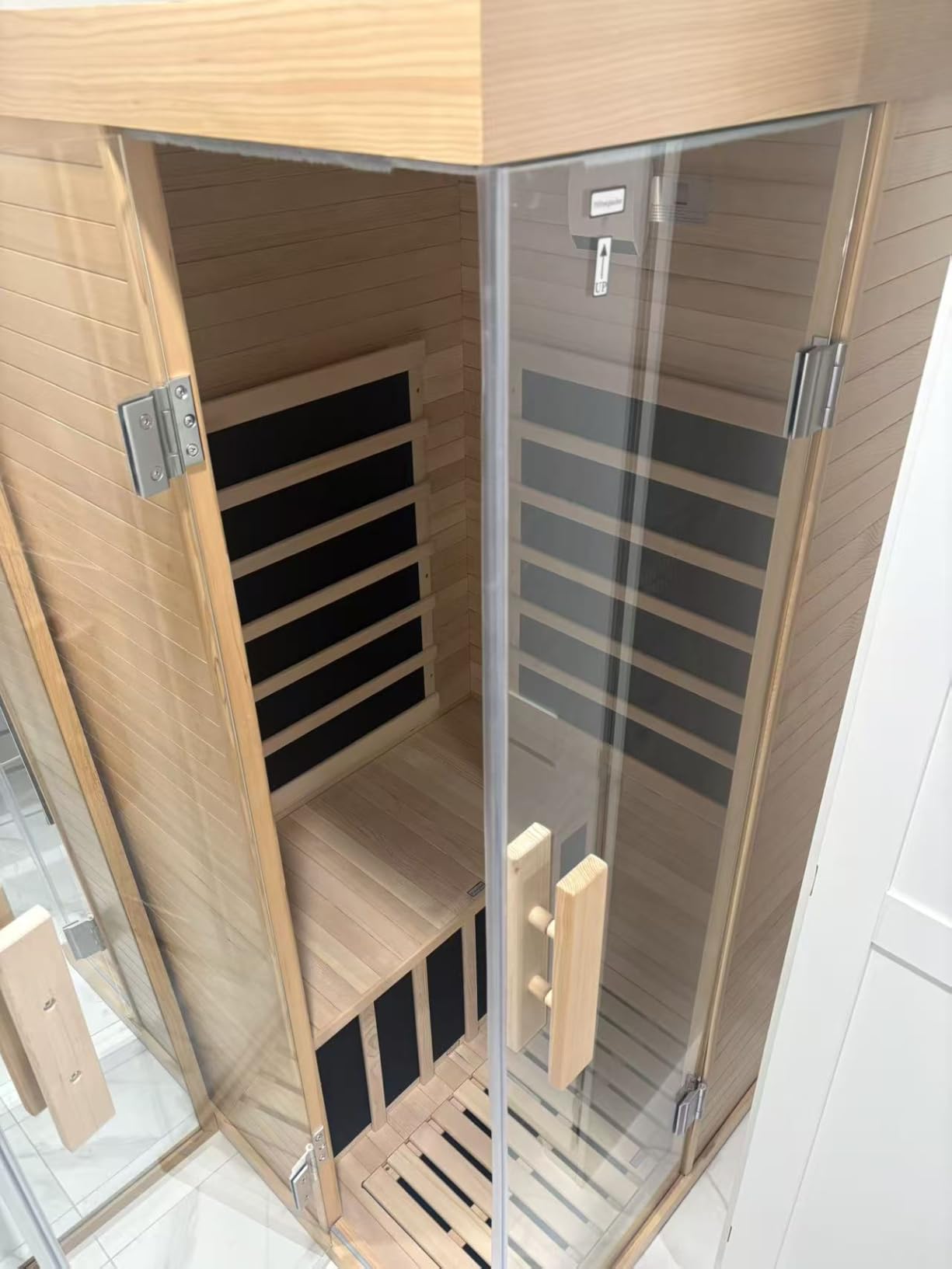
This barrel switches between a dry sauna and a traditional steam sauna, with included rocks to make löyly. The 6KW heater runs on 220V AC, the barrel measures 85 by 72.8 by 91.7 inches, and the solid wood walls carry an 8mm tempered glass door plus side windows for light and outward views.
Roof protection is a waterproof and heat-insulating tarp rather than shingles, which is the main compromise here. A tarp handles rain and moderate snow, and it is not what you want under two feet of wet snow that sits for days. The accessory kit is generous, covering installation tools, heater, rubber straps, tarp, a wooden step, sauna rocks, controller and thermometer.
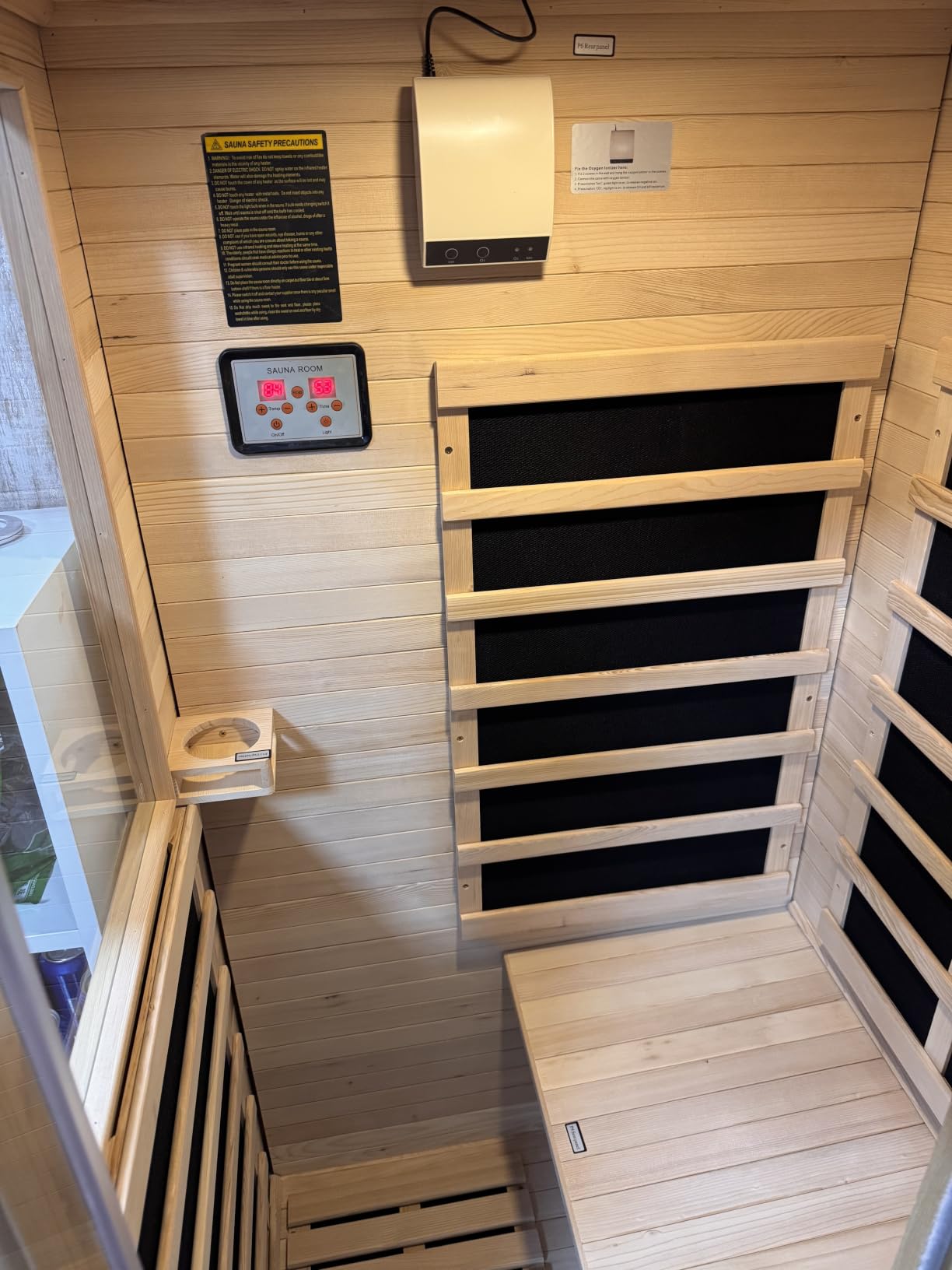
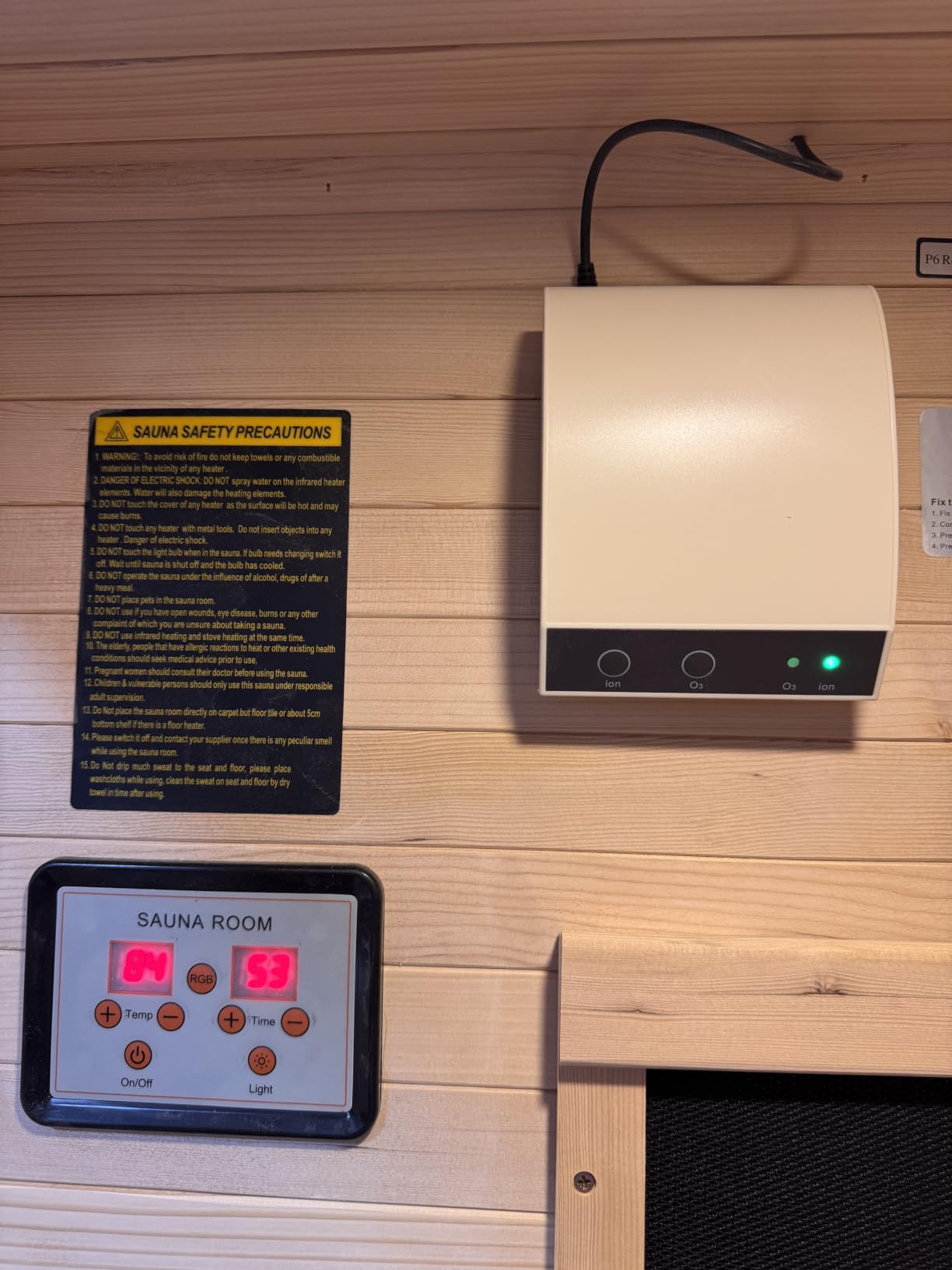
An intelligent controller handles temperature adjustment and the timer, and the press-button interface is about as simple as it gets. For cold climates, the single most important line in the spec sheet is that no external power cord is included and professional installation is recommended, so budget the electrical work into your total before you commit.
The 4.8 average here rests on 17 reviews, so treat it as provisional rather than proven. Buyers who own it rate the dry and steam versatility and the roomy layout highly, with 90 percent of those reviews at five stars.
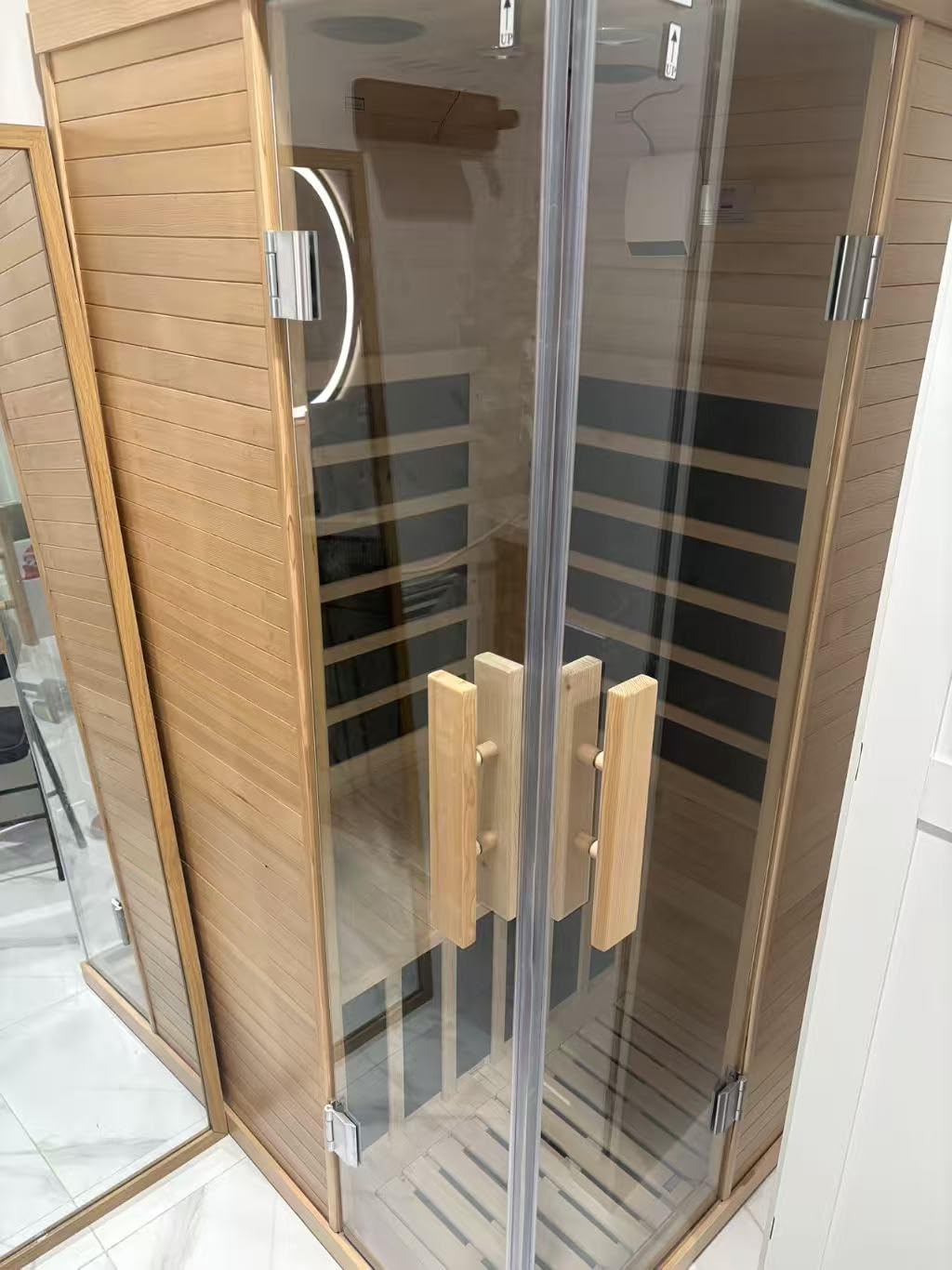
Whether a tarp roof holds up in a real snow season
It holds up if you clear it. A waterproof insulated tarp sheds rain completely and handles light to moderate snow, and the barrel’s curved profile means snow slides off rather than loading the top. What it will not do is carry the weight of a long-unattended drift, so this model suits households that clear the roof after a storm.
The 6KW output is well matched to a 4-6 person interior, and the 220V supply is a common household voltage in much of the world, though you still need a proper dedicated circuit. If your climate is mild-winter coastal rather than Upper Midwest, this is a very reasonable build.
Who should skip this barrel
Skip it if you receive heavy snow that you do not plan to clear, and skip it if a one-year warranty is not acceptable to you. That is the shortest coverage in this lineup, and on an outdoor structure in a freeze-thaw region warranty length is a reasonable proxy for how long the manufacturer expects the shell to last.
Skip it if you are not going to hire an electrician. The missing power cord is not a small detail, and an unlisted heater cable in a wet sauna shell is a genuine safety problem rather than a paperwork issue.
7. Breezestival 4-6 Person Glass Barrel – Best for Light and Views
Breezestival 4-6 Person Outdoor Barrel Sauna with 6KW Electric Heater
6KW heater on 220V AC
Full-view tempered glass
Dry and steam modes
Accessory kit included
Pros
- Spacious barrel that genuinely fits up to 6 adults
- Full-view tempered glass door and side windows
- 6KW heater supports dry and steam modes
- Complete accessory kit at purchase
- Control panel for temperature and timing
Cons
- Only 10 reviews so the rating is thin
- Weakest rating distribution with a 15 percent three-star share
- Listed weight of 99 pounds looks inconsistent
- No power cord and professional electrical work advised
The difference between this barrel and the previous one is glazing. Where that model uses a panoramic door with side windows, this one fits a full-view tempered glass door and side windows across a solid wood shell measuring 85.5 by 74 by 91.7 inches, which makes the interior feel less enclosed on a grey February afternoon.
The heater is the same 6KW unit on 220V AC, and it supports both dry and steam modes with included sauna stones. Roof protection is again a waterproof insulated tarp, and the control panel covers temperature adjustment and timers. The accessory kit includes the heater, stones, rubber tension straps, tarp, wooden steps, thermometer, controller and installation tools.
Owners who have it like the roominess, the glazing and the fact that a full accessory kit is included at purchase rather than added later. The 6KW heater is a genuine sauna heater rather than a panel array, which is why this barrel works in a roundup that leans heavily on infrared.
We are deliberately cautious with the numbers here. The rating distribution is the weakest of the barrel group in this roundup, with 69 percent five-star and a 15 percent three-star share across just 10 reviews, and the listed weight of 99 pounds does not seem consistent with a solid wood 4-6 person barrel. Treat the specification sheet as reliable and the rating as thin evidence.
What glazing does and does not solve in a cold climate
Large glass areas improve the experience more than the temperature, and it is worth being clear about that. Glass is a poor insulator compared with a thick spruce wall, so a cabin with a full-view door will lose heat faster than one with a small door and a wood wall. In a mild-winter climate that is irrelevant. In a deep-cold climate, it is a real cost you should price into your expectations of warm-up time.
What you gain is a session you will actually want to take in winter. Daylight and an outside view make a barrel feel like a room rather than a booth, and for a household using the sauna through the dark months that difference in habit-forming power is not trivial. The 6KW output is well proportioned to the interior volume, so the glass penalty is real but not severe.
Who should skip this barrel
Skip it if you live somewhere with sustained heavy snow that goes uncleared, and skip it if a 10-review rating is going to make you nervous. There is nothing wrong with the build, but we would not have you anchor a major purchase on that sample size.
Skip it if you want to lie flat or if you are installing alone, and skip it if you plan to do the electrical connection yourself. As with the other 6KW barrel, the power cord is not included and professional work is advised.
8. INFRADELUX 4-Person Vertical Barrel – Best for Small Yards
4 Person Outdoor Vertical Barrel Sauna, Cedar Wood Traditional Sauna
Premium cedar construction
6KW ETL-certified heater
63 inch footprint
Seats 4
Pros
- Premium cedar with natural moisture and decay resistance
- 6KW ETL heater gives consistent traditional heat
- Vertical barrel saves yard space while seating 4
- 5-color LED lighting
- Compact 63 inch footprint
Cons
- Sauna stones not included and bought separately
- Only 12 reviews so the 4.8 rests on a small sample
- Warranty void for commercial or rental use
- Heavy at 675 pounds
The vertical barrel is the shape answer to a small yard. Rather than lying a cylinder on its side, this model stands it up at 63 inches in diameter by 78 inches tall, which keeps the footprint compact while still seating four and giving you proper headroom to stand.
The material is the other headline: premium cedar, chosen for natural resistance to moisture and decay. Cedar is denser and more dimensionally stable than the spruce used by several of the barrels here, and it is a wood cold-climate builders reach for when they want a wall that tolerates repeated wetting and freezing.
Heat comes from a 6KW ETL-certified heater using a traditional heating method rather than infrared panels, which means it is a real sauna with temperature control, and it includes 5-color customizable LED lighting. At 675 pounds it is a serious two-person lift, and 88 percent of its 12 reviews sit at five stars with no ratings under three.
Two details to check before you order: sauna stones are not included and must be purchased separately, and the warranty applies to personal use only, with commercial or rental use excluded. If you were planning to rent this out or run it as a business asset, the warranty simply does not apply to you.
Why a vertical barrel suits a snowy yard
Two reasons. The first is snow shedding, because a tall cylinder presents almost no horizontal surface for a drift to sit on, which matters when climbing a ladder in a blizzard to clear a roof is the last thing you want to do. The second is footprint, because 63 inches across leaves room for a path, a changing area and a step in a yard that a horizontal barrel of the same capacity would not allow.
The 6KW traditional heater is also the right tool for the job here. Standing upright means the hot air column is short, so the heat stays near the bench level instead of stratifying at the crown of a long horizontal barrel, and owners report consistent temperatures. Cedar plus a 6KW stove plus a 4-person interior is a well-balanced winter combination.
Who should skip this sauna
Skip it if you want to lie down. A 63-inch diameter gives you a bench, not a reclining berth, and this is a seated sauna by design. Skip it if you planned a rental or commercial operation, because the warranty exclusion is explicit.
Also skip it if you are installing alone, at 675 pounds, and remember to budget for sauna stones. They are not in the box, and löyly is not possible without them.
9. AURGOD 2-Person Canadian Red Cedar Sauna – Best Thick Cedar for Couples
Outdoor Sauna 2 Person, Canadian Red Cedar, 220V 4.5KW ETL Toule Heater
1.96 inch Canadian Red Cedar boards
4.5KW ETL heater
195F in about 20 minutes
Bitumen roof
Pros
- 1.96 inch cedar boards that resist warping
- 4.5KW ETL heater reaches 195F in about 20 minutes
- Red cedar holds dimensions through humidity swings
- Bitumen roof insulates and sheds water
- Full accessory kit included with the sauna
Cons
- Only a single review so the rating says almost nothing
- 750 pounds is heavy for a two-person cabin
- Longer lead time than other models here
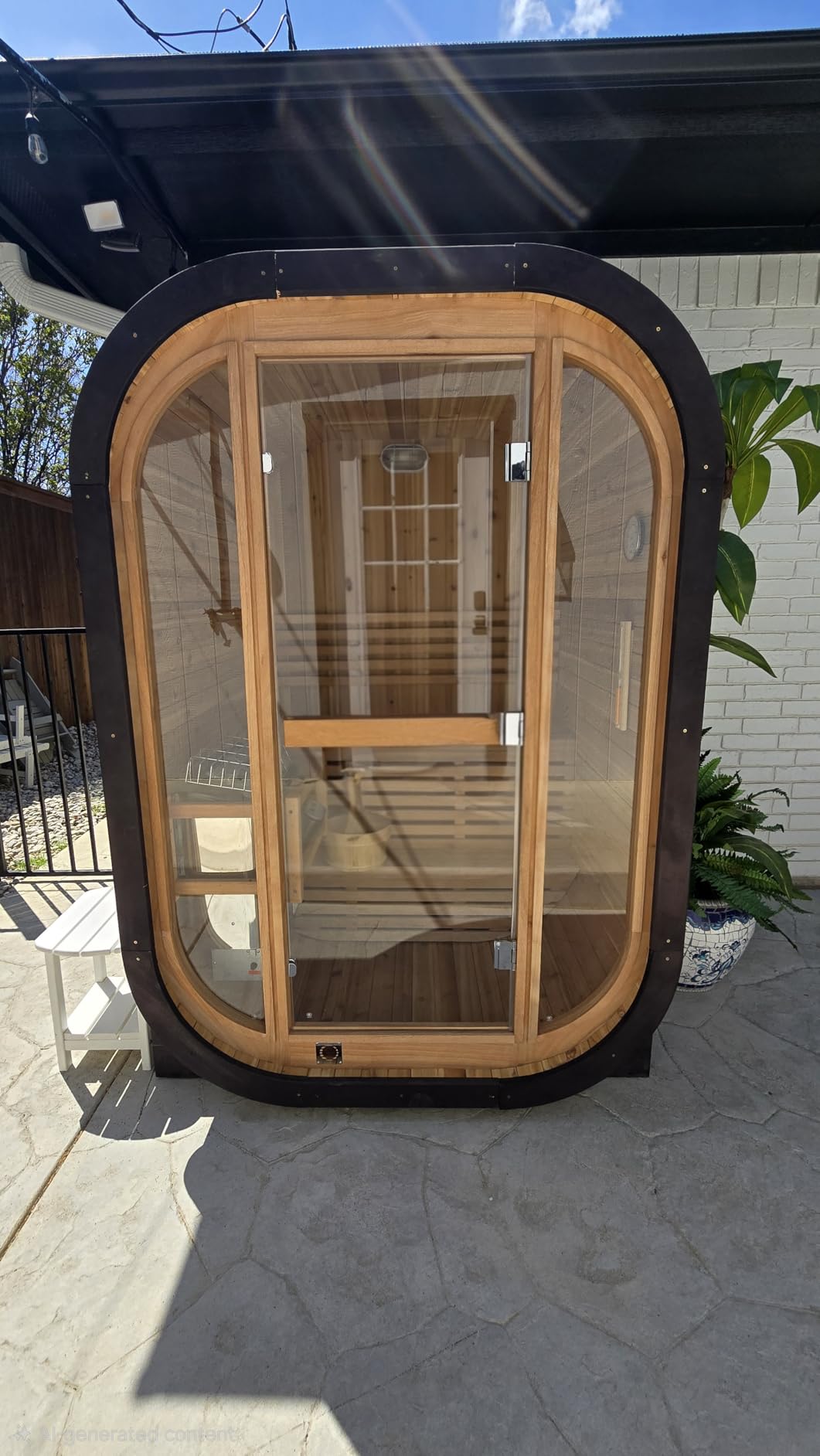
Wall thickness is the single most important cold-climate spec, and the 1.96 inch board on this cabin is the thickest we could verify across this roundup. The manufacturer chose red cedar specifically for minimal expansion and contraction across humidity and temperature swings, which is a detail that decides whether a wall stays tight after a decade of freeze-thaw cycles.
The heater is a 4.5KW ETL-certified Toule model, unit NTSA45, and the published figure is a maximum of 195°F reached in about 20 minutes on 240V power. Reaching 195°F from a cold start in a deep winter is a strong claim and a welcome one, since it puts this two-person cabin firmly in traditional-sauna territory rather than infrared territory.
The shape is a square sauna at 53 by 54 by 79 inches with a 240V supply and a nominal two-person capacity. The bitumen roof covering provides waterproofing and heat insulation, and an 8mm tempered glass door with a wooden handle is fitted at the entry. The accessory set includes volcanic stone, a sandglass, hygrometer, bucket and scoop, rubber hammer, explosion-proof light and a storage rack.
That rating carries almost no information, and the detail worth knowing from that review is that this model has a longer lead time than the others. Judge it on its specification sheet, which is strong, rather than on its star number.
Why wall thickness matters more than most buyers expect
Thick walls do two things. They add thermal mass, so the heat you generate stays in the structure rather than passing through to the outside, and they cut the rate at which cold air moves through the shell during a session. In a climate that sits below freezing for months, that difference compounds every time you open the door, and it is why cabins in this thickness class tend to survive multiple real winters.
The pairing here is what makes it work. A 4.5KW heater against 1.96 inches of cedar in a small 53-inch-wide interior is a close match, and the 20-minute figure to 195°F reflects that proportionality. Buy a thin-walled cabin with this much heater and you will overspend on electricity while still feeling a draft.
Who should skip this sauna
Skip it if you are buying on ratings, because one review is one review. Skip it if you need it quickly, since the longer lead time means this is not a decision to make in the middle of a delivery season if you want heat before the first real cold snap.
Also skip it if you want to stand up or lie down in a two-person footprint, and skip it if you are installing solo at 750 pounds. That weight is a practical limit rather than a quality judgement.
10. ZONEMEL 8-Person Wood-Burning Cedar Barrel – Best for Off-Grid Sites
ZONEMEL Barrel Steam Sauna Room with Panoramic View, Canadian Red Cedar Outdoor Sauna with Wood Shingle Roof, Wood-Fired Stove, 8 Person, 8mm Tempered Glass
Wood-burning heater no electricity
Heats like a 9-15kW unit
8 person capacity
Shingle roof with underlayment
Pros
- Wood-fired heater needs no electrical supply
- Seats 8 or 2 reclining in a 74.8 by 94.5 footprint
- Canadian Red Cedar insulates well and stays cool to touch
- Shingle roof with high-density underlayment
- EPDM rubber base protects wood from ground moisture
Cons
- Only one review so the rating is not meaningful
- Expect a multi-day assembly before your first session
- Chimney clearance and fire safety are on you
- Wood handling takes time every session
This is the only model in this lineup that needs no electricity at all, and that changes who it is for. The wood-burning heater requires no power supply and is described as equivalent to a 9-15kW electric heater in heating capacity, which puts it at the top of the power range in this roundup. If your site has no grid connection, a remote cabin, or a building where a 240V run is impractical, this is the answer.
It is also the largest here by capacity. The room measures 74.8 inches wide by 94.5 inches deep and 74.8 inches tall, fitting 2 people lying flat or 8 seated. The shell is Canadian Red Cedar with a low-density, high-porous structure chosen for insulation, held by double reinforced heavy-duty steel bands compression-locked at every corner.
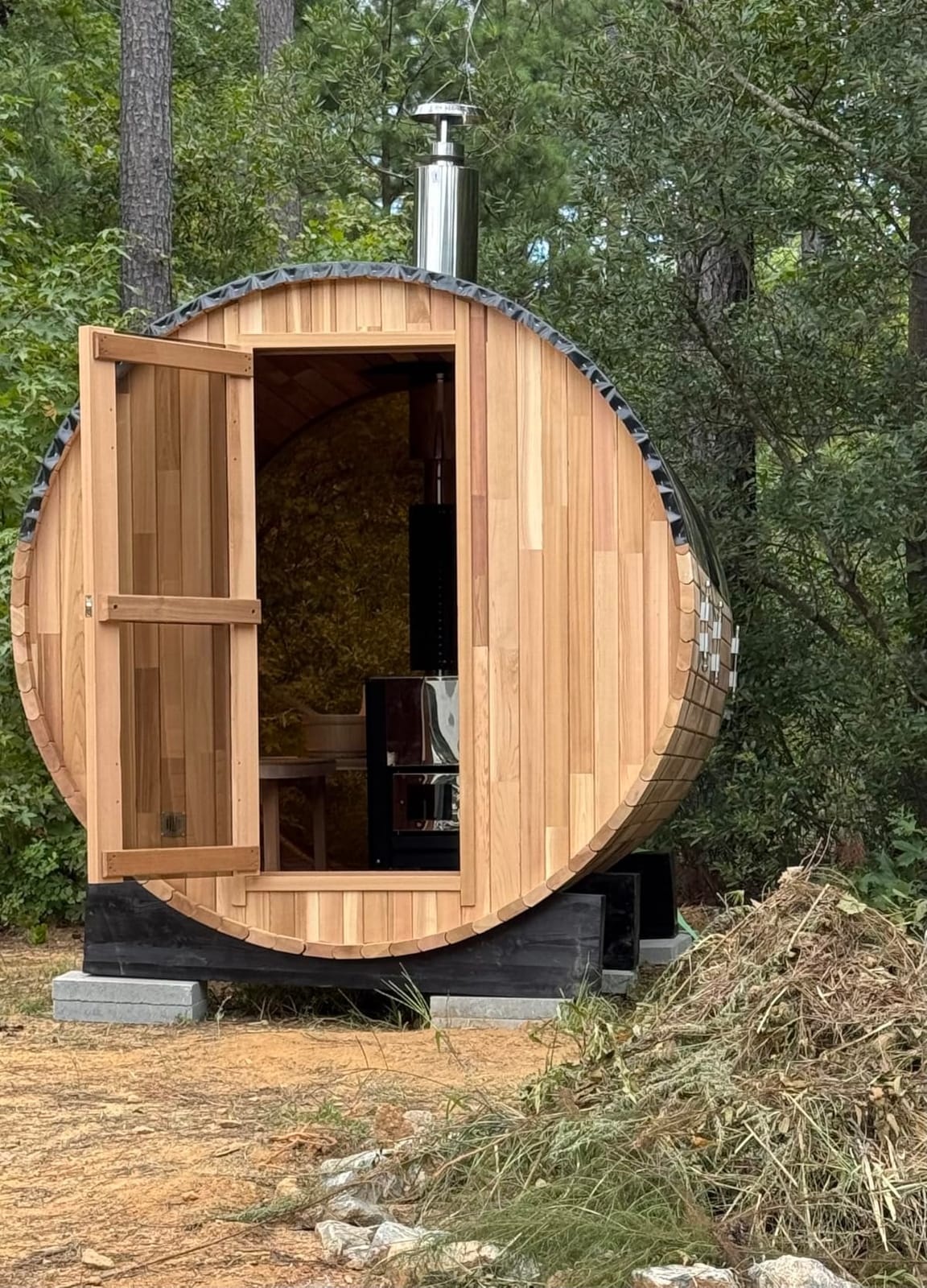
Roof and base are where the cold-climate engineering shows. An architectural asphalt shingle roof sits over high-density underlayment for double protection, and a weather-resistant EPDM rubber base keeps the wood off the ground and out of standing moisture. A ventilation channel handles indoor and outdoor air exchange, and an 8mm tempered glass door and panoramic window keep the interior from feeling enclosed.
The single review describes a two-day family build with a brad nailer and confirms the finished sauna works, with responsive text-based manufacturer support. It sits at the top of the cost range in this lineup, and chimney clearance, spark arrestor and stove safety become your responsibility in a way they never are with an electric heater.
How to run a wood-fired sauna safely in freezing weather
Wood heat changes the risk profile completely, and the differences matter in cold air. You need verified clearance between the stove and any combustible wall, which is a planning-stage decision rather than something to adjust after assembly. A spark arrestor on the chimney is close to non-negotiable in a region where dry snow and frozen brush sit outside the door.
Plan for fuel storage indoors or in a dry shed, because a wet wood load will not sustain a hot fire. Start the fire outside the hottest part of your session, bring it in once the stones are up to temperature, and keep a full water bucket inside rather than walking out to a frozen spigot.
Who should skip this sauna
Skip it if you have grid power within a reasonable distance. The wood-burning route is more work per session, and the EPDM base, steel bands and cedar shell mean you are paying a premium for convenience you can get from a large electric barrel instead.
Skip it if you are not prepared for chimney installation and the insurance and inspection implications in your jurisdiction, and skip it if you want the sauna running in ten minutes after work. A wood fire takes time, and a cold start takes longer.
What Actually Determines Cold-Weather Sauna Performance
The ten products above are the field. These are the criteria we used to rank them, and the same criteria apply to anything else you are considering, including a build you assemble yourself. If you want a deeper look at the equipment side, our guide to the best sauna heaters for home saunas covers the heat source question in detail, and the infrared sauna roundup is useful if you are leaning that way instead.
Heater output: size kW to cabin volume, then add for cold
The starting rule most builders use is roughly 1kW per 1.0 to 1.3 cubic meters of cabin volume. In a mild climate that is enough. In a climate that sits below freezing for months, aim for the top of that band or slightly above it, because a cold start is a much larger heat demand than a reheat.
Practical translation: a 2-person cabin around 5 cubic meters wants 4kW, a 4-person barrel near 8 cubic meters wants 6kW, and a 6-person barrel near 10 cubic meters wants 9kW. Owners repeatedly report that an undersized heater is a leading reason an outdoor sauna feels cold in winter, extending warm-up from 30 minutes to 90.
Wall thickness and wood species
Look for 1.5 to 2 inches of solid wood, and check what species. Canadian Red Cedar and thermally treated spruce are the two most reliable choices for freeze-thaw durability because both have low moisture uptake and good dimensional stability. Thermowood, a heat-treated product, is specifically valued in cold regions for the same reason.
Avoid thin laminated interiors and any panel that is described only as weather resistant without a species or a thickness. Your vapor barrier matters as much as the wood, and the correct build order is framing, insulation, a continuous vapor barrier on the warm side, then breathable cladding. Skipping the continuous vapor barrier is what lets interior moisture freeze inside the wall.
Roof pitch and snow load
A sloped or peaked roof is not a style choice, it is a drainage decision. Snow that sits on a flat or shallow roof loads your ceiling insulation, warps framing over time, and creates ice dams that drive meltwater back under the cladding. Asphalt shingles over underlayment are the most durable option here, and a bitumen covering is a reasonable second tier.
Also check for a ridge cap and an integrated waterproof layer, because water tracking back under shingles does more freeze-thaw damage than the cold itself. For barrel shapes, the curve does the work for you as long as you clear accumulated drifts.
Foundation, frost heave and drainage
Owners running saunas through real winters repeatedly report that the base matters more than the cabin. A deck, pavers or compacted gravel pad keeps the structure out of the freeze-thaw mess, and the base has to be built below the local frost depth with a drainage layer so meltwater does not refreeze underneath and push the whole thing sideways.
Excavate below frost depth, lay compacted gravel for drainage, add a level pad on top and anchor the structure to it. A slab is the most durable option if you are willing to have it poured, gravel is the most forgiving, and a bare ground or pier-only setup is what produces the heaving and cracked framing owners complain about. The same gravel-pad logic is why the cold-climate outdoor structures guide on this site treats the base the same way.
Electrical requirements and real installed cost
Anything above about 2kW needs a 240V hardwired circuit on a dedicated breaker with GFCI protection, and a 9kW stove needs an electrician rather than a weekend. The installed cost of a long circuit run frequently exceeds the gap between two saunas, which is why we call it out for every product here.
Add permit and inspection where your jurisdiction requires them, and check whether your heater’s control electronics are rated for the ambient temperatures you will see. WiFi and app preheat is a winter convenience, not a substitute for correct heater sizing, and control units that freeze are a recurring owner complaint worth asking about before you buy.
Rodent proofing and the winter checklist
Pest proofing is the most-asked question in cold-climate sauna discussions and the least-answered. Vents and the space under benches are the usual entry points, and mesh screening over intake and exhaust openings plus sealing gaps at the base deters nesting. A cabin that is used regularly in winter is far less attractive to pests than one that sits sealed for months, which is a free form of pest control.
Before each cold season: inspect the roof for damage and loose shingles, clear drifts off the roof and away from vents, confirm the pad is still level, keep ventilation openings clear, and run the heater for 30 to 60 minutes to bring the structure and the electronics up to temperature before a long freeze. If you want a practical companion piece, our steam generator guide covers the indoor side of the same question.
Frequently Asked Questions
What is the best outdoor sauna for cold climates?
Traditional steam barrels and cabins with thick solid-wood walls and a sloped roof perform best in sustained sub-zero climates. Look for walls at least 1.5 inches thick, a heater around 1kW per 1.0 to 1.3 cubic meters of interior volume, and a pitched roof that sheds snow. Our ranking puts the OUTEXER 4-5 person barrel first because its carbonized spruce and 4.5KW stove handle a sub-zero start without a 240V hardwired upgrade.
Can you use an outdoor sauna in the winter?
Yes, and most cold-climate buyers use theirs straight through the season. The key is to start the heat 30 to 60 minutes before you plan to enter so the cabin mass and the heater electronics are above freezing, dress in layers you can strip as you warm, and keep a clear path back to the house so you are not walking on ice in a sweat-soaked state. Leave the door cracked after a session to vent moisture.
What type of sauna is best for outdoors?
Three types are worth considering. Traditional electric or wood-fired barrels reach the highest temperatures and support löyly, making them the right choice for real winter sauna. Infrared and full spectrum cabins heat in minutes and cost far less to run, which suits weekday recovery sessions and contrast-therapy pairing. Portable tent saunas are the cheapest way to start the habit but tolerate repeated freeze-thaw cycles the least well.
What to put under an outdoor sauna?
A compacted gravel pad on a levelled, well-drained base is the most forgiving option, and a concrete slab is the most durable. In either case excavate below your local frost depth, add a drainage layer so meltwater does not refreeze and heave the structure, and anchor the sauna to the base. Owners running saunas through real winters consistently report that the base matters more than the cabin itself.
How long does a sauna take to heat up in cold weather?
Expect 25 to 35 minutes for a 4.5kW stove in a small barrel under normal conditions, and considerably longer from a deep-cold start. Published winter figures range from about 20 minutes to 195 degrees for a 4.5kW electric heater in a well-insulated two-person cabin, to 40 to 60 minutes for infrared models to reach 131 to 140 degrees when ambient temperature is below 32F. An undersized heater is the usual cause of a 90-minute wait.
How to protect a sauna outside through winter?
Inspect the roof before snow season and confirm shingles, ridge caps and the waterproof underlayment are intact. Clear drifts off the roof and keep the lower intake and upper exhaust vents open so moisture can escape, since trapped condensation causes rot. Check that the base is still level, screen vents against rodents, and bring the cabin up to temperature for 30 to 60 minutes before a deep freeze rather than leaving electronics cold for weeks.
The Best Outdoor Sauna for Your Winter, 2026
The best outdoor saunas for cold climates all share three things: a thick solid-wood wall, a roof that sheds snow, and a heater sized for the interior volume rather than for the spec sheet of a different model. The OUTEXER 4-5 person barrel takes our Editor’s Choice because it combines carbonized spruce, a 4.5KW stove and the deepest owner review base in the group.
Go with the KUNSANA cabin if you want a fast weekday session and a small outlay. Go with the HOSAUNA 9KW barrel if you regularly seat five or six people. Go with the ZONEMEL wood-burning barrel only if you have no reliable power at the site and you want the biggest room in this roundup.
Tell us your climate zone, how many people will use it, and whether you have a 240V circuit available, and we can narrow this to a single model for you.