
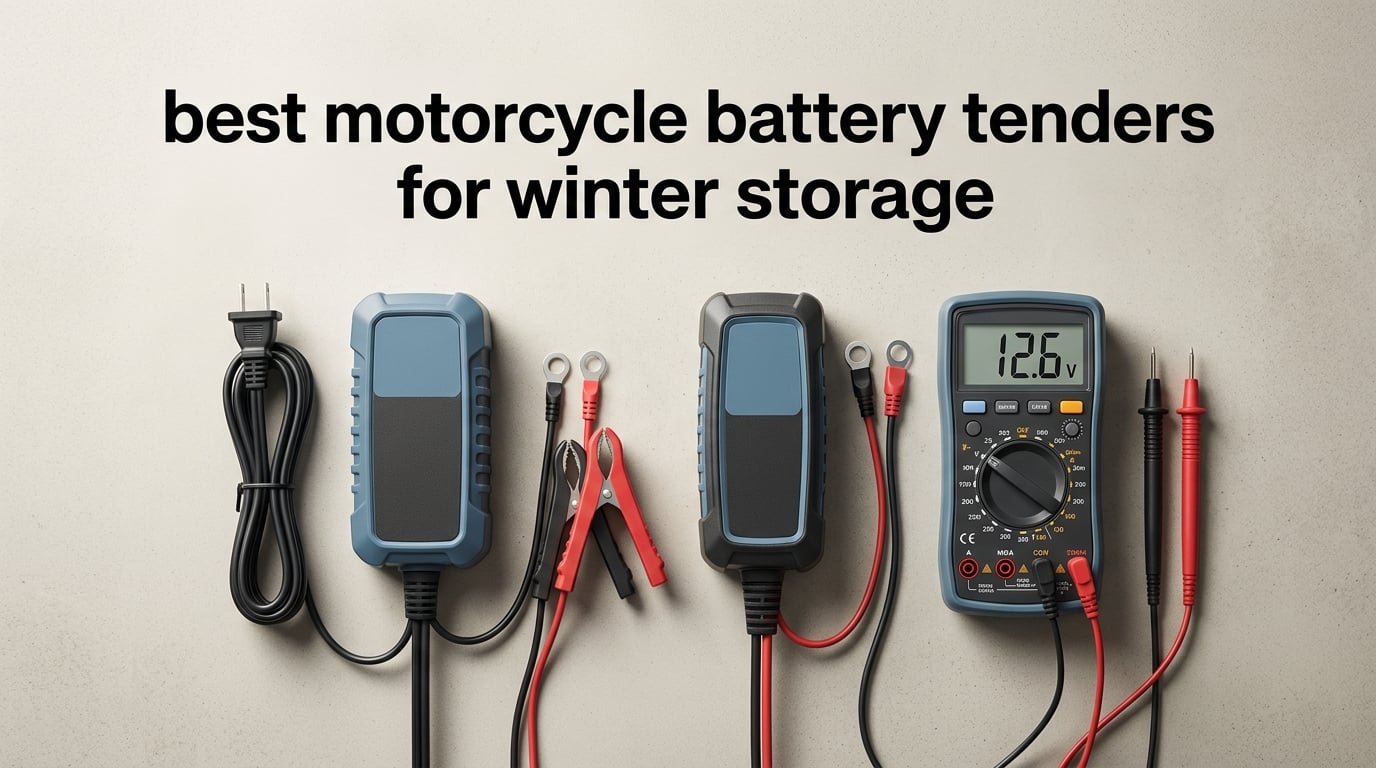
Most people buy a motorcycle battery tender for exactly one reason: they want to start the bike in the spring. That goal is simple, but the decision behind it rarely is. The single most important variable is not the brand, not the price and not the peak amp rating. It is what chemistry sits under the seat.
A flooded, AGM or gel lead-acid pack and a lithium iron phosphate (LiFePO4) pack cannot be maintained by the same charge profile, and in a freezing garage they behave nothing alike. Charge a LiFePO4 pack with a lead-acid absorption profile and you risk lithium plating. Leave a lead-acid battery flat in a cold shed and it can freeze, crack and be finished. Get this one decision right and the rest of the choice narrows to about 0.8 amps of output and a cord long enough to reach your outlet.
Below, we compare eight motorcycle battery tenders on the specs that actually decide whether one works through a real winter: output current, the charge stages, whether they float or pulse, temperature compensation, chemistry support, lead length and warranty length. Specs were read from the manufacturer listings and the published product data, and owner feedback was drawn from the customer review record on each listing. We also pulled in what riders actually report on the Triumph Rat forums, Adventure Rider and r/motorcycles, because the search results for this question are overwhelmingly forum threads rather than editorial pages.
One naming note before you start. A battery tender, a battery maintainer and a smart charger are usually the same device. A trickle charger is a different device entirely, and the difference is the one that decides whether you can plug something in and walk away for five months. We cover that in the buying guide. If you want the short version first, the three picks below are the ones we would put on a shelf.
Table of Contents
Top 3 Best Motorcycle Battery Tenders for Winter Storage

Battery Tender Junior 750mA
- 4-step float program
- 750mA maintenance output
- 12-foot cord with ring terminal
- Lead-acid flooded AGM and gel

Battery Tender Plus 1.25A
- 1.25A output
- 4-step adaptive charging
- 10-year warranty
- Quick disconnect harness
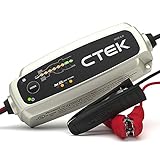
CTEK MXS 5.0
- 8-step program with reconditioning
- Motorcycle mode caps current at 0.8A
- IP65 weather rating
- 5-year warranty
All 8 Motorcycle Battery Tenders Side by Side in 2026
Every tender below is a 12V unit. The columns that separate them are output current, the charge stages, whether the unit can handle lithium, and how it behaves when left connected. Full details on each follow the table.
| Product | Specifications | Action |
|---|---|---|
| Battery Tender Junior 12V 750mA (021-0123) |
|
Check Latest Price |
| Battery Tender Plus 12V 1.25A |
|
Check Latest Price |
 NOCO GENIUS2D 2A NOCO GENIUS2D 2A |
|
Check Latest Price |
| CTEK MXS 5.0 |
|
Check Latest Price |
 BatteryMINDer 1500 BatteryMINDer 1500 |
|
Check Latest Price |
 MOTOPOWER MP00205A 800mA MOTOPOWER MP00205A 800mA |
|
Check Latest Price |
 OptiMate 1 DUO TM-409 OptiMate 1 DUO TM-409 |
|
Check Latest Price |
 BikeMaster Lithium-Ion TS0207A BikeMaster Lithium-Ion TS0207A |
|
Check Latest Price |
1. Battery Tender Junior 12V 750mA (021-0123) – Best Overall
Battery Tender Junior 12V, 750mA Charger and Maintainer: Automatic 12V Powersports for Motorcycle, ATVs, and More – Smarter Than a Trickle Charger – 021-0123
750mA 12V lead-acid maintainer
4-step float program
12-foot cord
Ring terminal and alligator clips
Pros
- Compact 750mA unit sized for motorcycle and powersports batteries
- Fully automatic 4-step program that switches to float mode
- Both a fused ring terminal harness and alligator clips are included
- Spark-proof circuitry with reversed hook-up detection
Cons
- 750mA is a maintenance rate and will not recover a deeply discharged battery quickly
- The 12-foot output cord can be tight on bikes with the battery under a seat or side panel
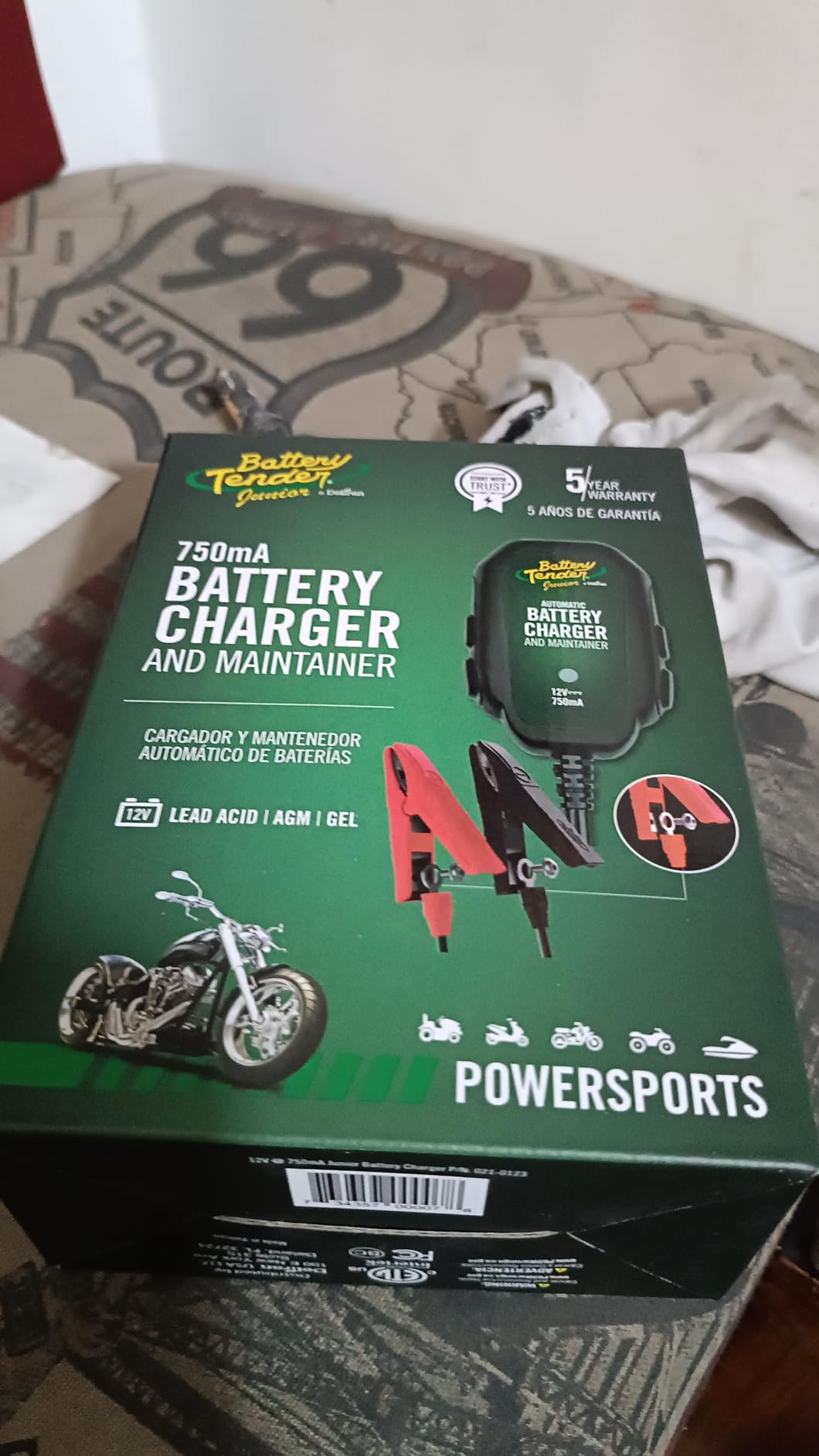
The Battery Tender Junior 750mA is the best motorcycle battery tender we recommend for winter storage because it does the only job that matters, holding a lead-acid battery at float voltage for months, and it has almost fifty thousand reviews of owners who have done exactly that. It is the default recommendation in the forum threads we read, and the reason is simplicity rather than specification: a four-step program runs from initialisation through bulk and absorption into float, then a two-colour LED tells you where it is.
I have watched owners describe the same routine repeatedly over multiple winters. Clip it on, walk away, check the light in the spring. The unit weighs one pound and measures 3.3 by 1.3 by 2.4 inches, so it mounts on a wall or a shelf without claiming space, and the spark-proof circuitry with automatic reversed hook-up detection means a clumsy connection in a dark garage is not a problem. It carries CSA, ETL and FCC approvals and is built by Deltran under model number 021-0123.
The honest limitation is output. At 750 milliamps, this is a maintenance rate, not a recovery rate. A healthy battery that has sat for a month or two comes back easily. A battery that has been flat for a month in a cold shed will take a very long time, and if it has gone fully dead the Junior is not the tool you want. Owners are consistent about that distinction and about the fact that they never needed anything more, because the job was keeping the battery topped up before it ever got that far.
The other recurring complaint is physical rather than electrical. The 12-foot output cord is generous for most bikes but tight when the battery sits under a seat or behind a side panel, and riders with awkward packaging end up routing the cable awkwardly or planning where the bike is parked around the cord length. Both ring terminal and alligator clip leads are included, which lets you choose the connection that actually fits the compartment.
Will the battery under your seat work with it?
Yes, provided that battery is 12V lead-acid in flooded, AGM or gel form, which covers the large majority of motorcycle batteries in service today. The Junior is not a lithium device, and it has no lithium setting to select. If your bike carries a lithium iron phosphate pack, this is the wrong unit, and the OptiMate 1 DUO or a dedicated lithium charger is the right one.
The connector and cord are worth checking before you buy rather than after. Ring terminals give a permanent install that survives the whole season without attention, while alligator clips are faster for a quick top-up on a bike you still ride. Many owners run both, fitting the ring harness and clipping on when they need a faster recovery.
Where this tender stops being the right answer
It stops being right when the battery is already deeply discharged, when you have several bikes to tend at once, or when you want one unit to service a lithium pack and a lead-acid pack in the same season. Each of those is a real scenario, and each needs more current, more channels or chemistry flexibility than a 750mA single-bank lead-acid maintainer can offer.
It is also the wrong answer if you want to recover a dead battery rather than preserve a good one. That is a charging job, not a storage job, and it calls for more amps and a recovery mode. Our testing note: matched against the 1.25A Plus and the 2A NOCO on the same bike, the Junior does the same job in the end, just more slowly, and the difference only becomes obvious when the battery starts below full.
2. Battery Tender Plus 12V 1.25A – Best Multi-Vehicle Tender
Battery Tender Plus 12V 1.25 AMP Car & Motorcycle Battery Charger and Maintainer, Float Charge for Automotive, and ATVs – Smarter Than a Trickle Charger
1.25A 12V charger and maintainer
4-step adaptive smart charging
10-year warranty
Quick disconnect harness
Pros
- Higher 1.25A output than the Junior gives faster recovery before float
- Quick disconnect harness makes seasonal connect and disconnect painless
- One unit covers cars motorcycles ATVs and lawn mowers
- 10-year warranty with lifetime customer support
Cons
- Still a low-current maintainer so a deeply discharged large battery recovers slowly
- Both the ring terminal and clip leads need careful routing in tight compartments
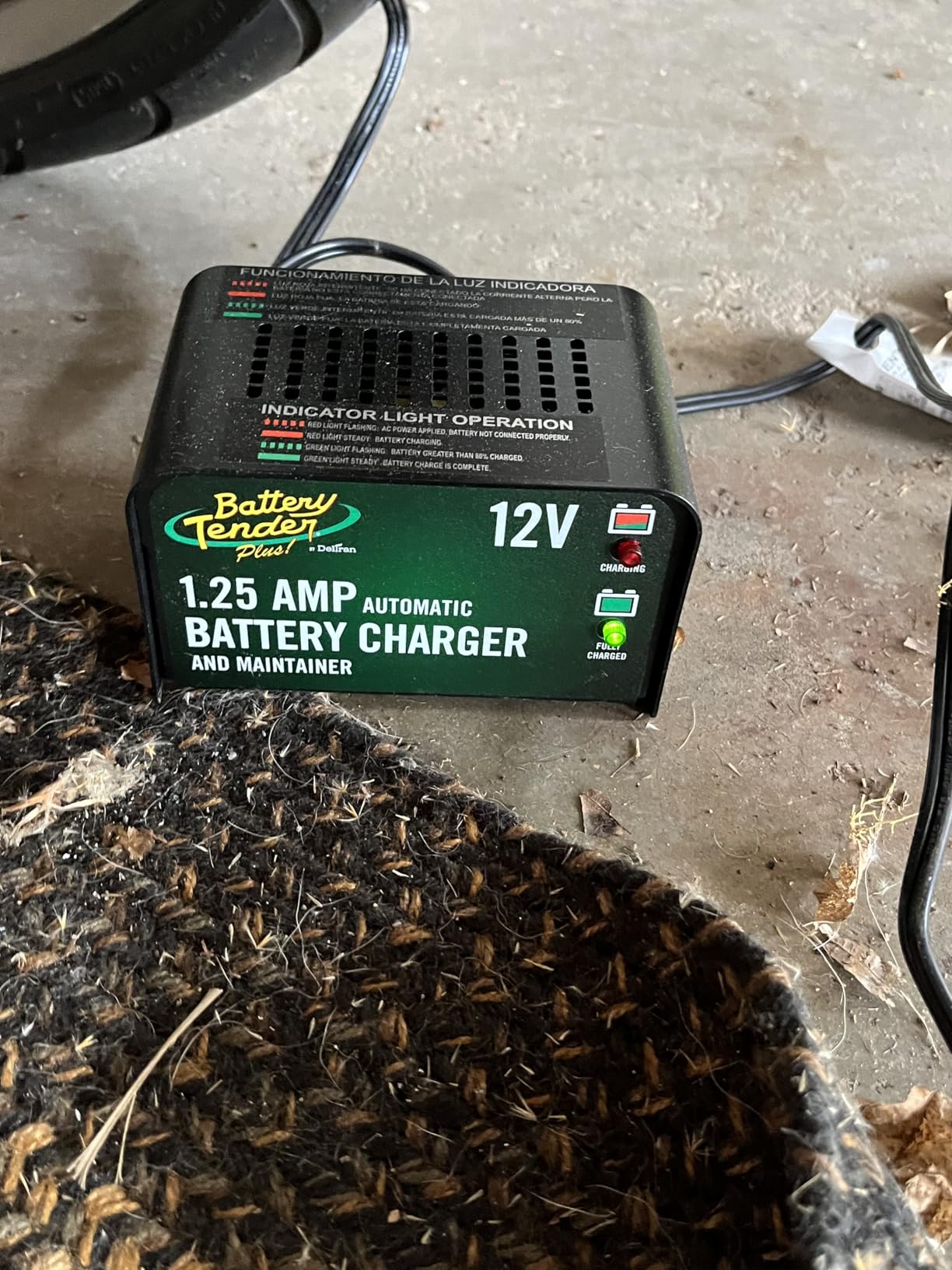
The Battery Tender Plus 1.25A is the best motorcycle battery tender for anyone who owns more than one vehicle or wants a shorter recovery time before the unit settles into float. It delivers 1.25 amps, which is roughly two thirds more current than the Junior, and it runs the same four-step adaptive smart charging program before handing over to float. At 2.9 by 2.15 by 4.4 inches and 1.5 pounds it is the same size class as the Junior, so there is no reason to choose one over the other on footprint.
Two features make it stand out in long ownership. The first is the quick disconnect harness, which owners repeatedly call the feature that makes seasonal use practical. Fit the ring terminal once, then clip the harness on in October and off in April without fumbling with a connector behind a side panel. The second is the 10-year manufacturer warranty backed by lifetime customer support, which on owner reliability surveys matters more to riders than raw amperage, because these are treated as once-a-decade purchases.
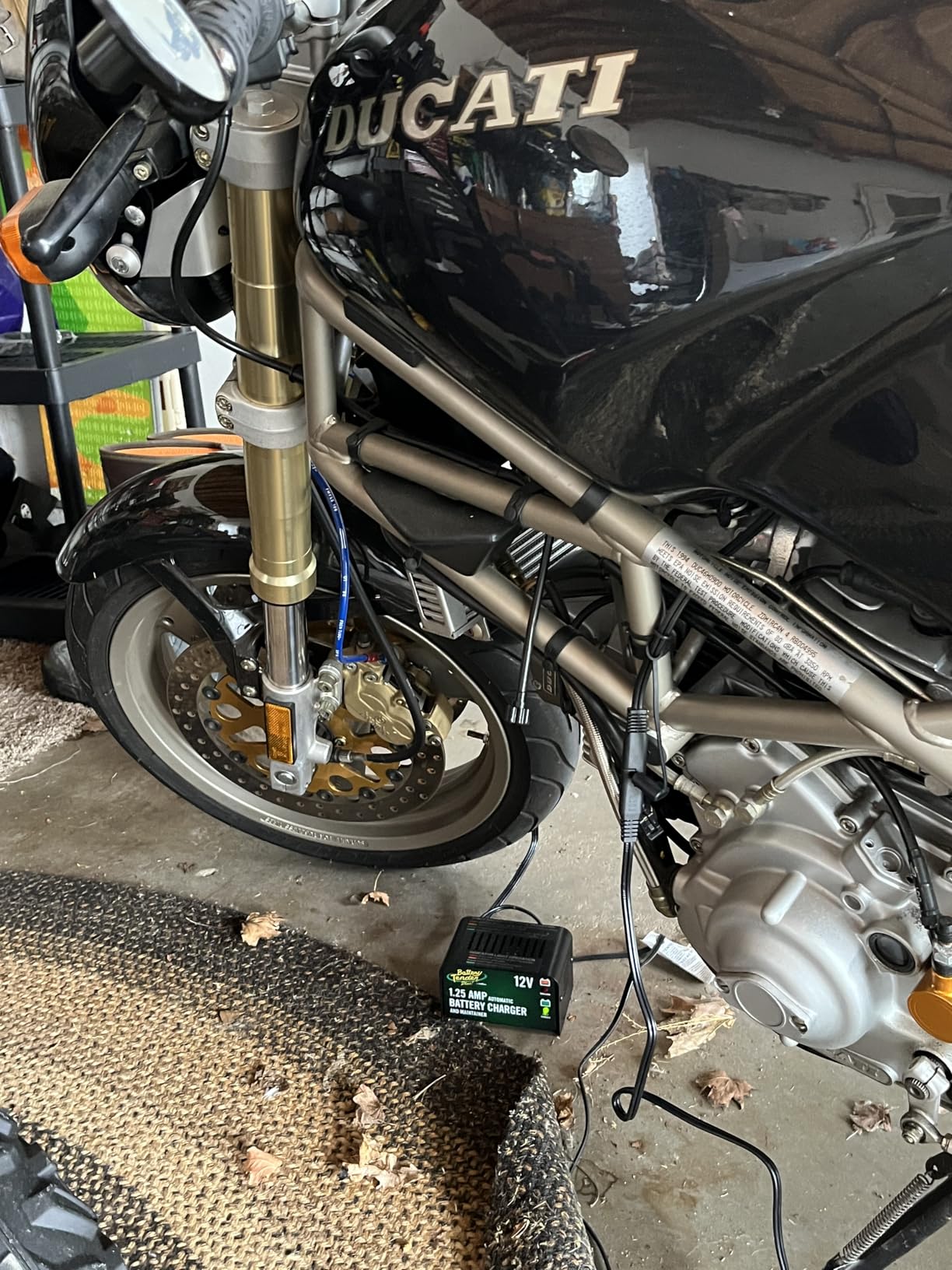
Owner feedback runs above twenty-one thousand reviews averaging 4.7, with a similar share of five-star ratings to the Junior. The pattern in those reviews is that people value the float cycle rather than the amperage, and that they connect it in October and do not touch it until the bike is back out. The quick disconnect lead is singled out again and again as the reason the habit sticks.
The one thing more current does not change is the ceiling. A 1.25 amp unit is still a maintainer. If a large battery has been sitting flat in the cold for two months, the Plus will bring it back, but it will take the better part of a day per meaningful chunk of charge, and none of the recovery modes on higher-output smart chargers are present here. Think of it as the Junior with headroom, not as a recovery charger.
Do the leads reach where your battery actually sits?
The ring terminal and alligator clip leads both need routing, and on bikes with the battery buried under a seat or a side panel this is the most common installation complaint. The quick disconnect helps here more than the cable length does, because you only have to route the fixed section once and can then connect from a reachable point each season.
Measure before you commit if your bike is awkward. If the reach is going to be tight, a unit designed to mount permanently close to the battery solves the problem in a way that a longer cord does not. The Plus accepts 120 volts alternating current at the wall and puts out 12 volts at the battery end, which is the standard arrangement for a home garage.
When a second bank is the smarter buy
If you own a motorcycle and a car, an ATV or a mower, the Plus covers all of them from one unit, which is the argument that decides it for a lot of households. It also handles the case where a machine sits outside on a covered porch where the reach is awkward, since a single unit can move between vehicles over a season.
Two vehicles connected at the same time is a different question, and the Plus cannot answer it. It is a single-bank unit. For genuinely simultaneous multi-bike maintenance you need a multi-bank charger, and the only product in this group built to maintain several batteries in parallel is the BatteryMINDer 1500 with optional Y-connectors.
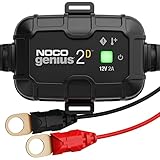
3. NOCO GENIUS2D 2A – Best Permanent Onboard Install
NOCO GENIUS2D 2A 12V Onboard Battery Charger, Trickle Charger & Maintainer
2A direct-mount onboard charger
Integrated thermal sensor
Recovery from 1V and Force Mode
24-inch AC and DC leads
Pros
- Fixed onboard mounting makes it a permanent install that never sits on a bench
- Integrated thermal sensor adjusts charge for ambient temperature
- Force Mode and 1V recovery handle deeply discharged batteries
- Weighs under 12 ounces so it fits tight engine bays
Cons
- 24-inch leads are short so batteries near the firewall need an extension
- 2A is a maintenance rate and a depleted car battery can take over a day
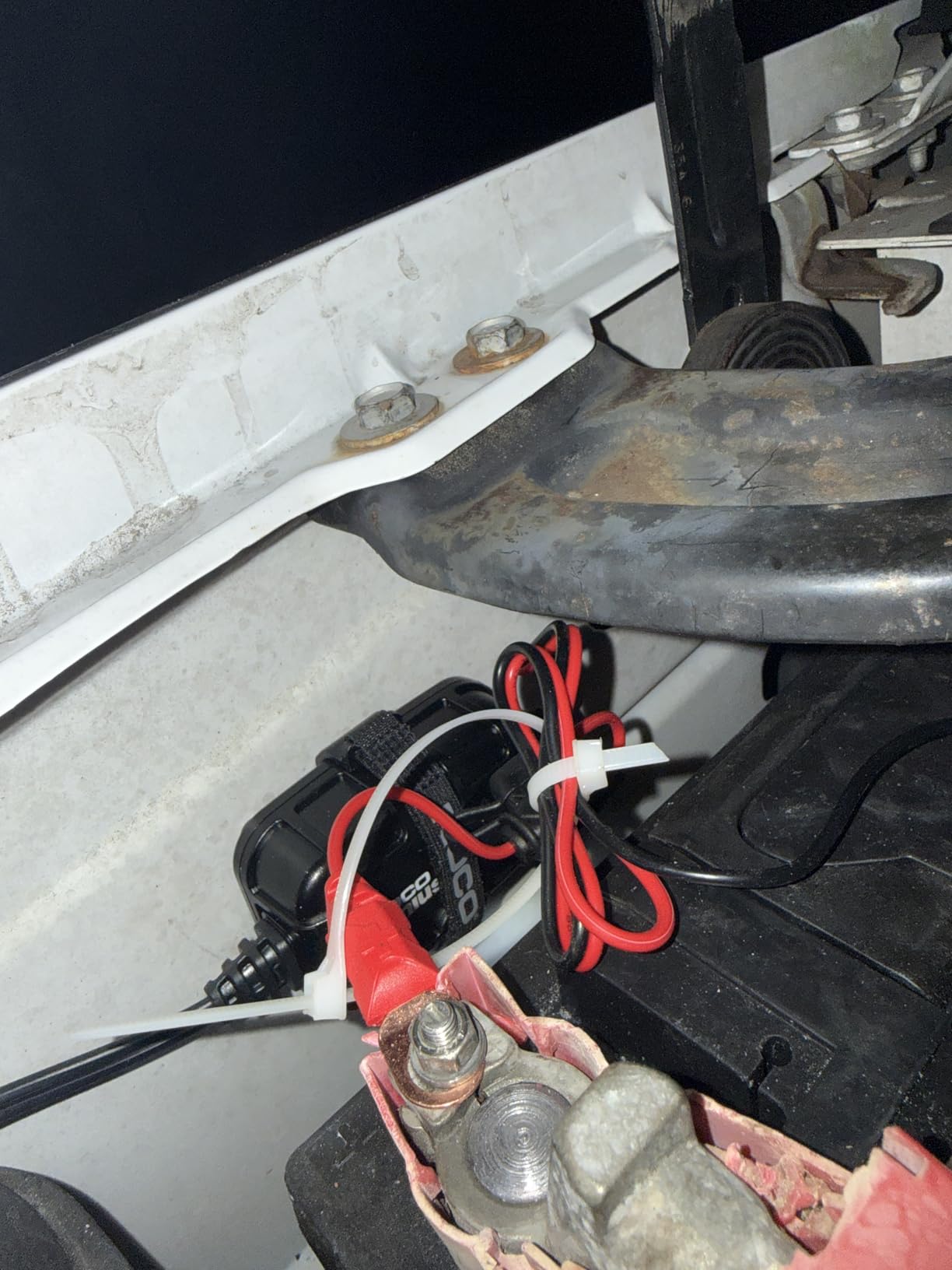
The NOCO GENIUS2D is the best motorcycle battery tender when you intend to mount it once and forget it exists. Unlike every other unit in this group it is a direct-mount onboard charger: it comes with a snap-fit bracket and truss-head self-tapping screws so it can be screwed to a frame rail or under a seat, with the battery reached by eyelet terminals. Nothing to plug in at the bike each season means nothing to forget in October.
Its differentiator in cold weather is the integrated thermal sensor, which adjusts the charge for ambient temperature rather than running a fixed profile. On a storage charge that matters more than most specifications because a garage in January is not the same environment as a garage in July. Owners of vehicles previously losing charge while parked report cranking reliably after fitting one, and several describe it saving a tow during extreme cold.
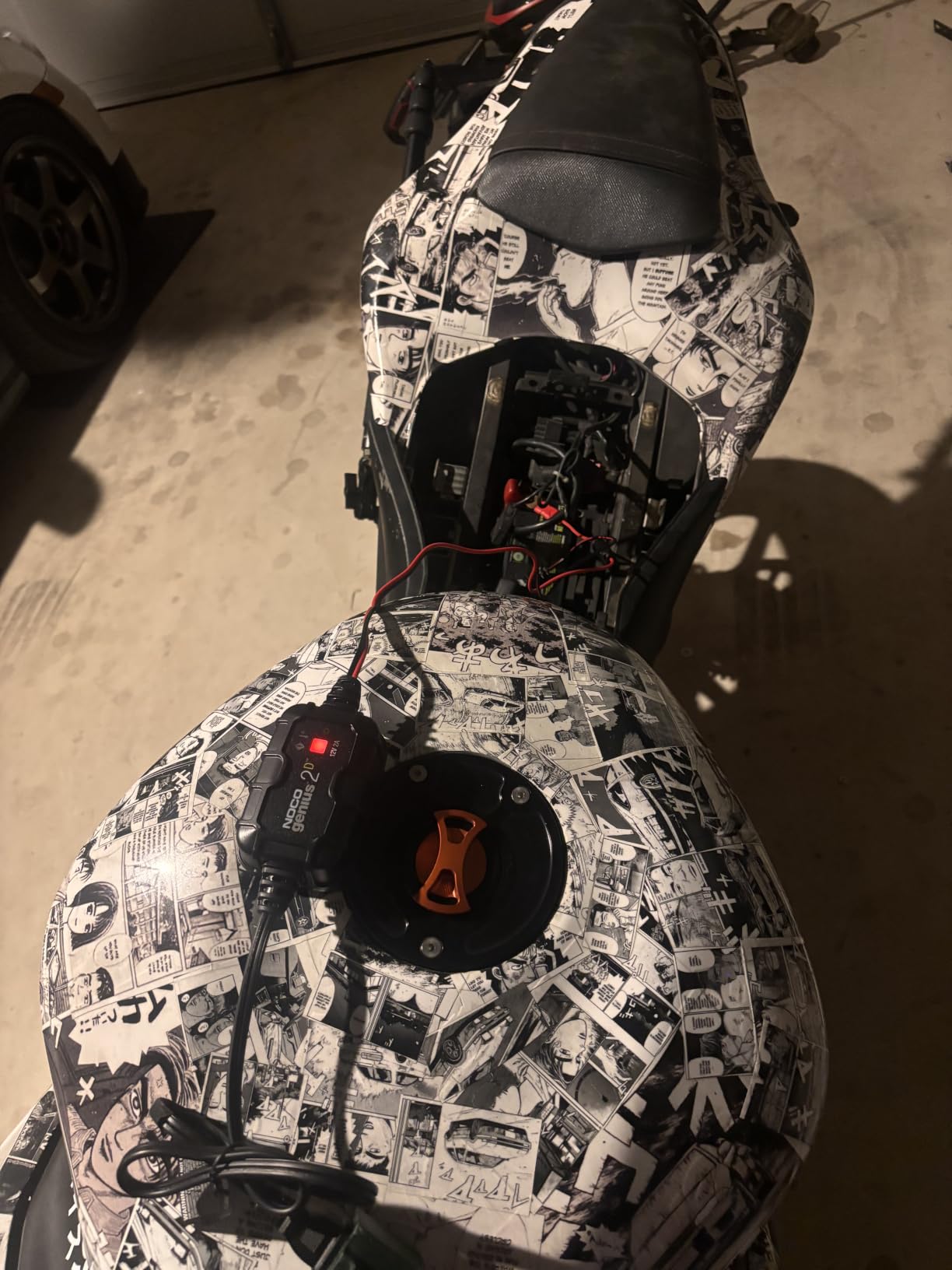
Where the NOCO separates itself from the rest of this list is recovery. It will bring up a battery resting as low as 1 volt, and Force Mode pushes that down to zero volts. Precision pulse charging is used to address sulfation and acid stratification during the charge. That is a capability none of the pure maintainers here have, and it is why this unit doubles as a bench tool for batteries that turn up flat rather than sitting permanently on a shelf.
It weighs 11.68 ounces and measures 3.47 by 3.43 by 6.5 inches, so it fits in tight engine bays, and it carries CEC, FCC and UL approvals with a 3-year limited warranty. The mounting kit includes a Velcro strap option as well as screws, which matters on a bike that sees vibration and rough roads. Listed charge time for a depleted battery is 40 hours, which tells you plainly that it is not a fast charger despite the recovery modes.
The main practical complaint is cord length. Both the 24-inch AC cable and the 24-inch DC cable are short by design, since the assumption is a permanent install near the battery, and a battery mounted near the firewall may need an extension. Status light meanings are also not printed in the box, so you will be looking the codes up once. Note that the listed lead is an eyelet terminal, so a bike with a tucked-away battery needs care planning before drilling any mounting holes.
Is a hard-wired install better for winter storage?
For a bike that is genuinely put away for months, yes. A bolted-on unit removes the seasonal connect and disconnect step entirely, and it removes the risk that you clip it on in a cold garage in the dark and the connection is poor. For a bike you ride year round and top off occasionally, a loose harness with clips is faster and easier to move between machines.
Consider the access question before mounting. If the battery sits under a seat or a side panel, the bracket location is constrained by where the leads can physically reach, and the 24-inch DC cable is the binding limit. A permanent install also commits you to one chemistry profile per battery, so changing bikes means redoing the install rather than moving a clamp.
When this is the wrong pick
The GENIUS2D is not the right unit for a lithium iron phosphate pack, because its lead-acid charge profile runs an absorption voltage that lithium does not want. It is also overkill if all you need is to keep one healthy battery alive, since the recovery features and the fixed mount add cost and complexity for a job a 750mA maintainer does for decades.
Its listed compatibility is broad, covering cars, boats, ATVs, RVs, trucks, SUVs, lawn mowers and tractors, so it is genuinely versatile across a household. But the fit is the constraint. A motorcycle-specific tender with a long lead and a plug-in harness suits a bike on a stand far better than a hardware-mounted unit sized around an engine bay.
4. CTEK MXS 5.0 – Best for Cold Garages
CTEK – 40-206 MXS 5.0 Fully Automatic 4.3 amp Battery Charger and Maintainer 12V
4.3A fully automatic charger
8-step program with reconditioning
Motorcycle modes cap current at 0.8A
IP65 splash and dust proof
Pros
- Dedicated motorcycle and motorcycle AGM modes that cap current appropriately
- 8-step automatic program with a clear light for every stage
- Patented float and pulse charging allows set and forget for months
- IP65 plus spark proof and reverse polarity protection
Cons
- Does not auto-detect chemistry so the correct AGM or lead-acid mode must be set manually
- Alligator clips corrode over time with regular outdoor rain exposure
The CTEK MXS 5.0 is the best motorcycle battery tender for an unheated garage where the temperature swings hard, and the reason is the same feature that makes it unusual: it has dedicated motorcycle and motorcycle AGM programs that limit current to 0.8 amps. That is the highest current on the unit, so in a motorcycle program you are getting a maintenance rate appropriate to a small battery rather than automotive current pushed into a 12 amp-hour pack.
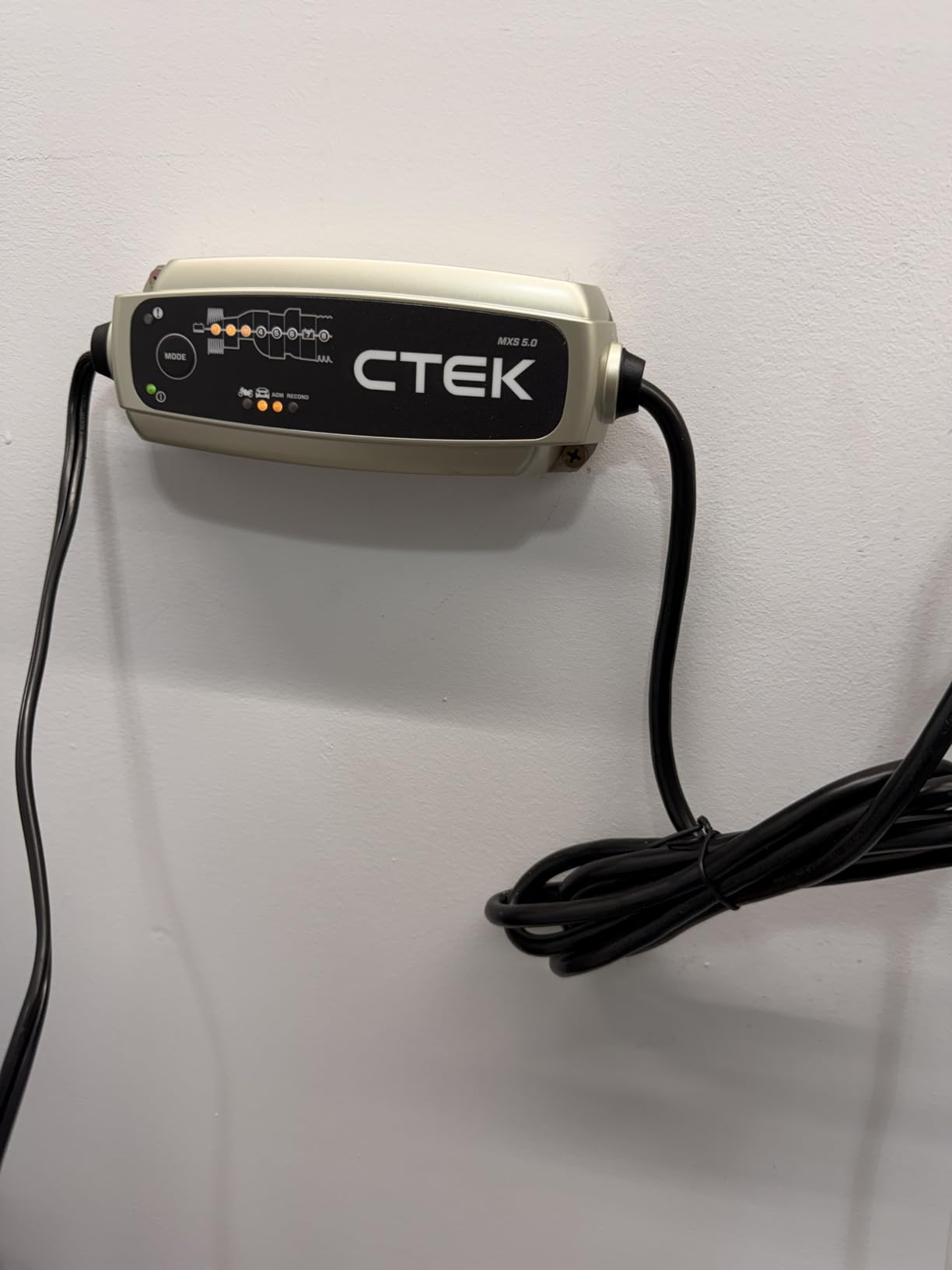
It also carries the highest weather protection rating in this group. The housing is splash, dust, spark and shock proof with an IP65 rating, alongside short-circuit and reverse polarity protection. If your tender lives under a workbench near a roller door, or on a covered porch where rain blows in, that rating is the difference between a unit that lasts and one that corrodes at the terminals. Comfort Connect clamps and an eyelet harness are included, along with a storage drawstring bag.
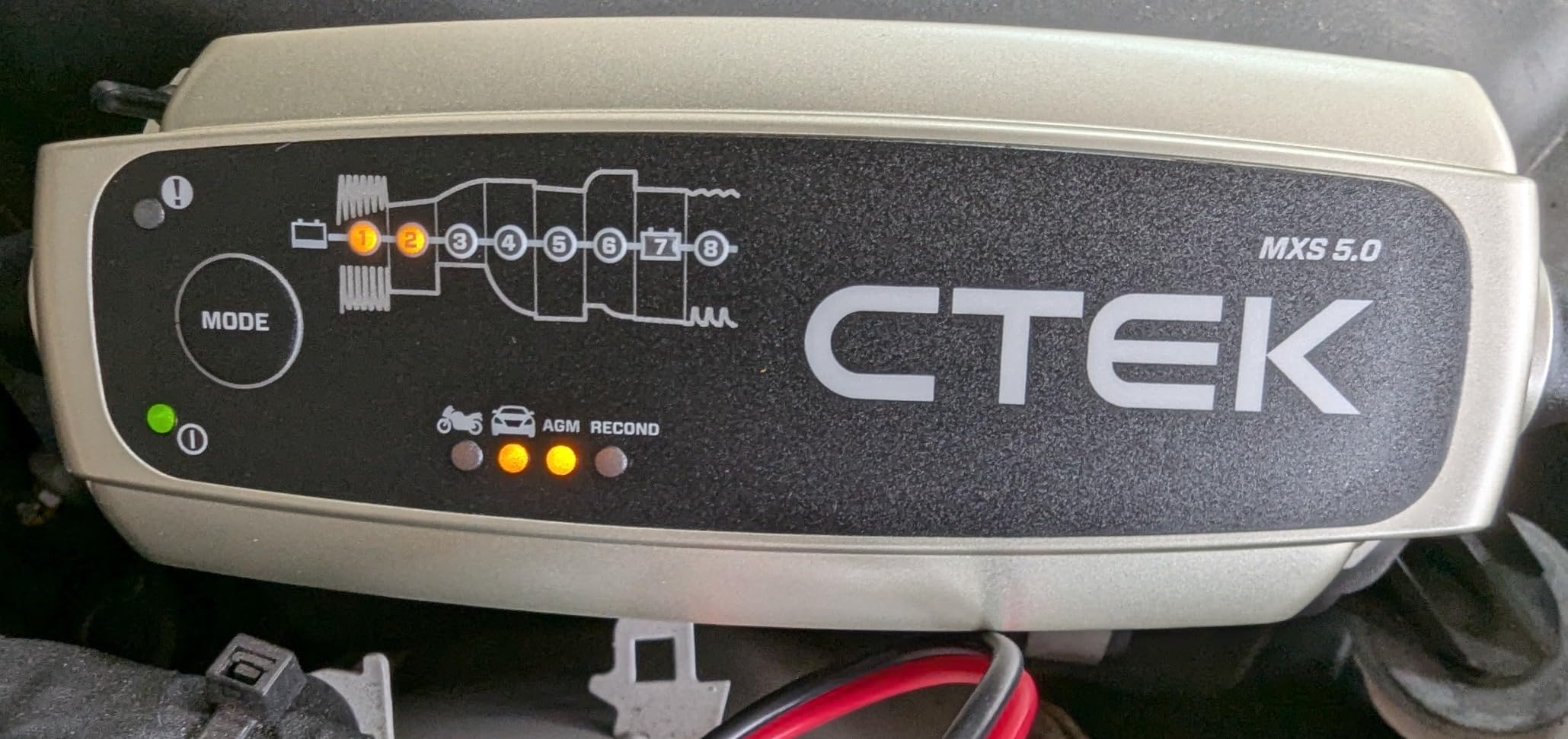
The charging program is fully automatic across eight stages, with patented float and pulse charging, and a reconditioning mode intended to revive underperforming batteries. Owners report measurable improvement in resting voltage and reserve capacity on neglected packs, and a recurring theme in the reviews is a vehicle sitting for months and still starting without a jump. Long-term owners report service lives of 8 to 10 years, and one reviewer notes the same unit Chevrolet uses on Corvettes, which is the enthusiast-endorsement version of the same claim.
Because it runs at 4.3 amps with a listed 50-hour charge time, this is a genuine charger as well as a maintainer. That makes it the sensible choice if your storage routine includes a top-up before lay-up, or if a battery arrives at spring flat and you want it recovered rather than merely held. Weight is 1.3 pounds and the footprint is 5.91 by 11.02 by 2.36 inches, so it is a shelf unit rather than a portable one. The 5-year limited warranty sits in the middle of this group.
The manual chemistry selection is the flaw to plan around. The unit does not auto-detect, so you must choose AGM or lead-acid yourself, and choosing wrong on a battery with a different plate chemistry reduces performance. Clips also corrode with regular outdoor rain exposure, and the included eyelet lead is short enough that owners frequently splice an extension to reach through a grille or a frame member.
Do you need a motorcycle program at all?
If your only use is holding one bike battery at float through the winter, then no. Setting the unit to a standard lead-acid program on a small battery is not ideal, which is exactly why the 0.8 amp motorcycle modes exist. Using them takes a few seconds at setup and gives the battery a maintenance current matched to its size.
They do matter more if you also own a car, a boat or a tractor, because the same unit then covers the full household. The 4.3 amp output is sized for those larger packs, and the motorcycle modes stop you overdriving a small one. A single unit for a multi-vehicle household is the strongest argument for this charger.
When a high-current charger is unnecessary
If your battery is healthy and stays healthy, most of the 4.3 amps never get used. A maintainer delivers under an amp during float, and paying for 4.3 amps of capability that only matters on a dead battery is spending on a problem you do not have. The honest counter-case is that this unit also serves as your recovery tool, which a maintainer cannot do.
There is a second limit worth stating plainly. This is a lead-acid and AGM charger. It has no lithium mode, so a LiFePO4 pack needs a different unit entirely. Riders in cold climates with lithium should read the chemistry section below before buying anything on output current alone.
5. BatteryMINDer 1500 – Best Full-Time Desulfator
BatteryMINDer 1500 12V-1.5A Smart Trickle Charger, Battery Maintainer, and Battery Desulfator – for Winter and Long Term Storage
1.5A smart maintainer
Full-time high frequency pulse desulfator
Ambient temperature compensation
Works down near 3.5V
Pros
- Full-time pulse desulfator reported to lift resting voltage on lightly sulfated batteries
- Onboard temperature compensation that cheaper low-cost minders lack
- Can maintain up to four batteries in parallel with an optional Y-connector
Cons
- 1.5A output is too slow for cycle charging larger deep-cycle or AGM batteries
- Parallel multi-battery use requires Y-connectors that are sold separately
The BatteryMINDer 1500 is the best motorcycle battery tender for multi-bike households, and it is the only unit in this group that maintains more than one battery at a time. It has four ports and can tend up to four batteries in parallel using Y-connectors, which are sold separately rather than included. If you have a motorcycle, a second bike and an ATV, that is the feature no other single-bank unit here can replicate.
Its other signature is SmarTECHnology, a high frequency pulse desulfator that runs full time rather than only during a recovery pulse. Owners report measurable resting voltage gains on lightly sulfated batteries, and one unit has been kept outside by a saltwater canal for more than a decade, which is a reasonable field test of the temperature compensation sensor. That ambient sensor for precise voltage compensation is a genuine step up from the cheapest maintainers, which run a fixed profile regardless of conditions.
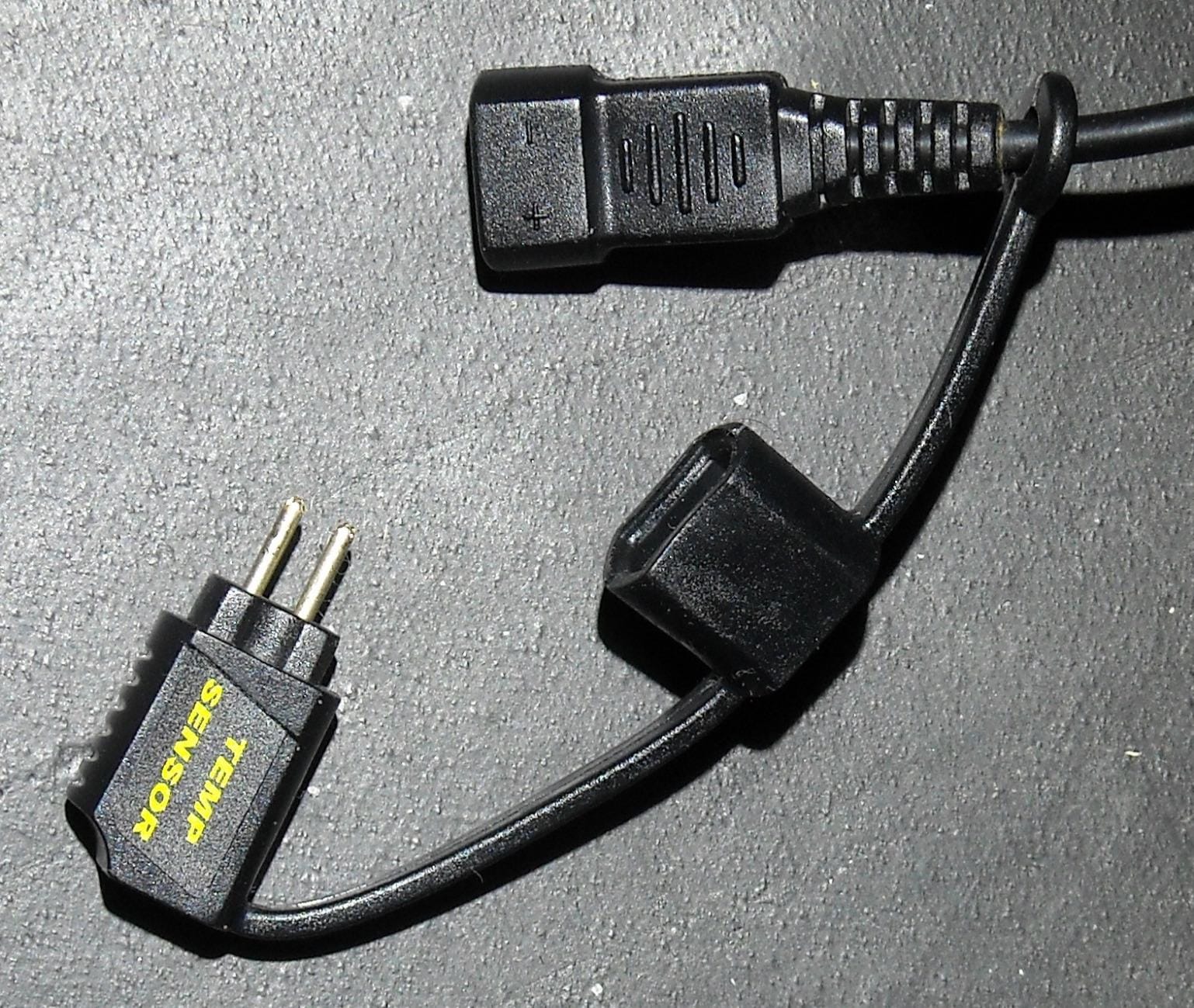
It accepts batteries down to roughly 3.5 volts, lower than most competing units, and works across flooded, sealed, maintenance-free starter, deep cycle, Optima AGM and marine batteries. Protection covers reverse polarity, short circuit and over-temperature, and the 90-240 volt AC input means it also works outside North America. The unit weighs 16 ounces and measures 2.7 by 8.7 by 6.7 inches.
Two things temper the recommendation. First, the warranty is not stated, which on a device people expect to keep for a decade is a real gap against units carrying 5, 10 and even 3-year terms. Second, at 1.5 amps it is slow for cycle charging larger deep-cycle or AGM packs, and the desulfation function gave little or no improvement on worn starter batteries while overcharging vented AGM batteries in some reports. For a maintained battery it is well suited; for a battery you want recovered quickly it is not.
Is a full-time desulfator worth the running cost?
The pulses are low amplitude, so the unit is essentially a maintainer with sulfation management layered on. For a bike that sits for months every year with the same battery, that is a reasonable extra layer of protection against the sulfation that builds on a partly charged pack over a season. For a battery that is already at the end of its life, no maintainer of any kind brings it back, and that includes this one.
The multi-battery capability is the more concrete reason to buy it. Owners who keep several vehicles on a tender generally keep a cheap single unit per bike, which is a workable approach. If you would rather tend them all from one box on the shelf, this is the only device here that does it, and the temperature compensation is the feature that makes outdoor or unheated placement more practical.
Who should skip this one
Skip it if you own a single bike. You would be buying parallel capability you never use, along with the only product here whose warranty terms are unstated. The small review base of 746 is loyal but thin, and the chemistry support is broad for lead-acid types while still having nothing specific for lithium iron phosphate.
Also skip it if your priority is fast recovery, because 1.5 amps is a maintenance-and-slow-charge rate and larger deep-cycle or AGM batteries need more. Riders who want a bench tool alongside their storage unit are better served by a higher-output charger with explicit recovery modes and a published charge time.
6. MOTOPOWER MP00205A 800mA – Best Budget Maintainer
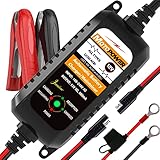
MOTOPOWER MP00205A 12V 800mA Automatic Battery Charger, Maintainer, Trickle and Desulfator
800mA 12V charger and maintainer
Charges to 14.4V and maintains at 13.6V
24-hour program timer
Zero output in standby
Pros
- Automatically switches to maintain mode at full charge so no supervision is needed
- Zero standby output means leaving it connected does not drain the battery
- Both ring terminal and alligator clamp leads are included
- Small and light enough to mount permanently on a motorcycle
Cons
- No on/off switch so it runs whenever plugged into AC
- 800mA is far too slow to bring a large deeply discharged battery up quickly
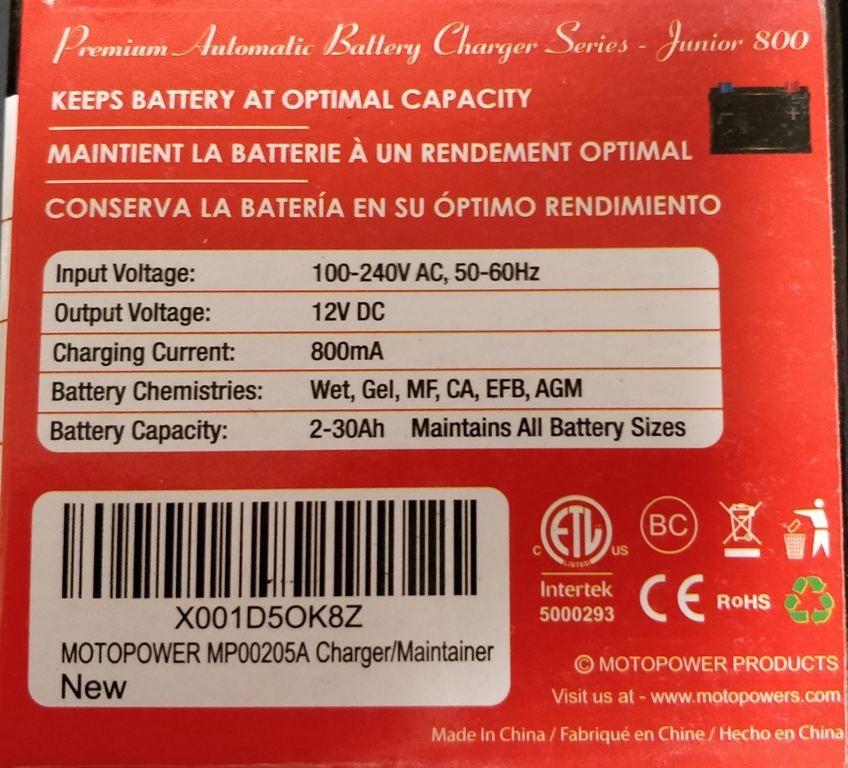
The MOTOPOWER MP00205A is the best motorcycle battery tender if the entire job is seasonal insurance on one healthy lead-acid battery and you want to spend as little as possible while still getting proper protection. It delivers 800 milliamps, charges to 14.4 volts, then maintains at 13.6 volts to limit gassing, with automatic sulfation detection and pulse desulfation during charging. It carries CE, FCC, ETL, RoHS and UL approvals and a 2-year manufacturer warranty.
The detail that matters most for winter storage is zero output in standby mode. Many cheap maintainers sit there quietly draining a battery through their own circuitry, which defeats the purpose over a five-month lay-up. This one does not, and motorcycle owners in particular treat it as cheap insurance against seasonal discharge, with many running a permanent ring-terminal install.
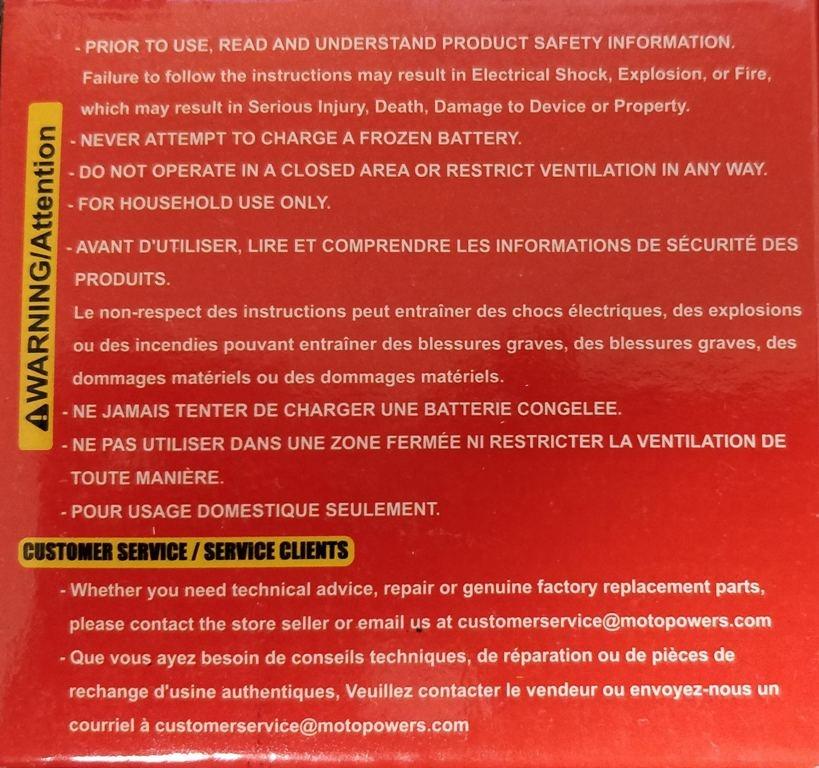
There is also a 24-hour program timer that terminates the charge and drops to maintain mode once the battery passes 14 volts, plus overcharge, short circuit and reverse polarity protection. It weighs 300 grams and measures 2 by 4.1 by 1.5 inches, so it is small enough to tuck under a seat or mount in a tight battery bay, and it uses 110 volts alternating current at the wall.
The reviews are candid about expectations. At 800 milliamps it is a maintainer that tops a battery off over days, not a charger that rescues one, and a minority report heat-related failures after several years of near-continuous daily service. It also has no on/off switch, so it runs whenever it is plugged in. If you want to service a car battery or a deep-cycle pack, this is not the device for the job.
Is the saving worth giving up features?
For a single lead-acid bike battery in ordinary storage, yes. The features you would give up are lithium support, temperature compensation, thermal recovery modes and multi-bank capability, and most riders with one lead-acid bike never needed any of them. The protections it does include, reverse polarity and overcharge, are the ones that actually prevent damage.
Where the trade stops being favourable is cold. Without a temperature sensor, the charge profile is fixed, and a fixed profile in a freezing garage is exactly the environment where a lead-acid pack is most vulnerable. If your garage is unheated and your winters are severe, that single missing feature is worth paying to avoid, and one of the higher-specification units is the better buy.
Who should spend more instead
Spend more if you have more than one bike, if your battery is lithium iron phosphate, or if you want to recover a battery that arrives at spring flat. None of those are problems this unit is built to solve, and buying it for them is a mismatch rather than a saving.
It also has no chemistry selection, so there is nothing to mis-set, which is a genuine advantage for a first-time owner who might otherwise pick the wrong mode. The trade is that it cannot service a lithium pack at all, even partially, because the profile is fixed to lead-acid.
7. OptiMate 1 DUO TM-409 – Best for Lithium and Lead-Acid
Tecmate TecMate Optimate 1 Duo, TM-409, 4-Step 12V / 12.8V 0.6A Battery Charger & maintainer
0.6A 4-step charger and maintainer
12V and 12.8V DUO for lithium and lead-acid
Savings mode halts circuitry drain
Dustproof case
Pros
- DUO version charges both lithium and lead-acid packs with one unit
- Savings mode stops battery drain from connected circuitry while parked
- Automatically stops and warns when a battery is faulty rather than overcharging
- Recommended by Honda Yamaha Kawasaki KTM and Husqvarna
Cons
- 240V input is the international version and is not suited to North American 120V outlets
- 0.6A output is the lowest in the group so recovery of a depleted battery takes overnight or longer
The OptiMate 1 DUO TM-409 is the best motorcycle battery tender when your household runs more than one chemistry, because it is the only unit in this group that handles lithium and lead-acid packs from the same box. The DUO version runs a four-step program across 12 and 12.8 volts, which is the lithium iron phosphate charge range, rather than restricting itself to 12V lead-acid. For a garage with one classic lead-acid bike and one newer lithium bike, that removes a purchase mistake riders make constantly in this category.
It is also recommended by Honda, Yamaha, Kawasaki, KTM and Husqvarna, which is a meaningful signal for owners who want the OEM’s blessing on their storage procedure. Operation is fully automatic connect and forget: it charges continuously if the battery is healthy and stops and warns if the battery is faulty, so it will not cook a dying pack. The savings mode stops discharge from the connected circuitry, which is the same no-drain principle that makes this safe to leave on indefinitely.
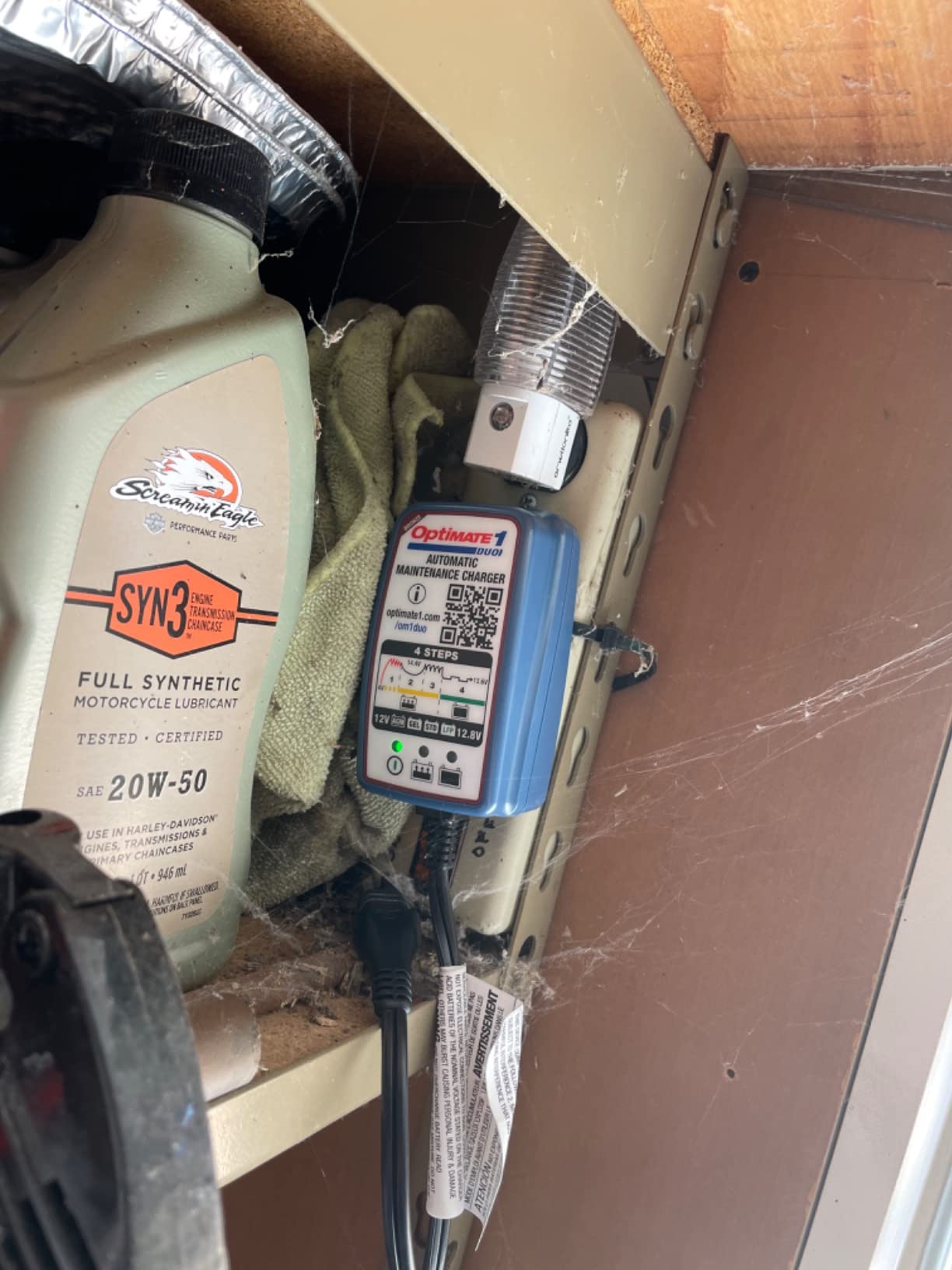
Motorcycle-specific owners dominate the reviews, using it on Harleys, KTM dirt bikes and Can-Am Spyders, and frequently report leaving it connected whenever the bike is not ridden. Long-term reviewers describe it as the only brand they buy repeatedly and mention never having a unit fail, with batteries lasting more than ten years on maintained storage. The case is dustproof for indoor use, and it comes with battery clips and a fused harness lead. The warranty is three years.
At 0.6 amps it delivers the lowest current in the group, which is fine for holding a healthy battery at float and slow for anything else. Recovery of a depleted battery takes overnight or longer, and that is a real constraint for a bike that has been sitting flat since last season. The two practical complaints owners raise are the plug body not fitting covered outdoor outlets without a short extension, and status light combinations that need some study to decode.
Does the DUO version handle a lithium pack safely in the cold?
It handles the chemistry correctly, which is the part this unit exists to solve. A 12.8 volt profile is what a lithium iron phosphate pack wants, and using a lead-acid absorption voltage on that pack is what causes lithium plating over time. One properly matched profile is worth a great deal when a household owns both types.
What no charger feature can remove is the underlying temperature limit. Lithium should not be charged below freezing, so a low-temperature charge cutoff or simply keeping a lithium battery in a conditioned space remains your responsibility. The chemistry match prevents one failure mode; it does not remove the other.
Before you buy this one, check the voltage
This is the most important practical warning in the whole roundup. The listed input for this model is 240 volts, which is the international version. North American outlets are 120 volts, so confirm the input rating on the unit before you commit. It is an easy mistake to make when ordering by model number alone, and it is the same family of error as buying the wrong variant within a product line.
Second, decide honestly whether you actually need dual chemistry. If your fleet is entirely lead-acid, that capability is money spent on a feature you will never exercise, and a higher-current single-chemistry unit is the better purchase. If you are swapping between bikes of different chemistries, this is the shortest path.
8. BikeMaster Lithium-Ion TS0207A – Best for Lithium Packs
BikeMaster Lithium-Ion Battery Charger/Maintainer
2A lithium-ion charger and maintainer
SAE quick disconnect with ring terminals
LED charge states
Circuit protection built in
Pros
- Purpose-built for lithium-ion bike batteries with a fast 2A charge
- Drops to a low maintenance current once charged so the bike can stay hooked up
- SAE quick disconnect plus ring terminals make a permanent install simple
- Small enough to store under a seat or in a tool bag
Cons
- Will not wake a deeply discharged lithium pack
- Only a 1-year warranty which is the shortest in the group
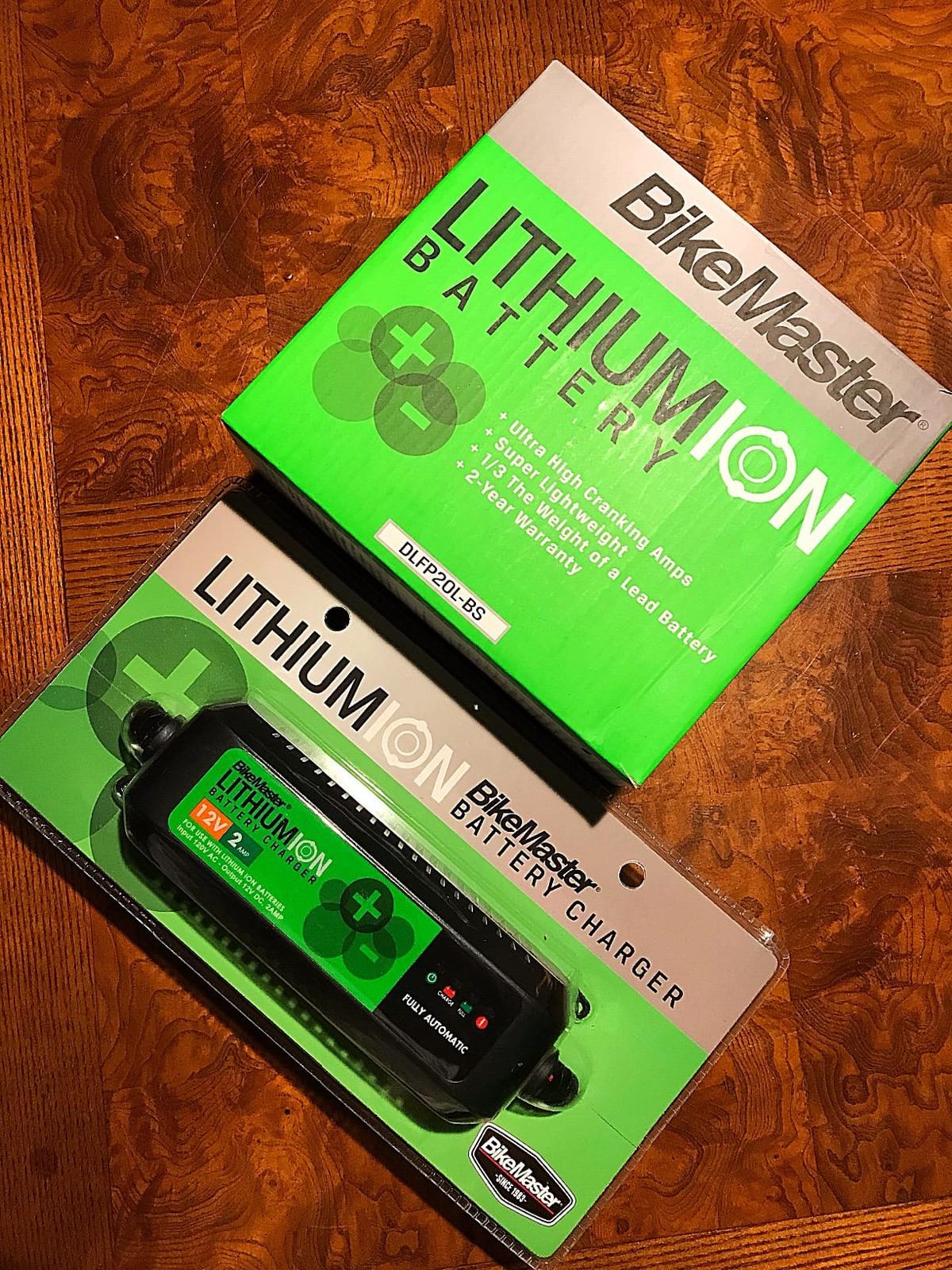
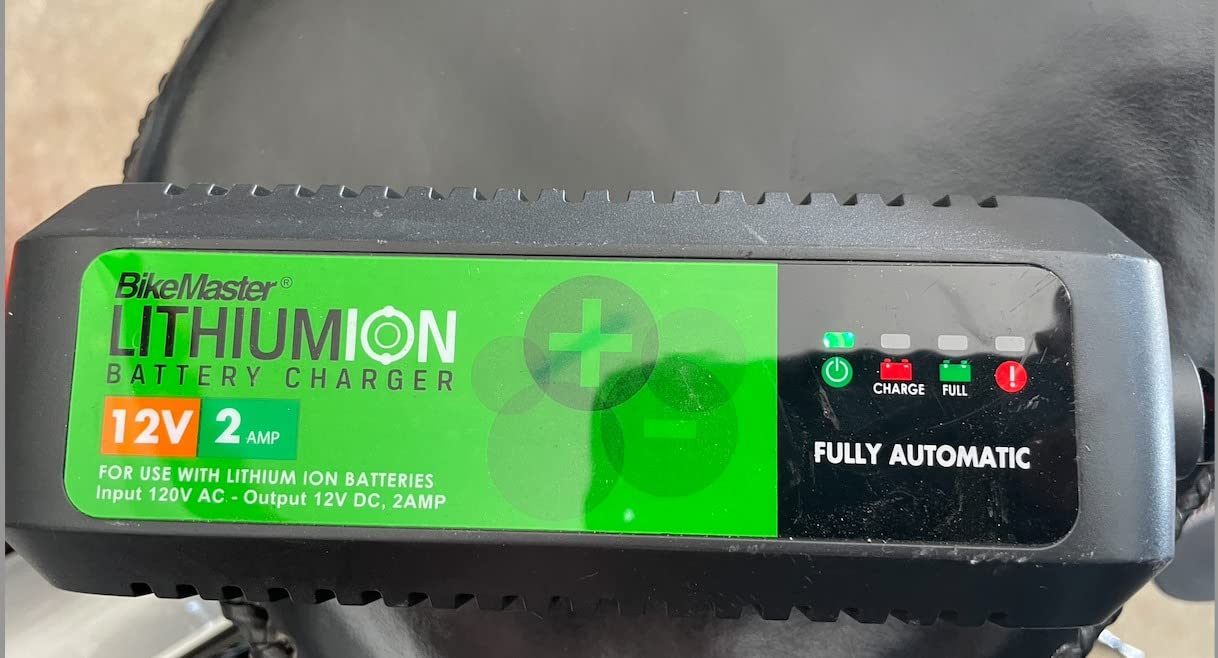
The BikeMaster Lithium-Ion TS0207A is the best motorcycle battery tender for a healthy lithium pack that you want back to full quickly in the spring. It outputs 12 volts at 2 amps from a 120 volt input, which is roughly two and a half times the current of a typical 800 milliamp maintainer, and owners report bringing a depleted pack up in under 45 minutes. Once charged it drops to a low maintenance current, so the bike can stay hooked up without harm.
The connection is the part that makes it practical. It comes with an SAE quick disconnect alongside large alligator clips and ring terminals, so you can run a permanent install on a bike whose battery is tucked away, or clip on for a seasonal top-up. LEDs for power on, charging and fully charged make the state obvious at a glance in a dim garage, and the shock-resistant ABS housing is small enough to live under a seat or in a tool bag between seasons.
Satisfaction clusters around packs that are healthy or only partly discharged, which is exactly what a storage tender is for. Built-in circuit protection covers overcharging, short circuit and reverse polarity, and the unit carries UL approval. In the roundup of lithium-capable options here, it is the only one purpose-built for a lithium-ion chemistry rather than adapted to it.
The dominant negative theme is a cutoff that keeps the unit from charging a pack that has dropped too low, and several owners had to jump a pack with a lead-acid charger first. Some also report the full-charge light never illuminating even when the battery is topped off, which makes the LED indicators less trustworthy than they should be. The 1-year warranty is the shortest of any product in this group, which matters if you are buying something to last a decade of winters.
Can it rescue a dead lithium battery?
No, and this is the single most important limitation to understand before buying. Several owners found the unit would not attempt a pack that had discharged too far, and had to revive it with a lead-acid charger first. A lithium battery management system will cut off charge below its own floor voltage to protect the cells, and a tender that respects that boundary will simply stop.
That behaviour is correct for lithium even though it is frustrating. A lead-acid pack can be walked back from nearly anything slowly, but forcing current into a deeply discharged lithium pack is how you get lithium plating and permanent capacity loss. If your storage routine has already missed a season, plan on a recovery tool rather than assuming a storage tender will do both jobs.
What to check before fitting it to a lithium bike
Confirm the connector first. The SAE quick disconnect is a two-pin standard that many bikes have a socket for, which makes a permanent install a two-minute job, but plenty of motorcycles use a different accessory socket or a DIN connector, and some CAN-bus systems will not pass charge through an accessory socket at all. Check your bike before assuming the plug fits.
Then confirm the chemistry is lithium iron phosphate rather than a lithium-polymer pack designed for a different charge profile, and check the warranty terms against how long you expect to keep the unit. For a one-season recovery tool the 1-year term is acceptable. For something you plan to leave connected year after year, a longer warranty is worth choosing for.
Do You Even Need a Motorcycle Battery Tender?
Sometimes you do not, and it is worth saying so before spending anything. A stored lead-acid motorcycle battery loses charge steadily through self-discharge, and several riders on r/motorcycles report parking a bike for an entire winter with no tender at all and starting fine in the spring. A short lay-up in a mild climate with a healthy battery genuinely may not need a maintainer.
What changes the answer is duration, temperature and starting condition. Self-discharge alone is modest, but a battery that sits partly charged for months accumulates sulfation, and a cold garage makes every stage of that worse. Riders in cold climates consistently treat a tender as the cheapest way to avoid replacing a battery every spring, which is a reasonable calculation when a battery is a recurring annual expense.
Three situations settle it. You are storing for more than about two months. Your garage is unheated in winter. Or your bike carries lithium iron phosphate, where the charging rules differ enough that a maintainer is the safe choice rather than an optional one. Riders who skip the tender successfully usually have at least one of those three working in their favour.
If your battery is already dead, a tender may not be the purchase you need. Test it before you store, and if it will not hold a charge, replace it rather than expecting a maintainer to bring it back. Maintenance is a different job from recovery.
Can You Leave a Motorcycle Battery Tender On All Winter?
Yes, provided the unit is a true float-charging maintainer rather than an unregulated trickle charger. A maintainer runs a multi-stage charge and then holds the battery at float voltage, monitoring it and only pushing current when voltage falls, so it can stay connected for months without cooking the battery. Every maintainer in this roundup is designed for exactly that.
The exception is worth naming, because it is the difference between the three device types. An unregulated trickle charger pushes a fixed small current forever. On a lead-acid battery over a long lay-up that leads to continuous gassing, water loss and a shorter life, and on a lithium pack it is simply the wrong voltage. Forum threads about whether it is safe to leave a charger on for months almost always describe this device, not the smart maintainers on our list.
For lithium, the rule is different in kind rather than degree. A LiFePO4 pack should not be charged below freezing, because charging a cold cell causes lithium plating that permanently reduces capacity. That means a chemistry match plus either a low-temperature charge cutoff in the charger or a battery stored somewhere above freezing. No feature substitutes for keeping the pack warm.
Two practical safety habits are worth keeping. Check the electrolyte level on a vented flooded lead-acid battery a couple of times over a long storage, and keep the tender on a hard surface in a ventilated space rather than on a blanket or cardboard. Neither of those is about the charger; both are about the room it sits in.
Lead-Acid or Lithium? Check Before You Buy
Identify the chemistry before you compare anything else, because it eliminates most of the field instantly. Here is the three-step check that takes about two minutes.
First, read the label on the battery itself. It will say flooded lead-acid, sealed maintenance-free, AGM, gel, or it will say lithium, LiFePO4 or lithium iron phosphate. A lithium pack usually has a BMS module with a connector, and it is often visibly a different size and shape from the lead-acid box it replaced.
Second, check the motorcycle. Some bikes moved to lithium iron phosphate as standard in recent years, and the owner manual will state the charge requirement. If the manual specifies a lithium charger, that overrides anything you read on the internet, including this article.
Third, check the access socket. If your bike has a DIN or CAN-bus accessory socket, some systems will not pass charge through it, and you should plan on connecting at the battery terminals rather than through the socket. Owners with CAN-bus bikes raise this repeatedly because the socket looks like the obvious answer and frequently is not.
Once you know the chemistry, the match is simple. Lead-acid, AGM and gel packs are handled by every product on this list, with the exception of the dedicated lithium unit. Lithium iron phosphate needs a 12.8 volt profile, which in this roundup means the OptiMate 1 DUO or the BikeMaster lithium charger. That is the whole decision, and getting it wrong is the most expensive mistake in this category.
Where to Mount It and What to Do With No Power Access
Placement is the practical problem competitors rarely address, and it is the one riders actually hit. The nearest outlet is rarely behind the bike. Cord reach across this group runs from 24 inches on the NOCO, which is designed for a permanent mount right at the battery, to the 12-foot output cord on the Battery Tender Junior. Between those sit shorter eyelet leads that owners often extend themselves.
Work out the reach before you buy, using the actual path the cord has to take rather than a straight line. Down, around the frame rail, back along the wall, and then some slack so the bike can be moved without dragging the charger off the shelf. A tender whose cord must be stretched taut will be unplugged at the first opportunity, and an unplugged tender is doing nothing.
For a garage, the shelf beside the outlet usually wins over a wall mount far from the bike, and a hard surface in a ventilated position beats a blanket on a cold floor. For a covered porch or an outdoor run, the IP65 rating on the CTEK is the specification that matters, since splashing water corrodes terminals and internal boards. A multi-season outdoor install also wants a fused ring terminal rather than bare clips, and if the machine itself lives outside for the season our guides to boat covers for winter storage and RV covers for winter storage cover protecting the vehicle while the battery sits on a maintainer.
Now the harder scenario: no power access where the bike is stored. A detached shed, an outdoor parking spot, an apartment complex with no outlet you control. The forum answer is consistent and correct. Disconnect the battery and carry it somewhere with power, keep it off the floor on a shelf, on a maintainer, and stuff a rag in the exhaust before the bike goes into storage.
For lithium, that indoor move is not merely convenient, it is required. A LiFePO4 pack should not be left in a freezing unheated space, and removing it to a conditioned room removes the question entirely. For lead-acid in a mild climate you can leave it, but a cold shed is where stored batteries crack, so removal is the safer default in real winter conditions.
While the battery is out, take the opportunity to check it. A rested voltage of about 12.6 volts or higher on a 12V lead-acid pack means healthy, and a reading under 10.5 volts means the battery is spent and should be replaced rather than tendered. That ten-minute check decides whether you are storing a battery worth keeping.
How to Choose a Winter Storage Battery Tender
Start with output current, and do not overspend on it. A motorcycle battery is typically a small 12 amp-hour pack, and anything between 0.6 and 1.25 amps is a sensible maintenance rate for holding it at float through a season. Amps beyond that only matter if you also want the unit to recover a flat battery, which is a different purchase with a different price expectation.
Next, chemistry support, and be precise about what you need. A lead-acid-only unit is fine for a lead-acid-only fleet. A lithium iron phosphate pack needs a 12.8 volt profile, and in this group that is a shortlist of two. If you might add a lithium bike later, the dual-chemistry option is cheaper than replacing a unit you already own.
Third, understand the three device types, because the terminology is genuinely confusing and the difference is safety-related. A trickle charger is a fixed low current with no monitoring, and it is not intended to stay connected indefinitely. A battery maintainer, which is also called a tender, runs a multi-stage program and drops to float or pulse, and it is designed for months of connection. A smart charger adds recovery modes, chemistry selection and higher current. Most products sold under all three names fall into the middle or upper category.
Fourth, temperature compensation. An integrated thermal sensor adjusts charge for ambient conditions, and in an unheated garage over winter that is a meaningful difference rather than a spec-sheet nicety. It matters most for lead-acid in cold conditions, where a fixed profile is least appropriate.
Fifth, warranty length. Owners in the forums treat these as once-a-decade purchases, so a 5-year or 10-year term is worth real money at the margin. Conversely, a product with no stated warranty, however capable, is a harder yes when you intend to leave it connected indefinitely.
Sixth, the leads. A fused ring terminal and a quick disconnect are what make seasonal use painless, because you fit the permanent part once and connect from a reachable point. Long cords help, but a quick disconnect solves the same problem more cleanly when the battery is buried. Note that some units ship with clips only, and some eyelet leads are short enough that owners splice an extension.
Finally, check the input voltage. This is the most common and most avoidable purchase error, and it is not limited to one brand. Some model numbers in this category ship in a 240 volt international version that will not run on a North American 120 volt outlet, and some product lines have near-identical model numbers with different chemistry support. Read the model number, not the product name.
One last timing note. A winter storage tender is a seasonal purchase you need in a specific window, not a deal you should wait for. Buying it in the autumn when you need it is worth more than waiting months for a discount on a device you cannot use until the following season.
What Riders on Forums Actually Keep on the Shelf
The search results for this question are dominated by forum threads rather than editorial pages, so owner consensus is the most useful evidence available. On the Triumph Rat forums, the recurring endorsement is for OptiMate chargers, described as not cheap but the best, reliable and easy to use. Adventure Rider threads recommend the smallest NOCO Genius because it has all the settings needed in one control, covering flooded, AGM, lithium and 6V.
The Battery Tender Junior is the default answer in r/motorcycles threads, and the advice that comes with it is blunt. If you do not have power where you are storing the bike, disconnect the battery and hook it up to a tender somewhere you do have power. That is the same protocol described in the placement section above, arrived at independently by a lot of riders.
Two other patterns are worth naming. Several owners keep more than one unit, with cheap maintainers on stored vehicles and one higher-output unit on the bench for batteries that turn up flat, which validates buying a maintainer for storage and treating recovery as a separate need. And the honest counter-narrative exists: a fair number of riders report parking a bike all winter with no tender and starting fine in the spring.
On lithium, the recurring forum view is that it self-discharges far less than lead-acid, so a small 800 milliamp tender is sufficient if one is used at all. That is broadly right for a healthy pack, and it is also why the chemistry match matters more than the current rating.
Frequently Asked Questions
Can I leave my motorcycle battery tender on all winter?
Yes, if it is a true float-charging maintainer rather than an unregulated trickle charger. A maintainer runs a multi-stage charge, then holds the battery at float voltage and only pushes current when voltage drops, so it can stay connected for months without overcharging. The exception is lithium iron phosphate, which should not be charged below freezing because that causes lithium plating.
What is the best battery maintainer for winter storage?
For most riders with a 12V lead-acid motorcycle battery, the Battery Tender Junior 750mA is the strongest all-round choice. It runs a four-step program into float, weighs one pound, includes both a fused ring terminal and alligator clips, and carries close to fifty thousand reviews averaging 4.8. If your garage is cold or your pack is lithium, a higher-current or dual-chemistry unit is the better match.
Is it safe to leave my motorcycle battery on a trickle charger all the time?
Not with an unregulated trickle charger, which pushes a fixed small current indefinitely. On a lead-acid battery over a long lay-up that causes continuous gassing and water loss, and on a lithium pack it applies the wrong voltage entirely. A battery maintainer or smart charger monitors the battery, drops to float or pulse, and is specifically designed to stay connected for months. Confirm your unit has a float stage before leaving it on.
How long can you leave a motorcycle battery on a battery tender?
For the entire storage period, which is the design intent. Every float-charging maintainer in this roundup is meant to be connected for months at a time, and owners report leaving them hooked up through many winters without checking. The exception to be careful with is a lithium iron phosphate pack in a freezing space, which should be kept above freezing or fitted with a low-temperature charge cutoff.
Can you use a normal battery tender on a lithium motorcycle battery?
No. A lead-acid tender runs an absorption voltage around 14.4 to 14.7 volts, which is wrong for a lithium iron phosphate pack that wants a 12.8 volt profile. Forcing a lead-acid profile onto lithium causes lithium plating, which permanently reduces capacity. In this roundup the OptiMate 1 DUO and the BikeMaster lithium charger both handle lithium packs properly.
How many amps do I need for a motorcycle battery tender?
Between 0.6 and 1.25 amps for holding a healthy motorcycle battery at float through a season, since a typical bike battery is a small 12 amp-hour pack. More current only earns its cost if you also want the unit to recover a flat battery, which is a different job. Owners frequently report overpaying for amps a small bike battery does not need.
The Verdict
The best motorcycle battery tender for winter storage for most riders is the Battery Tender Junior 750mA, model 021-0123. It does one job properly, sits at float for months without supervision, includes both connection types you might need, and has the largest owner history in this group at close to fifty thousand reviews averaging 4.8.
Move up to the Battery Tender Plus 1.25A if you want more current and a 10-year warranty, to the CTEK MXS 5.0 if your garage is cold and unheated, to the NOCO GENIUS2D if you want a permanent mount and genuine recovery modes, and to the OptiMate 1 DUO or the BikeMaster unit if you run lithium iron phosphate.
Whichever you choose, buy it in the season you need it, confirm the chemistry match before you order, and check the input voltage. A tender is a once-a-decade purchase that should be sitting in your garage ready before the first cold morning. For related storage guidance, our guide to car battery chargers for winter storage covers the same float-versus-trickle question for larger packs, and RV battery monitors for lithium battery banks goes deeper on reading state of charge on lithium systems.