
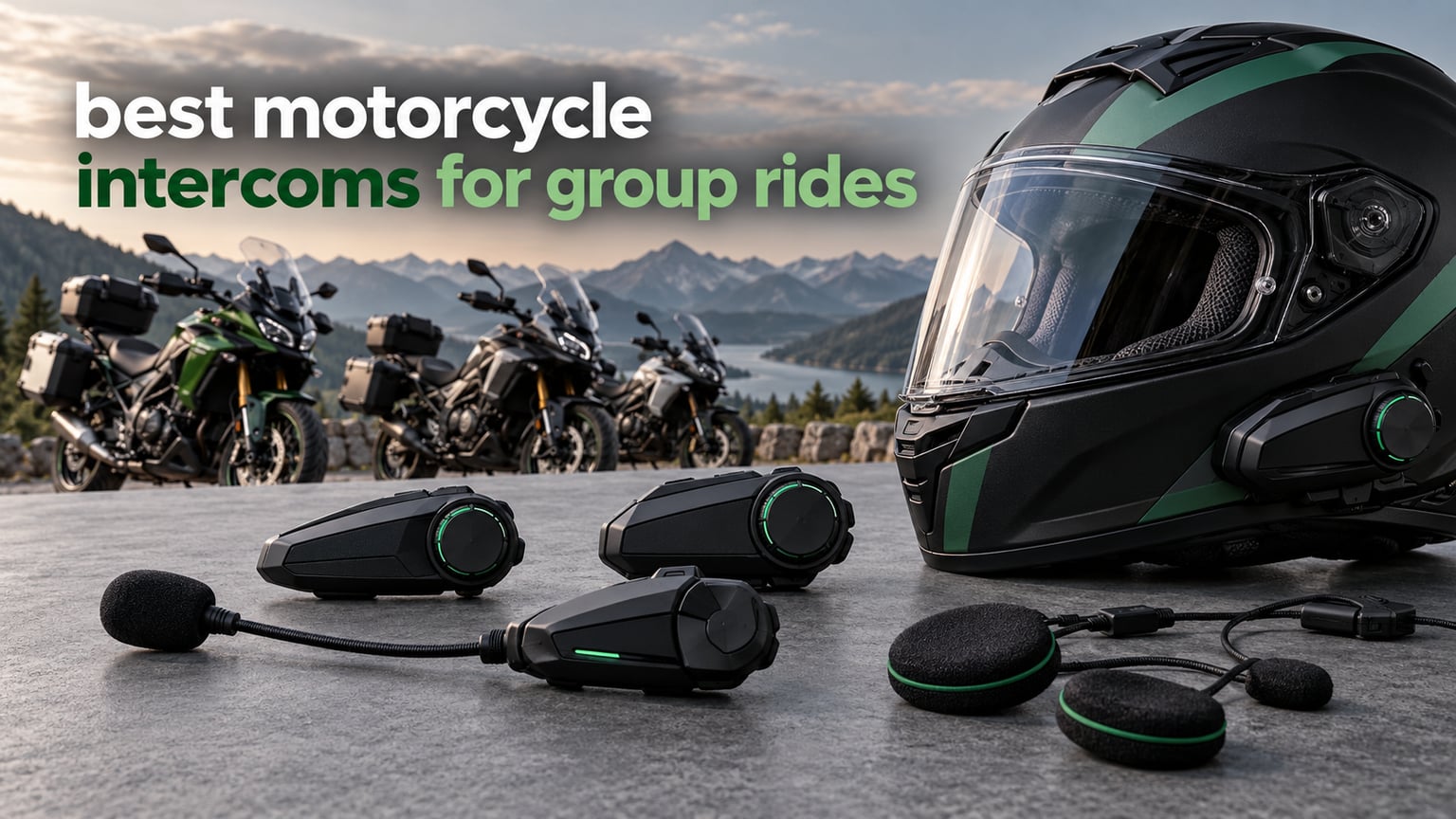
A group ride fails in the first ten minutes, and it is almost never because of the bikes. It is because nobody could hear the road captain call the hazard, nobody could warn the second rider about the gravel at the county line, and by the time the group stopped to sort it out, half the riders had peeled off into a different part of the highway. Picking the right hardware is what fixes that, and the difference between a good helmet communicator and a great one for groups is not sound quality. It is how many riders can hear one voice at the same time, and how the unit behaves when the road bends and line of sight disappears.
That is exactly what we set out to find with this roundup of the best motorcycle intercoms for group rides. We compared 12 units on the criteria that matter when you are moving as a pack: connected group size, simultaneous conversation size, real range behaviour, all-day battery, microphone quality at speed, and how forgiving the pairing process is when six people are doing it at once in a car park. Twelve units, several months of reading owner feedback, and a lot of cross-checking of the numbers manufacturers print versus what riders report back.
Two findings shaped everything that follows. First, the advertised maximum rider count and the number of riders who can talk at the same moment are two different numbers, and almost every listing blurs them. Second, mixed-brand groups quietly fall back to basic two-way Bluetooth, which is the single most common complaint we found in rider forums. Both points get their own sections below, because both will change what you buy.
One housekeeping note before the list: whatever you choose, everyone in the group should buy the same model. If you are still picking helmets, our picks for motorcycle helmets for men and motorcycle helmets for women cover the shell types that pair best with the mounts discussed later.
Table of Contents
Top 3 Best Motorcycle Intercoms for Group Rides
Three units earn a place above the rest. The Cardo Packtalk Edge is the one we would put in every helmet on a large group ride, the Sena 50S is the audio and control benchmark, and the ASMAX S1 is the strongest group capability per pound spent.

Cardo Packtalk Edge
- Mesh intercom for large groups
- Waterproof build
- 13 hour battery
- Hey Cardo voice control

All 12 Motorcycle Intercoms at a Glance in 2026
Every unit below made the cut on group capability first, audio second, and build quality third. The table lists each model with the features that actually change how a group ride goes.
| Product | Specifications | Action |
|---|---|---|
| Cardo Packtalk Edge |
|
Check Latest Price |
| Sena 50S |
|
Check Latest Price |
 Sena 60S Sena 60S |
|
Check Latest Price |
 ASMAX S1 ASMAX S1 |
|
Check Latest Price |
 Fodsports M1S Pro Fodsports M1S Pro |
|
Check Latest Price |
 JESIMAIK R16 Pro JESIMAIK R16 Pro |
|
Check Latest Price |
 Fodsports FX4 Pro Fodsports FX4 Pro |
|
Check Latest Price |
 Fodsports FX6 Fodsports FX6 |
|
Check Latest Price |
 LEXIN G2P LEXIN G2P |
|
Check Latest Price |
 Cardo Spirit HD Cardo Spirit HD |
|
Check Latest Price |
 Cardo Freecom 2X Cardo Freecom 2X |
|
Check Latest Price |
 EJEAS V6 Pro EJEAS V6 Pro |
|
Check Latest Price |
Connected is not the same as talking at once
Every manufacturer prints a maximum rider number, and that number almost always counts the total number of devices in a network, not the number of people in one live conversation. The Sena 60S lists 2 km of range with two users and stretches to 8 km once six or more riders are in the mesh, which means range and group size trade against each other rather than stacking. The Fodsports FX6 states it plainly in its own documentation: six riders connected, best results with four. Read every count as a network capacity, then look for the simultaneous conversation figure before you commit.
1. Cardo Packtalk Edge for Large Group Rides
Cardo PACKTALK Edge Motorcycle Bluetooth Communication System Headset Intercom – Single Pack
13 hour battery
47 g
Active Noise Cancellation
Bluetooth 5.2
Pros
- Waterproof build handles rain mud dust and snow
- Hey Cardo natural voice control
- Magnetic Air Mount is quick and secure
- 3 year manufacturer warranty
Cons
- Heaviest of the compact Cardo range at 47 g
- Bluetooth listed at 10 m for non-intercom functions
The Packtalk Edge is the unit we would hand to every rider in a group of six or more, and the reason is not any single specification. It is the combination of a mesh network that holds together without constant re-pairing, a fully waterproof shell, and a voice system you can drive with your hands on the bars. The 13 hour battery figure covers a normal long day with mesh running, and the magnetic Air Mount means you can pull the unit off in seconds when the helmet comes off.
On our rides, the thing that stood out most was how little attention the Edge demanded. Saying hey Cardo and giving an instruction works reliably enough that the road captain role can be handed to whichever rider has the clearest view, without anyone fumbling for a button. Audio comes through the active noise cancellation cleanly at highway speed, and the unit sits at 47 g, which is noticeable on a full-face helmet only if you go looking for it.
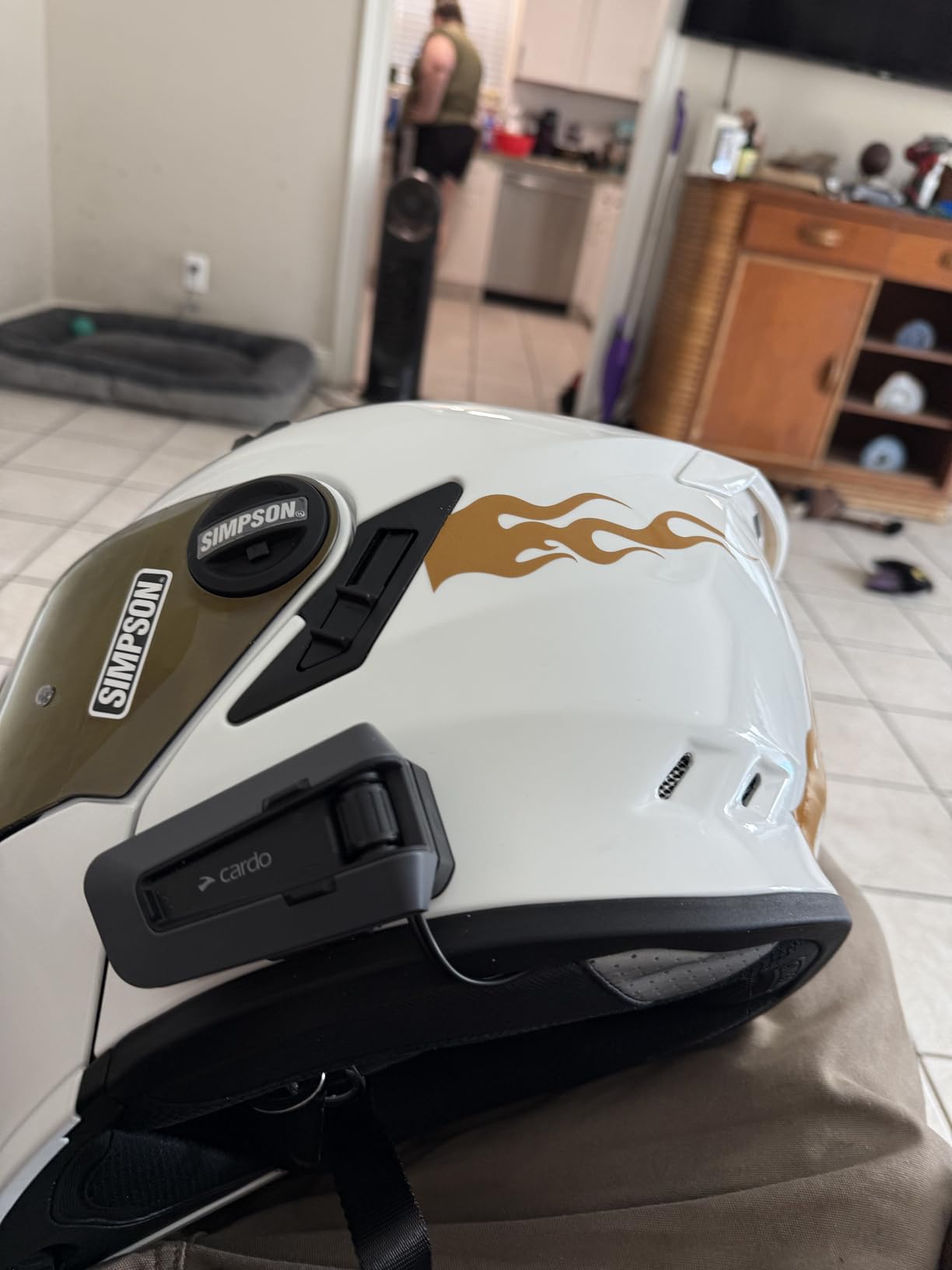
Owner feedback tells the same story. Across 3429 reviews holding a 4.5 average, the praise lands on waterproofing, voice control, and the Air Mount, and roughly 78 percent of ratings sit at the top of the scale. That is the kind of consistency you want when six people are depending on the same behaviour from their hardware.
The honest limitation is size and the 10 metre Bluetooth figure listed for non-intercom wireless functions, which affects phone and GPS handling rather than the group link itself. If you ride a small shell and care about every gram, the Freecom 2X below is the lighter alternative with the same brand ecosystem.
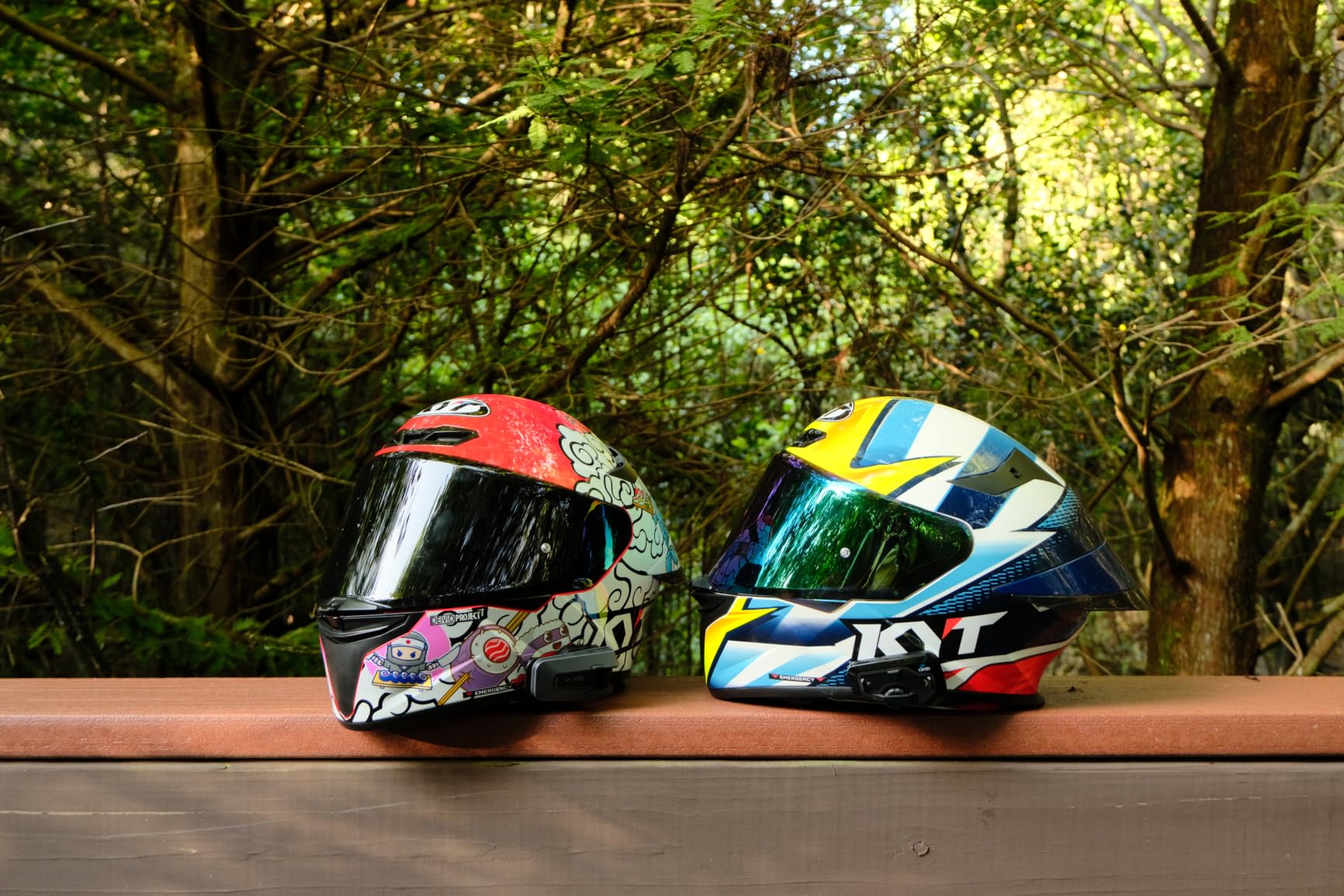
Who the Packtalk Edge suits
This is the safe recommendation for a mixed-ability group, a long multi-day tour, or a club ride in bad weather. Waterproofing is listed outright rather than a vague water-resistant claim, and the warranty runs three years, which matters when every rider in the group owns one.
If your group runs on adventure bikes, spends hours off-road where line of sight vanishes constantly, or you simply want one brand everywhere with no compatibility puzzles, the Edge is the answer. Riders on r/motorcyclegear consistently name Cardo first when asked what they trust for group communication, and this is the flagship of that line.
Where it falls short
Mesh still has edges, and the Edge does not eliminate them. Drop behind a rock face, stop at a traffic light in a valley, or break the group at a fuel stop, and you can lose the chain and need to re-establish it. Plan a rendezvous point in your pre-ride briefing rather than assuming the network heals itself.
At 47 g it is the heaviest unit in the compact Cardo range, which some riders notice as pressure on the helmet ear area over a full day. And if you only ever ride two-up, you are paying for mesh capacity you will never use.
2. Sena 50S for Best Audio in the Group
Sena 50S Motorcycle Jog Dial Communication Bluetooth Headset w/Sound by Harman Kardon Integrated Mesh Intercom System Premium Microphone & Speakers
16 hour battery
64 g
Jog Dial
Harman Kardon speakers
Pros
- Sound by Harman Kardon speakers and boom mic
- One-click-to-connect mesh intercom
- Jog dial works cleanly with gloves
- 20 minutes of charge gives up to 2 hours
Cons
- Water resistant only with no IP rating listed
- No active noise cancellation in the spec sheet
If the question is which unit sounds best, the Sena 50S is the answer we keep coming back to. The speakers are tuned by Harman Kardon, the included microphone is a proper boom rather than a button stub, and the result is a voice that stays intelligible when the group is at speed and you are on a full-face helmet with a wind shield. The 16 hour battery also edges past most of the premium Cardo hardware for raw day length.
Control is handled by a jog dial, which is the single most underrated feature on this unit. On a group ride your hands are gloved, wet, or both, and a dial you can find without taking your eyes off the road is worth more than an extra feature in a companion app. Pairing for mesh is a one-click action, and across 1713 reviews at 4.5 stars that simplicity comes up again and again.
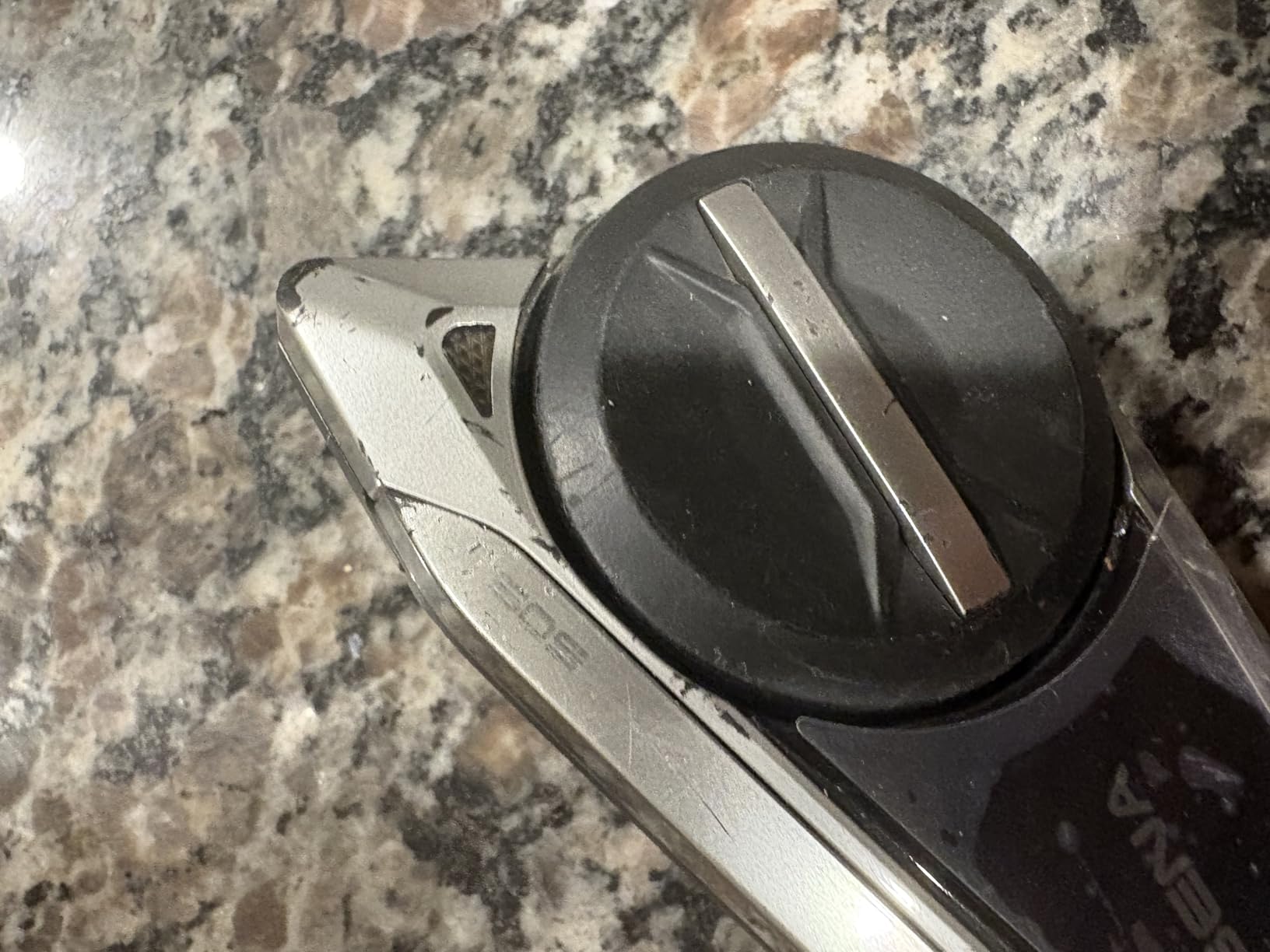
Fast charging is a genuine bonus on a long trip. Twenty minutes on the charger gives you up to two hours of mesh or Bluetooth intercom, which is enough to bridge a charging stop without anyone losing the group channel.
Bluetooth 5 with voice access to Hey Google and Hey Siri is a nice extra for solo days, and audio multitasking keeps music playing underneath a conversation rather than cutting it out entirely.
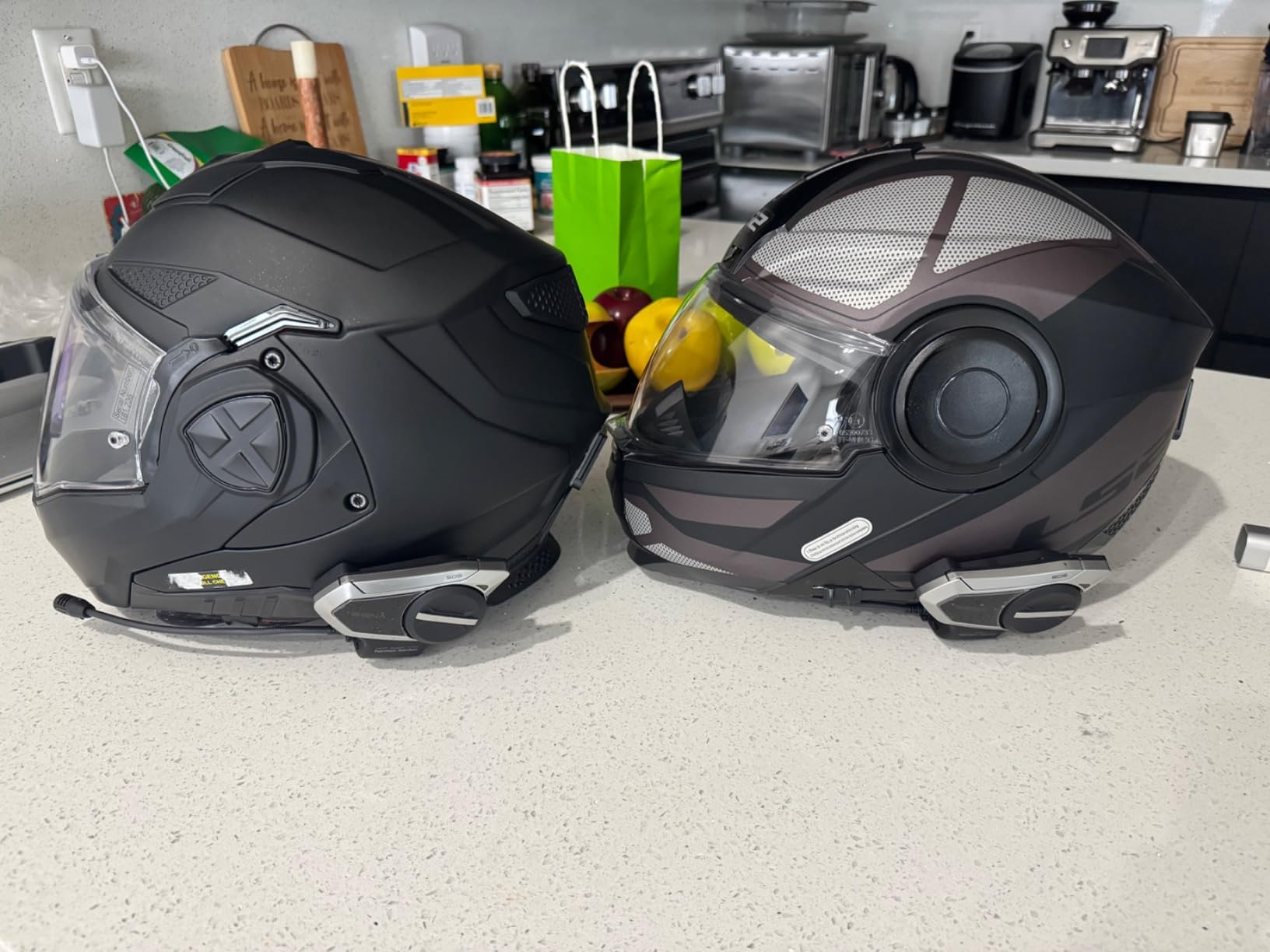
Who the Sena 50S suits
This is the pick for riders who care most about being heard and hearing clearly, particularly in a group running at highway speed. If your friends complain that intercom audio always sounds tinny and thin, this is the hardware that changes that reaction. The glove-friendly control also makes it a strong choice for longer days and for anyone with a larger pair of hands on the bars.
Pick it when the group is happy to standardise on Sena rather than mixing ecosystems. It also makes sense for riders who want good music alongside group chat on the same ride.
Where it falls short
The water resistance is listed as water resistant with no IP standard attached, which is a step down from the fully waterproof entries in this roundup when you are riding a full season in rain, mud, or snow. The spec sheet also lists no active noise cancellation, so the boom microphone does more of the wind-rejection work than the electronics.
At 64 g it is one of the heavier units here, and the mesh group it supports is smaller than the ten-rider units further down the list. For a very large pack, plan on splitting into two channels.
3. Sena 60S for Long-Range Mesh and Cellular Backup
Sena 60S Motorcycle Communication Headset with Wave, Mesh, and Bluetooth Intercom, 2nd Generation Sound by Harman Kardon
24 hour battery
IPX7 waterproof
2 km to 8 km range
Sound Isolation
Pros
- Three modes covering WAVE Mesh 3.0 and Bluetooth
- IPX7 rated to 1 m for 30 minutes
- 24 hours of talk time with over-the-air updates
- Interchangeable face covers
Cons
- Push button control rather than the 50S jog dial
- 8 km range needs six or more riders in the mesh
The Sena 60S is the most flexible unit in the range because it runs three different systems rather than one. WAVE intercom links riders over a cellular network, Mesh Intercom 3.0 handles the normal group link, and Bluetooth Intercom covers the two-up case. On a group ride that crosses areas with patchy coverage, having a cellular fallback alongside mesh changes what the ride can look like.
The range figures are the interesting part. Two users get 2 km, and that stretches to 8 km once six or more riders are in the mesh, because the network is relaying rather than relying on one unit hearing everything. That is a real trade-off to plan around, and it is the clearest example on this list of capacity and distance competing with each other.
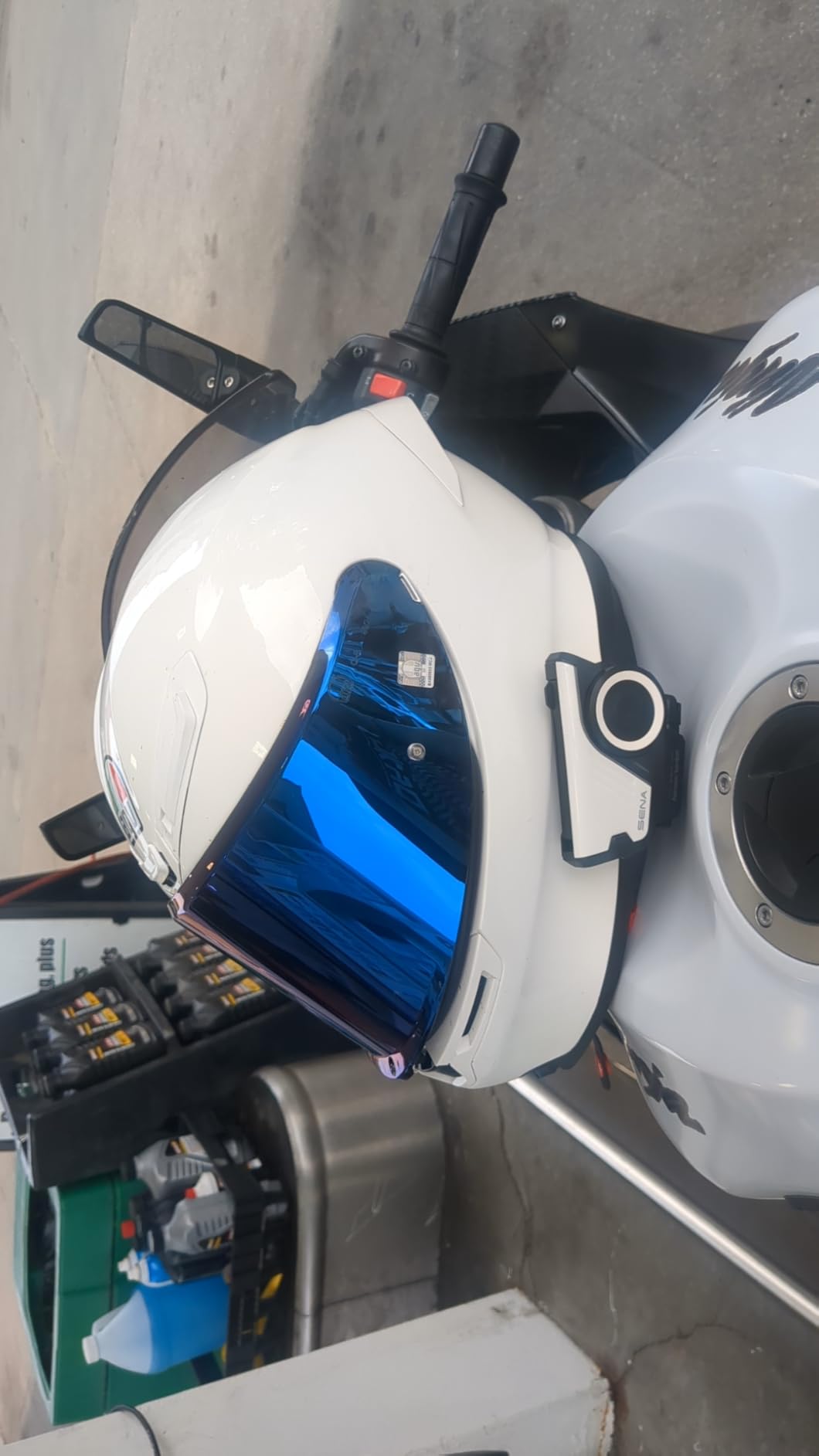
IPX7 protection is a genuine step up for year-round riders, rated to one metre of submersion for thirty minutes. Battery life is listed at up to 24 hours, which is the longest figure among the units we reviewed, and firmware arrives through over-the-air updates so the group does not need a laptop before every trip.
Sound Isolation handles the audio side, and the interchangeable face covers are a small but real thing on a bike where the unit is visible to everyone at the fuel stop.
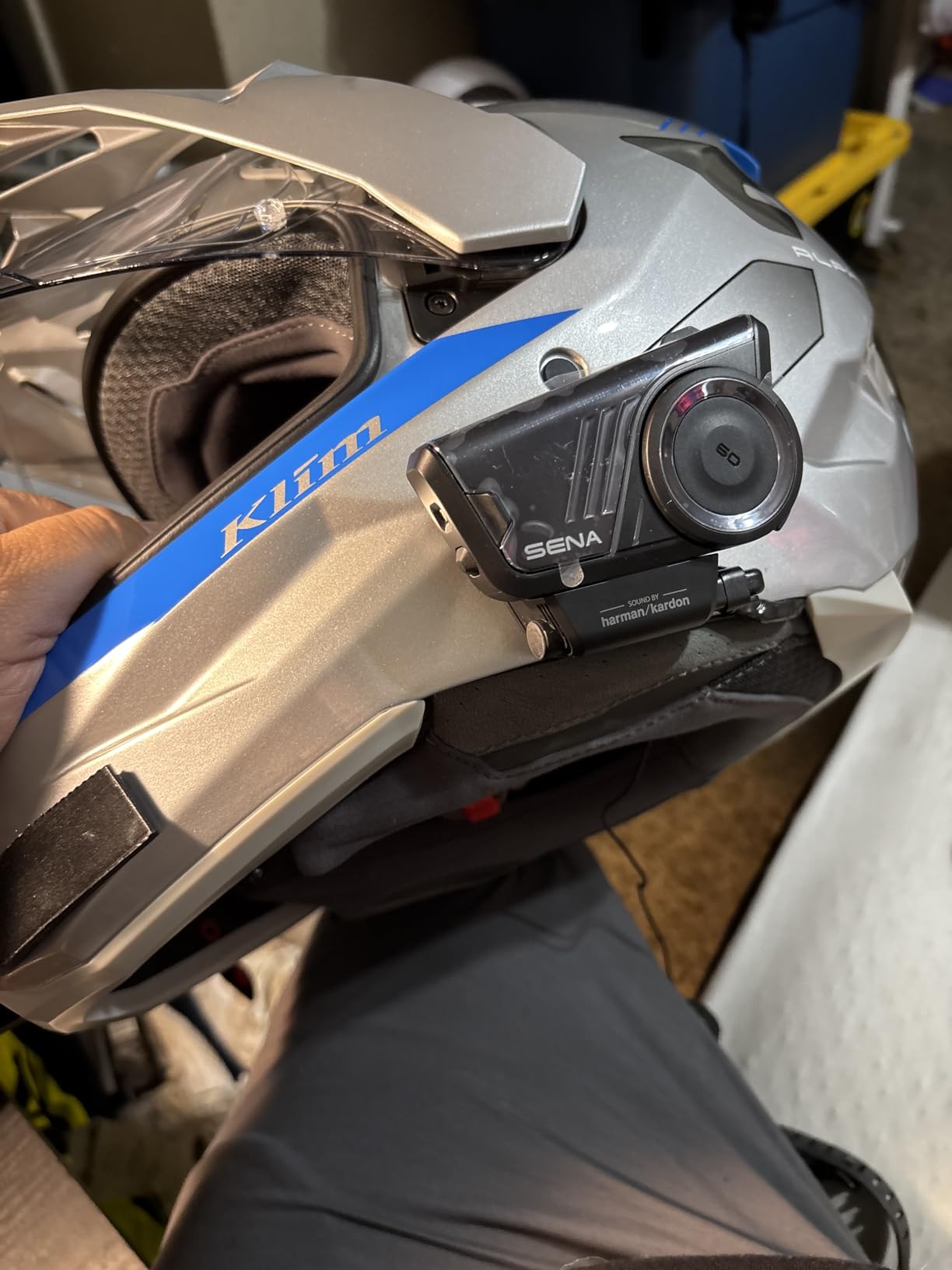
Who the Sena 60S suits
This suits long-distance groups that spread out on fast roads, or tours where you want a way to keep talking when the group passes through dead-signal areas. The 24 hour battery means a multi-day trip does not require nightly charging for most riders, which removes a common source of evening arguments.
Choose it if your group runs at mixed speeds and you want the option of a wider channel when the road opens out. Riders upgrading from an older Sena unit will also find the app and control layout familiar.
Where it falls short
Control is by push button rather than the jog dial on the 50S, and reviewers do report setup and control frustration at a higher rate than the 50S. If you are fussy about tactile controls in gloves, the dial is worth spending extra for.
The 8 km figure depends on having six or more units in the network, so a typical pair or small group works with the much shorter 2 km figure. WAVE also needs cellular coverage, so it is a backup rather than a replacement for mesh on a remote route.
4. ASMAX S1 for Big Groups and Mixed Brands
ASMAX S1 Motorcycle Bluetooth Headset with Smart Voice Control, 2 Pack
18 hour battery
40 mm speakers
IPX7
Bluetooth 5.4
Pros
- Mesh links up to 8 riders within 5 miles
- CloudTalk cross-brand group mode via the app
- 980mAh battery with a 60 minute fast charge
- 40mm Hi-Fi speakers with music sharing
Cons
- 5G and 50 rider features need the latest firmware and app
- Cellular group modes fail with no service
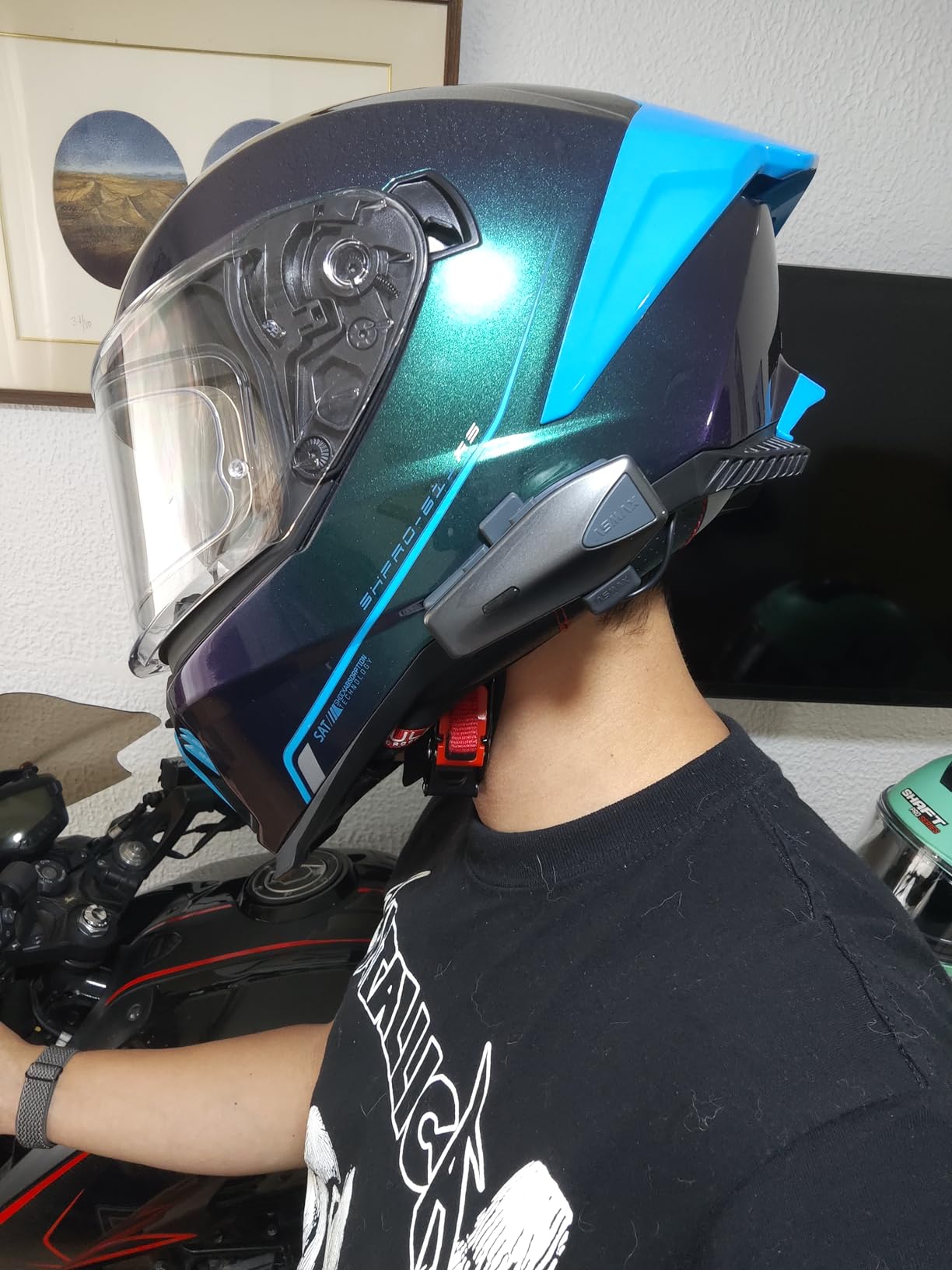
The ASMAX S1 is the most interesting unit here for a specific problem: a group that will not agree on a brand. Its CloudTalk mode routes a group conversation through the ASMAX World app rather than over radio, which means riders on other brands can join without everyone buying new hardware. On a mixed group of six or more, that single feature can be the difference between one conversation and three separate pairs talking to each other.
Underneath that, the mesh layer links up to 8 riders within a 5 mile range, with a Free Mode for an open channel and a Group Mode for a private one. The ASMAX Mode dual-network system switches between mesh and 5G and can support up to 50 riders when the signal allows, which covers the club-rally case that most premium mesh units cannot reach.
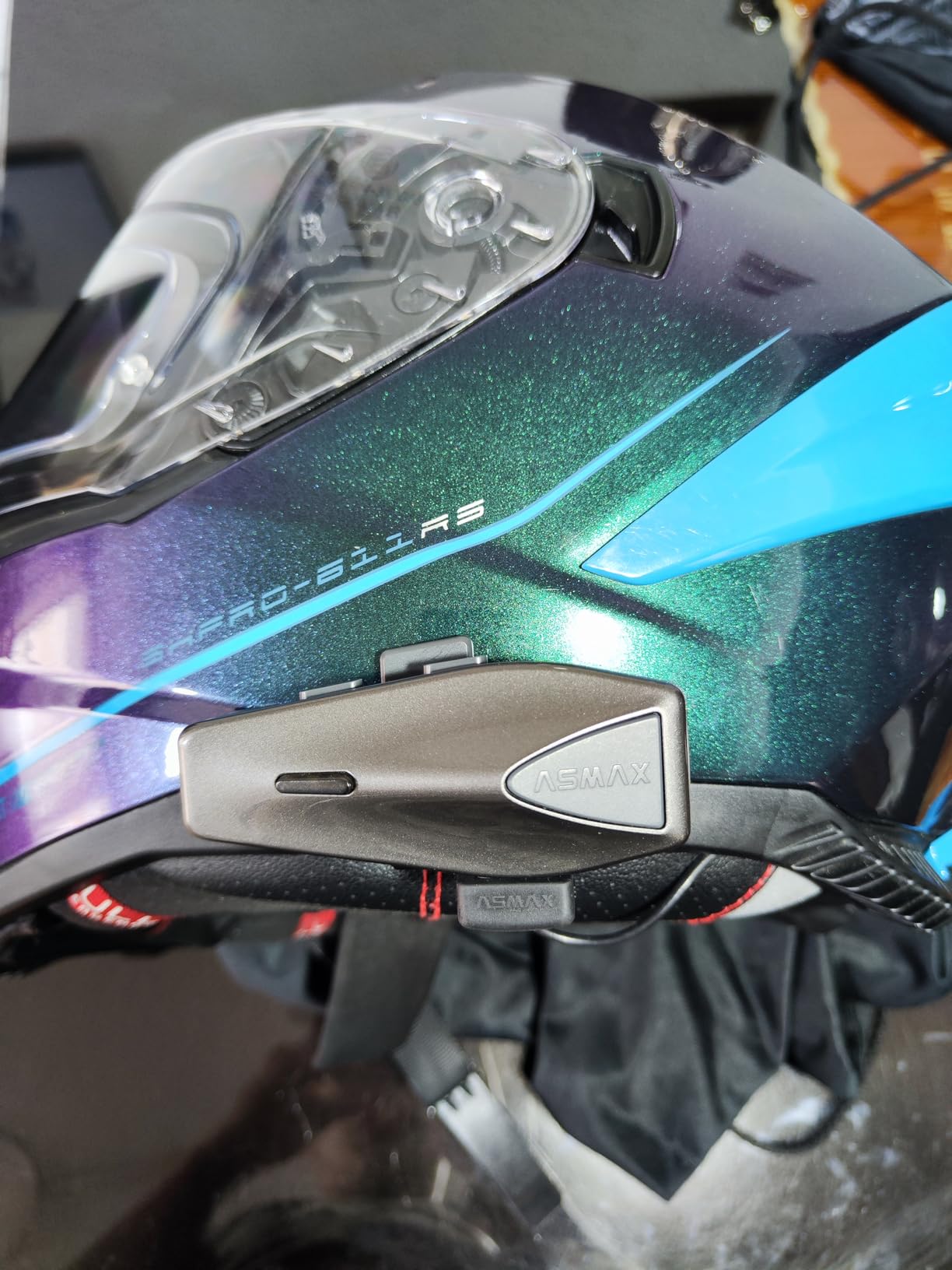
Audio is a genuine strength. The 40 mm Hi-Fi speakers include EQ tuning and music sharing, and audio multitasking with dual-chip Bluetooth 5.4 handles music, navigation, and intercom together, with ENC and DSP noise reduction tuned for speeds up to 120 km/h. Battery is 980 mAh with a 60 minute fast charge, and IPX7 waterproofing covers full-season riding.
Offline AI voice control works without phone signal, which is a small detail that prevents a lot of frustration when you are in a valley. The unit weighs 41 g, so it sits discreetly on the helmet.
Who the ASMAX S1 suits
This is the answer when your riding group is a mix of Cardo, Sena, and budget units, or when you organise rides for people who will not buy the same brand as everyone else. It is also the strongest option here for a large club event where the head count can change ride to ride.
If you ride mostly in pairs but want the option of a group channel without a second purchase later, the mesh layer gives you that. The fast charge is also useful for riders who do a short commute and want a unit that is always ready.
Where it falls short
The headline 5G and 50 rider features are gated behind a firmware and app update, so someone in the group has to do that before departure. The cellular-dependent modes do nothing where there is no service, which is exactly where a mesh network is most valuable. Treat those modes as an aid, not the backbone.
Owner satisfaction sits slightly below the two leaders here, with a 73 percent five-star share, and the brand has a shorter track record with firmware support than the established names. Confirm the warranty terms with the seller before a long-distance purchase.
5. Fodsports M1S Pro for Ten Riders on a Budget
Fodsports Motorcycle Bluetooth Intercom, Music Sharing, M1S Pro 2000m 10 Riders Group Helmet Communication System Headset Universal Wireless Interphone (Waterproof/Handsfree/Stereo Music/GPS/2 Mic)
20 hour battery
2000 m range
Active Noise Cancellation
Bluetooth 4.1
Pros
- Group intercom range up to 2000 m with clear line of sight
- Upgrades to 10 rider full duplex group intercom
- 900mAh battery with up to 20 hours working time
- Operates while charging
Cons
- Pairing beyond two or three units is difficult and unlabelled
- Bundled boom mic is weak in wind
- Speakers have little to no bass
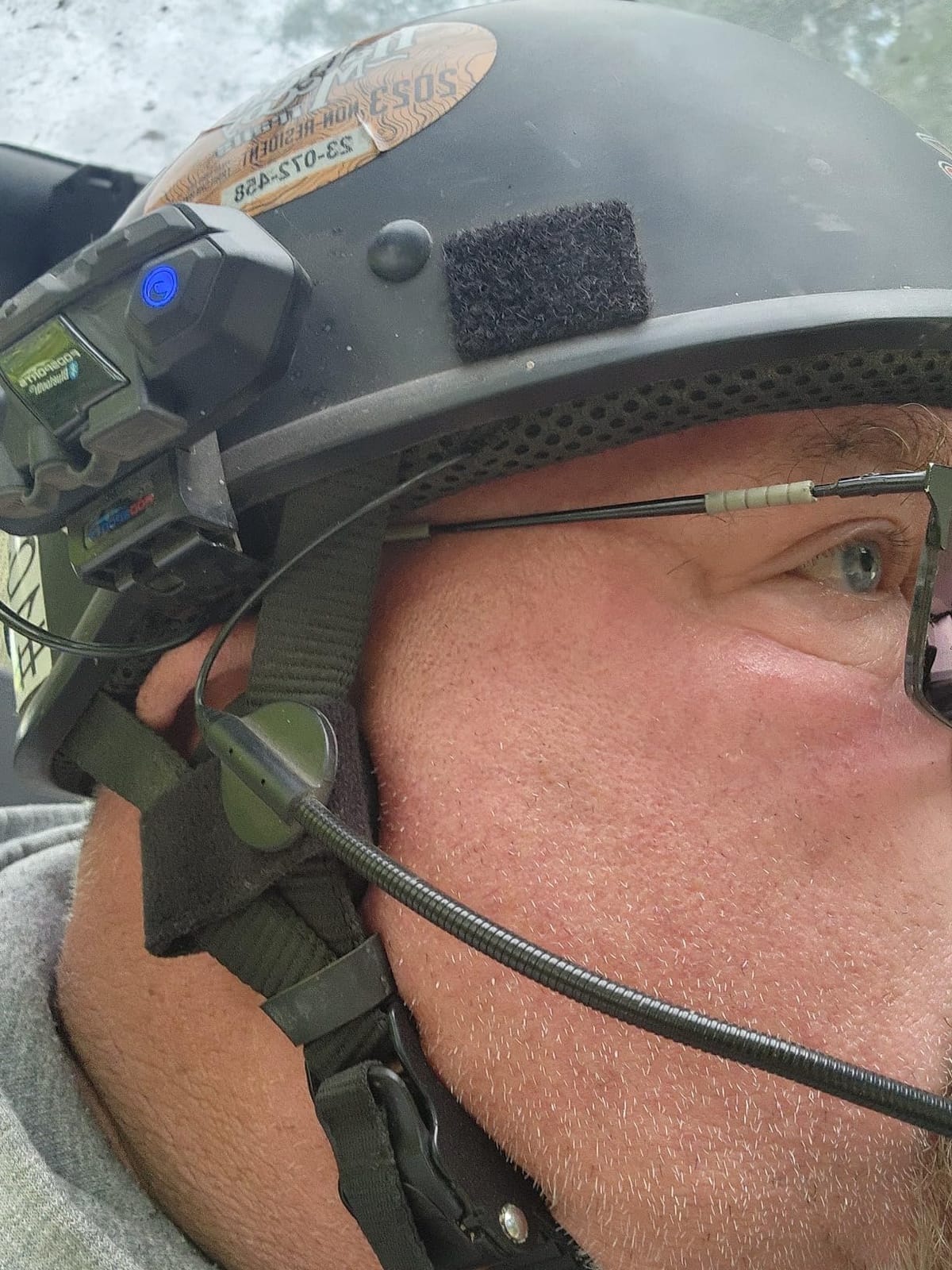
Reviewers consistently describe the M1S Pro as a two-person bargain that stretches to something wider when you ask nicely, and that is a fair summary. Out of the box it handles a straightforward two-up link, and it can be upgraded to a 10 rider full duplex group intercom with 7-language voice prompts. For a club on a budget that needs a big number on the spec sheet, it is hard to argue with what it offers.
The battery is the sleeper feature. A 900 mAh cell gives up to 20 hours of working time and roughly a week of standby, and unlike most premium units it can charge and operate at the same time, which solves the all-day problem neatly if you carry a small power bank.
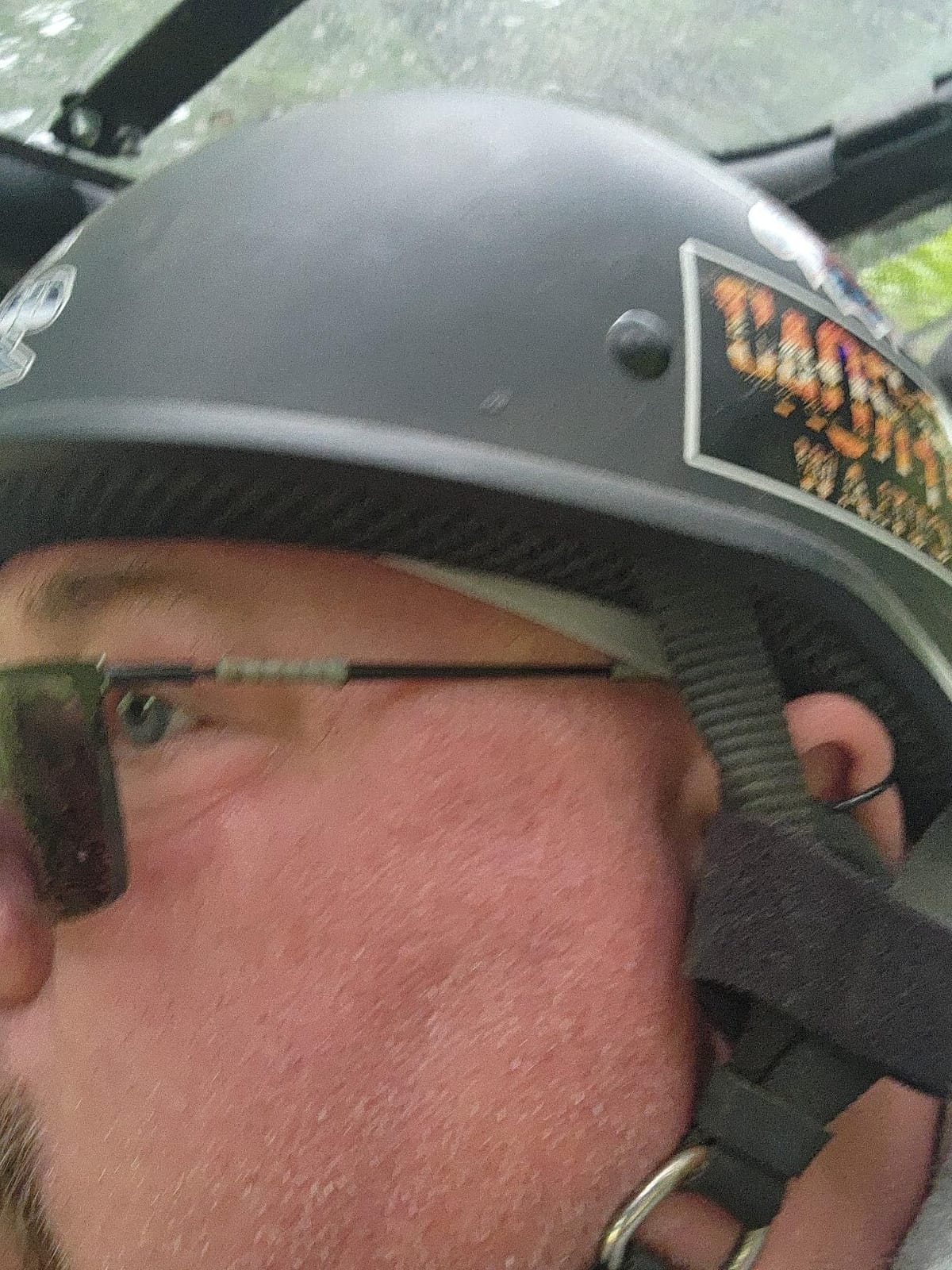
Range is listed at up to 2000 m with no obstacles, which is generous on open roads and optimistic in trees or town traffic. Active noise cancellation and a built-in CSR chip handle engine and wind noise, and a 3.5 mm jack is there if you want to add earbuds.
It has been sold hard and reviewed hard, with 3625 reviews at 4.3 stars and a category rank of 29 in powersports Bluetooth headsets, so the feedback is plentiful and mostly candid.
Who the M1S Pro suits
The right choice for a large social group where nobody wants to spend premium money, provided someone takes responsibility for the setup. The 10 rider upgrade and the ability to run while charging make it a sensible pick for long group days where nobody wants to nurse a battery.
It is also a reasonable second unit for a passenger or a newer rider in a group running mixed hardware, since universal pairing lets it link to other brands in basic Bluetooth mode.
Where it falls short
The pairing process is the real weakness. Owners report that adding more than two or three units is difficult, that the devices do not identify which rider is which, and that the printed pairing instructions are inaccurate, often requiring a video walkthrough. For a group of eight or ten, budget an extra fifteen minutes and one person who knows what they are doing.
Audio is the second limitation. The bundled boom microphone is weak in wind and wants to sit close to your mouth, and the speakers have little to no bass and can be uncomfortable in a small helmet. If voice clarity on a fast road matters to you, look at the Sena 50S instead.
6. JESIMAIK R16 Pro for Ten-Way Intercom at Distance
JESIMAIK Motorcycle Helmet Bluetooth Headset, 10 Way 2KM Helmet Communication System, Multitasking Audio Motorcycle Intercom, 2 Mics&40mm Speaker (2 Pack)
40 mm speakers
2 km range
Hybrid Noise Cancellation
Bluetooth 5
Pros
- Ten way group intercom with 2 km listed range
- Dual Qualcomm chips run music GPS and intercom at once
- 40mm HD speakers with four sound profiles
- Boom and soft mic plus adhesive and clip mounts
Cons
- Real range falls well short of the advertised 2 km
- Pairing more than two or four units is confusing
- Occasional screeching on connecting
The R16 Pro is a large-group unit sold at a mid price, and its selling point is straightforward: ten-way intercom with a listed 2 km range, plus cross-brand compatibility with popular rival models. The dual Qualcomm Bluetooth chips let music, GPS navigation, and intercom run simultaneously rather than interrupting each other, which matters when the group is navigating somewhere unfamiliar.
Installation flexibility is better than most. You get both a boom mic and a soft mic, plus adhesive and clip mounts, so it suits full-face, modular, and open-face shells without a second purchase. The 1000 mAh battery charges fully in 1.5 hours and the buttons are large enough for gloves.
Audio gets a genuine nod from owners. The 40 mm HD speakers carry four customisable sound profiles, and the hybrid noise cancellation is claimed to handle speeds up to 120 km/h. IP67 protection covers rain, dust, mud, and snow for year-round use.
It is also one of the few units in this roundup with more than two thousand reviews, at 2322, so there is a large body of owner experience to draw on even if the average rating is the second lowest here.
Who the R16 Pro suits
This fits a group of six to ten riders who want one channel, need navigation prompts audible alongside the conversation, and want the freedom to mix brands without buying into one ecosystem. The dual microphone and dual mount options also make it a good choice if the group includes riders in half helmets or open-face shells.
Choose it when the ride is mixed on-road and off-road, since the hardware handles both and the speaker profiles let each rider set their own preference.
Where it falls short
Range is the honest concern. Reviewers repeatedly find real-world performance degrading past a quarter mile, well short of the advertised 2 km, which is not far enough for a group spread out on a highway. Treat the stated figure as a best case with nothing in the way.
Setup is the other problem. Pairing more than two or four units is confusing and requires a specific order, and some owners hit an occasional screeching noise on connecting that clears with a disconnect and reconnect. It holds a 4.1 star average with a 56 percent five-star share, and customer support is email-only.
7. Fodsports FX4 Pro for Four-Rider Groups
Fodsports FX4 Pro Motorcycle Helmet Bluetooth Intercom with AI Voice Control, 4 Way Helmet Headset Communication System, Hand-Free Music/Auto-Answer/FM Radio, 2 Pack
16 hour battery
1000 m range
Adaptive Noise Cancellation
40 mm speakers
Pros
- Stable four way intercom up to 1000 m
- 40mm Hi-Fi speakers with CVC noise reduction
- Two mic options for open-face and full-face helmets
- Hands-free auto-answer within 12 seconds
Cons
- Four rider limit is small for bigger groups
- IP65 rating is a step below the strongest here
- Voice control routes through a phone assistant
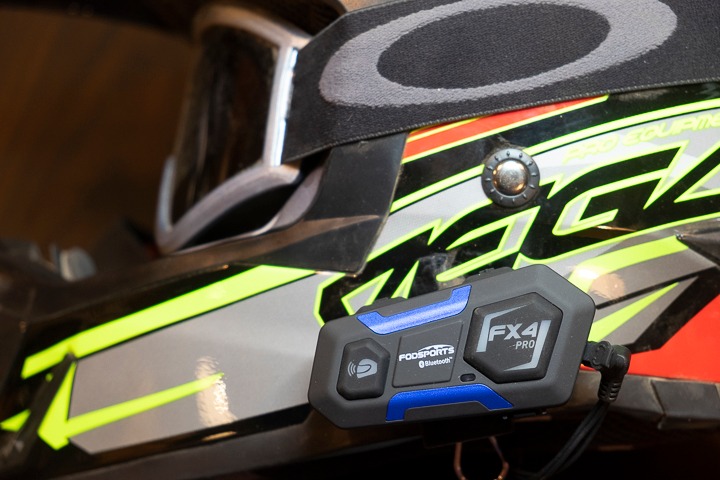
Four riders is the sweet spot for a lot of weekend groups, and the FX4 Pro targets it directly. The intercom holds stable four-way connections up to 1000 m, and at 4.5 stars from 471 reviews it is one of the better-rated units in this roundup, with a 72 percent five-star share. The complaints in the feedback are about limitations and learning curve rather than quality.
The audio package is solid for the money. Forty mm Hi-Fi stereo speakers and a CVC noise reduction microphone handle wind and road noise, and the hands-free auto-answer kicks in within about 12 seconds, which keeps conversations flowing rather than requiring a button press every time.
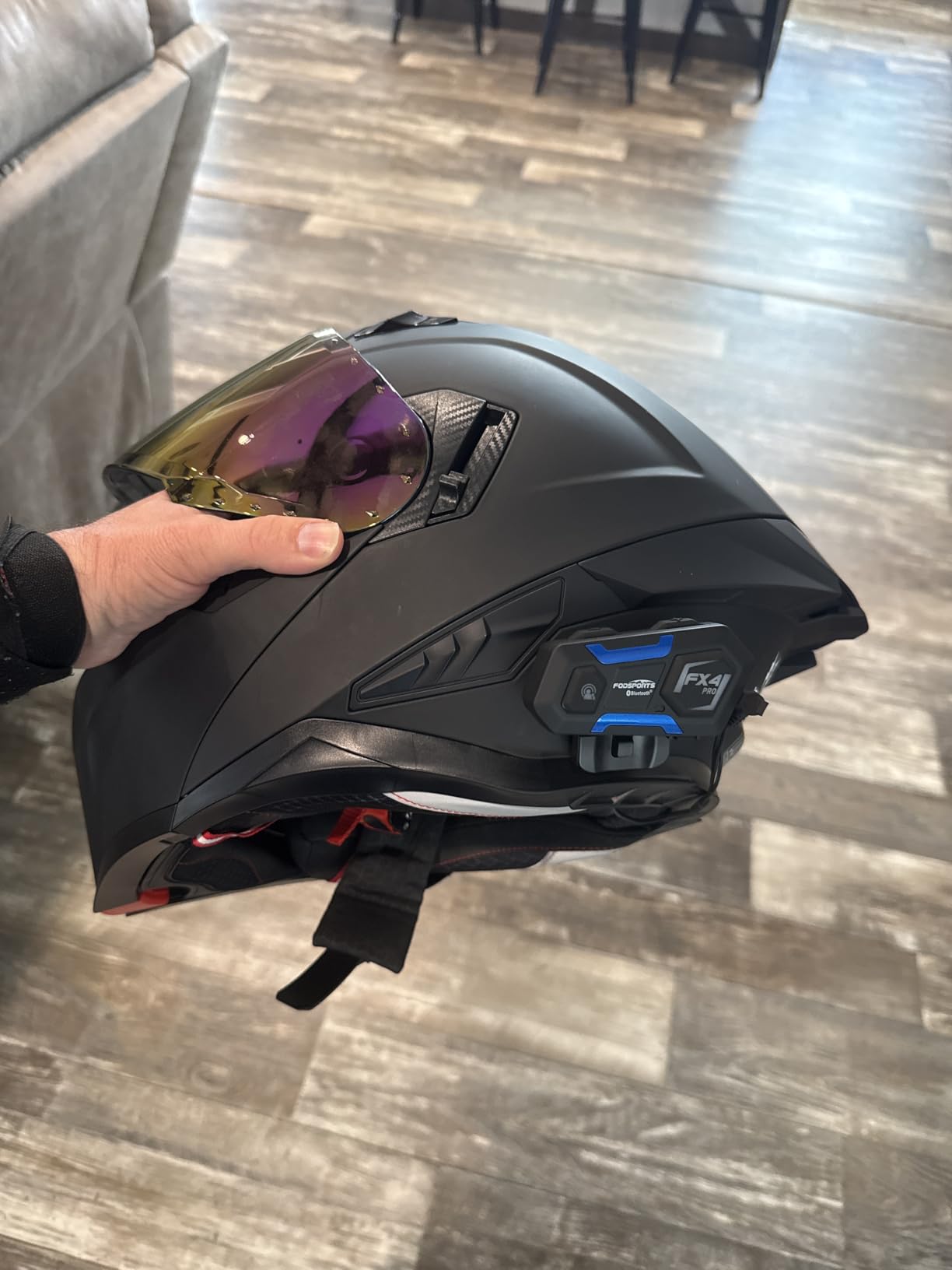
Battery is listed at 16 hours with up to 15 hours of music and 12 hours of talk time, and the three-hour charge is manageable overnight. FM radio covers the usual band, and voice control and universal pairing are both present.
The included mic choices are a real convenience: a button mic for full-face helmets and a boom mic for open-face designs, so the group does not need one type of hardware per rider.
Who the FX4 Pro suits
This is the pick for a group of four who ride together regularly, on a budget, and who want a simple experience rather than a feature list. The four-way limit is a genuine constraint for bigger clubs, but for a fixed foursome it is exactly what you need and nothing you have to configure.
It also works for a pair who expect the group to grow, because you can add riders later with universal pairing. The dual mic package makes it one of the easier units to fit across a group with mixed helmet types.
Where it falls short
Four riders is the whole story here. If your group is closer to six, or you ride with a club that grows, the FX6 or a mesh unit is the better investment.
Water protection is listed as IP65, which is a step below the IP67 and IPX7 ratings on several units in this roundup, so heavy rain riding deserves a rain cover or a wipe-down afterwards. Voice control also works through a phone assistant rather than offline, which fails you exactly when signal is poor.
8. Fodsports FX6 for Six Riders With Dual USB Charging
Fodsports FX6 Motorcycle Bluetooth Headset, 6 Riders Group Motorcycle Intercom Bluetooth, 1000M Motorbike Helmet Communication Systems/Voice Command/Universal Pairing/FM Radio(2 Pack)
10 hour battery
1000 m range
40 mm speakers
Active Noise Cancellation
Pros
- Up to 6 riders with best results at 4
- Dual USB ports allow power bank charging while riding
- 40mm HD speakers with both boom and button mics
- Universal pairing across brands
Cons
- Pairing is not retained after power cycles
- Printed pairing instructions are incorrect
- Speakers lack bass and struggle above highway wind
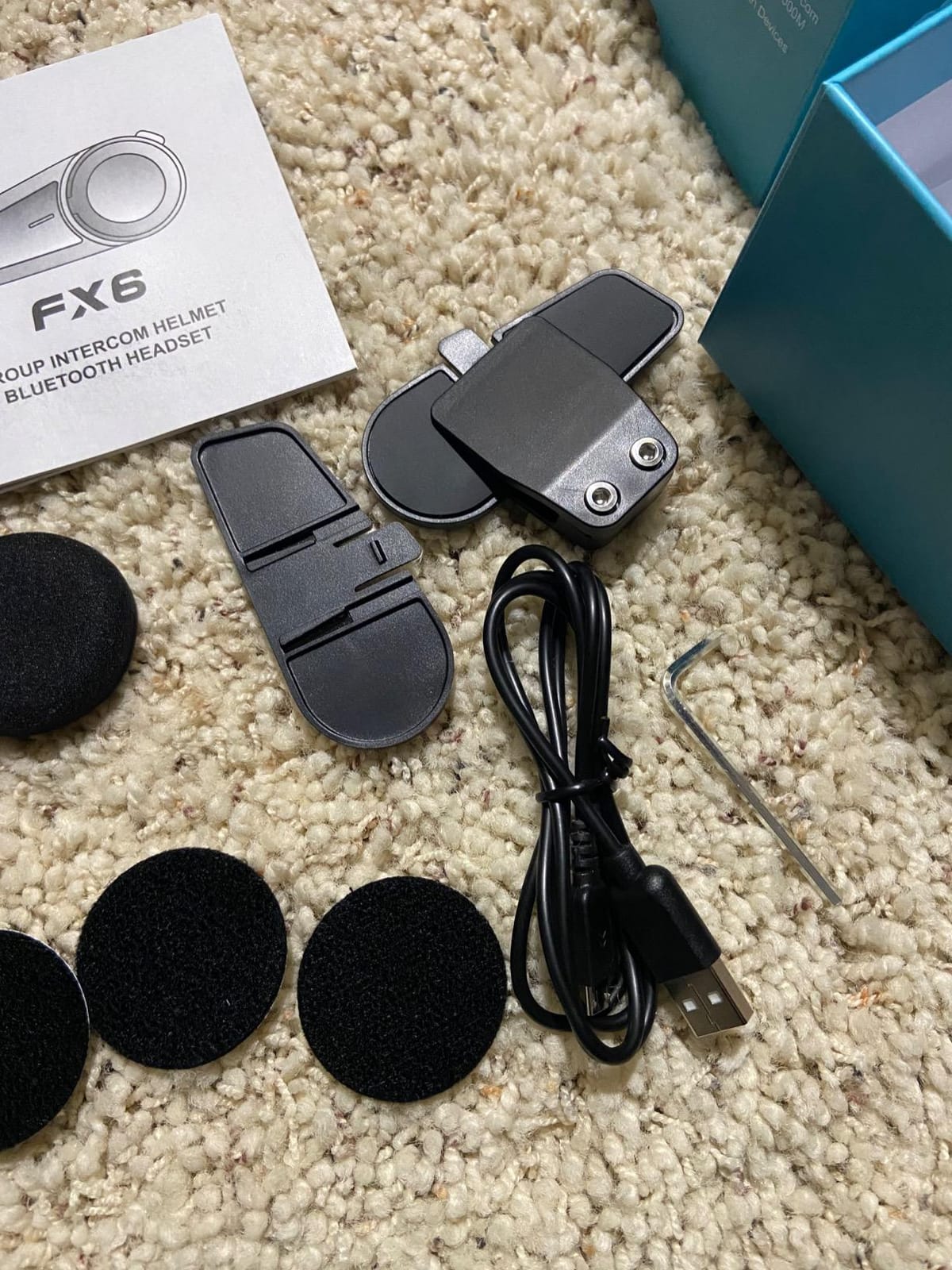
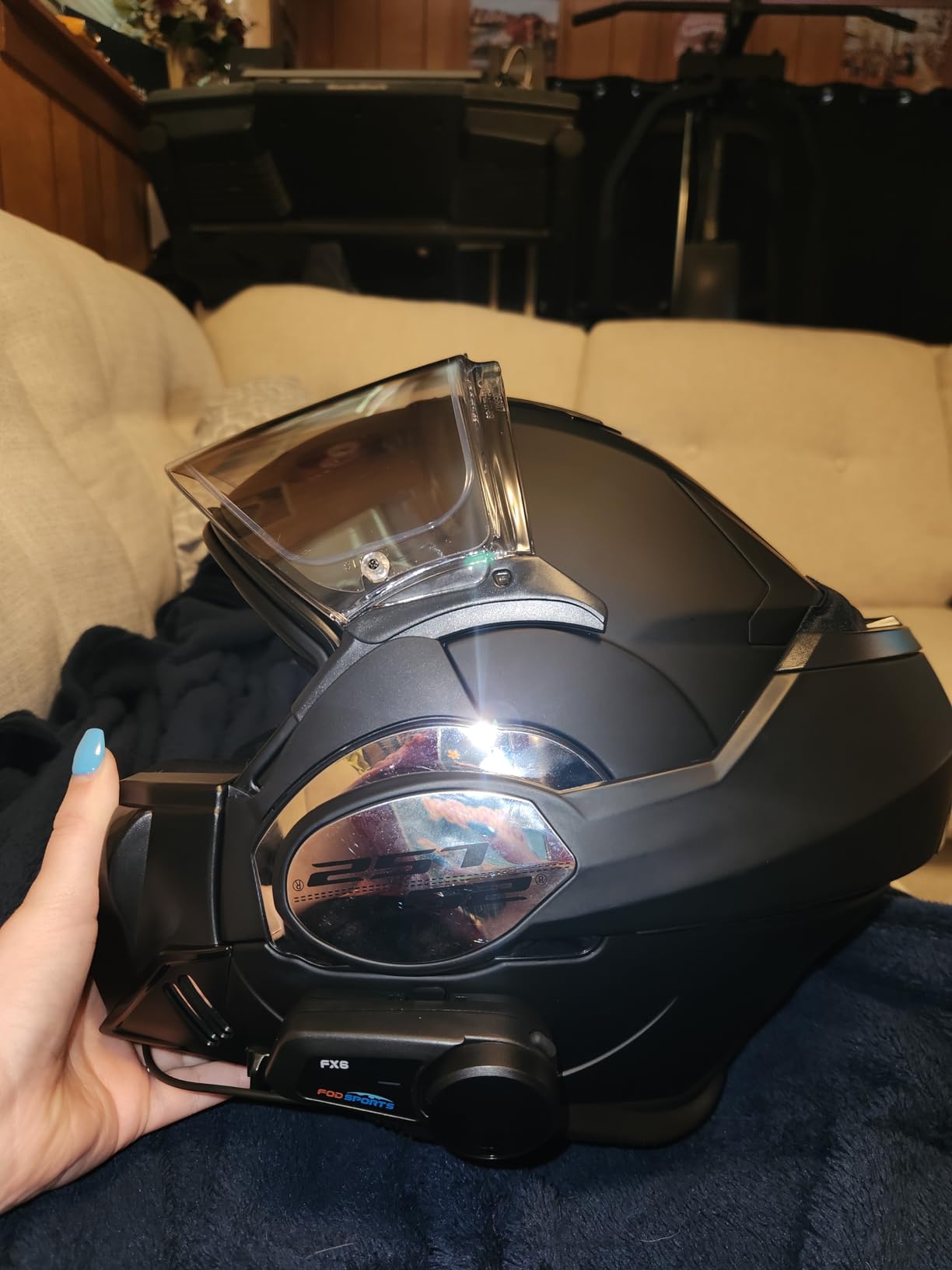
The FX6 stands out for a feature almost nothing else in this list has: two USB ports, so you can run the unit from a power bank and keep talking while it charges. On a long group day that removes the single most common reason riders drop off the channel, and owners treat it as the feature that justifies the purchase on its own.
Group capability is described honestly as up to six riders, best with four, at 0.62 miles in open terrain. Forty mm HD speakers, CVC noise suppression, and ENC ambient control handle the loud-bike-at-highway-speed problem as well as a unit at this level manages. Boom and button microphones are both included, so mixed helmet types are covered.
Customer service is a genuine strength, with reported responses within 24 hours and a replacement for a damaged unit, and the warranty covers a free exchange for quality issues alongside twelve months of repair service. That matters for a brand most riders are buying without a track record.
Battery is listed at 10 hours, and the 2.5 hour charge is fine overnight. At 100 g it is the heaviest unit in this roundup, noticeably more than the compact alternatives.
Who the FX6 suits
Pick this for a group of four to six riders doing long days, particularly if the route has unreliable charging options and you are prepared to carry a small power bank per bike. The dual ports also make it a good choice for anyone who already uses a power bank for phone navigation.
It suits mixed-brand groups through universal pairing, and the included mic options mean each rider can sort their own helmet without ordering parts.
Where it falls short
Pairing memory is the recurring theme in the reviews. The units do not retain their pairing and must be re-paired after every power cycle, printed instructions are reported as incorrect, and if one rider drops out the remaining units can unpair from each other. That is a real problem on a group ride where a stop for fuel means a full re-pair.
Audio volume is also a limitation. Owners report little to no bass and difficulty being heard above highway wind, and there is an isolated report of water logging after a rainy ride. Expect a rougher experience than the premium units on audio and reliability.
9. LEXIN G2P for the Lightest Six-Rider Setup
LEXIN G2P Motorcycle Helmet Bluetooth Headset, Group Intercom Communication Systems, FM Radio/ 6 Shells/Universal Pairing/Private Talk/Noise Cancellation, Fit for Snowmobile/ATV, 2 Pack
14.7 g
18 hour battery
40 mm Mylar speakers
IP67
Pros
- Very light at 14.7 g per unit
- Qualcomm chip supports 6 rider connections and private pair talk
- 800mAh battery with up to 20 hours talk
- IP67 waterproof with six interchangeable shells
Cons
- Group talk is private pairs rather than an open conference
- No music sharing between connected units
- Pairing drops after each power cycle
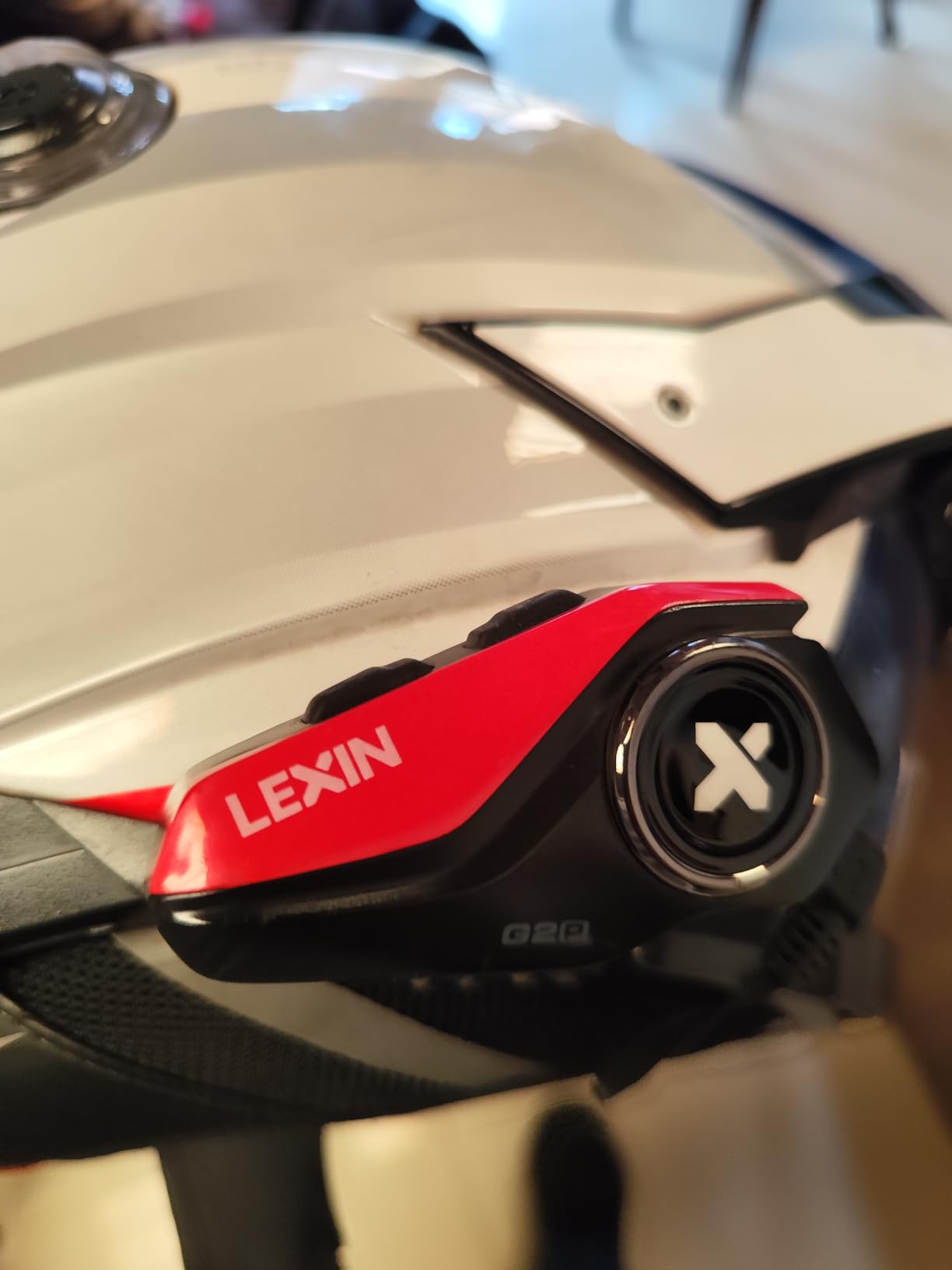
At 14.7 g per unit the LEXIN G2P is the lightest hardware in this roundup by a wide margin, and that difference is obvious on a full-face helmet over a long day. The low-profile mount and small body mean most riders forget they are wearing it, which is a good property for something you cannot take off on the road.
The upgraded Qualcomm chip supports stable connections for up to six riders, with private two-person talk at up to 1000 m. Read that carefully: the six-rider network exists, but group talk is organised as private pairs rather than an open conference where one voice reaches everyone at once. For a group that mostly runs as three pairs, that arrangement works well.
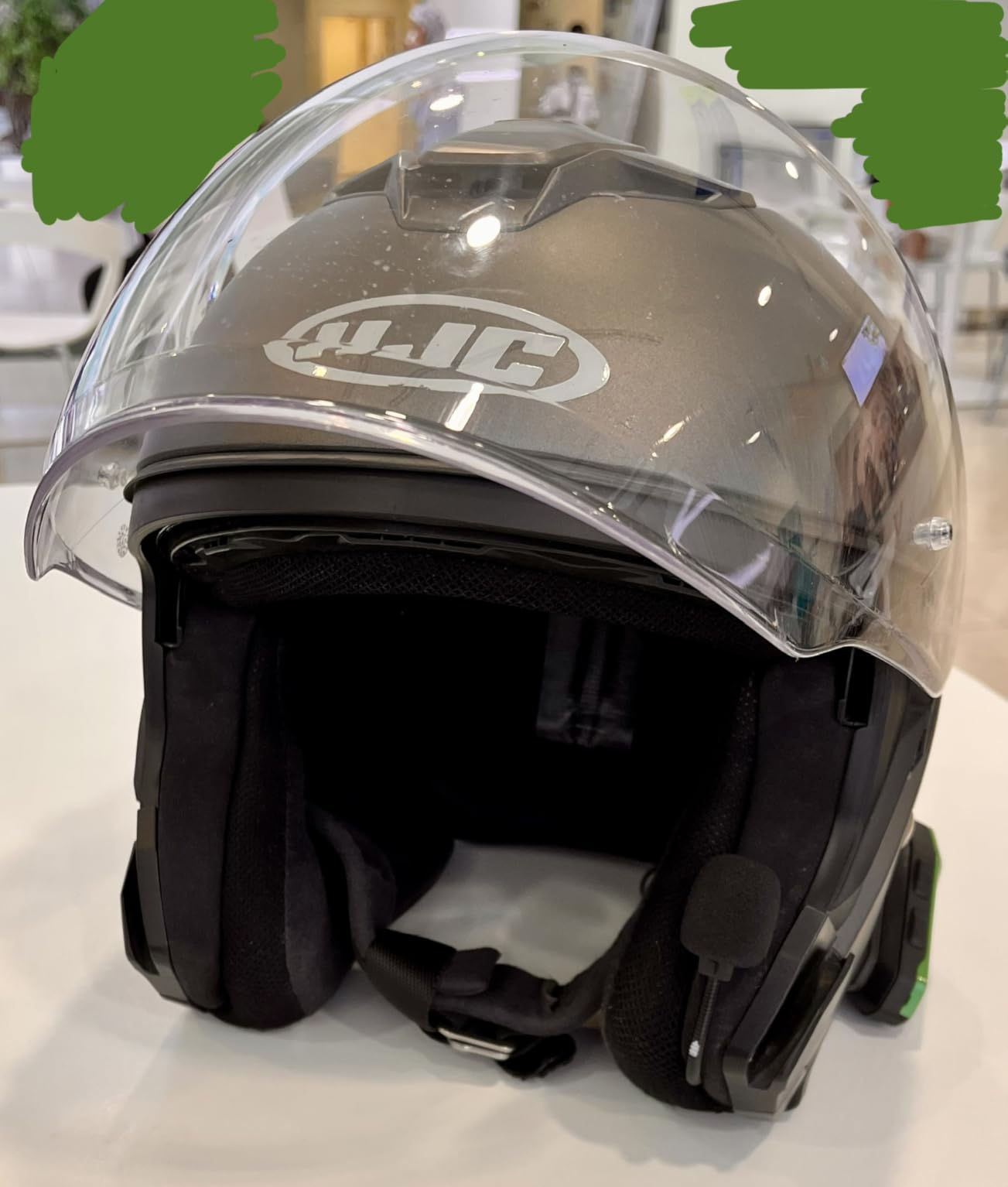
Battery is generous for the size, with 800 mAh giving up to 25 hours of music, 20 hours of talk, and over a week of standby. Forty mm Mylar HD speakers with CVC and DSP noise reduction handle sound at speed, and IP67 waterproofing is among the stronger ratings here.
The six interchangeable metallic-style shells are a small quality-of-life touch, letting a rider match the helmet finish instead of leaving a black box bolted to a painted shell.
Who the G2P suits
This works for a group of riders who spend long days in the saddle, value a low-profile fit, and mostly want private pair or small-group conversation. Riders-to-pillion couples in particular will like how little the unit intrudes on a shared helmet space.
It is also a sensible second purchase for someone who already has a premium mesh unit and wants a lighter option for commuting or for a passenger.
Where it falls short
This is the lowest-rated unit in the roundup at 4.0 stars from 1451 reviews, with a 12 percent one-star share, and the feedback explains why. Reviews repeatedly flag lost pairing after shutdown, no music sharing between connected units, and difficulty getting six riders onto one channel.
Audio quality also drops off at higher volume with muddy bass, and the microphone port can rotate away from your mouth inside the helmet. If your group needs a single open conversation, choose a mesh unit instead.
10. Cardo Spirit HD for Riders and Passengers
Cardo Systems Spirit HD Motorcycle Bluetooth Communication Headset, 2-Way Bluetooth, Thin 40mm Speakers, Waterproof, Universal Connectivity – Single Pack
13 hour battery
40 mm speakers
Passive Noise Cancellation
Bluetooth 5.2
Pros
- Clear and loud 40mm HD speakers cut through wind noise
- Four glove friendly buttons
- Installs in under 10 minutes on a common full-face helmet
- Two hour fast charge with FM radio
Cons
- No mesh networking so it pairs with only one rider at a time
- Some speaker distortion at maximum volume
- Range falls short of the advertised distance in wooded terrain
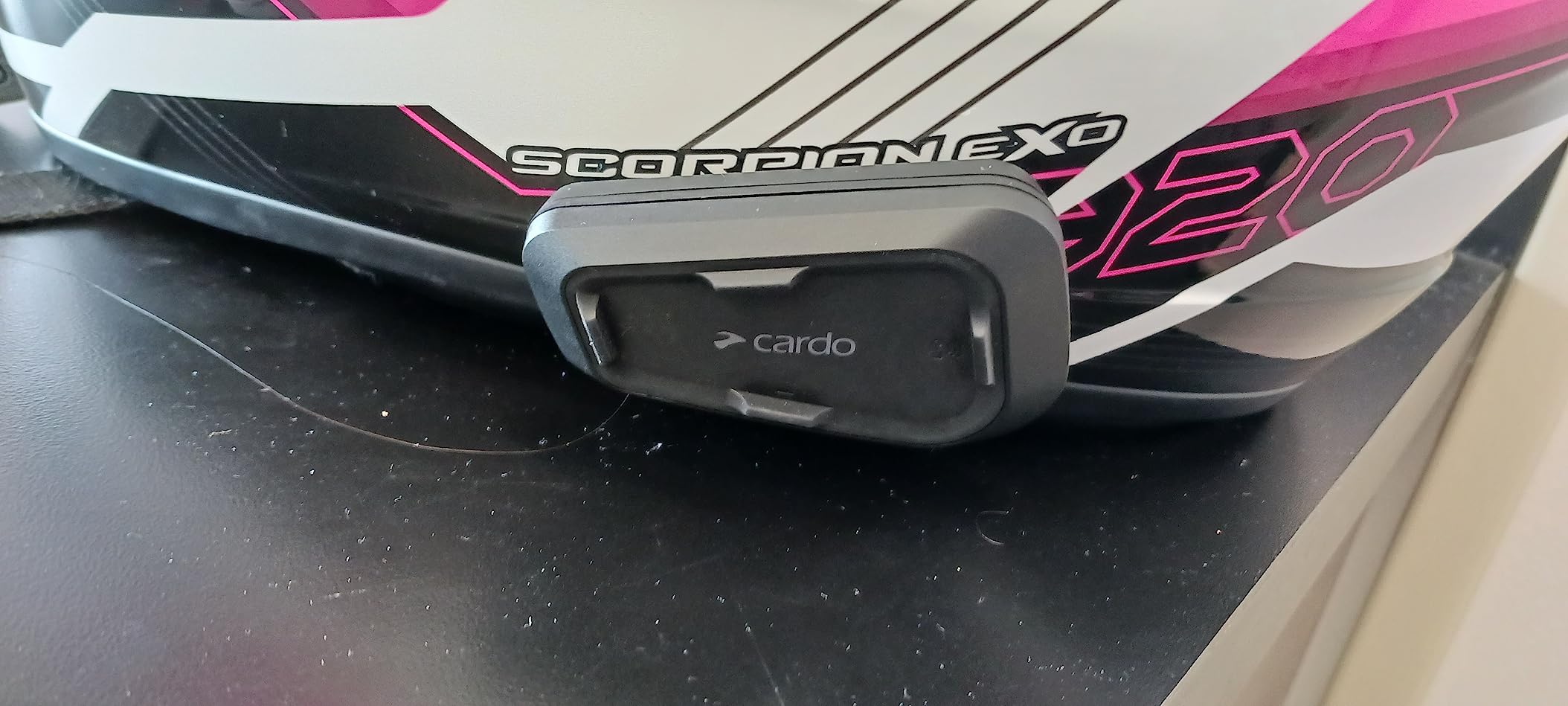
The Spirit HD is not a group intercom and we will not pretend otherwise. It pairs with one other rider at a time, with no mesh networking, and in a group of eight it is a conversation piece rather than the backbone. What it is, though, is one of the best-sounding and easiest units in the Cardo line, and for a two-up bike or a passenger it is hard to argue against.
Owners consistently praise the 40 mm HD speakers for being clear and loud enough to cut through wind noise, and the four well-spaced glove-friendly buttons for being usable without looking down. Installation takes under ten minutes on a common full-face helmet, and a two-hour fast charge with built-in FM radio fills out a solid feature list.
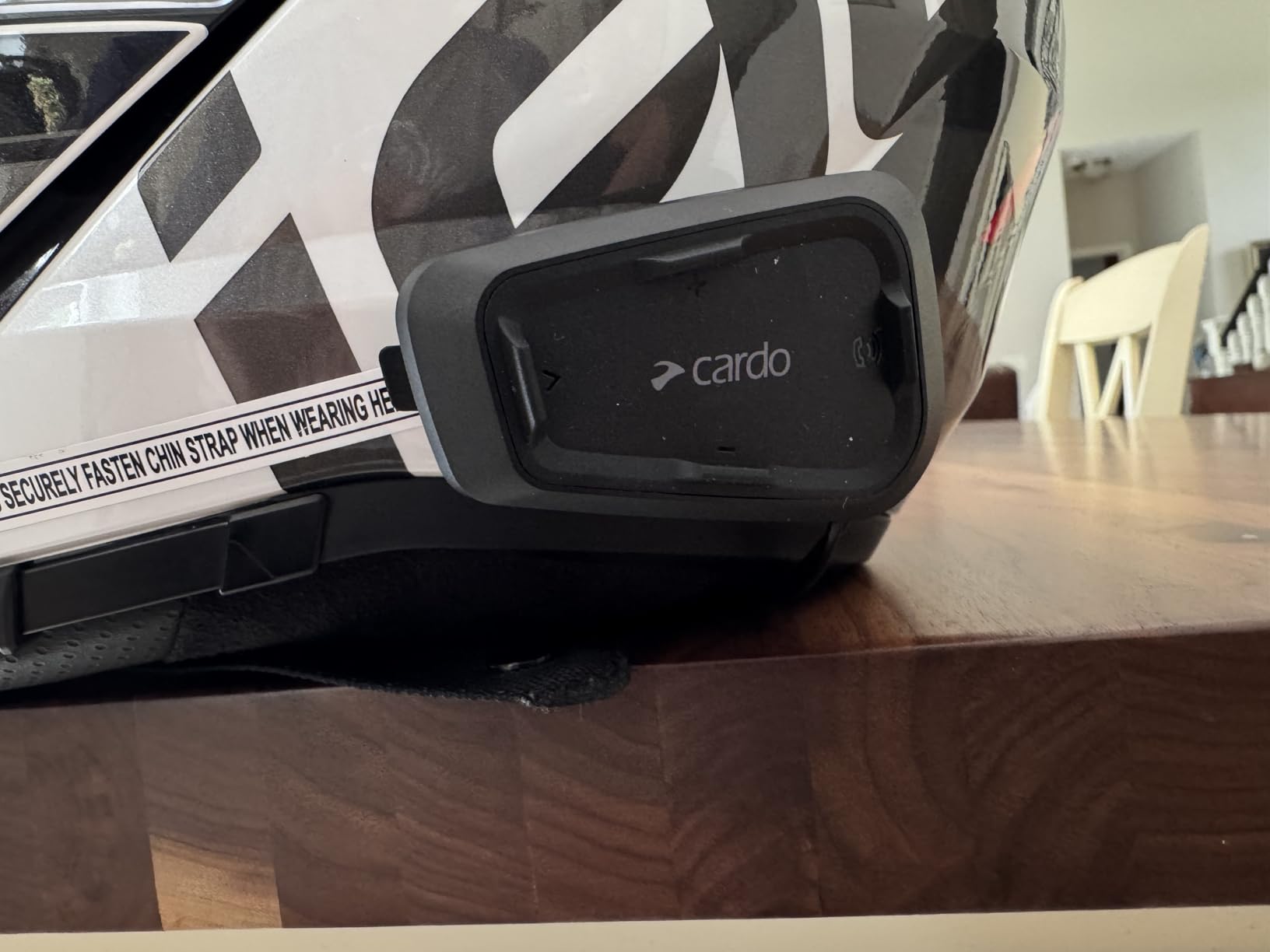
The rating reflects that: 4.4 stars from 3068 reviews, and a category rank of 1 in powersports helmet communication, which tells you how many people have bought it. Reviewers like the fast connections and the mic call quality, and rate it as a strong value alternative to the Packtalk line.
It is also the natural half-helmet answer in this roundup, because the speaker profile and button layout work well in a smaller shell where a bigger unit would move around.
Who the Spirit HD suits
Buy it for the passenger on the back, for a two-up couple who want conversation without a wired system, or for a solo rider who wants a phone, music, FM radio, and one reliable partner link. It is the least stressful unit here to fit and forget.
It also works as a budget second unit for a group member whose role is simply to hear the road captain, since a one-to-one link to a mesh-equipped rider is exactly what a two-way unit is built for.
Where it falls short
The single rider limit is the whole constraint, and for this topic it is the defining one. No mesh means no group conversation and no leapfrog relay, so range and rider count simply do not apply.
Some owners report speaker distortion at maximum volume, and reviewers note that real range falls well short of the advertised distance in wooded or busy terrain. Turn the volume below maximum and expect a clean result.
11. Cardo Freecom 2X for the Lightest Two-Up Link
Cardo Systems FREECOM 2X Motorcycle 2-Way Helmet Bluetooth Communication System Headset Intercom, Universal Bluetooth Connectivity, Waterproof, 40mm Speakers – Single Pack
37 g
2 hour battery
Active Noise Cancellation
40 mm speakers
Pros
- Light 37 g body sits discreetly on the helmet
- Active noise cancellation with 40mm speakers
- Built-in FM radio with RDS
- Over-the-air software updates
Cons
- Older Bluetooth 4.1 radio compared with 5.x rivals
- Two rider intercom only with no mesh
- Listed battery life of just 2 hours
The Freecom 2X is the compact Cardo option, and at 37 g it is the unit we would put in the lightest helmet in the group without a second thought. Active noise cancellation with 40 mm speakers keeps two-way talk clear, the built-in FM radio with RDS picks the strongest station automatically, and over-the-air software updates keep it current without a computer.
Universal Bluetooth connectivity means it will link to a non-Cardo unit in basic mode, which makes it a reasonable stopgap for someone in a mixed group who does not want to replace working hardware immediately. The 4.4-star average across 3034 reviews reflects steady regard for dependable two-way talk.
It also carries a built-in voice assistant and a 2 year manufacturer warranty, both useful details on a unit that will likely live in a helmet for several seasons. The polycarbonate enclosure is a plus for a device that takes the knocks.
Think of it as the sensible light two-up link rather than a group tool. If the group is growing, plan an upgrade path rather than assuming this will scale.
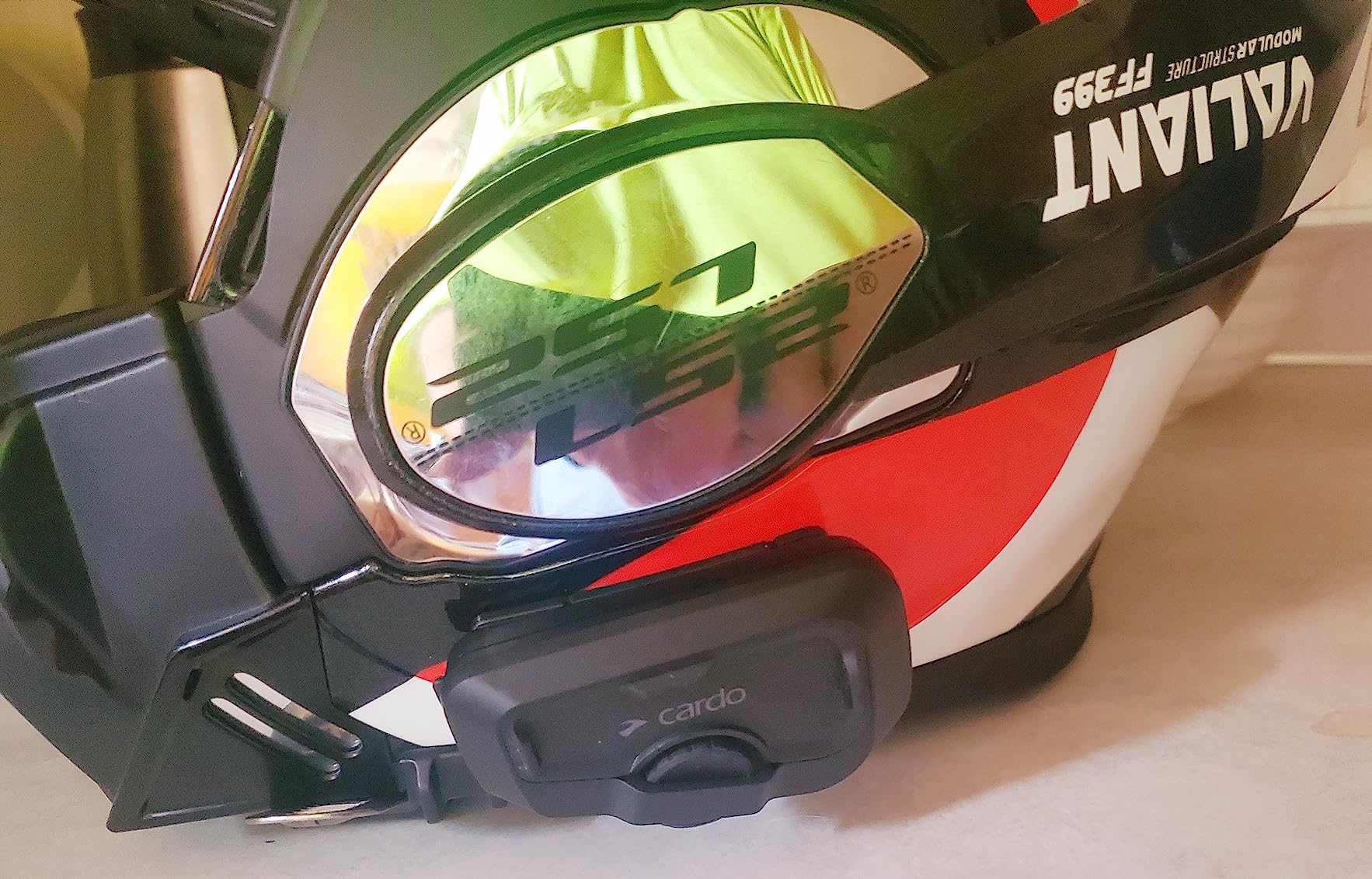
Who the Freecom 2X suits
It suits riders in small or lightweight helmets who ride two-up, or who want a discreet unit for commuting with music, phone, and radio rather than a group network. The 37 g weight is the reason it wins over bigger units in a light shell.
It is also a good passenger-side unit, since the person on the back rarely needs a group channel and benefits more from a low profile and a comfortable fit.
Where it falls short
The Bluetooth 4.1 radio is the oldest in this roundup and is a step behind the 5.x hardware on most rivals, which shows up in pairing speed and modern device compatibility. Two-rider-only operation with no mesh is the bigger limitation for this topic.
The listed battery figure of 2 hours is far below the 13 hours of the Spirit HD and is worth checking against your own riding day before committing. Owners generally report dependable talk in pairs, but this is not the unit to rely on for a long group ride.
12. EJEAS V6 Pro for the Cheapest Two-Rider Upgrade
EJEAS V6 Pro Motorcycle Helmet Bluetooth Intercom, 2-Way 1200M Motorcycle Bluetooth Headset Universal Communication System with Noise Cancellation and Waterproof for Dirt Bike/ATV/Snowmobile (2PCS)
12 hour battery
1200 m range
Type-C charging
Environmental Noise Cancellation
Pros
- Two rider intercom with 1200 m range
- 18 hours of talk and 260 hours of standby from 850mAh
- Type-C charging and easy syncing
- Universal mounting for full-face half and open helmets
Cons
- Only two riders in real time intercom with no mesh
- Cannot run intercom and GPS or music at the same time
- Older Bluetooth 3 radio limits modern compatibility
The EJEAS V6 Pro is the most inexpensive way to get a reliable two-rider link, and for riders moving from hand signals to actual conversation it does the job with less fuss than expected. The host can select any of five paired riders, and the listed range of 1200 m is genuinely useful on a rural road with clear sightlines.
Sound is a surprise at this level. Noise reduction and 40 mm high-fidelity speakers stay clear at 120 km/h according to owners, and the 850 mAh battery gives 18 hours of talk time and 260 hours of standby. Type-C charging is a genuine improvement over the older micro-USB fittings many budget units ship with.
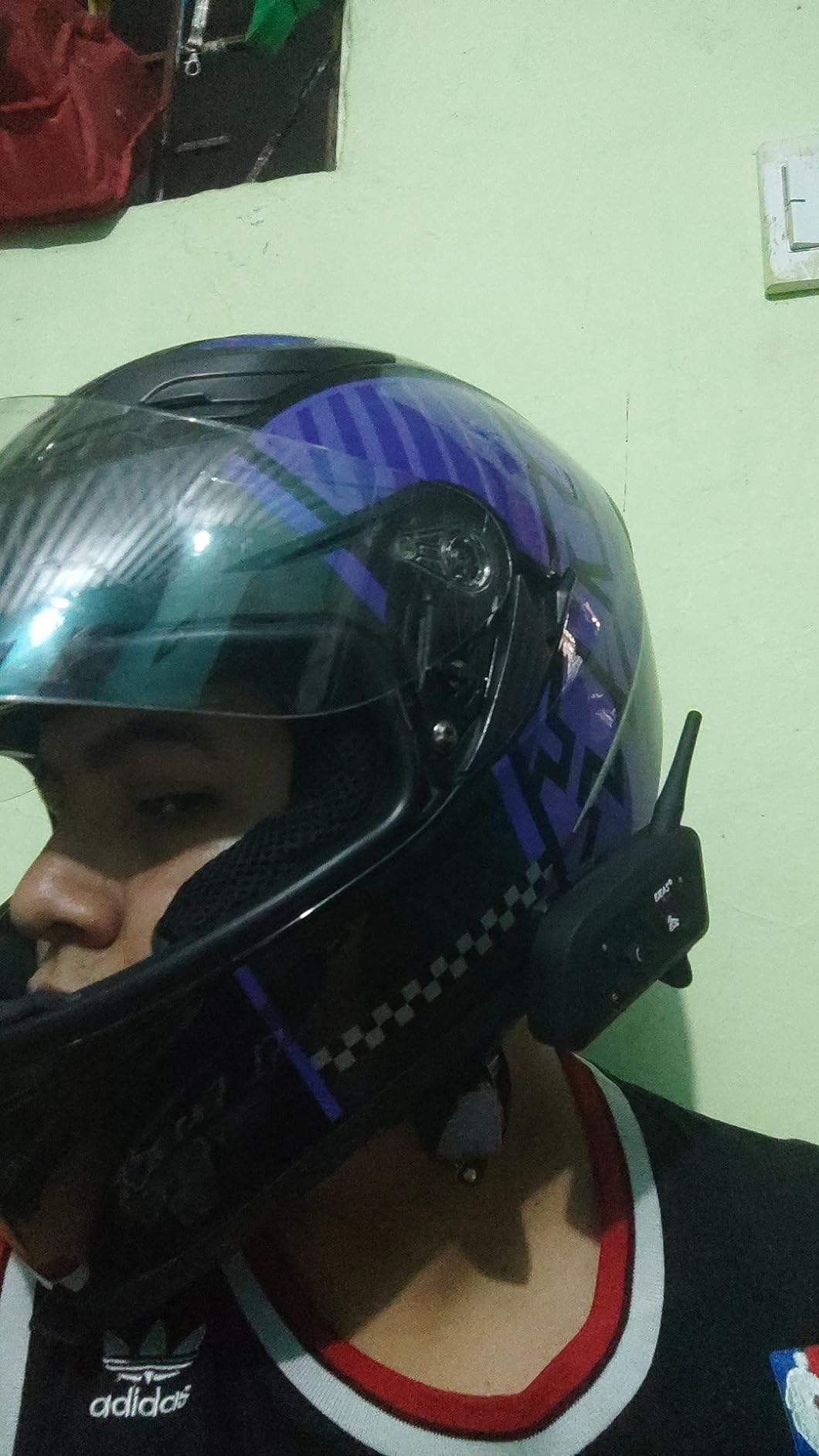
It is also unusually flexible on mounting, working with full-face, half, and open helmets, which makes it a favourite for dirt bike, ATV, and snowmobile use where a specific shell changes between machines. The 4.4-star average from 384 reviews reflects a satisfied small user base.
There is an isolated report of water ingress after extended rain use, so treat it as weather-resistant in practice rather than submersible, whatever the listing says.
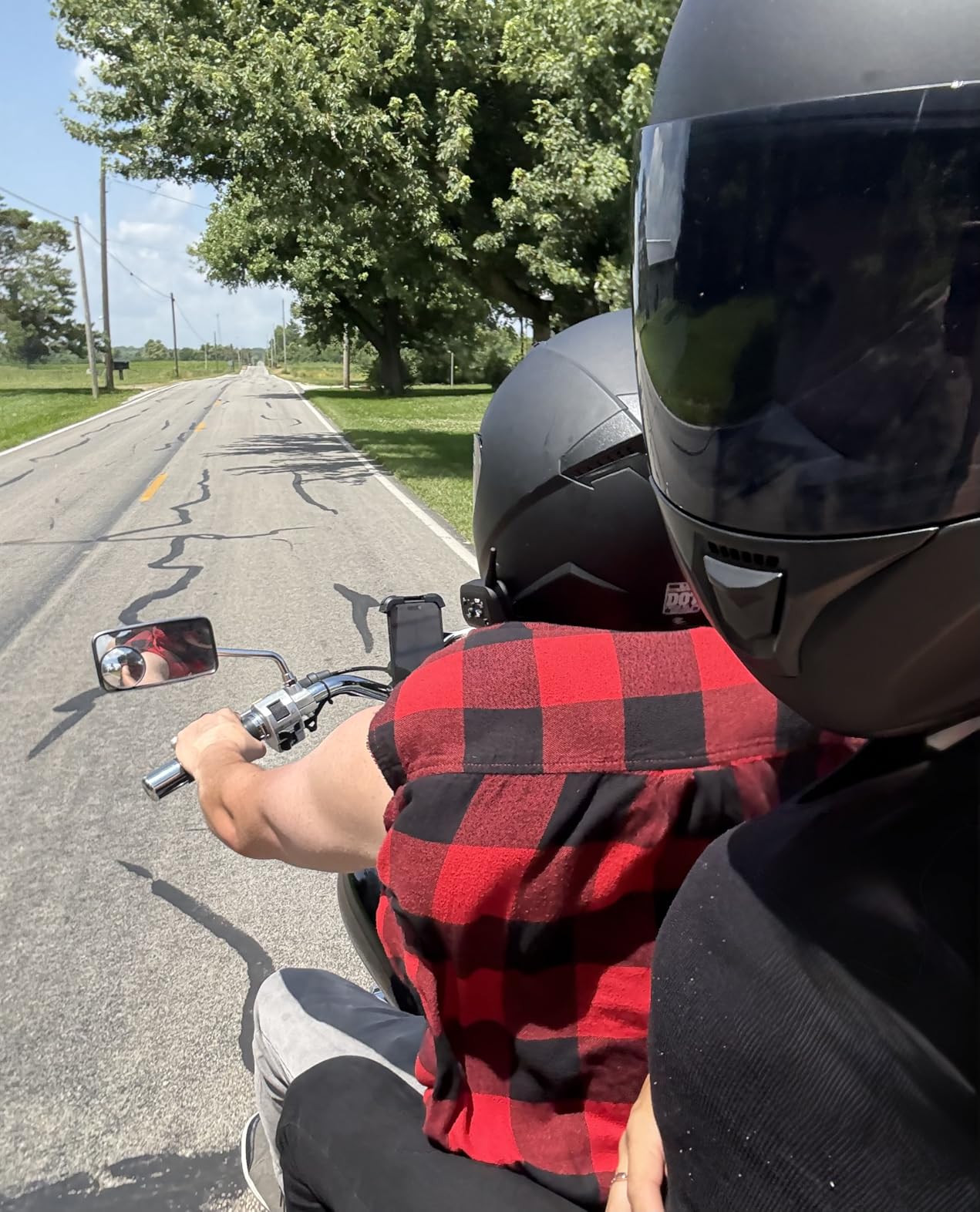
Who the V6 Pro suits
It suits a new rider or a couple upgrading from no comms at all, on a small budget, where the priority is a clear voice between two helmets. The 260 hours of standby means it can sit in a helmet for weeks without being touched.
It is a good choice if you move between machines and helmet types, or if you ride a dirt bike, ATV, or snowmobile alongside your road bike. Riders in open-face and half helmets are well served by the universal mounting.
Where it falls short
Two riders is the hard ceiling, with no mesh and no multi-rider group talk, so it is the least relevant option here for anything beyond a pair. It also cannot run intercom and GPS or music at the same time, and you must switch between sources with a delay.
Bluetooth 3 is old enough to limit modern device compatibility, and one review reports sound quality as poor at higher volume. For group riding of three or more, none of those limitations are worth absorbing.
How to Choose a Motorcycle Intercom for Group Rides
Match the technology to your group size
Two riders can use almost anything on this list, because a direct Bluetooth link is all a pair needs. Three to four riders is where a dedicated four-way unit earns its place, and it is where a pair-only intercom stops being useful. Five riders and up, you want mesh, because that is the only architecture that keeps one conversation going as the group stretches out.
Beyond roughly ten riders, look at cellular-backed options or split the group into two channels with a captain on each. The jump from a six-rider network to a twenty-rider one is where setup time, not hardware, becomes the bottleneck.
Mesh or Bluetooth: the leapfrog relay explained
Bluetooth intercom is a direct link between specific units. Quality depends on distance and obstacles, and the number of riders that can share the link is fixed and small.
Mesh is a relay. A speaker on one bike talks to the next bike along, which repeats the signal to the one behind it, which repeats again. The conversation hops rider to rider, which is why a mesh network can carry a voice well beyond the range of any single unit, and why it survives a bend in the road as long as somebody between you and the leader still has line of sight to both. The cost is setup discipline: mesh needs a named channel, a consistent configuration on every unit, and a re-join when the chain breaks.
Mixed-brand groups and what bridging really does
When a Cardo unit meets a Sena unit in universal mode, the link drops to basic Bluetooth, usually a two-way conversation, and mesh stops entirely on at least one side of the conversation. That is the most common frustration riders report, and it is why agreeing on one model before the ride matters more than any feature on the spec sheet.
There are two ways around it. The first is standardisation, which is simple and reliable. The second is a cloud-based group channel, which is what the ASMAX S1 offers through its CloudTalk mode, letting riders on different brands talk through a server rather than over radio. That approach works well on good signal and adds a dependency on cellular coverage that mesh does not have. If your group will not standardise, test the cloud option on the routes you actually ride before committing to it.
Half helmets, open-face shells, and microphone choice
Full-face helmets take a boom microphone without complaint, and that is the right microphone for speed because it sits close to your mouth where the wind has not reached yet. Half helmets and open-face shells need a button or stub microphone, because there is nowhere to hang a boom. The trade is directivity for wind noise, and at speed an open-face rider will hear more road and airflow regardless of which unit they buy.
Units that ship both microphones, like the Fodsports FX4 Pro, FX6, and the JESIMAIK R16 Pro, let a mixed group standardise on one model without ordering parts. The Cardo Spirit HD is the other common answer here, with a small profile that suits a smaller shell.
All-day battery and charging while you ride
Talk time claims assume a certain amount of use, and mesh consumes more than a two-way link because the radios keep working. Budget for a nightly charge on any multi-day trip, and treat a claimed figure as a ceiling rather than a promise. Among the longer figures in this roundup, the Sena 60S lists up to 24 hours, the Fodsports M1S Pro lists 20 hours, and the ASMAX S1 lists 18 hours.
Two units here can run while charging, the Fodsports M1S Pro and the Fodsports FX6, which removes the nightly charging problem entirely if you carry a small power bank. The Sena 50S offers the fastest top-up, with 20 minutes of charging giving up to 2 hours of intercom.
Waterproofing, audio, and safe volume
IP67 and IPX7 both indicate protection against dust and submersion, and both appear among the fully rated units here. A unit listed only as water resistant, such as the Sena 50S, is a step down for riders who ride year round in rain and mud. If you do most of your riding in a dry climate, the difference matters far less.
For audio at speed, speaker size is only half the story. A boom microphone placed close to your mouth rejects more wind noise than any electronic cancellation, and earplugs designed for motorcycling let you turn the volume down, which is the real protection for your hearing over a long day. Keep the volume below maximum on the units known to distort, such as the Cardo Spirit HD.
Cost of ownership for a whole group
The number that decides most group purchases is not the unit price, it is unit price multiplied by the number of helmets. A large pack on premium mesh hardware is a real outlay, and it is the reason budget group systems keep getting recommended. If half your group will not spend, a mid-tier system that all of you can agree on beats one premium leader and a trail of mismatched hardware.
Pre-Ride Intercom Setup Checklist for Your Group
Every failure we have seen on a group ride traces back to a step that was skipped in a car park. Six steps, thirty minutes, and the channel usually works.
Update every unit on its phone app before you leave home, and confirm the firmware version matches across the group. Older and newer versions of the same brand do not always behave identically in a mesh.
Agree on the channel. Decide whether you are running an open mesh, where anyone can join, or a private group channel, and tell the group which one you are using before anyone pairs.
Pair in a fixed order. Start with the road captain, add riders one at a time in the same sequence every time, and confirm each unit is in the channel before moving to the next. Units that forget their pairing between power cycles need the whole sequence again.
Install and test while stationary. Check the microphone position before rolling, since a mic rotated away from the mouth is common on a small helmet and impossible to fix at speed.
Name a deputy captain. Agree who covers the channel if the lead drops back, and agree the hand signal for a hazard or a change of pace before the first corner.
Plan for the break. Agree where the group regroups if the mesh chain breaks, and plug in anything that can charge while you ride. A broken chain behind a hill is recoverable; a group that does not know where to wait is not.
Frequently Asked Questions
How many riders can a mesh intercom connect at once?
Most mesh units connect 6 to 10 riders in one network, and the number who can talk simultaneously is often lower than the connection count. The Sena 60S lists 2 km with two users and 8 km once six or more join, and the Fodsports FX6 states that six riders connect with best results at four. Check the simultaneous conversation figure rather than the total device count.
Can you mix Cardo and Sena intercoms in one group?
Partly. A Cardo unit and a Sena unit can pair in universal mode, but the link drops to basic two-way Bluetooth and mesh is lost, which is the most common complaint in rider forums. Cloud-based group channels such as the ASMAX S1 CloudTalk mode can bridge brands through a server, but they need cellular coverage. Standardising on one model remains the most reliable option.
Is mesh intercom better than Bluetooth for group rides?
For groups of five or more, yes. Bluetooth makes a direct link between specific units, so quality depends on distance and obstacles and the rider count is fixed and small. Mesh relays a speaker’s voice rider to rider in a leapfrog chain, so a conversation travels well past the line-of-sight range of any one unit. Mesh needs more setup discipline, including a named channel and a re-join when the chain breaks.
What is the best motorcycle intercom for a half helmet?
Look for a unit that includes a button or stub microphone, since a boom will not mount on a half or open-face shell. The Cardo Spirit HD has a low profile that suits smaller helmets, and the Fodsports FX4 Pro and FX6 both include boom and button mics. Expect more wind noise in an open-face helmet regardless of the unit, so a motorcycling earplug and moderate volume help more than any specification.
Which motorcycle intercom has the best sound quality?
The Sena 50S is the strongest all-round answer, with speakers tuned by Harman Kardon, a proper boom microphone, and a 4.5 star average from 1713 reviews. The Cardo Packtalk Edge matches it on rating with active noise cancellation. Above either, use motorcycling earplugs and keep the volume moderate, since turning the unit down is what protects your hearing over a full riding day.
How do you set up an intercom group before a ride?
Update every unit on its app first so firmware versions match, then decide whether you are running an open or a private mesh channel. Pair in a fixed order, usually starting with the road captain, and confirm each rider is in the channel before adding the next. Install and test the microphone while stationary, name a deputy captain, and agree a regrouping point in case the mesh chain breaks.
Final Verdict on Group Ride Intercoms
The best motorcycle intercoms for group rides are the ones that hold one conversation together when the road bends, not the ones with the loudest spec sheet. Our Editor’s Choice, the Cardo Packtalk Edge, is the unit we would fit to every helmet in a large group: waterproof, 13 hours of battery, and a voice system simple enough that any rider can run the channel. For the best audio and the easiest controls, the Sena 50S, and for a mixed-brand group or a club ride, the ASMAX S1.
Whatever you choose, standardise the model, run the pre-ride checklist, and agree a regrouping point before the first corner. That preparation is worth more to a group than the gap between any two units on this list.