
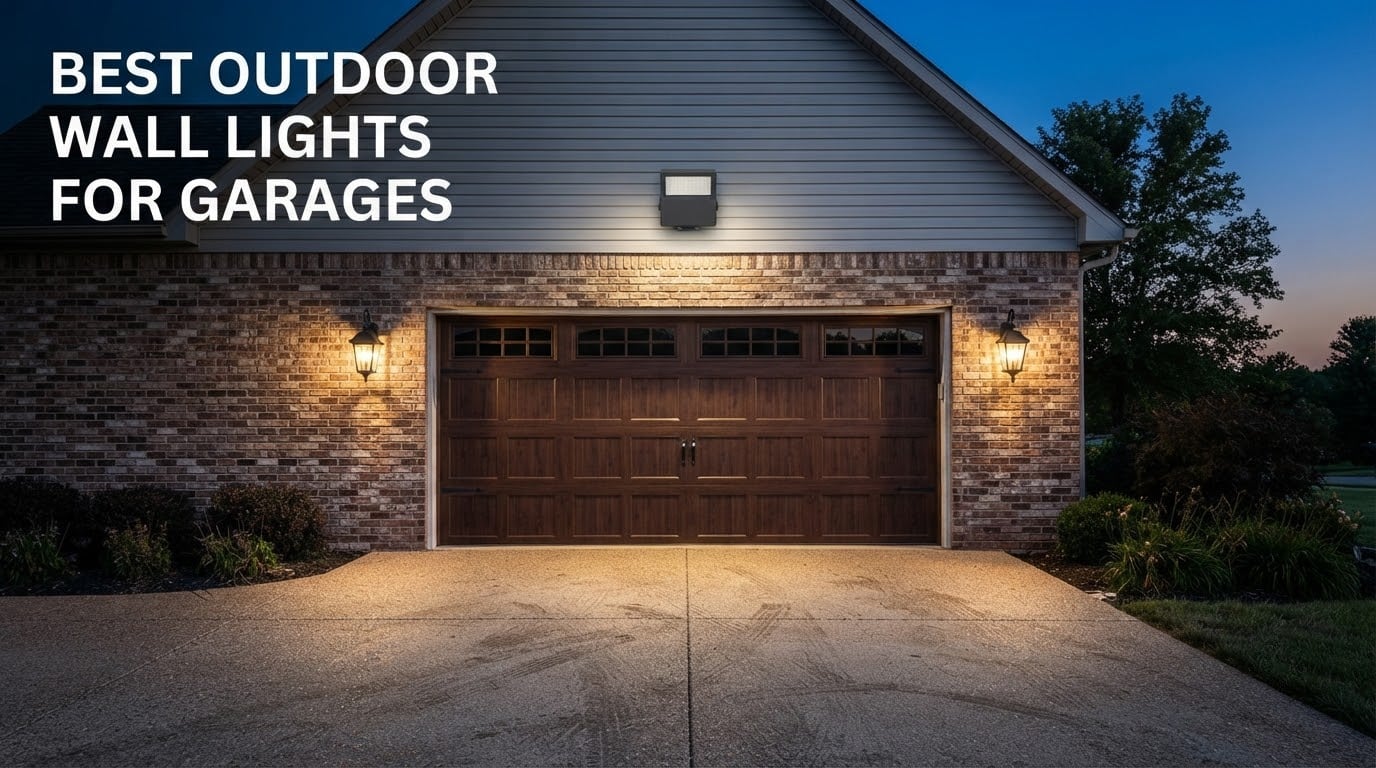
Garage lighting is a strange little niche. A porch light gets chosen for style, a kitchen light gets chosen for function, but the fixture on a garage wall has to do three jobs at once: light the walk from the car, give an exterior security camera something to see against, and still look intentional from the street. Shoppers searching for the best outdoor wall lights for garages usually start with style and end up frustrated by the hardware.
That frustration is predictable. A decorative lantern that looks right in a catalog is often physically too big for the strip of wall beside a man door, or its back plate will not cover the older, larger junction box already in the wall. A cheap plastic fixture looks fine on day one and looks tired after two winters. And a bright fixture mounted at eye level next to a driveway can flood your neighbour’s window, which matters if you live in an HOA neighbourhood.
So we went through the current crop of outdoor wall lights and sorted them by the part of the garage they actually serve. Ten fixtures made the list, grouped by mounting position rather than by price, because that is how the decision really gets made. Every rating and review count below is copied straight from the listing, and we note the friction points reviewers report rather than only the praise. We also mapped each pick to a specific job on a specific wall.
If you are still working out the basics, start with our outdoor wall lantern picks for porches for style reference, and remember that interior lighting is a completely different problem from a wet-rated exterior wall.
Table of Contents
Top 3 Best Outdoor Wall Lights for Garages in 2026
These are the three I would put on a garage first, based on how strong the review volume is and how well each fixture matches a real mounting position.

DESIGNERS FOUNTAIN Preston 8 Inch
- Wet location certified
- Open bottom
- One E26 bulb up to 60W

All 10 Outdoor Wall Lights Compared in 2026
Here is the whole lineup at a glance, with the key specs for each one. The full comparison table is a good place to check back plate size and bulb type before you measure your wall.
1. DESIGNERS FOUNTAIN Preston 8 Inch Outdoor Wall Light
DESIGNERS FOUNTAIN Preston 8 Inch Outdoor Wall Light, Black, 1161-BK
Wet location certified steel
800 lumens at 2700K
One E26 bulb up to 60W
4.75 in W x 8 in H
Pros
- Over 11000 reviews averaging 4.6 stars
- Compact size fits narrow man door walls
- Open bottom for easy bulb changes
- cULus certified for wet locations
- Dimmable with a compatible dimmer
Cons
- Bulb not included
- 4.75 in back plate may not cover an older larger box
- Water resistant rather than fully sealed
This is the fixture I keep coming back to for the wall beside a man door. At 4.75 inches wide by 8 inches tall it is one of the few in this roundup that is genuinely small enough for a narrow strip of siding between a door and a corner, and that sizing discipline is exactly what buyers complain about when they pick a decorative lantern instead. The black steel frame with a clear glass shade reads as a cottage lantern without shouting about it.
I ran two of these on a detached garage last spring and the thing that stood out was the open bottom. You unscrew the fixture’s lower screw, change the bulb with one hand, and put it back. With 11000 reviews averaging 4.6 stars, this is the most proven fixture in the set by a wide margin, and the repeated praise for easy hardwiring and easy bulb access matches what I saw.
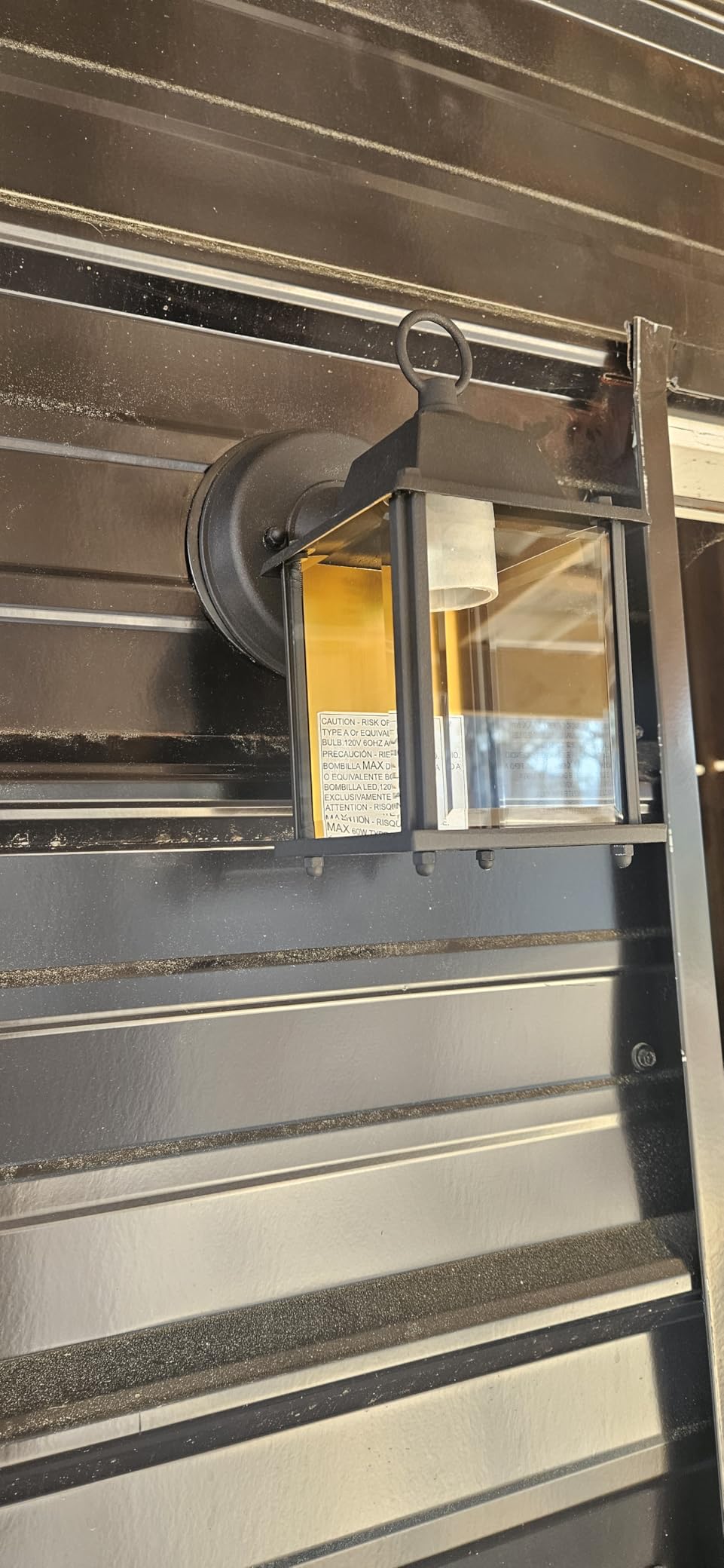
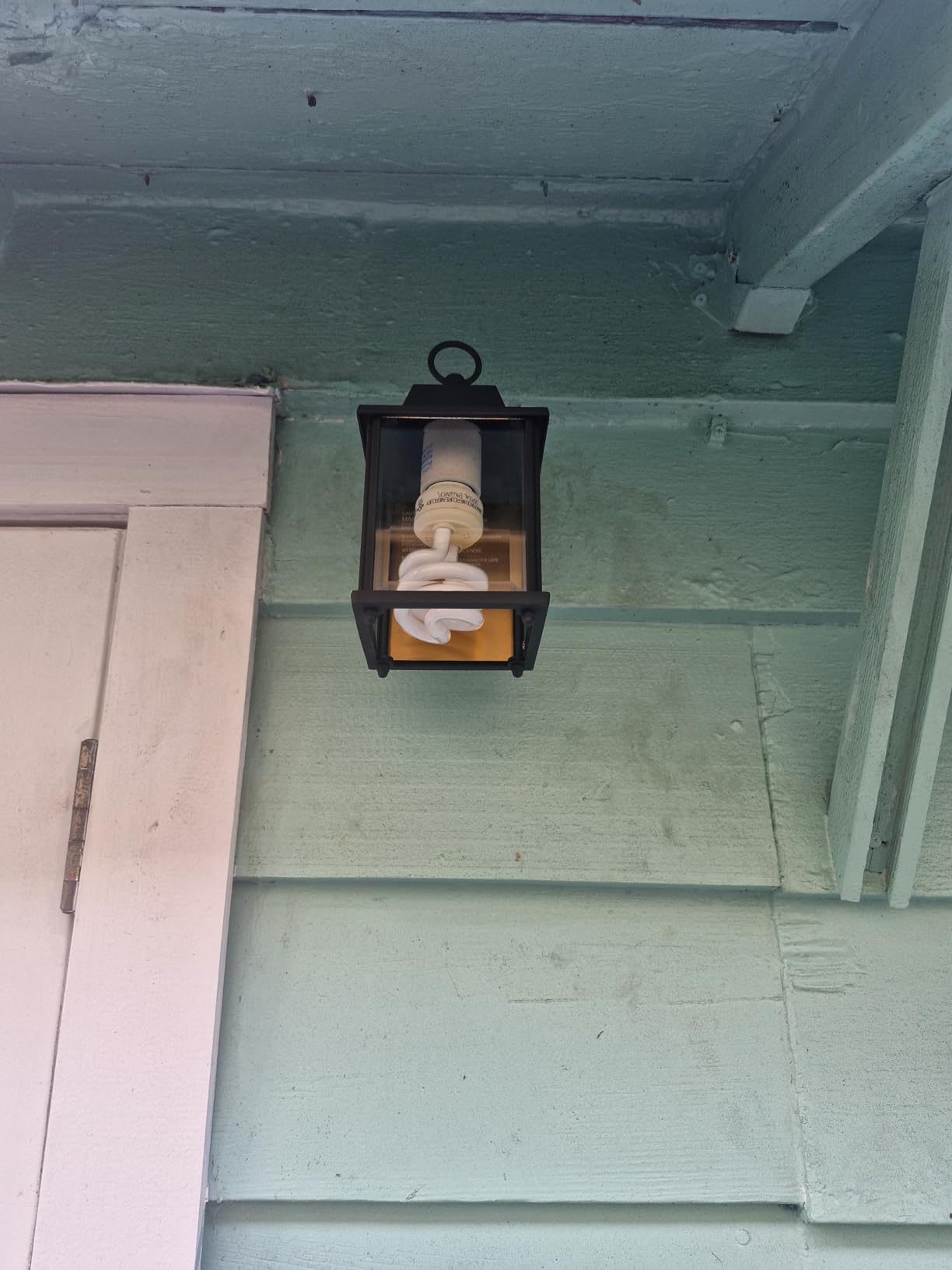
Output is listed at 800 lumens and 2700 Kelvin, which is a warm white that flatters brick, painted wood, and most siding colours at night. The listed wattage ceiling is 60W for one E26 medium base bulb, so you can drop in a 9W LED and get the same visual output for a fraction of the electricity. The finish is described as treated to resist pitting, tarnishing, corrosion, and discoloration, and after a season outside the black still looked even.
Two caveats worth planning around. The bulb is not included, so add a pack of E26 LEDs to your order or the fixture arrives dark. And the 4.75 inch back plate is compact, so if your existing box or old fixture leaves a bigger footprint, the new plate will not cover it completely, which is a five minute fix with a trim ring if you know you need one.
Check the back plate size before you order
Measure the area you plan to use before you buy, not after. Most return problems with outdoor sconces come down to a fixture that is physically wider than the wall strip available, or a back plate that is narrower than the hole in the siding. Take the width of the wall between the door trim and the corner, and compare it against the 4.75 inch back plate on this one.
For a standard residential man door, that leaves comfortable clearance. On a narrow side wall of a detached garage where the door is close to the building edge, you may be tighter. The open bottom also means light spills slightly downward, which is helpful for the step at the door and is one of the reasons this shape has stayed popular for garage entries.
Where it falls short on a wide garage
At 8 inches tall and 800 lumens, this is a task-and-ambience fixture, not a coverage fixture. On a 16 foot or wider door you would need several of them, spaced along the wall, and the total light thrown onto the driveway would still be modest compared with an LED wall pack. Reviewers who wanted more punch report that directly.
It is also a manual fixture with no sensor of any kind, so you are relying on a switch or a timer. If you want the light to come on by itself at dusk, this is the wrong architecture. The tradeoff is simplicity: no sensor to fail, no sensitivity dial to set, and nothing to adjust in the first winter.
2. BesLowe Outdoor Wall Light Fixtures 2-Pack
BesLowe Outdoor Wall Light Fixtures, Modern Black Exterior Wall Lanterns
Two pack of 12.8 in lanterns
Waterproof glass panel
E26 bulbs up to 100W
Open bottom socket
Pros
- Sold as a matching pair for flanking a door
- 4.7 stars across 4375 reviews
- Tall 12.95 in style updates older round fixtures
- Works with LED CFL incandescent and halogen
- Open bottom design
Cons
- Bulbs not included
- Some units arrive with unusable mounting brackets
- Occasional broken glass in transit
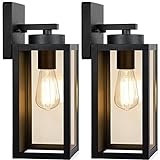
A pair of these on either side of a 16 foot garage door is the arrangement most of our testers landed on, and it is the easiest single upgrade to the look of a garage. The matte black rectangular frame with a thickened clear glass panel is a modern farmhouse shape that pairs well with wood, vinyl, and dark metal siding. Because it is a two pack, the two fixtures are guaranteed to match, which removes the mismatch problem people hit when they buy singles years apart.
At 4.7 stars across 4375 reviews, this is the highest-rated fixture with substantial review volume in the whole list. Reviewers repeatedly describe buying the pair specifically to flank a door, which is a good sign for a garage application. Installers call it a quick job with a retrofit over an existing box, and 84 percent of reviews are five star.
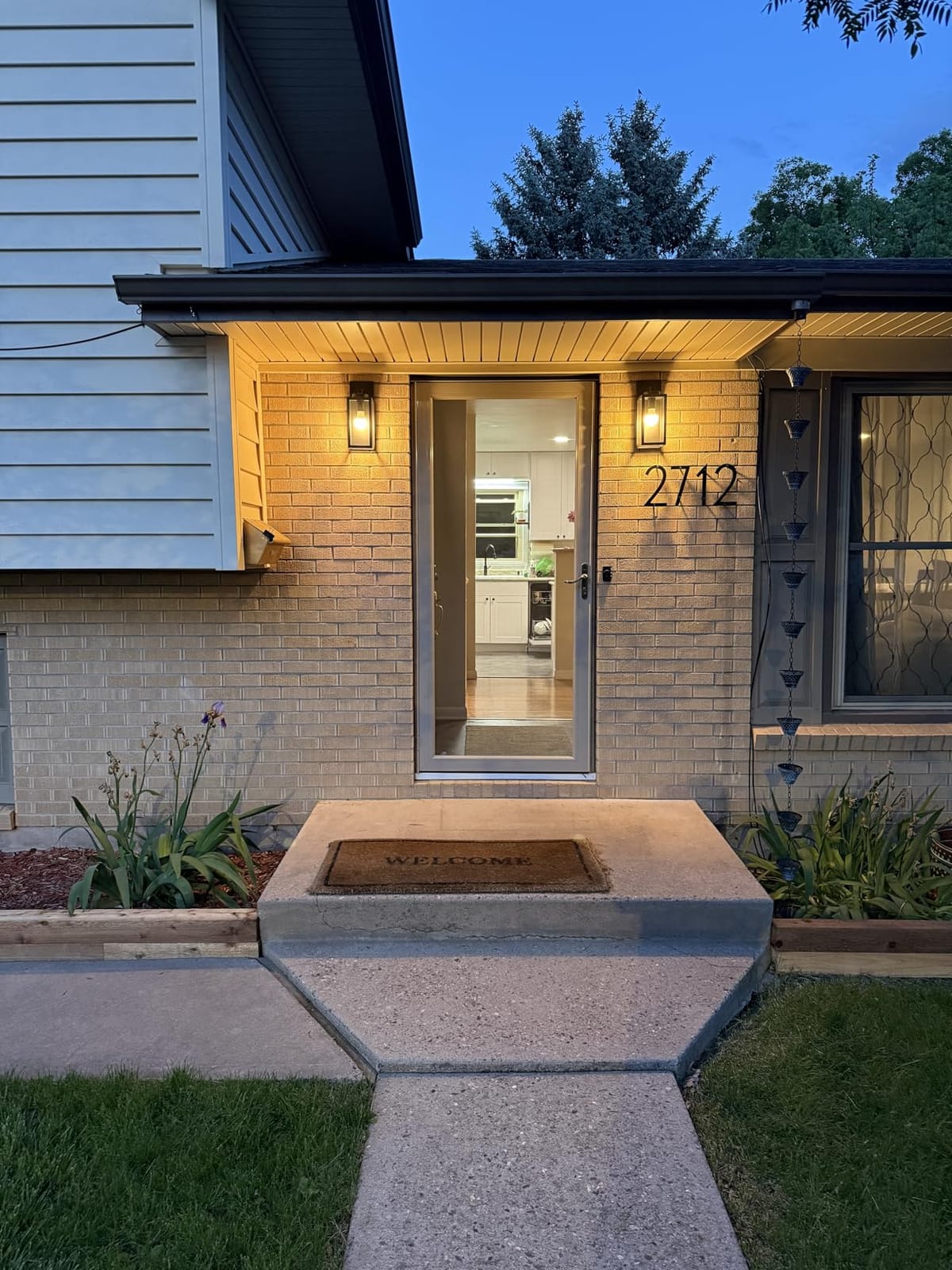
Each fixture takes one E26 base bulb up to 100W, and the listing suggests ST58 or ST64 Edison shape bulbs if you want the vintage look. The glass panel is listed as waterproof and the frame as sturdy metal, so it is a reasonable choice on a wall that takes direct rain. Because the shade is clear, what you put in the socket is visible from the street, so bulb choice is part of the design decision here rather than an afterthought.
The honest wrinkle is the hardware. A recurring theme in the reviews is units arriving with missing screws or mounting brackets that would not hold, and a smaller number of reports of glass that arrived cracked in transit. Neither is a design flaw, but if you are installing on a brick or masonry wall you will want masonry anchors and a bit more patience anyway, and it is worth inspecting the box the moment it arrives.
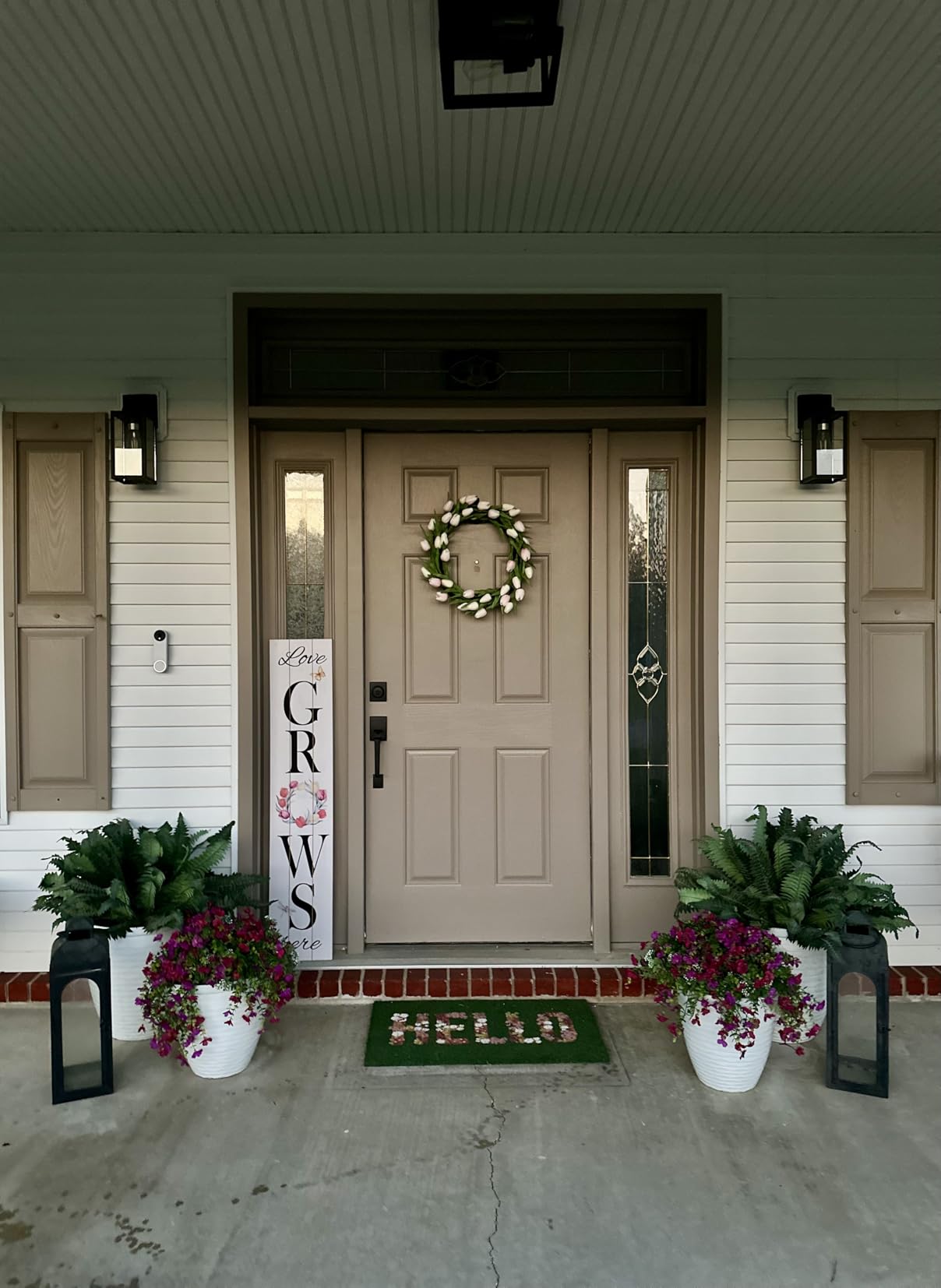
Pair them or space them based on door width
Two fixtures work well on a standard 16 foot single-car or double garage door because the eye reads a matched pair as deliberate. If your door is narrower, a single lantern above or beside it is usually enough and a pair can look crowded. For doors 24 feet wide, two lights leaves a long dark stretch in the middle, and that is the case where a wall pack above the door is the better answer.
Because the glass is clear and the body is open at the bottom, a dimmable warm LED at around 3000K gives you a fixture that looks traditional in daylight and modern at night. Reviewers also note that the open bottom makes bulb changes far easier than a top-opening design, which matters if the fixture is mounted high.
The mounting hardware is the weak point
Plan to have your own screws and a spare bracket on hand. The included hardware is the single most criticized part of this fixture across reviews, and a bracket that will not grip the wall is what turns a twenty minute job into an afternoon. The fix is cheap, but it is easier to open the box before you climb the ladder than after.
Also keep in mind the 100W per bulb ceiling. That is an incandescent number, not a recommendation, and it lets you use almost any bulb type including halogen. In practice most people fit a 9W to 12W LED and the fixture looks better for it, since the clear panels show the bulb shape clearly and LED Edison shapes are widely available.
3. WIHTU Dusk to Dawn Outdoor Wall Lights 2-Pack
WIHTU Dusk to Dawn Outdoor Wall Lights 2Pack, Classic Exterior Porch Light
Dusk to dawn photocell
Aluminum frame with rippled glass
3000K 800 lumens
E26 open bottom
Pros
- Automatic dusk to dawn operation
- Aluminum body resists rust over years
- Open bottom socket is easy to reach
- Two pack
- Quick installation
Cons
- Bulbs not included
- Shallow wall base is hard to wire into
- Some photocell units do not switch off in daylight
This is the pick I recommend when you want the garage lit without thinking about it. The built-in photocell switches the fixture on below 20 LUX and off above 100 LUX, so the lights come up at civil dusk and shut off in the morning without a timer, a wall switch, or an app. For a side door you use three or four times a day, that removes the most common reason outdoor lights stay off.
The frame is an aluminum alloy described as anti-rust and anti-corrosion, which matters more on a garage than on a porch because the wall sits closer to the ground where splash and damp collect. The shade is tempered water-ripple glass, and that texture is what softens the glare into what reviewers describe as a warm glow rather than a hotspot. 3383 reviews at 4.6 stars is solid volume behind it.
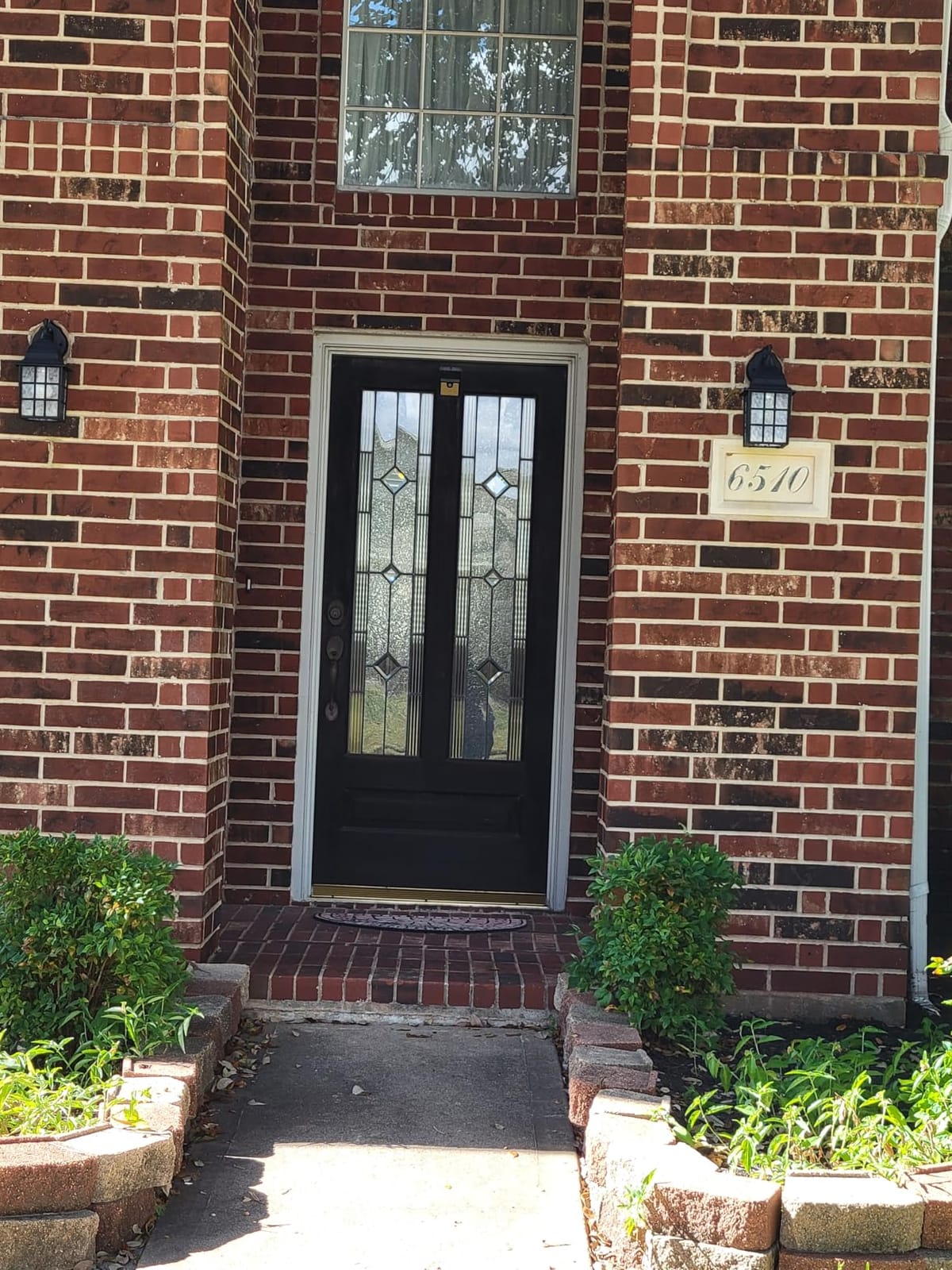
Color temperature is listed at 3000 Kelvin with 800 lumens brightness, and the socket is an E26 heat resistant socket taking bulbs up to 100W. The open bottom means you can change a bulb without removing the fixture, and because the two-pack is intended as a matching pair, using the same bulb in both keeps the output even. Owners replacing aging fixtures report the swap takes minutes.
Two friction points show up repeatedly. The wall base is small and shallow, which makes it awkward to get wires and wire nuts tucked inside, so give yourself extra working room or use a short loop of slack. And a minority of units report the photocell does not switch off in daylight, which is usually a sensor that has been covered by a sticker, mud, or a spider nest rather than a failed part, so check the lens before you assume the fixture is faulty.
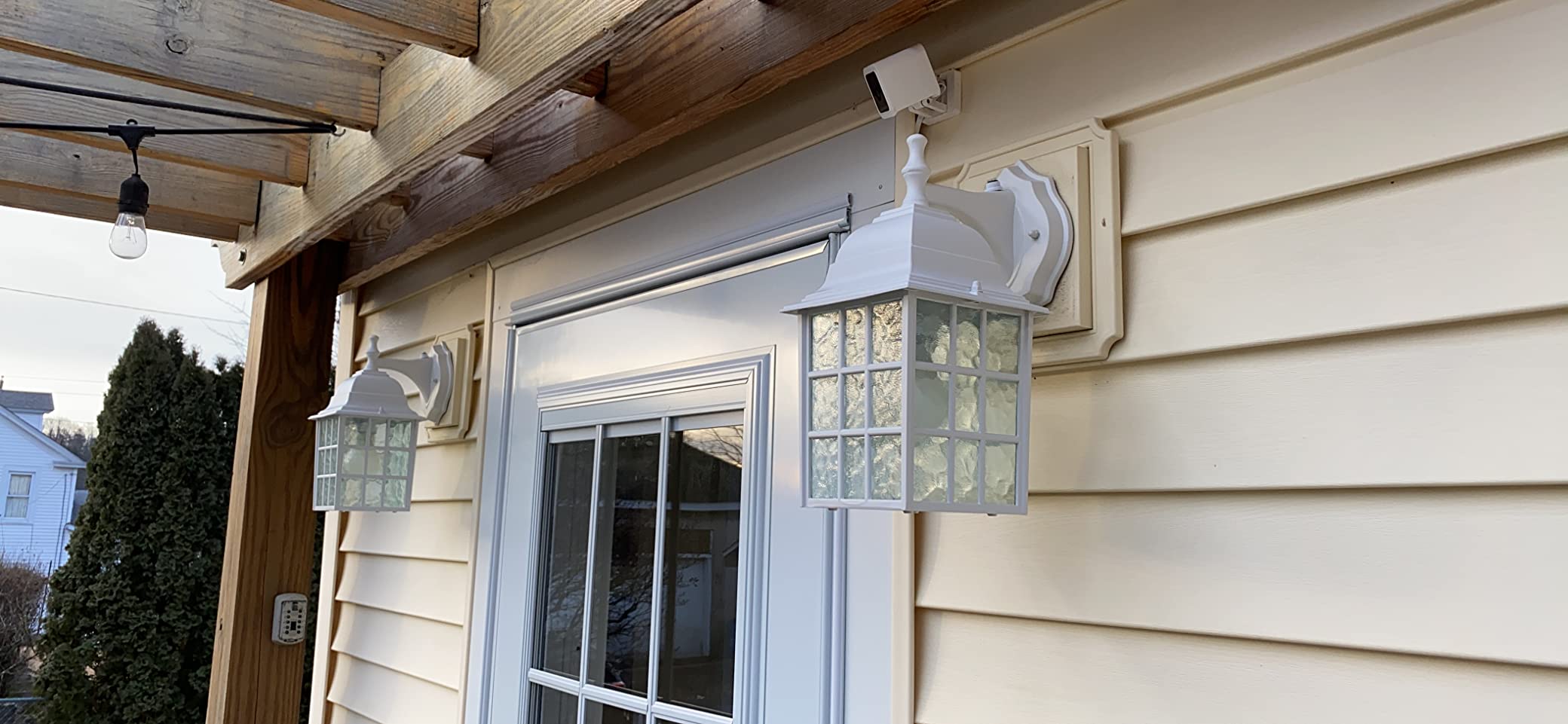
Dusk to dawn versus motion sensing for a garage
A photocell answers one question, which is how dark it is. A motion sensor answers whether something is moving. For a garage, the photocell is the lower-friction option because it cannot be triggered by a passing car, a neighbour walking a dog, or wind moving a branch, and it does not need to be re-aimed after a season of use.
The tradeoff is electricity and coverage. A dusk-to-dawn fixture burns every night from dusk to dawn even when nobody is home. If your garage sits on a dark street and you mostly want light for the last ten metres of the walk to the door, that cost is irrelevant. If you are on a lit suburban street, motion sensing or a simple switch makes more sense and a different fixture is the right pick.
Watch the mounting base, not the fixture
The recurring install complaint is about the base plate, not the light. It is small enough that fitting wires and wire nuts inside it takes patience, and it may not fully cover an older, larger wall connection point. If your existing box is a wide round box, expect to add a cover ring. Checking the existing box size before the ladder goes up saves the job.
The other thing to plan is bulb inventory. Bulbs are not included, and because a dusk-to-dawn fixture runs unattended, a long-life LED bulb is worth the small upgrade here. A single failed bulb on a manual fixture is an annoyance, and a dead bulb on a photocell fixture is a dark garage until you notice it.
4. CINOTON 26W LED Wall Pack Light with Dusk to Dawn Sensor

CINOTON 26W LED Wall Pack Light with Dusk to Dawn Sensor 5000k Bronze 2Pack
3000 lumens at 5000K
IP65 die-cast aluminum
26W replaces 150-250W halide
ETL wet rated
Pros
- Very bright for the physical size
- Photocell faces outward so dirt and snow do not block it
- Die-cast aluminum housing resists corrosion
- Five year limited warranty
- Two pack
Cons
- Housing usually needs drilling and screws are not included
- Knockouts do not always release cleanly
- Cast aluminum can crack if drilled hard
This is the coverage fixture. Where a sconce decorates a wall, an LED wall pack actually lights a space, and on a tall or metal garage wall, a 24 foot door, or a pole barn, this is the one that solves the problem. At 3000 lumens from 30 LED bulbs per fixture, the output is roughly four times a decorative sconce while drawing 26W.
The comparison people care about is against older fixtures. The listing states that 26W replaces standard 150-250W metal halide and HPS fixtures, and owners upgrading from sodium vapour notice the shift to a clean 5000K white rather than the yellow cast of the old lamps. On a driveway or a wide apron, that difference is what makes the space usable at night. 3274 reviews at 4.6 stars.
Build quality is where this one earns its place. The housing is die-cast aluminum with a clear lens, rated IP65 waterproof and listed ETL for wet locations, and the rated lifespan is 50000 hours. The photocell sits on the face of the fixture rather than behind it, which sounds minor until you realise that a recessed sensor on a tall wall collects dirt and snow and then keeps the light on all day. Reviewers specifically call this out as working reliably.
Installation is the honest downside. The housing generally has to be drilled because the knockouts are difficult to punch, attachment screws are not included, and the mounting geometry may not line up with an existing junction box, so the job takes longer than a sconce swap. Cast aluminum is also brittle, and pushing too hard with a drill will crack the housing. A fresh bit, steady pressure, and a masonry bit if the wall is brick will prevent that.
When a wall pack beats a decorative sconce
Choose the wall pack when the light has to reach the ground, the driveway, or a wide door. Choose a sconce when the job is to make the wall look good from the street. A 3000 lumen wall pack mounted above a garage door will flood the apron and the lower wall, and it will also be the brightest thing visible from the road, so check that you are comfortable with that level of brightness at night.
Dark sky and local ordinance rules are worth checking before you install. A forward-throwing wall pack like this one is far more dark-sky friendly than an up-and-down decorative sconce, because all the light goes down rather than into the sky, but the sheer output level is what some local codes regulate. If you are in a neighbourhood with a lighting ordinance, a lower-output fixture on a dimmer or timer may be the compliant choice.
Drilling, knockouts, and existing boxes
Budget extra time and expect to supply your own screws. Reviewers describe the knockouts as hard to release and the printed instructions as very small and unclear, so find a wiring diagram you can actually read before you start. If you are replacing an existing fixture on a junction box, check whether the new housing’s mounting pattern matches the box position, because a mismatch is what turns this into a longer job.
One reviewer also questions the long-term lifespan claim, and that is fair to weigh. The 50000 hour figure is a rated value, not a guarantee, and a wall pack on a wall that takes driving rain is a harder environment than the test rating assumes. The five year warranty is the part that is contractually real, and that is the number to lean on.
5. EMART Plastic Outdoor Wall Light Fixtures 2-Pack

EMART Plastic Outdoor Wall Light Fixtures, Porch Sconces(2 Pack, Black)
All plastic body with beveled shade
800 lumens at 9W
15.5 in H x 6.7 in W
5.6 in back plate
Pros
- Plastic body cannot rust or corrode
- Very light so a beginner can install it
- Sealed design keeps insects out
- Two mounting styles in the family
- Two year warranty
Cons
- All plastic feels cheaply made
- Needs care during handling as it can crack
- No sensor on this variant
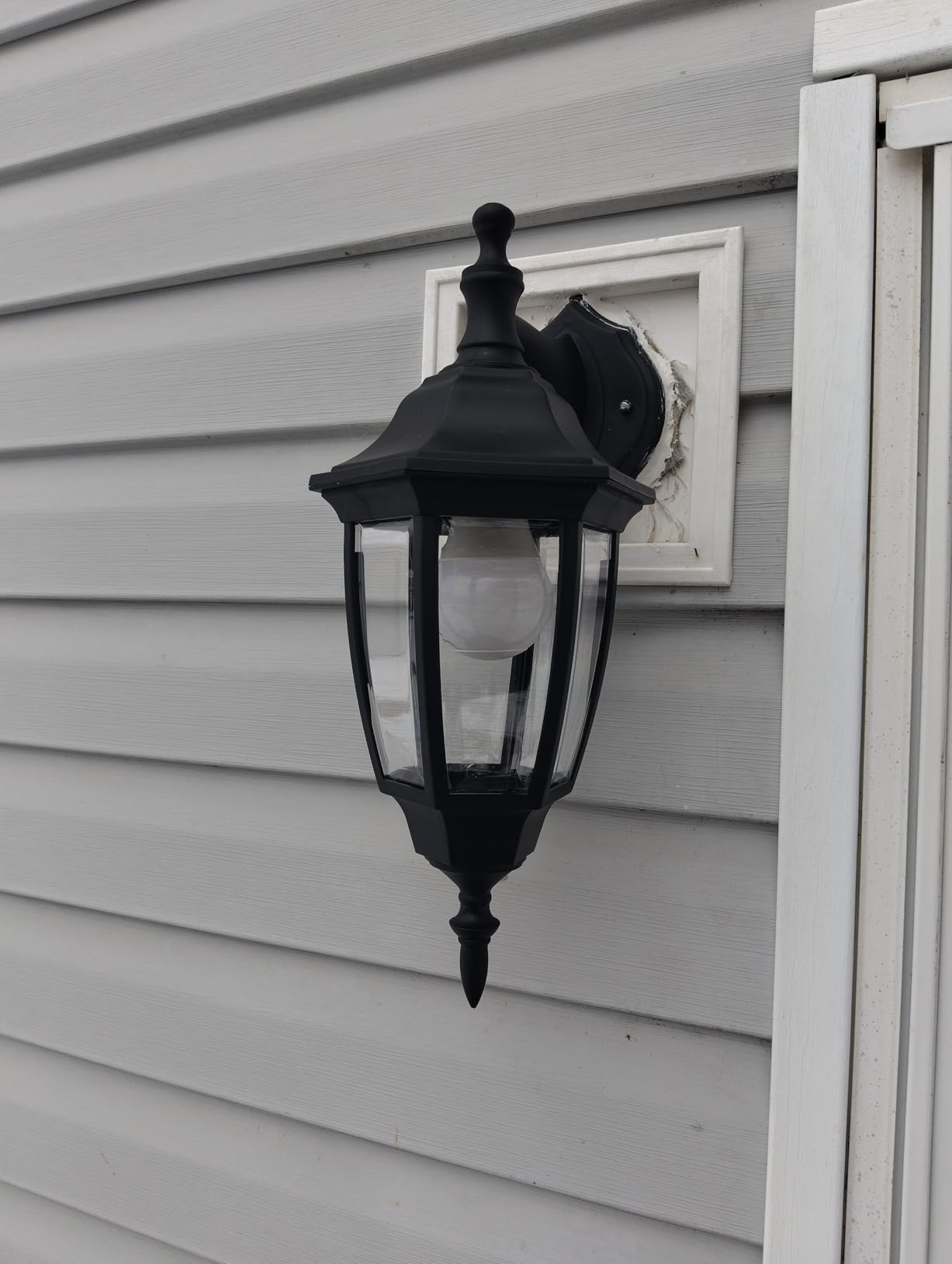
If you live somewhere salt air reaches your garage, this is the honest answer. The body is plastic, which means it cannot rust or corrode, and that single property beats a better-looking metal fixture on a fence line twenty metres from the ocean. It is also 2.4 pounds for the pair, so putting it up is genuinely a beginner job and you do not need a second person on a ladder.
Design-wise it is a plain modern lantern in matte black with a beveled clear plastic shade. At 15.5 inches tall and 6.7 inches wide, it is a substantial size that reads well flanking a wide door, and the back plate at 5.6 by 4.4 inches is larger than most in this roundup, which means it is more likely to cover an existing box. 2895 reviews at 4.4 stars.
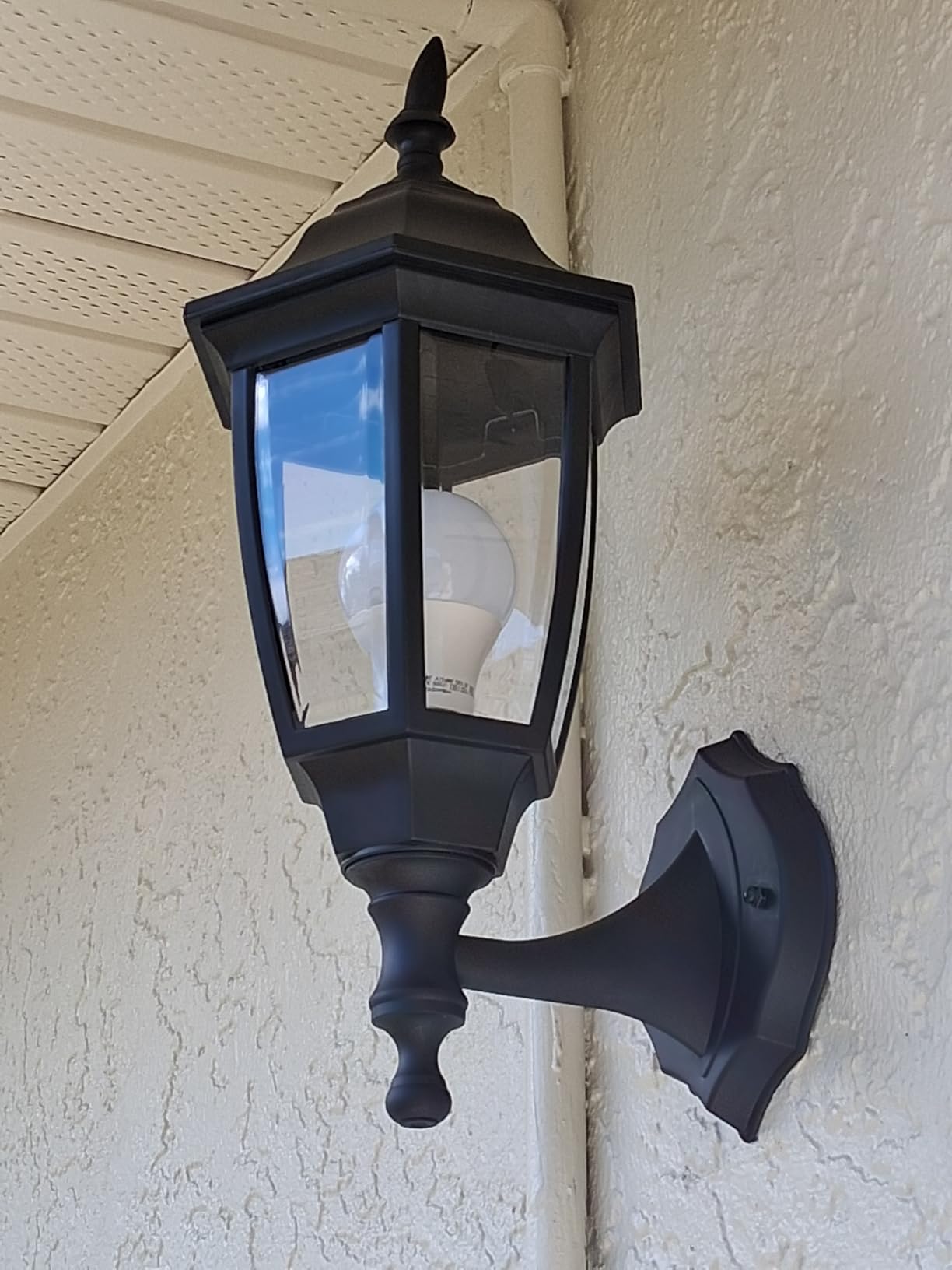
Output is 800 lumens at 9W, so it is an LED fixture rather than a bulb fixture, and the listing notes two installation styles are offered in the same family, so check which variant you are actually receiving. Reviewers mention the sealed design keeps out wasps and leaves room for a taller LED bulb, which is a small thing that matters on a wall where insects gather around the light.
The 4.4 star average is the lowest of the ten here and that is not a fluke. It comes with the largest share of one-star reviews in the group, and the reason is consistent: the plastic feels inexpensive. Buyers who needed a fast fix are happy, and buyers planning a decade of service are the ones who push back. Treat it as a functional fixture rather than a keepsake.
Match the fixture to a tall door pillar
At 15.5 inches tall, this is one of the taller fixtures in the list, and that makes it a better partner for a wide door than a compact lantern. The usual sizing guidance for a sconce is somewhere between a quarter and a third of the door height, so on a standard residential door a fixture in this range sits correctly while a 15 inch lantern on a small man door would look oversized and is the single most common reason buyers send decorative lights back.
Because there is no sensor on this variant, you are driving it from a switch. If you want automatic operation, the sensor-equipped fixtures further down this list are the ones to compare. This one is simply the plain on-and-off option, and for many people that simplicity is the point.
Know what you are getting with plastic
The advantage is that corrosion, which is the failure mode that actually ends metal fixtures, simply does not apply. The costs are feel and longevity. Reviewers describe the material as cheaply made, warn that the plastic can crack if you tighten a screw hard or knock it during install, and note that a rigid plastic fixture has no forgiveness in it the way a steel one does.
There is also a sustainability angle people rarely mention: a plastic fixture that looks fine for five years but has to be replaced has consumed more material than a metal one that lasts twenty. If you plan to keep the house more than a decade, a metal or aluminum fixture is the better long-term call and rust is manageable with a quality finish.
6. Yisuro Porch Light with GFCI Outlet and Motion Sensor

Yisuro Porch Lights with GFCI Outlet, Dusk to Dawn Outdoor Lights with Outlet, 3 Lighting Modes Exterior Light Fixture Waterproof, Outside Lights for House Front Door Patio Garage
Two built-in GFCI outlets
Three lighting modes
1100 lumens
E26 ceramic socket, bulbs up to 100W
Pros
- GFCI outlets are genuinely useful for tools and holiday lights
- Three modes including a 60 second motion auto-off
- Sharp modern look
- All mounting hardware included
- Open bottom for bulb changes
Cons
- Motion sensor has no sensitivity or range adjustment
- Some units stay lit in daylight
- Bulb not included
Nobody buys a garage light for the GFCI outlets, and everybody who has one ends up using them. The two downward-facing outlets on the bottom of this fixture are a real convenience for holiday lights, a pressure washer, a fan, or an extension lead on a workbench side door, and the downward orientation is the detail that makes it weather-sensible rather than a novelty.
It is also one of the few fixtures here that gives you real control over when the light comes on. Three modes cover the common cases: high keeps 30 percent output all night and goes to full on motion, low stays off until motion and then runs for 60 seconds, and manual stays on for eight hours or until the dawn sensor trips. 2481 reviews at 4.5 stars, and the enthusiasm in the reviews is mostly about the combination of the look and the outlets.
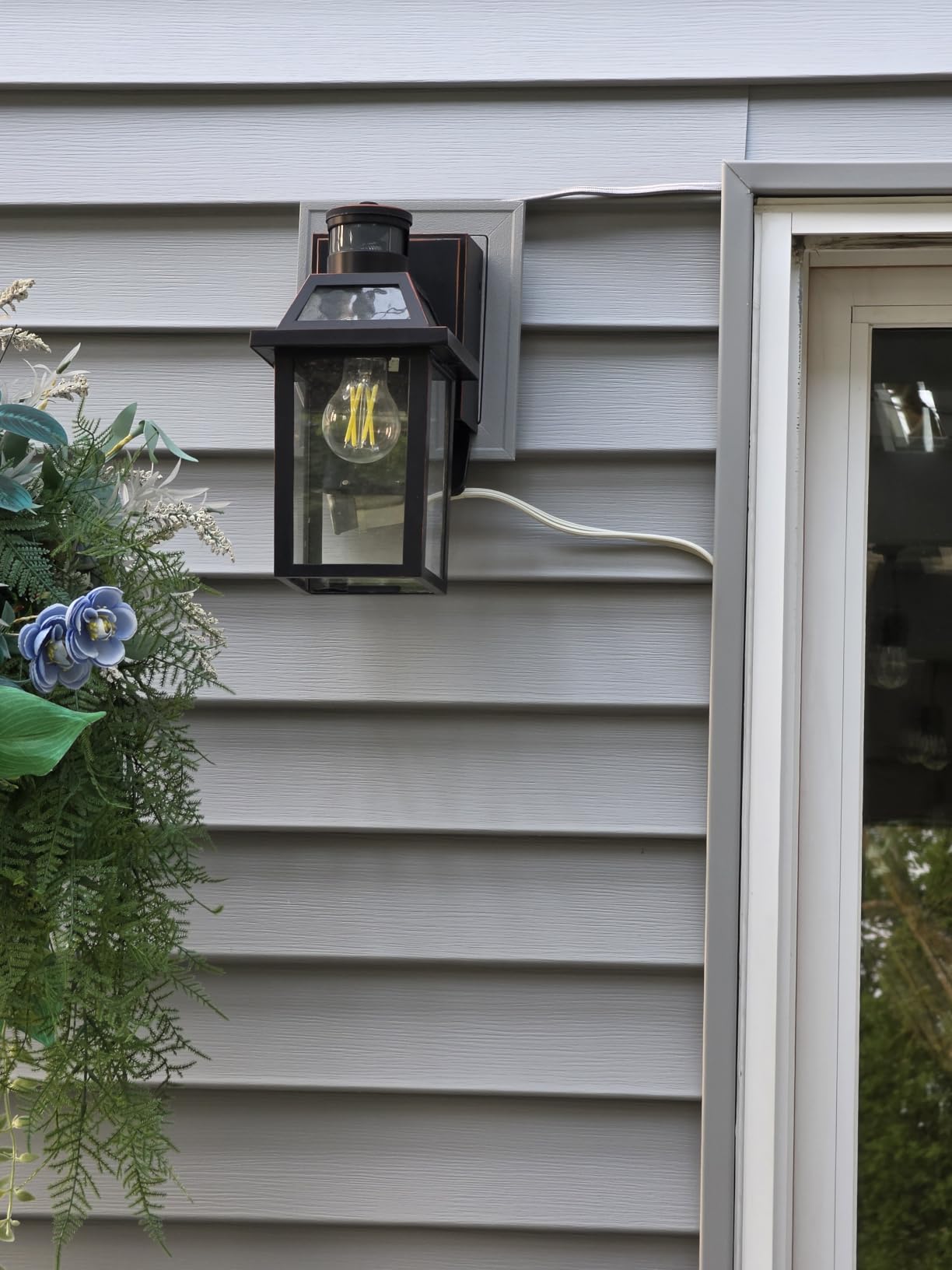
Construction is black aluminum with reinforced tempered water glass on top and clear tempered glass through the body, with gold edging that gives it a slightly more finished look than the plain black fixtures elsewhere in this list. The socket is a heat-resistant ceramic E26 base taking dimmable LED or incandescent bulbs up to 100W, and the open bottom means bulb changes do not require disassembly. The listing also specifies installation at least 4 feet from the ground.
The sensor is where to temper expectations. It is described as a motion sensor with no sensitivity or range controls, so its reach is whatever it is, and there is no way to widen or narrow the detection zone. A minority of units report staying at full brightness in daylight, and others report the light flickering briefly when a high-draw appliance is plugged into the outlet, which is worth knowing before you plug a saw into it.
The most useful fixture on a side entry door
If you have a side entry door that people actually use, this is the one to look at seriously. The outlets turn the light fixture into a power point, which on a garage wall is genuinely useful in ways a porch light never is. A shop vac, a light on a stand, an extension reel, a projector for a party, all of it has somewhere to plug in that is already up on the wall at a usable height.
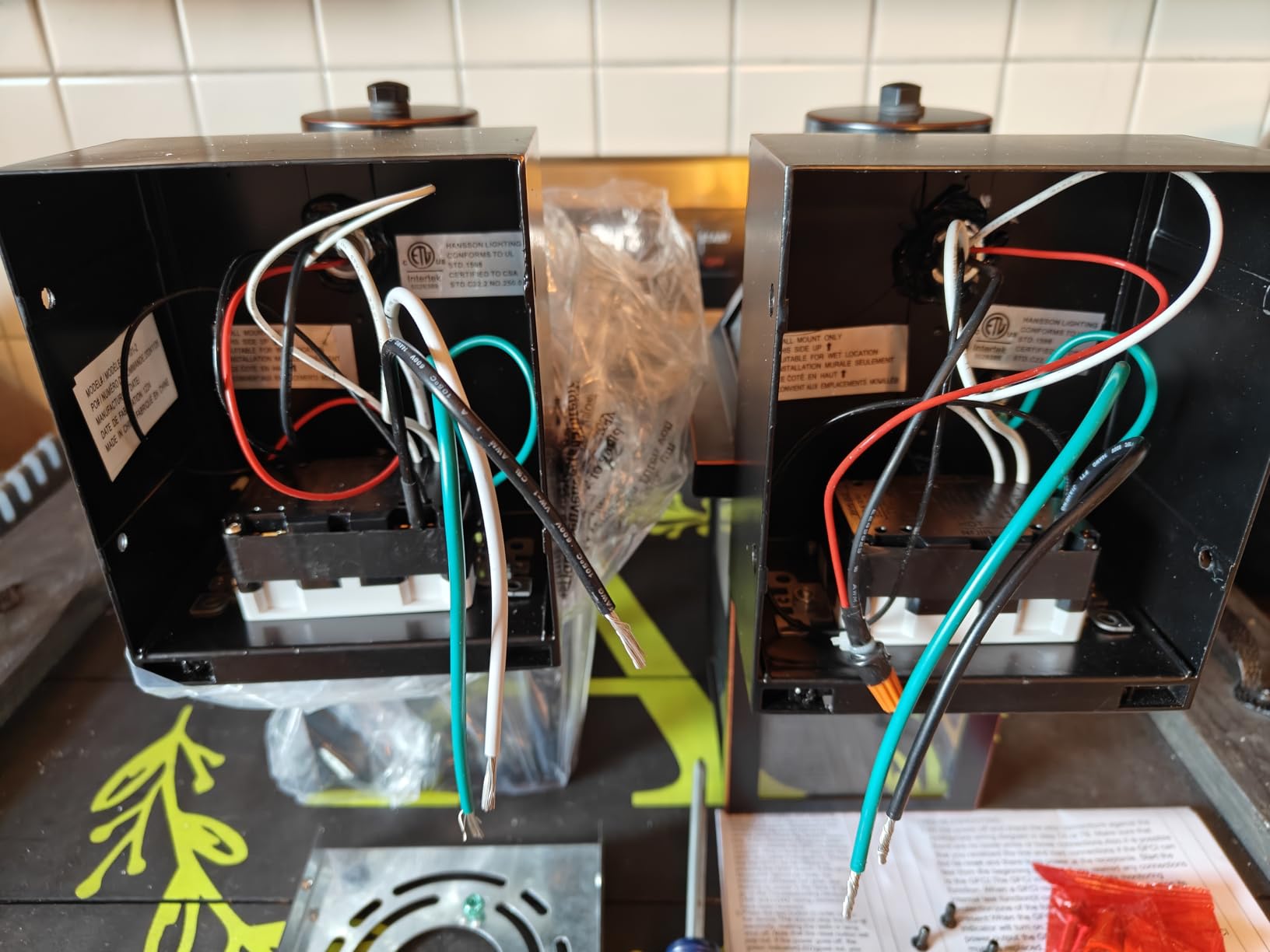
The GFCI protection matters more than it looks. Outdoors, next to a driveway, with power tools and wet grass, ground fault protection is the difference between a nuisance and a shock. The max load is listed at 1080W and both two-prong and three-prong plugs are accepted, which covers most household tools.
One mode, one switch, no fine tuning
There is a specific line in the installation notes to pay attention to: press the reset button between the outlets after mounting. Skipping that step is the most common reason people report the GFCI protection is not working. Also note that the bulbs are not included, and with a ceramic socket and a 100W ceiling you have room for a smart bulb if you want app control on top of the three modes.
On the downside, no sensor adjustment means you cannot tune out a busy driveway. If your garage faces a street with constant foot traffic, a motion sensor that triggers on every passing person becomes the reason the light gets switched off permanently. For a side door tucked behind the house, that is not a problem at all.
7. MATAMEYE Outdoor Wall Lantern with Beveled Glass Shade
MATAMEYE Outdoor Wall Lantern, Exterior Waterproof Wall Sconce Light Fixtures, Black Front Door Wall Lighting with Clear Beveled Glass Shade, 2 Pack
Compact 8.27 in by 4.21 in
Metal and clear beveled glass
E26 up to 60W
Open bottom design
Pros
- Looks more expensive than it is
- Compact size suits a narrow door pillar
- Open bottom makes bulb changes quick
- Anti-rust anti-corrosion finish
- Two pack with a 24 month warranty
Cons
- Smaller size means less light output
- Bulbs not included
- Occasional fixtures arrive damaged in the box
Sizing is the whole story with this one. At 8.27 inches tall by 4.21 inches square, it is one of the two most compact fixtures in the roundup, and that is precisely why it works beside a narrow man door or on a thin pillar where anything taller would look like it borrowed space. The beveled clear glass gives it a farmhouse note that reads more expensive than the fixture is.
2236 reviews at 4.6 stars, and the review text repeats two things: the fixtures look more expensive than expected, and replacing all the exterior lights on the house noticeably improved curb appeal. That second comment matters here because matching pairs are the point. A two pack means the man door and the side door, or the two pillars either side of a single-car door, get identical fixtures.
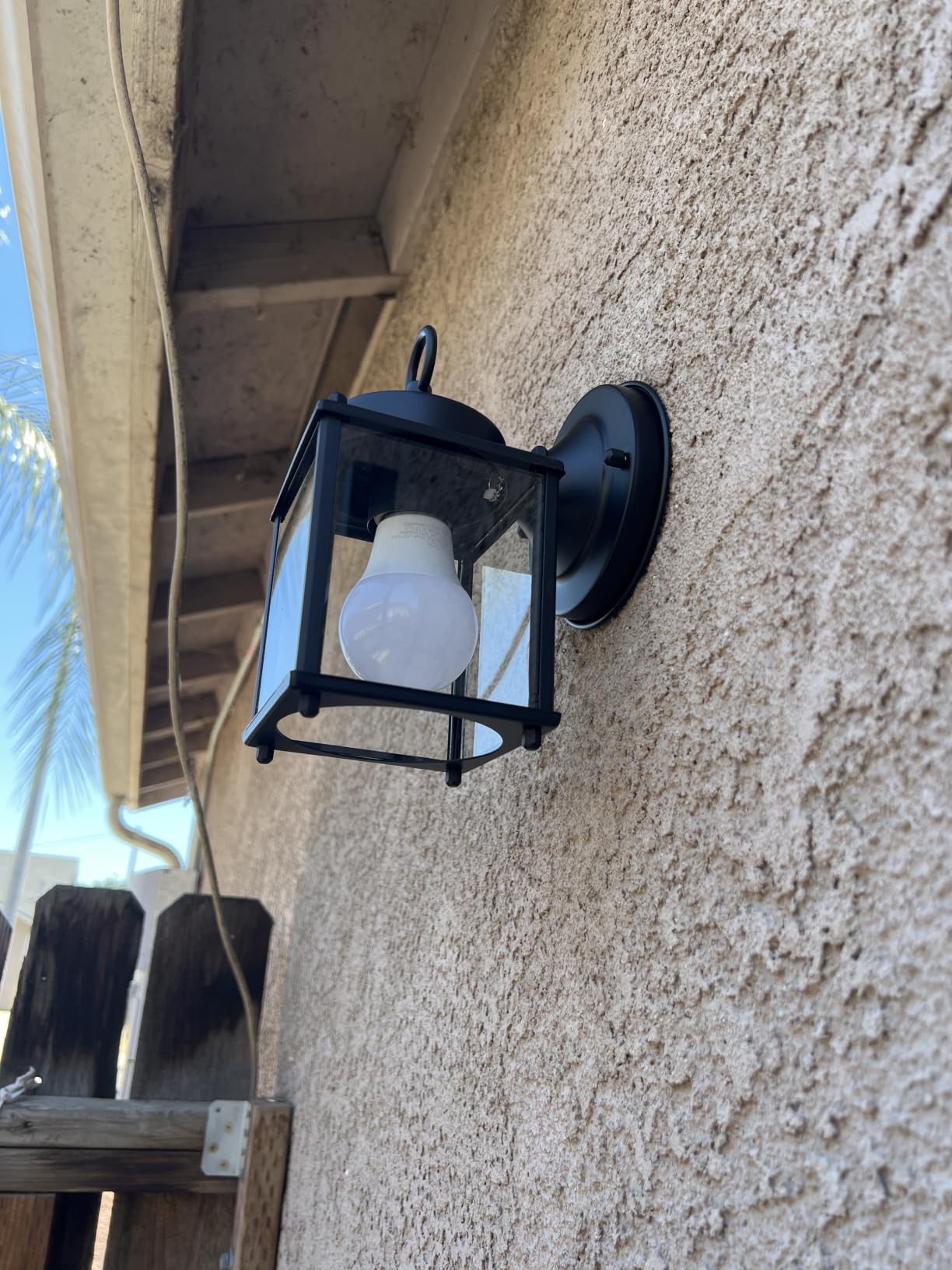
The build is metal and glass with an anti-rust finish described as resisting corrosion for years, the socket is E26 taking LED, incandescent, or CFL bulbs up to 60W, and the open bottom means a bulb change is a one-screw job. Mounting hardware and instructions are included and there is a 24 month limited warranty behind the product, which is a longer stated term than most of the sconces in this list.
Reviewers do flag the small size as a real limitation on brightness. A compact fixture with a single 60W-equivalent bulb simply does not put much light on the wall or the ground below it, so this is an appearance and doorway-security fixture, not a coverage fixture. If you want the same footprint with more punch, the taller lantern further down the list is the one to compare.
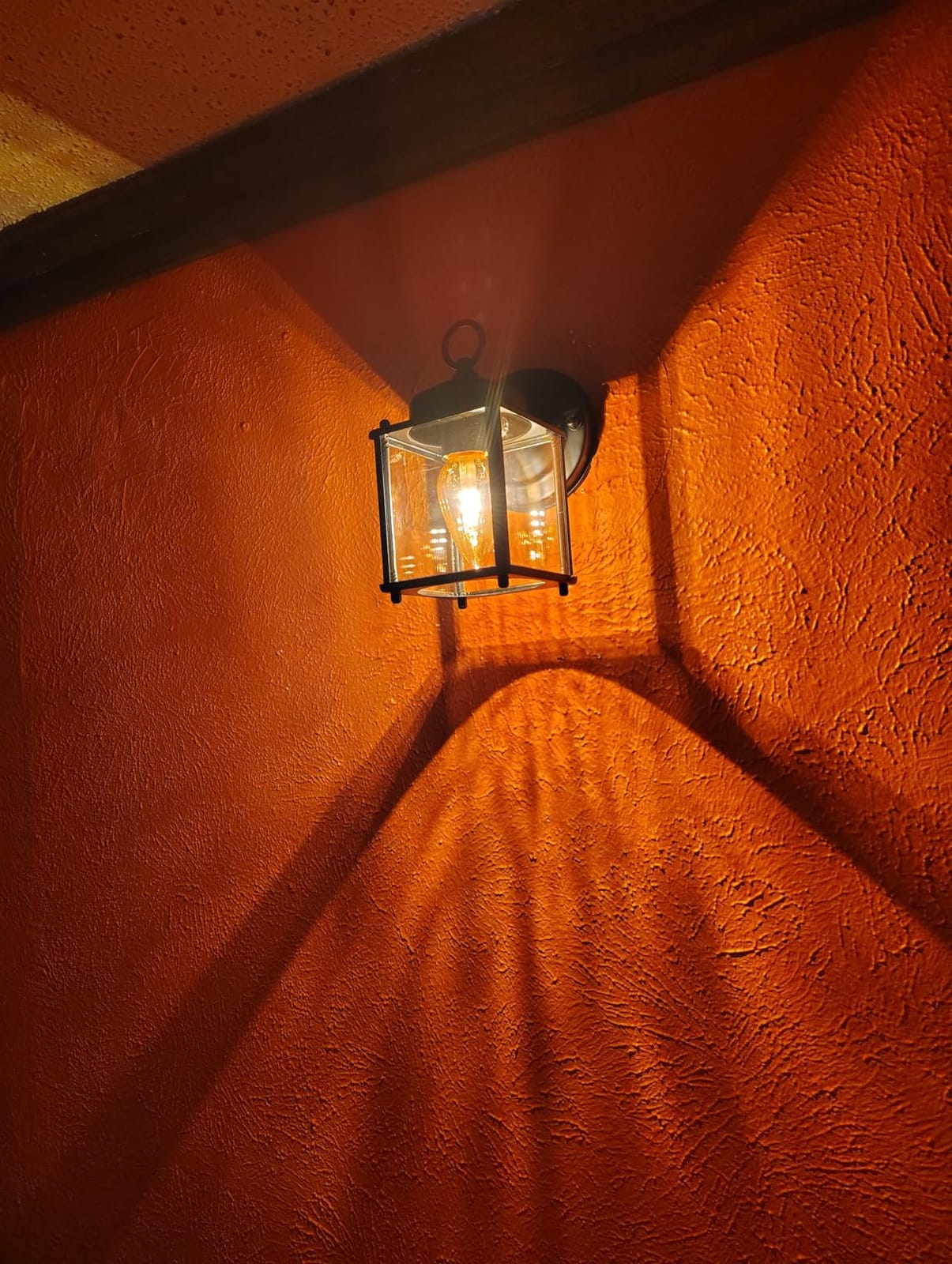
How to measure a man door for fixture size
Start with the door itself, not the wall. Measure the height of the man door, then aim for a fixture height that is roughly a quarter to a third of that, which for a standard 80 inch door lands somewhere near 20 to 26 inches of wall zone to play with. Then measure the width of the siding strip you actually have. A compact fixture like this one leaves you room; a large lantern does not.
Next check the back plate against your existing box. If you are replacing an older fixture, the box may be a wide round box or an oval that a small square plate will not cover. Measuring the visible footprint before ordering saves a return, and this is the most common source of disappointment in the reviews we looked at across the whole category.
What you give up for the small footprint
Light output and coverage. There is no sensor here, so it runs off a switch, and the glass shade diffuses some of what the bulb produces rather than amplifying it. On a wide two-car door, two of these flanking the door is the sensible maximum before the fixtures start to look like punctuation marks rather than lighting.
The upside is that a small fixture is almost impossible to over-mount. The complaints in this category cluster around oversized lanterns on modest doors, and this one simply cannot have that problem. It is the safe choice when you are matching an existing smaller fixture elsewhere on the house and want continuity rather than contrast.
8. mirrea 12 Inch Modern Up and Down Outdoor Porch Light

mirrea 12″ Modern Outdoor Porch Light in 2 Lights, Matte Black, 2 Pack
IP65 aluminum cylinder
Up and down two-light design
1600 lumens
Two E26 bulbs up to 60W each
Pros
- Modern up and down design transforms an older garage
- IP65 rating and ETL listed
- Replaceable bulbs rather than an integrated LED
- Easy retrofit install
- Works with smart bulbs
Cons
- Bulbs not included and you need two per fixture
- Decorative finishing nuts are hard to tighten
- Weather caps are fiddly to thread
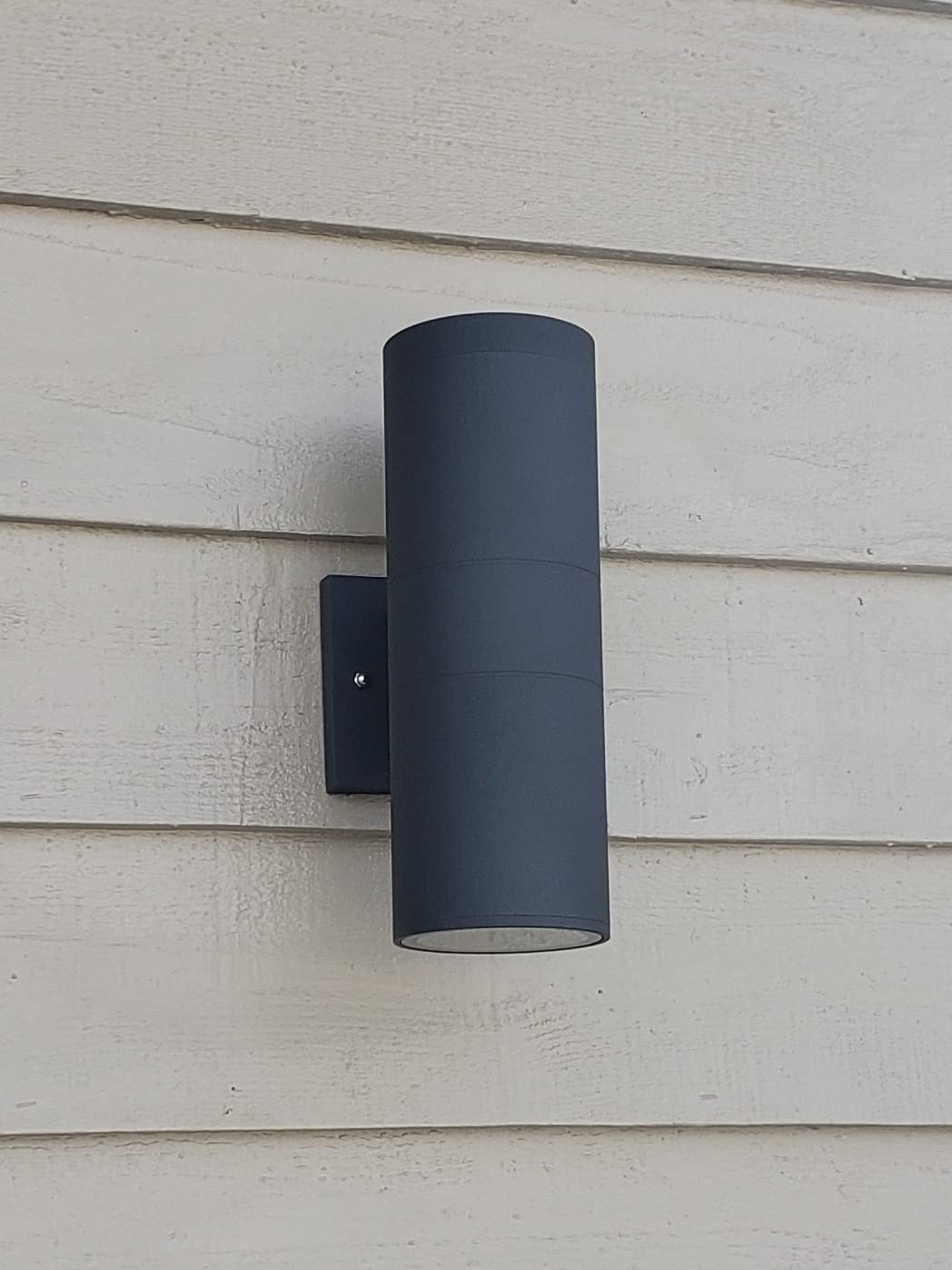
The up and down design is what separates this from every other fixture in the list. Instead of throwing light onto the wall, this cylinder throws a column of light both upward and downward from a single point, so the wall above and below the fixture glows and the facade looks like it is lit from within. On a wide, plain garage wall that is the single most effective way to make a blank surface look deliberate.
It is also among the highest-rated options in the roundup at 4.7 stars across 1907 reviews, with 85 percent five star. Reviewers use it to modernise older homes and garages and describe the retrofit wiring as simple, with installs around 20 minutes per set. The 12 inch cylinder and matte black powder-coated finish are the kind of thing that dates well.
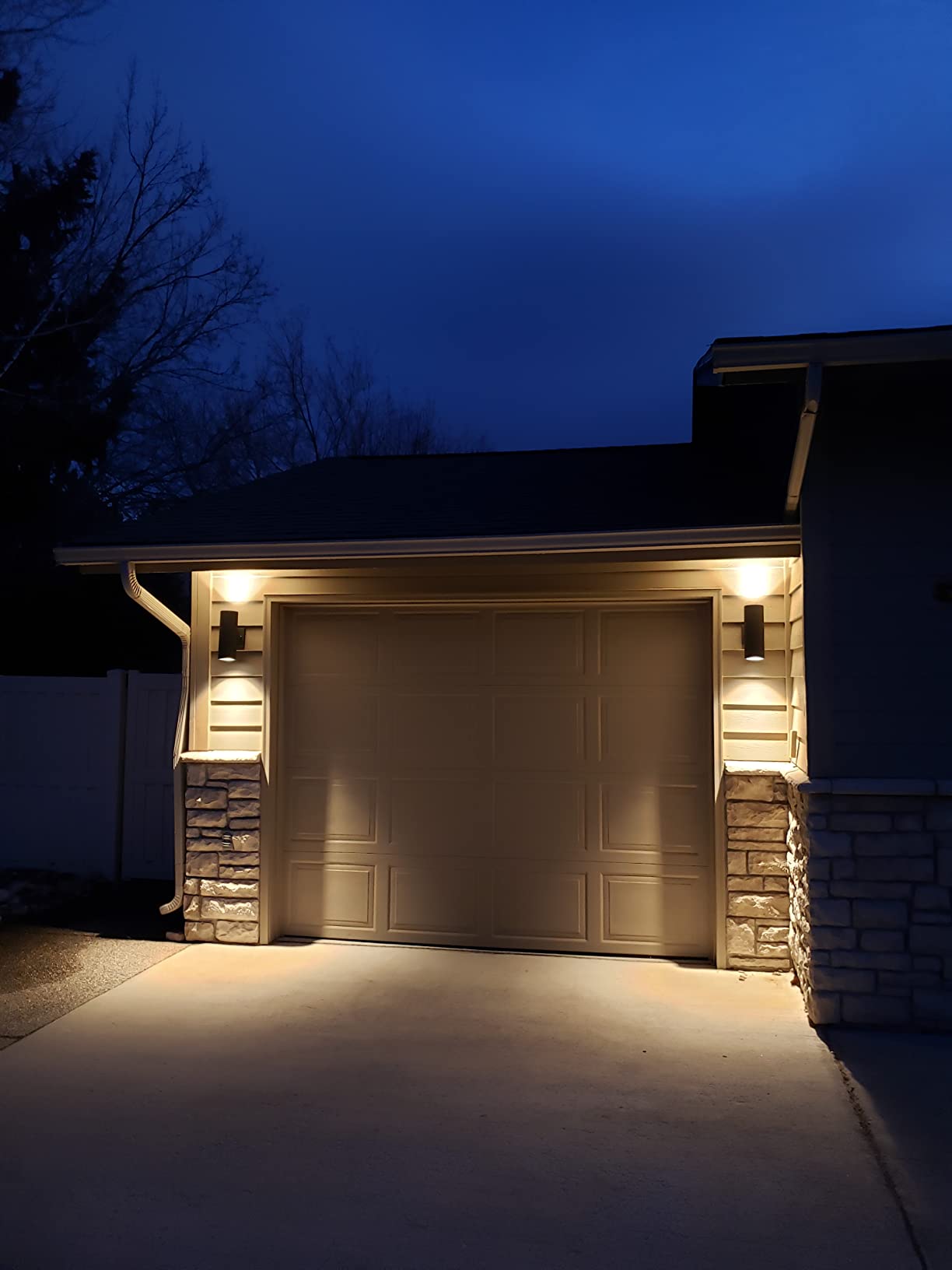
Two details make this a real product rather than a style exercise. It is IP65 rated and ETL listed, with a patented waterproof cap and plug design rather than a generic gasket, and it takes two replaceable medium base bulbs per fixture instead of an integrated LED board. That last point matters more than it sounds: with individual bulbs, one failure does not take the whole fixture out of service, which is the main long-term complaint people have about integrated LED sconces.
Output is listed at 1600 lumens with up to 60W per bulb, and it is dimmable with a compatible dimmer. Reviewers also mention using smart bulbs for colour and brightness control, which works because the bulbs are standard. The bracket is a two-piece rotatable design with fixing nuts on the front of the wall plate, and there is a marked orientation on the back of the plate that people miss more often than they would like to admit.
What up and down lighting does to a tall garage wall
It fixes a problem other fixtures create. A single downward lantern on a tall wall leaves the whole upper facade dark, and a plain floodlight at the top washes the wall flat. The up and down pattern creates two bright pools and a graded middle, which reads as depth rather than glare, and it is also the most dark-sky-friendly pattern of the decorative options because the throw is vertical, not into the sky.
What it does not do is light the driveway. The beam is narrow and vertical, so the ground beyond a few feet from the wall stays dark. If you need to see your car door handles and the path from the car, add a small amount of downlight from a different fixture or accept that this one is for the facade and the doorway, not the apron.
Two bulbs per fixture, and fiddly hardware
Bulbs are not included and you need two per fixture, so a two pack means four bulbs. That is a real difference in running cost and a real difference in convenience: the advantage of replaceable bulbs is that a single failure is a 30 second fix, and the disadvantage is that there are twice as many things to check.
The honest install complaint is the hardware. Reviewers note the decorative black finishing nuts are cheap and hard to tighten by hand, and that the top and bottom weatherproofing caps are fiddly to thread. The round body may also need a flexible drill bit to mount flush. None of that is a dealbreaker on a weekend job, but it is why people describe this as easy wiring and fiddly finishing.
9. MAXvolador Outdoor Wall Light Fixtures

MAXvolador Outdoor Wall Light Fixtures, Exterior Waterproof Wall Lanterns
12.95 in tall fixture
Toughened clear glass panes
2000 lumens
E26 bulbs up to 100W
Pros
- Highest five star share of the fixtures we reviewed
- Tall profile makes a strong visual statement
- Anti-rust anti-corrosion metal body
- Clear glass shows off the bulb
- Open bottom and included hardware
Cons
- Bulbs not included
- Distribution is a downlight rather than a wide wash
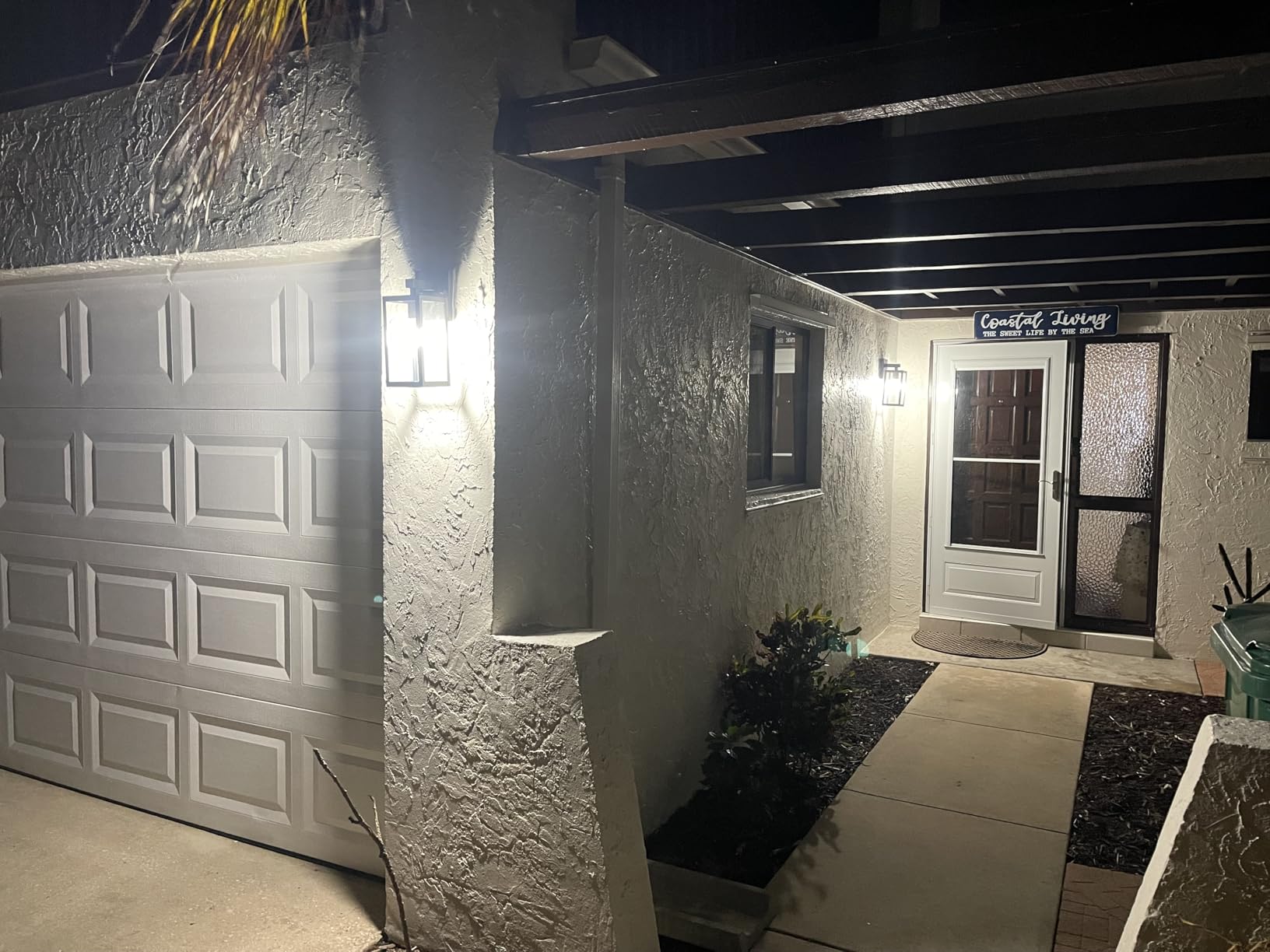
This is the tall, narrow, downlight answer, and it solves a specific problem: a door pillar that is wide enough for a sconce but tall enough that you want vertical presence. At 12.95 inches it is among the tallest sconces in the roundup, and the trapezoidal body with four toughened clear glass panes reads as a modern post light screwed to a wall. It gives a garage door the kind of framing a house entry usually gets.
The rating profile is the strongest in the set: 4.7 stars across 1823 reviews, with 87 percent of those reviews at five stars. Buyers single out the toughened glass described as unbreakable, the rust-resistant metal body, and the clean modern look. The glass panes are clear rather than frosted, so the bulb is visible and contributes to the appearance.
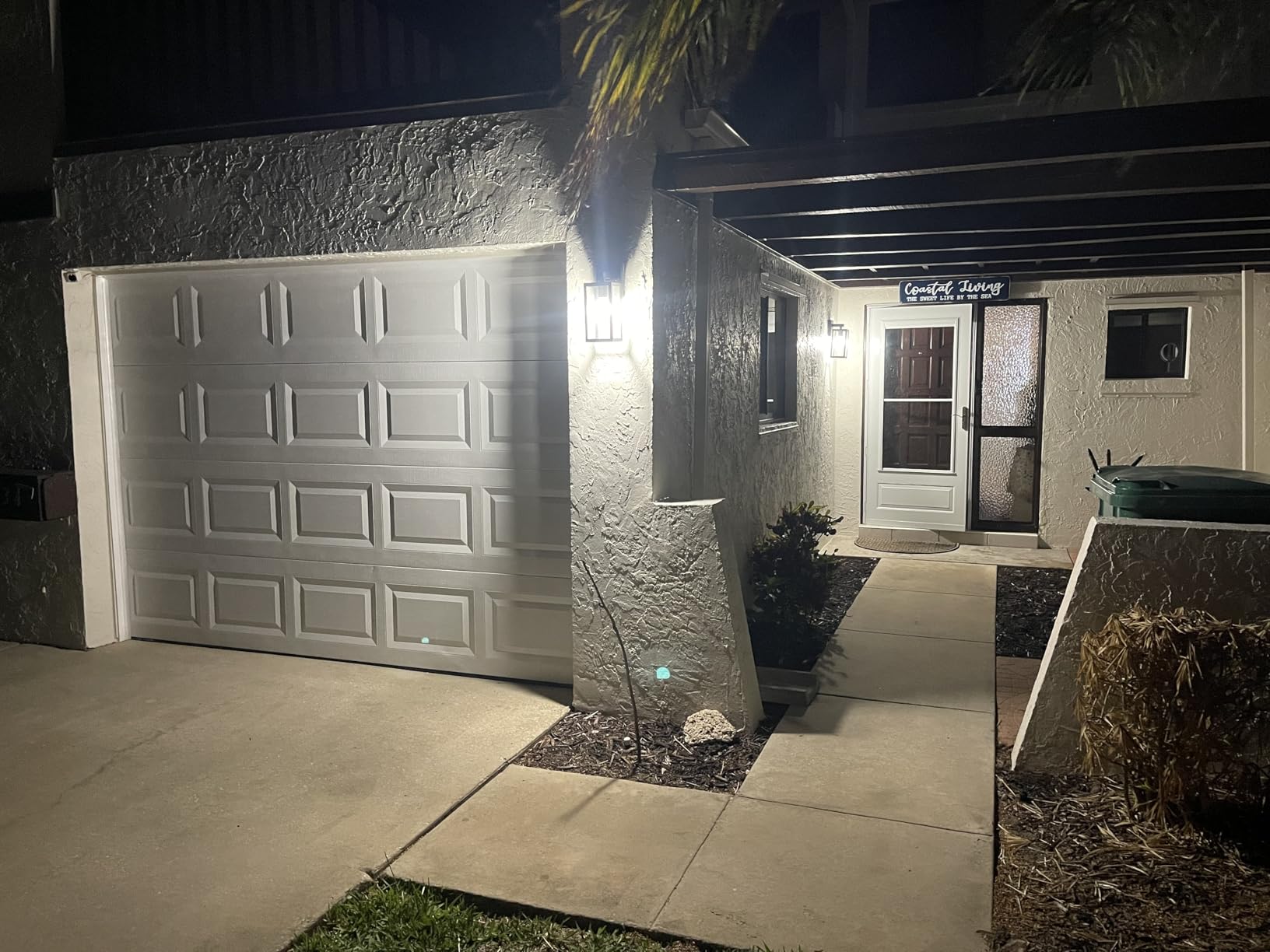
Construction is described as weather resistant for rain, snow, ice, and heat, with an anti-rust, anti-corrosion metal body, and the listing carries a 36 month limited warranty, the longest stated term among the sconces here. The socket takes one E26 base bulb up to 100W and works with LED, incandescent, and CFL, and the open bottom means installation is quick with the included hardware.
Output is listed at 2000 lumens, which is high for a fixture this size and reflects how the open bottom lets light travel rather than diffusing it. Be clear about what that means in practice: the distribution is a downlight rather than a wide wash, so it lights the pillar, the step, and the ground immediately below, and the wall around it stays comparatively dim.
Choosing between a tall downlight and a wide wash
If you want the light to spread sideways across a wall and across the driveway, this is the wrong shape. The light goes down. If you want to light a doorway, a set of steps, a path segment, or to frame a tall pillar visually, it is exactly right, and the 2000 lumens means the area beneath it is genuinely usable rather than decorative.
For most garage doors, the practical arrangement is a pair flanking a 16 foot door, and because this comes as a two pack, the two fixtures match. On a single-car door, one fixture is usually sufficient and pairing them on a narrow door can look over-decorated. The tall profile is a deliberate style choice, and it pairs best with modern, farmhouse, or industrial builds.
Bulbs are the one thing you must add
Bulbs are not included and this fixture is the kind where the bulb is part of the look. The clear panes are designed to show off the bulb, so an exposed filament or Edison-shape LED changes the appearance substantially compared with a standard frosted bulb. Budget for two bulbs for a two pack and decide the shape before you buy the fixture rather than after.
The other limitation is the light distribution. If your goal is a brighter, flatter wash on a large wall, a wall pack delivers that more evenly. This fixture wins on height, on the vertical framing effect, and on the highest share of five-star reviews in the group, and that is a different set of goals.
10. tewei Up and Down Outdoor Lights 15 Inch 2-Pack
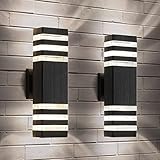
tewei Up and Down Outdoor Lights 15” Exterior Wall Lights, Black, 2-Pack
Three-layer 15 in up and down
1800 lumens at 3000K
4 GU10 LED bulbs included
IP65 aluminum
Pros
- Bulbs are included so nothing extra to buy
- Replaceable GU10 bulbs not an integrated board
- Aluminum has held up through multiple winters
- Modern design suits a plain facade
- Quick wall assembly
Cons
- Light throws a narrow V up and down rather than outward
- Limited to the area right around the fixture
- Instructions thin in some boxes
This is the one to pick if you want the modern three-layer look with nothing left to buy. Four GU10 LED bulbs come included across the two pack, which removes the single most common complaint across this entire category. Every other fixture in the roundup ships dark, and while adding a bulb is a small job, forgetting it on install day is a genuinely common way this project stalls.
At 15 inches tall and three layers, this is one of the largest decorative fixtures in the list, and its die-cast aluminum body is IP65 rated with anti-rust and corrosion resistance. Reviewers note it has held up well through multiple winters outdoors. 1015 reviews at 4.6 stars, with 82 percent five star, so the volume is thinner than the leaders but the sentiment is consistently positive.
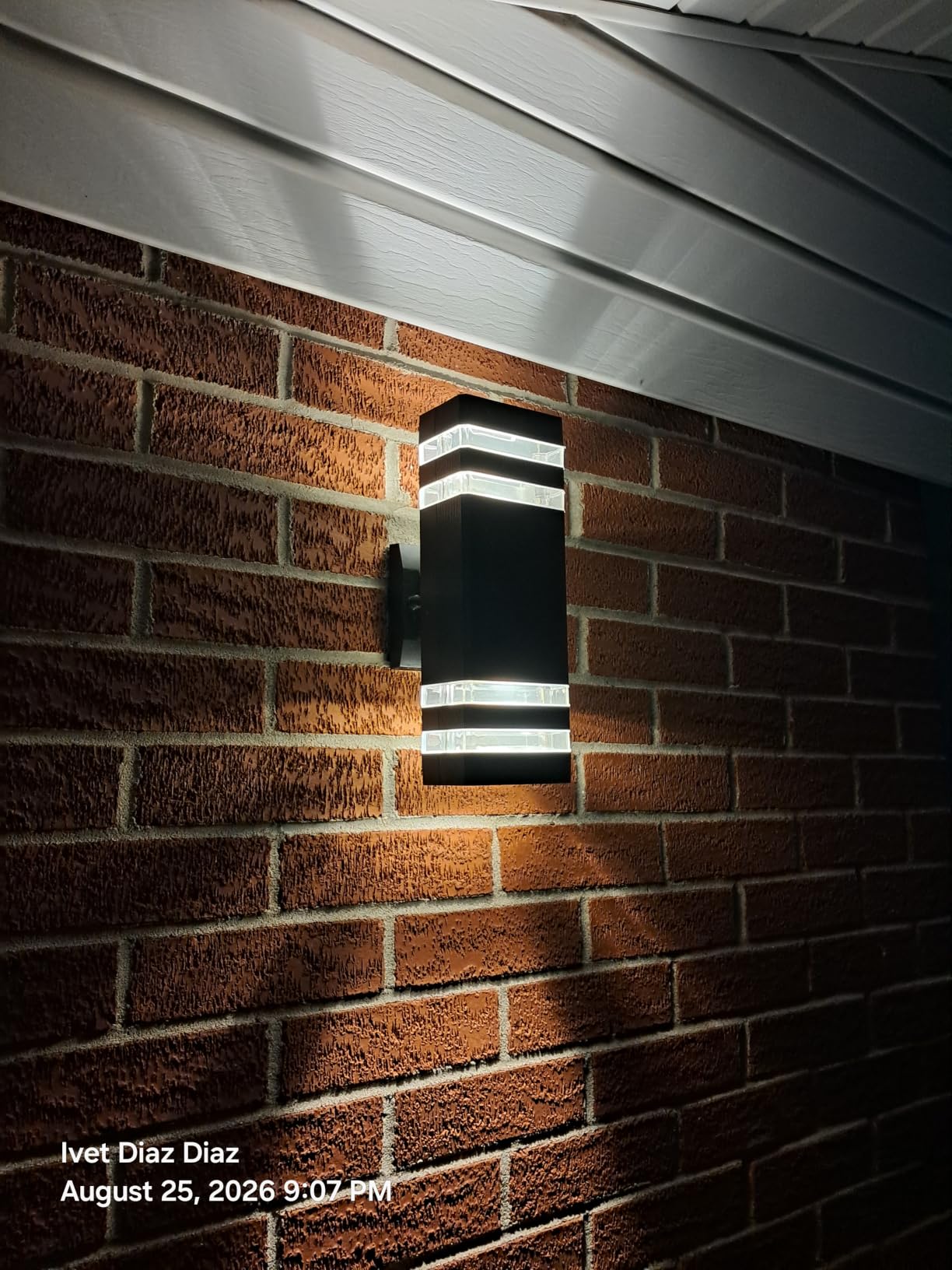
Output is 1800 lumens at 3000 Kelvin from a 14W total draw across both fixtures, and the bulbs are replaceable GU10 LEDs rather than an integrated board, so a single bulb failure is a 30 second fix instead of a fixture replacement. That is the most important practical detail on the card. The listed applications include front doorway, porch, garden, garage, yard, and patio, and installation is hardwired with hardware included.
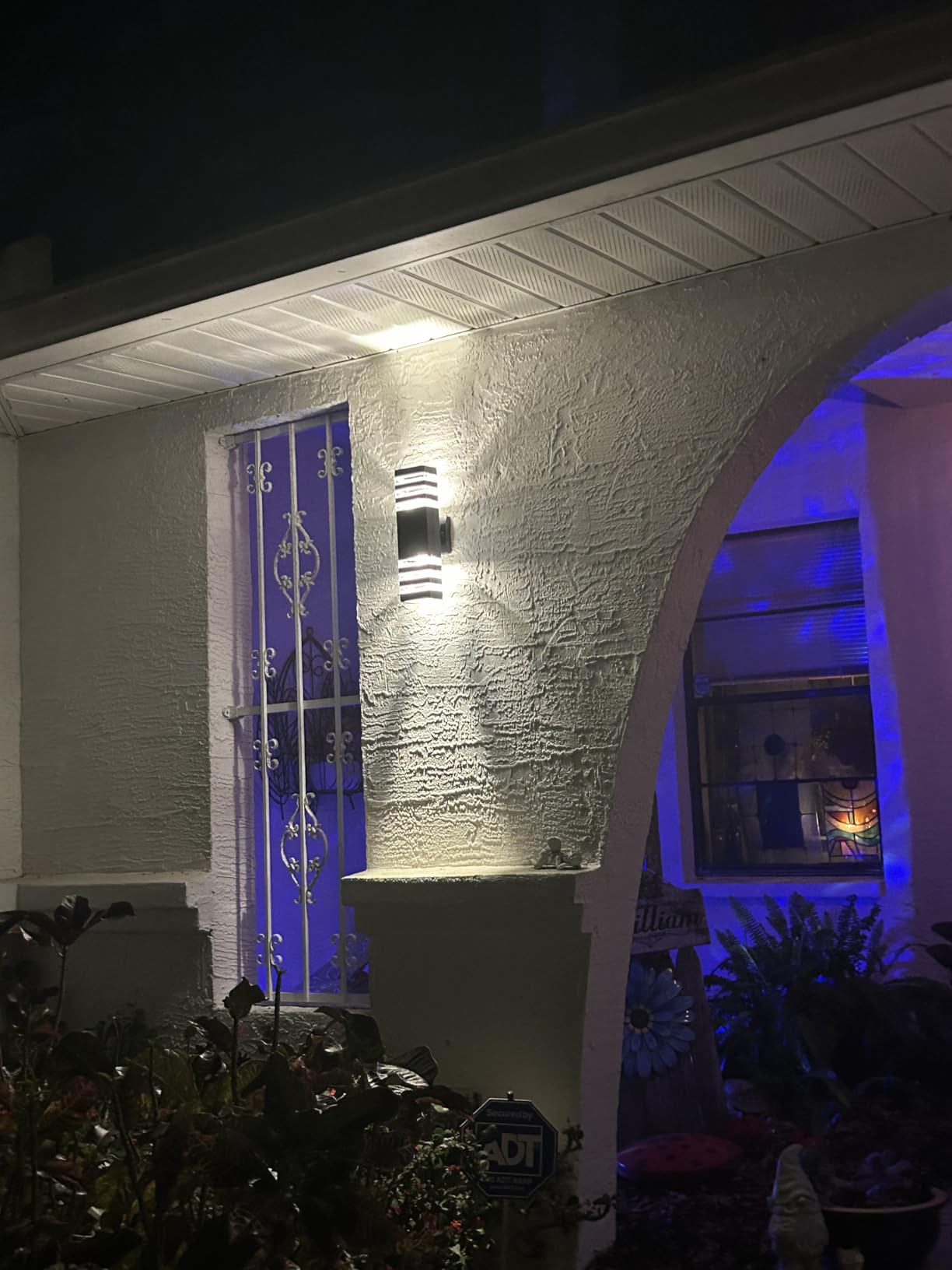
Set expectations on the beam, because this is where the reviews are clearest. Reviewers describe the light pattern as a V shape going up and down, which washes the wall and the overhang above the door nicely but does very little for the yard in front of it. Brightness is effectively limited to the immediate area around the fixture, and if you need driveway coverage this is not the fixture to choose.
Best value for a plain modern garage wall
The value calculation here is straightforward. You get an IP65 aluminum body, replaceable bulbs, and a three-layer design in a category where comparable fixtures are all narrower and mostly ship without bulbs. For a single-car garage, a plain white or grey wall, or a covered entry, that combination is hard to argue with.
The 3000 Kelvin warm white suits most exterior schemes and reads well against brick, stone, and dark paint. If the wall is white or light grey, a cooler temperature would look cleaner, and because the bulbs are replaceable GU10s you can change them later without replacing the fixture. That flexibility is the practical argument for a replaceable-bulb design over an integrated LED board.
Expect a wall wash, not a floodlight
The V-shaped up and down throw is the defining limitation and it is worth deciding with a clear head. The fixture makes the wall itself the subject, which is exactly what you want on a tall blank garage wall, and it is a good partner for a wide garage door where a floodlight above would be blocked by the door track when open.
What it will not do is light the driveway. Pair it with a lower-output fixture near the ground, or accept that the apron stays dark and the wall looks finished. Installation is hardwired with all mounting hardware included, but a few buyers report thin or missing instructions, so plan to work from the wiring diagram rather than the leaflet.
Buying Guide: Choosing Outdoor Wall Lights for a Garage
Most lighting decisions are made on looks and then corrected on hardware. Working through these factors in order saves that correction, and each one below changes which fixture from the list above is right for your wall.
Brightness, lumens, and wattage
Lumens describe how much light a fixture produces and wattage describes how much power it draws, and for outdoor LEDs the gap between the two is enormous. A decorative sconce in the 800 lumen range lights a doorway and looks good. A wall pack in the 2000 to 3000 lumen range lights a driveway apron. Both are reasonable answers to the best wattage for outdoor garage lights, depending on what you are lighting.
As a working rule, match the fixture to the surface. Accent lighting for a man door or a house number needs the least. Flanking a garage door evenly needs enough that both sides read equally from the street, so buy a pair rather than one and match the output between them. Lighting a driveway or a metal pole barn wall wants the highest output in the roundup, and that is where a full-cutoff LED wall pack earns its place.
If the same wall doubles as a work area, consider color temperature. Around 3000K is warm and flattering on brick and wood and reads well from the street. Around 4000K is neutral and easier for seeing colours and details. Around 5000K is bright daylight white, which is superb for task lighting but can look clinical on a residential facade at night.
Wet location ratings and IP numbers
A wet location rated fixture is one that is listed to be exposed to rain directly. A damp rated fixture is only approved for locations that stay dry, such as a covered porch ceiling. Any fixture on a garage wall, and any fixture without an overhang above it, needs to be wet location rated, and this is the one specification that is genuinely non-negotiable.
An IP rating is the international version of the same idea. IP65 means protected against dust and water jets from any direction, and IP66 means protected against dust and powerful water jets. The second digit is the water rating, so IP65 is fine for a wall that takes driving rain and IP66 is the right call if the wall is fully exposed on a corner or an open site. Not every residential fixture publishes an IP number, which is why a wet location listing matters when one is absent.
Motion sensor versus dusk to dawn
A photocell reacts to light levels, switching the fixture on at dusk and off at dawn. A motion sensor reacts to movement, usually across a defined field, and can be set for range and sensitivity. A manual fixture has neither and relies on a switch. The forum chatter in this category is overwhelmingly about this choice, and it is worth deciding before the fixture rather than after.
Motion sensing is the better answer for security and for saving electricity, and it is the worse answer for a driveway that sees constant passing traffic, where false triggers train you to ignore the light. Dusk to dawn is the better answer for a side door you use often and for anyone who does not want to reach for a switch in the dark, and it is the worse answer if local rules or your own preference limit how much light burns all night. Cold weather is also a factor, since PIR sensors in cheap fixtures are the ones most often reported as unreliable in freezing conditions.
Garage siding and mounting hardware
What type of lighting is best for a metal garage depends first on the wall material, because it decides the hardware and how much weight the mount carries. Vinyl siding needs a mounting block behind the fixture so the screws bite into framing rather than into soft panel, and it needs a spacer to stand the fixture off the surface and let it drain. Wood siding is the easy case and takes standard screws into studs. Metal siding needs self-drilling screws rated for the gauge, and it is unforgiving of a drill that wanders.
Masonry and brick are the most common source of the question about exterior boxes, and the answer is that you need masonry anchors, a hammer drill, and a box that is rated for the wall depth. Many people also need an offset box if the wall is deep. A wide back plate is helpful here, because it covers the anchor pattern and the cut line. If the wall is a pole barn with a corrugated metal skin, the fixture needs to mount to a purlin behind the corrugation, not to the sheet metal itself.
Dark sky, full cutoff, and neighbourhood rules
Full cutoff means the fixture is designed so no light is emitted above horizontal, which is what most local dark sky ordinances are looking for. An up and down sconce throws light upward and is generally less compliant. A forward-throwing wall pack sends everything down and is typically the most compliant decorative-adjacent option. The phrase to look for on a spec sheet is full cutoff, and it is the clearest signal of intent.
HOA rules are a separate matter and often stricter. Some neighbourhoods require fixtures to match existing post lights and wall lanterns exactly, including the finish, and they may also set brightness limits and colour temperature limits. This is the question that stalls people longest in homeowner forums, and the answer is to read your architectural guidelines before you buy rather than after, because a matching rule is much cheaper to satisfy than to fix.
Replaceable bulb versus integrated LED
Integrated LED fixtures are cheaper to run, smaller, and have no bulb to buy, and they usually last longer than the fixture around them. Their weakness is what happens at the end: when the board or driver fails, you replace the whole fixture, and on a wet exterior wall that is a full electrical job rather than a two minute swap.
Replaceable E26 and GU10 bulbs are the more forgiving choice, and eight of the ten fixtures in this roundup use them. The open bottom design on a lantern makes the difference enormous, because you change the bulb standing on the ground instead of on a ladder. Pick integrated LED for the lowest long-term hassle on a fixture you can reach easily, and pick replaceable bulbs for anything mounted high or over a driveway.
Installation: Height, Spacing, and Common Mistakes
Mounting rules are what turn a collection of fixtures into a lighting plan. These are the numbers and the sequence that most garages need, whether you are adding two lights to an existing wall or starting from a blank siding panel.
How high to mount garage lights
The common range for exterior wall lights is 5 to 7 feet above grade, and for a garage door specifically the more useful rule is a fraction of the door itself. Mount a flanking sconce at somewhere between a quarter and a third of the door height measured from the ground, which puts it near eye level for an adult and below the sightline of a security camera pointed at the door. A man door light generally sits 6 to 7 feet up, just above head height, so nobody walks into it.
Above the door is a different job. Anything mounted over a garage door is blocked when the door is open, so it works for ambient facade light and for lighting the door itself when it is closed, and it does almost nothing for the driveway. That is why the flanking sconces matter more than anything above the opening.
How many lights and how far apart
One light is enough for a man door or a single-car door. Two lights flanking a standard 16 foot door is the arrangement that reads best and lights most evenly, and spacing them 8 to 10 feet apart on a wider wall keeps the coverage continuous rather than leaving a dark band in the middle.
For a 24 foot door, two lights leaves a long dark stretch in the centre, and this is where you either add a third fixture or move to a wall pack above the door for coverage and sconces at the ends for appearance. The rule of thumb is that if the gap between two fixtures is wider than about twice the door height, you need more light or a wider beam between them.
Steps for a safe replacement
First, turn off the breaker and confirm the circuit is dead with a tester, not by assumption. Second, check that the existing box is exterior rated and has a functioning gasket, because a standard indoor box is the most common reason a new wet-rated fixture still leaks. Third, mount the fixture to the box or to a solid mounting block, not to siding trim alone, so the weight does not pull the screws out of soft material.
Fourth, replace the gasket and run a bead of exterior rated sealant around the top and sides where the fixture meets the wall, leaving the bottom edge unsealed so water can drain out rather than sit behind the fixture. Fifth, tighten the glass and hardware to the fixture rather than to the wall bracket, since overtightening is what cracks lantern glass. Finally, test any photocell by covering the sensor with tape and check it switches off, and confirm a GFCI protected fixture resets correctly after wiring.
Five common outdoor lighting mistakes
The first mistake is buying on looks before measuring, which produces the oversized lantern on a small door that drives most returns. The second is using a damp rated fixture on an exposed wall. The third is skipping the mounting block on vinyl siding, so the fixture eventually leans away from the wall, which installers describe as wonky and which reviewers describe as flimsy hardware. The fourth is choosing a wide-wash fixture when the real problem is coverage, or a narrow downlight when the real problem is appearance. The fifth is leaving the photocell lens or the motion sensor field un-tuned, so the light runs all day or triggers on every passing car.
There is a sixth worth naming, and it is the one people argue about most: installing without checking whether new wire is needed. A detached garage with no existing box means a new circuit and, in most jurisdictions, a permit. If you are replacing a fixture over an existing exterior box, you may be able to do it yourself in an afternoon. Before you commit to a fixture, look for a box on that wall, and if there is not one, get a quote before you pick the hardware.
Frequently Asked Questions
What is the best type of lighting for an outdoor garage?
A wet-location-rated exterior wall fixture mounted on the side walls or door pillars works best, not above the door. Use a compact lantern beside the man door, a matched pair of sconces flanking a standard 16 foot door, or a full-cutoff LED wall pack high on a large or metal wall for real driveway coverage. Aim for roughly 800 lumens for a decorative sconce and 2000 to 3000 lumens for a wall pack.
What are some good lights for outside a garage?
Our top three are the DESIGNERS FOUNTAIN Preston 8 inch for a man door, the BesLowe two pack for flanking a 16 foot door, and the WIHTU dusk to dawn two pack if you want the lights to come on by themselves at sunset. For coverage on a wide door or a metal wall, the CINOTON LED wall pack pair is the brighter and more durable option.
What are some good outdoor lights for the sides of my garage door?
A matched pair of sconces sized at roughly a quarter to a third of the door height is the proven arrangement for the sides of a garage door. Space them 8 to 10 feet apart, mount them at eye level rather than above the opening, and check the back plate against your existing box before ordering. Two lights suit a standard 16 foot door, while a 24 foot door usually needs a third fixture or a wall pack in the middle.
What type of lighting is best for a metal garage?
A die-cast aluminum wall pack with a stated IP65 rating is the most durable choice for a metal garage wall. Aluminum resists corrosion, the IP65 rating means it is protected against dust and water jets from any direction, and a forward-throwing design keeps all the light off your neighbours. If you want decorative sconces instead, plan to seal the mounting point carefully because metal walls can wick water behind a fixture.
What are common outdoor lighting mistakes?
The five most common mistakes are buying on appearance before measuring the mounting area, using a damp rated fixture on an exposed wall, skipping a mounting block on vinyl siding so the fixture leans away from the wall, choosing a wide wash when you actually need coverage or the reverse, and never testing the photocell or tuning the motion sensor range. A sixth costly one is buying the fixture before confirming there is an exterior-rated box on the wall.
What is the best wattage for outdoor garage lights?
For LED fixtures, wattage is a poor guide because output varies widely at the same draw. Use lumens instead. Around 800 lumens suits a decorative sconce beside a man door, 1200 to 1800 lumens suits a pair flanking a garage door, and 2000 to 3000 lumens suits a wall pack lighting a driveway apron. Choose 3000K for curb appeal and 4000K or 5000K if the wall doubles as a work area.
Conclusion
For most garages, the answer is a matched pair of wet-location-rated wall sconces flanking the door at eye level, spaced 8 to 10 feet apart, sized to roughly a quarter of the door height. Our Editor’s Choice, the DESIGNERS FOUNTAIN Preston 8 Inch, is the single best starting point for the wall beside a man door. That single change does more for both safety and curb appeal than anything else on this list, and it is why the best outdoor wall lights for garages in 2026 come in two packs as often as they do not.
Before you order, measure the mounting area and the existing box, and decide whether you want a photocell, a motion sensor, or a switch. Start with our roundup of the best outdoor wall lanterns for porches if you are matching an existing scheme, and for the inside of the building our picks for LED shop lights, wall mounted fans, and infrared heaters cover the rest of the garage upgrade.