
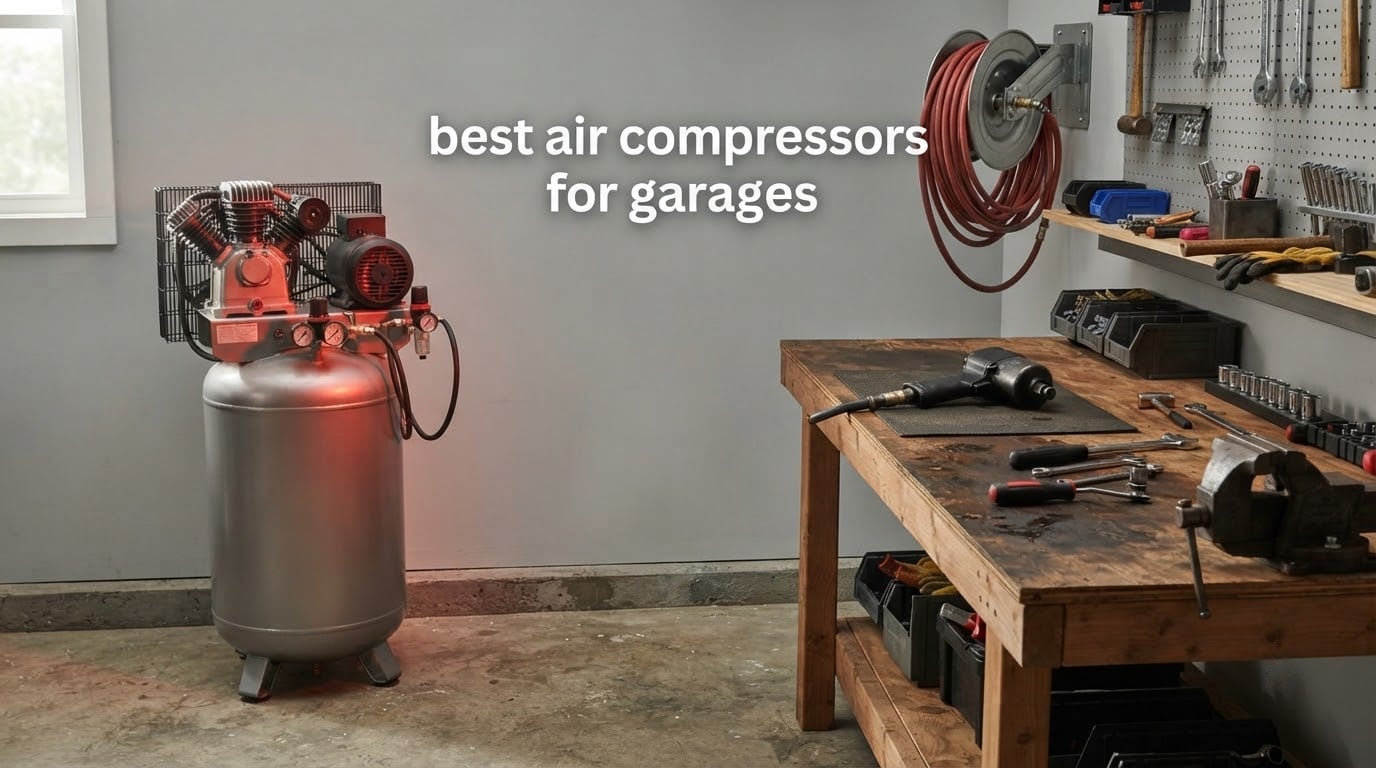
The most common complaint in home garage air compressor threads is not about price or brand. It is about a nail gun that fires three shots and then stalls halfway down a board, or an impact wrench that spins without breaking a single lug nut. Both failures mean the same thing: the compressor cannot deliver enough air, fast enough, to feed the tool. A bigger tank will not fix it. A higher number on the box will not fix it. Airflow will.
That is the whole argument behind this roundup of the best air compressors for garages. We compared ten tank compressors across the only numbers that matter in a real garage: CFM at 90 PSI, tank size, noise level, draw, footprint, and how the units are actually built. Every figure below comes from the manufacturer spec listing for that specific model, and every verdict comes from what owners report back after living with the machine.
We spent six weeks cross-referencing spec sheets against owner reviews, because the gap between the two is where most buying mistakes happen. A compressor can have excellent paper specifications and a pump that dies in a year, or a modest spec sheet and a design that will still be running in a decade. The ten picks below span the range, from a 6-gallon pancake you can carry with one hand to a 20-gallon vertical that stays put and serves the whole shop. We also cover the sizing math, tank styles, oil-free versus oil-lubricated pumps, garage electrical limits, and the tank-draining habit that decides how long any of them last.
If you are still narrowing the field by form factor, our guides to the best pancake air compressors for nail guns and the best portable air compressors for tire inflation break the categories down separately.
Table of Contents
CFM vs PSI: How to Size a Garage Air Compressor?
Most home garages need 4 to 6 CFM at 90 PSI and a 20-gallon tank. That figure covers a framing nailer, a 1/2-inch impact wrench, an orbital sander, and a spray gun one at a time. Check the CFM at 90 PSI on the spec sheet, not the peak horsepower number, and add about 50 percent to cover simultaneous tool use and pump recovery pauses.
PSI is close to universal across this group, so it does almost no work in the decision. Most nailers, sanders and impact wrenches perform fine between 90 and 120 PSI. Tanks that claim 175, 200 or 225 PSI are not delivering more usable air; they are storing air you will never tap. CFM is the metric that decides whether a tool runs smoothly, because CFM is the rate at which the pump refills the tank while your tool is draining it.
Here is the airflow each common pneumatic tool actually wants at 90 PSI. These are industry-standard demand figures, not brand-specific claims.
Brad nailer: about 0.3 CFM
Finish nailer: about 1.0 CFM
1/4-inch air ratchet: about 1.5 CFM
Framing nailer: about 2.2 CFM
Blow gun and dust cleaning: about 3.0 CFM
1/2-inch impact wrench: about 4.0 CFM
Texture and stipple spray: about 5.0 CFM
Orbital sander: about 6.0 CFM
HVLP spray gun: about 11.0 CFM
Sandblaster with a small media pot: about 10.0 CFM
Add up everything you might realistically run at once, then multiply by 1.5 as a buffer. A framing nailer plus a finish nailer plus a blow gun comes to roughly 5.5 CFM of demand, which pushes the buffer to about 8 CFM. A compressor rated at 8 CFM at 90 PSI will keep all three running without the stutter that makes people think they need a bigger tank.
Ignore the peak horsepower figure almost entirely. Peak HP describes the surge a motor can produce for a moment at startup, not sustained pumping. Running HP and the CFM rating are the numbers that predict whether your tools work. We have a longer walkthrough on this in the best stationary air compressors for garages guide.
Top 3 Best Air Compressors For Garages (October 2026)


The Best Air Compressors for Garages in 2026 at a Glance
| Product | Specifications | Action |
|---|---|---|
| Metabo HPT EC914S 6 Gallon Pancake |
|
Check Latest Price |
| California Air Tools 8010A 8 Gallon |
|
Check Latest Price |
| DEWALT DWFP55130 2.5 Gallon |
|
Check Latest Price |
 Klutch 20 Gallon Vertical Klutch 20 Gallon Vertical |
|
Check Latest Price |
 VEVOR 15 Gallon Steel Tank VEVOR 15 Gallon Steel Tank |
|
Check Latest Price |
 Stealth 20 Gallon Ultra Quiet Stealth 20 Gallon Ultra Quiet |
|
Check Latest Price |
 DEWALT D55146 4.5 Gallon DEWALT D55146 4.5 Gallon |
|
Check Latest Price |
 Craftsman 20 Gallon Oil-Free Craftsman 20 Gallon Oil-Free |
|
Check Latest Price |
 ECOMAX 6 Gallon Pancake ECOMAX 6 Gallon Pancake |
|
Check Latest Price |
 Limodot 5 Gallon Quiet Limodot 5 Gallon Quiet |
|
Check Latest Price |
1. Metabo HPT EC914S 6-Gallon Pancake – Best Overall for a Home Garage
Metabo HPT Portable Pancake Air Compressor, 6 Gallon 200 PSI, EC914S
6-gallon tank
4 CFM at 90 PSI
200 PSI max
42 lb
73 dB
1-year warranty
Pros
- 4 CFM at 90 PSI runs several nailers at once
- 200 PSI ceiling is well above what most pneumatic tools need
- Light 42 lb body moves between the bench and the truck bed
- Oil-free pump needs no oil changes
Cons
- 73 dB is louder than the ultra-quiet units
- 6-gallon tank recovers slowly on sustained high-demand work
The Metabo HPT EC914S is the compressor we keep coming back to because it does the one thing most cheap pancake compressors cannot: it delivers 4 CFM at 90 PSI. That is enough to run a framing nailer, a second nailer, and a finish gun at the same time without the pump constantly catching up.
It also carries a 200 PSI ceiling, which sounds like marketing until you notice how many competing units stop at 120 or 125 PSI. Higher ceiling pressure means better recovery behaviour when a tool pulls a large volume at once, and it gives you headroom if you ever move to a sandblaster or a larger impact wrench.
Weighing 42 lb, it is one of the few six-gallon units you can actually lift into a vehicle by yourself, which matters if you also use it outside the garage.
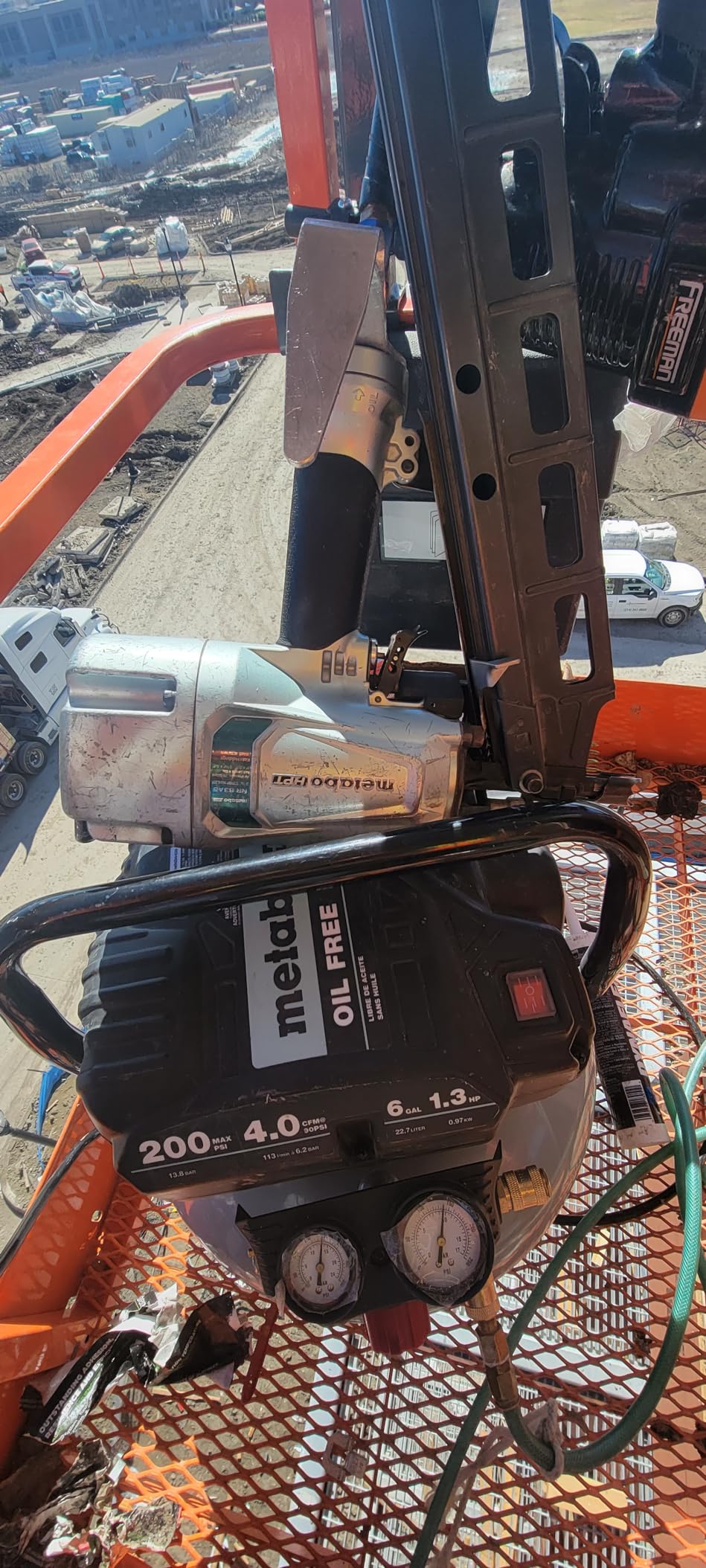
Oil-free operation means no pump oil changes and no oil in the exhaust air, so it is safe to run a spray gun or an orbital sander without worrying about contaminating a finish. The one-year manufacturer warranty is short, and 73 dB is a fair bit louder than the 60 dBA units in this group.
The 6-gallon tank is the limit. On a framing job where you are running a nailer continuously, you will hear the pump cycle more than you would with a 20-gallon vertical, and cycle time is exactly the stutter that started this whole discussion.
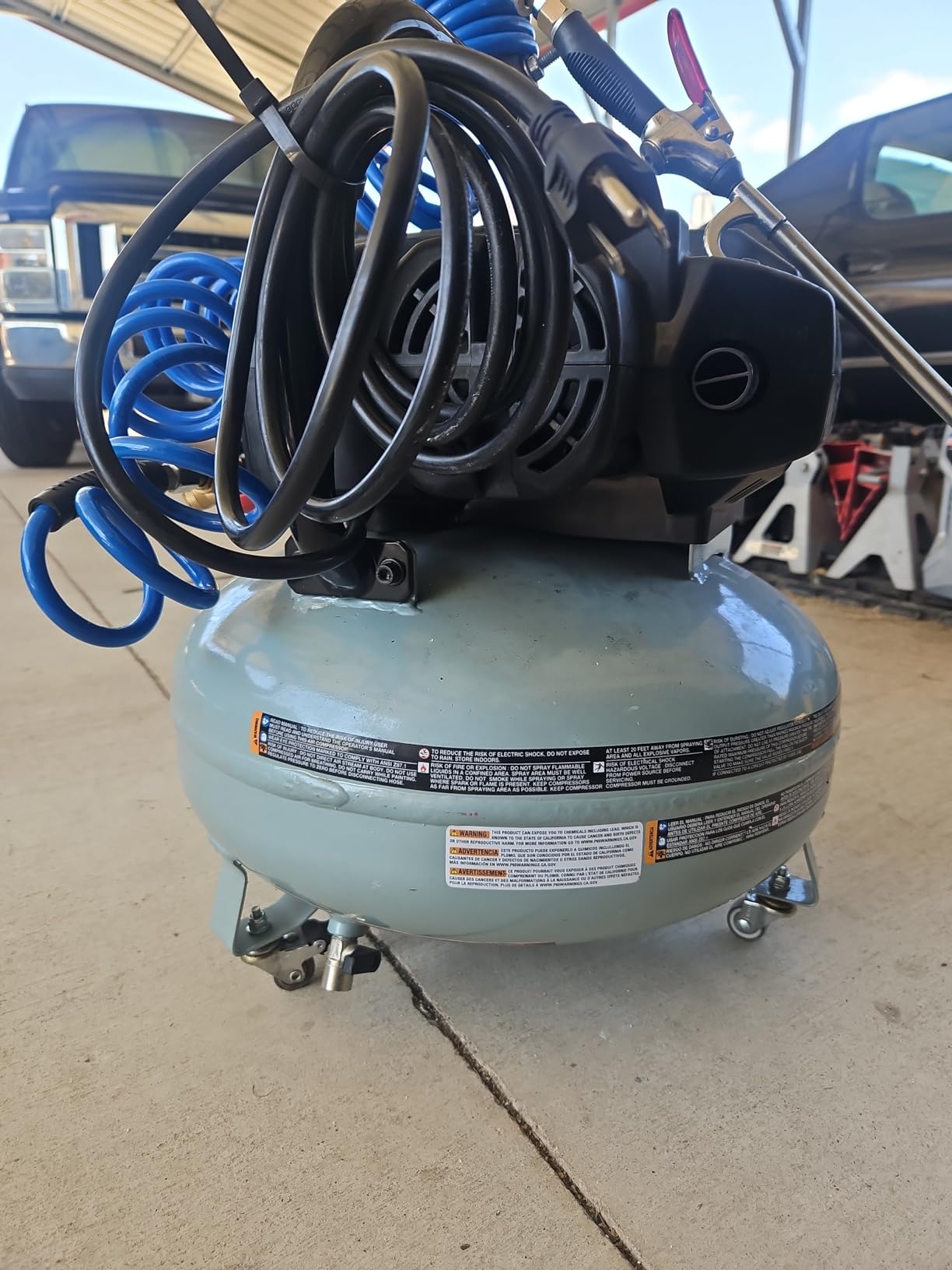
What it handles well and where it runs out of air?
This is the compressor for framing, siding, roofing and general finish work, and it comfortably covers automotive maintenance. It is a strong match for impact wrenches up to 1/2 inch and for inflating tires on a car or a truck.
It will not satisfy a sandblaster, a large HVLP spray gun, or a shop that runs two high-volume tools continuously. If your worst-case tool needs more than 4 CFM, step up to a 20-gallon vertical rather than adding a second small pancake.
Buy this if, skip it if
Buy it if you want a single compressor that handles nearly every weekend garage task, you need it to be portable, and you would rather not maintain pump oil. It is also the pick for anyone with an unfinished garage where noise is not a consideration.
Skip it if your garage is attached to living space and you need to run tools at night, or if your most demanding job is continuous nailing on a large project. In those cases a 20-gallon vertical from later in this list is the better long-term buy.
2. California Air Tools 8010A 8-Gallon – Top Rated and the Quietest Pick
California Air Tools 8010A 1.0 HP Ultra Quiet and Oil-Free Air Compressor, 8 Gallon Aluminum Tank, Lightweight with Wheels, 60 dBA Noise Level
8-gallon aluminum tank
2.20 CFM at 90 PSI
120 PSI max
60 dBA
37.3 lb
1-year warranty
Pros
- Quietest unit here at 60 dBA
- Light 37.3 lb aluminum body with wheel kit
- Oil-free dual piston pump rated for 3000+ hours
- Low 1680 RPM motor cuts noise and wear
Cons
- 120 PSI ceiling and 2.2 CFM limit it to light-duty trim work
- Small tank means longer waits between fill cycles
The 8010A carries the highest average rating of any unit in this roundup at 4.7 out of 5 across 1115 ratings, and the reason is straightforward: at 60 dBA it is the quietest compressor here by a wide margin. That number is low enough to run inside a shop, a basement, or a converted closet without disrupting conversation.
The dual piston oil-free pump turns at just 1680 RPM, and that low motor speed is the design decision behind the noise figure. It also reduces mechanical wear, which is why the manufacturer rates the pump for more than 3000 hours of service.
Fill time is 165 seconds empty to full, with recovery from 90 to 120 PSI in about 60 seconds. In practice that is fast enough for trim carpentry, where most pneumatic work is short bursts rather than sustained pulling.
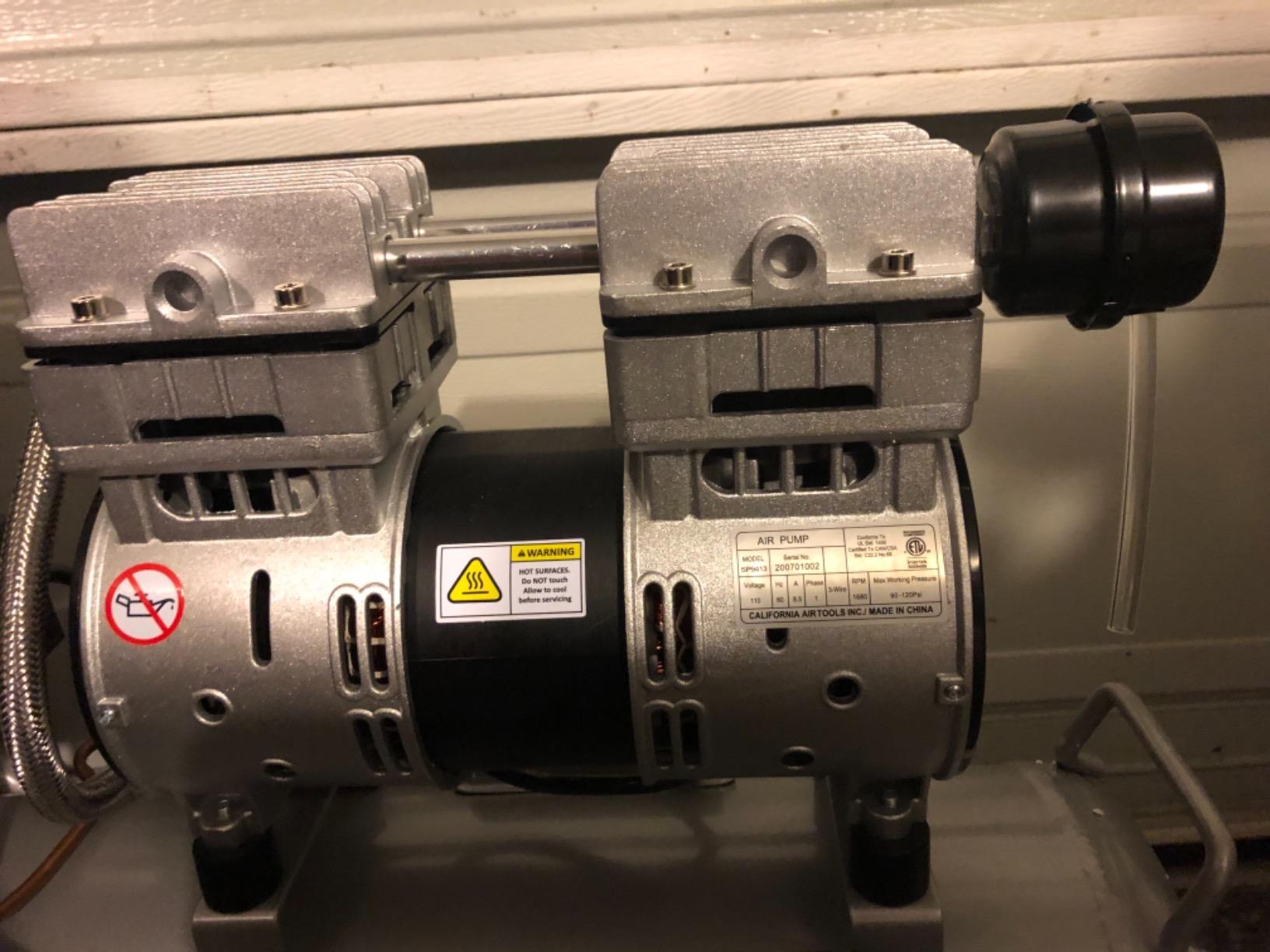
The aluminum tank at 37.3 lb is the lightest serious unit in the group, and the wheel kit makes it easy to roll from a workbench to a car. Two-piston configuration gives smoother pressure delivery than a single-piston pump of the same size.
The trade-off is capacity. 2.20 CFM at 90 PSI covers finish and brad nailers, an air ratchet, and a blow gun with room to spare, but it is not enough for a framing nailer running flat out or for any sanding work.
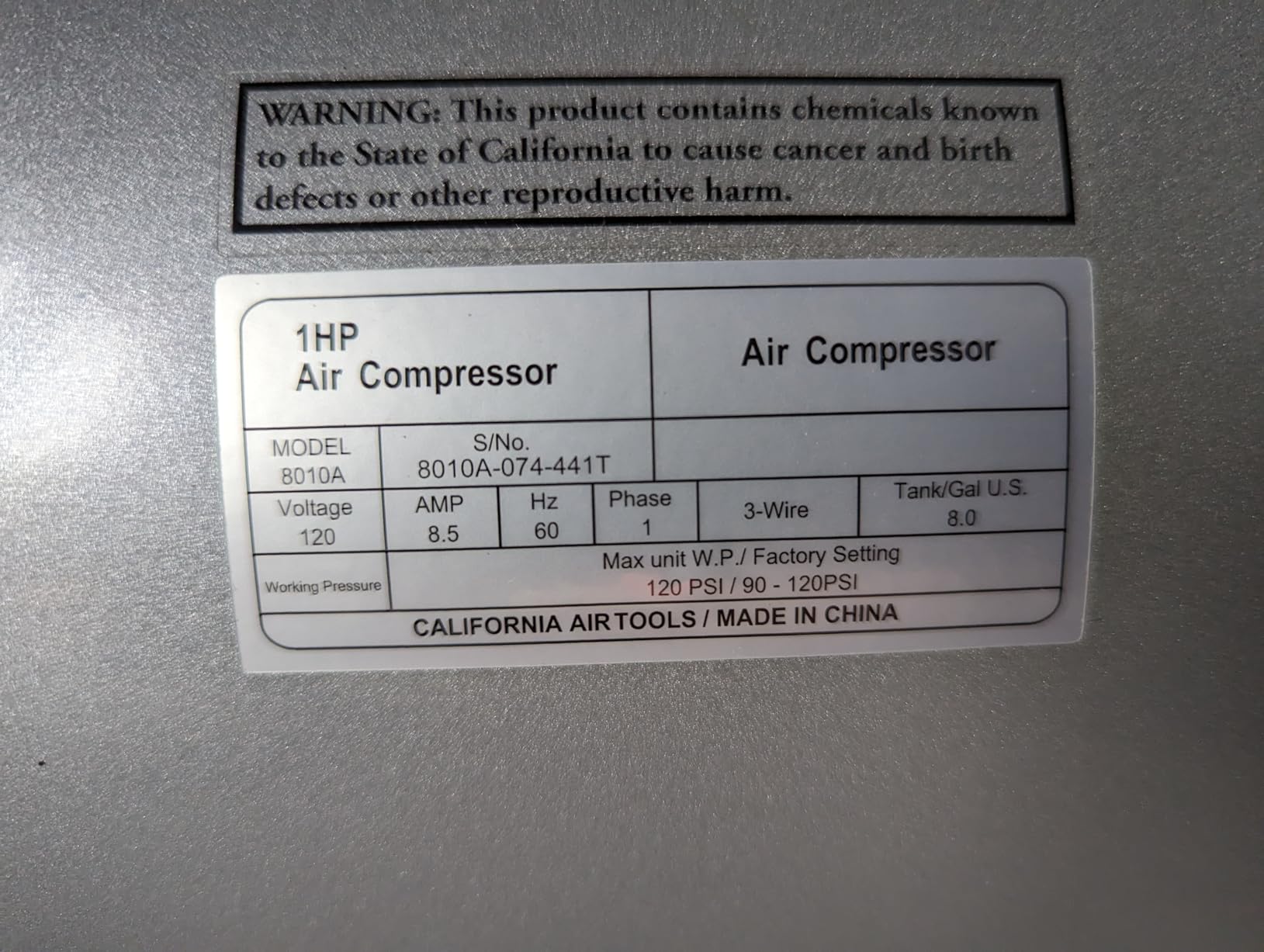
Where this quiet compressor earns its rating?
This is the right pick for a home office or basement shop, a bedroom-adjacent garage, or any space where you work at odd hours. Owners consistently point to the noise level as the reason they bought it and the reason they recommend it.
It also works well as a second compressor alongside a larger unit, handling finish work quietly while the big tank handles framing.
Buy this if, skip it if
Buy it if noise is your binding constraint, your work is trim, brad nailing, blowing out dust, or inflating tires, and you want zero maintenance. It is also the safest choice to run indoors.
Skip it if you plan to run a framing nailer, an orbital sander, or any paint spraying. The 120 PSI ceiling and 2.2 CFM are real limits, not conservatism on our part.
3. DEWALT DWFP55130 2.5-Gallon – Best for Finish and Trim Nailers
DEWALT Air Compressor for Trim, 200-PSI Max, Quiet Operation (DWFP55130)
2.5-gallon tank
3.0 SCFM at 90 PSI
200 PSI max
71.5 dBA
12 amp
1-year warranty
Pros
- 3.0 SCFM at 90 PSI with a 200 PSI ceiling
- Only 36 lb and 12.5 inches thick
- Low 12 amp draw reduces breaker tripping
- Oil-free pump and roll cage
- Stores in any orientation
Cons
- 2.5-gallon tank is the smallest here
- 71.5 dBA is louder than the 60 dBA units
The DWFP55130 solves a specific problem better than anything else in this roundup: trim work in a tight garage. At 2.5 gallons and 200 PSI max it is the thinnest unit we reviewed, measuring just over 12 inches deep, so it slides onto a shelf or a workbench where a pancake cannot fit.
Its 3.0 SCFM at 90 PSI is a genuinely useful number for its size. That is more than the 8-gallon California Air Tools delivers, because the smaller motor can cycle faster. It handles a finish nailer with no hesitation and will keep up with a second one if the tank is not empty.
The 12 amp motor is the quiet electrical advantage here. On a shared household circuit in a garage that also has a welder or a table saw, the low draw means you are far less likely to trip the breaker mid-job.
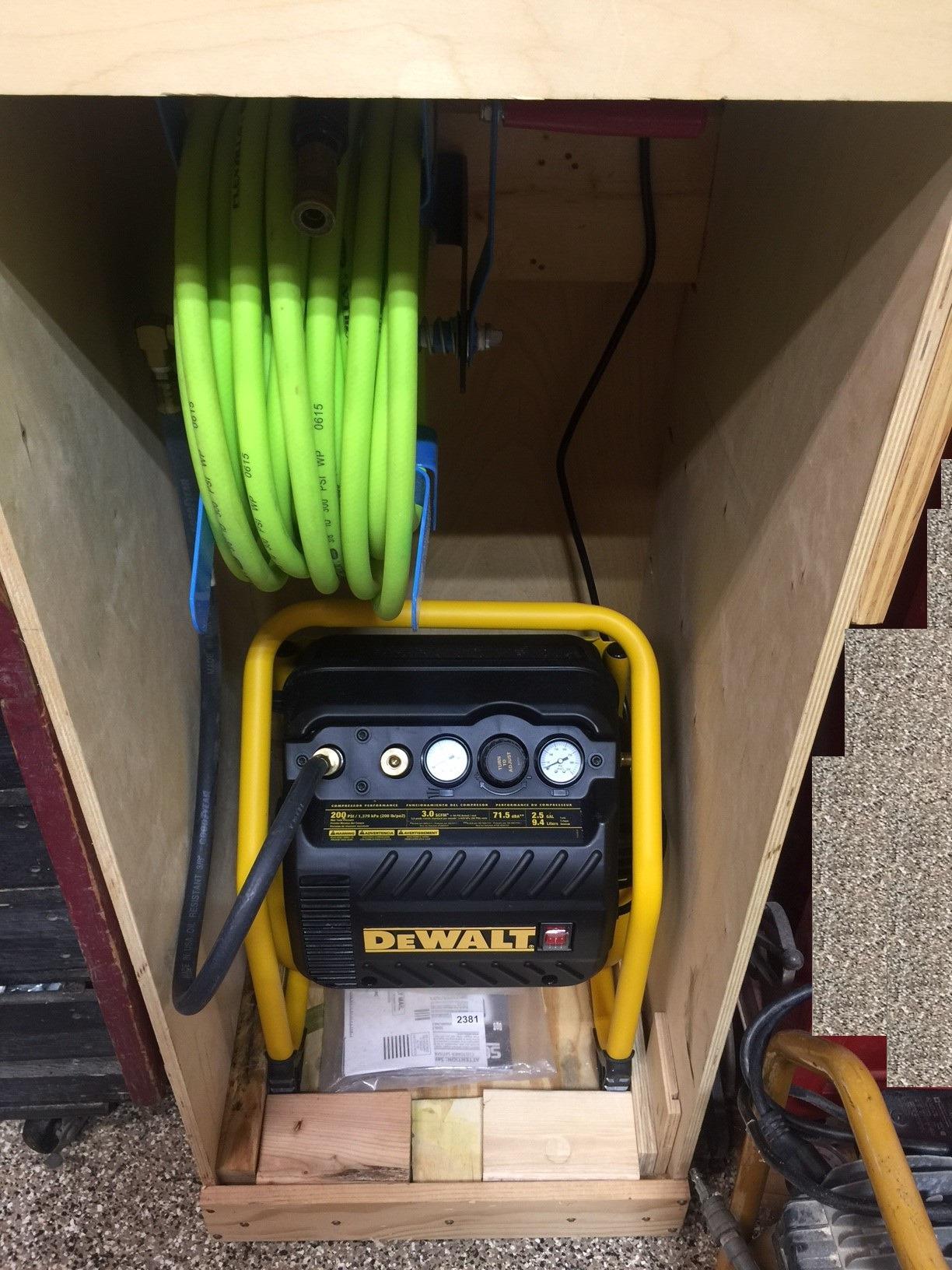
Two universal quick couplers are included, so you can run two nailers simultaneously, and the oil-free pump means no oil in your finish. The unit operates or stores in either orientation, which is unusual at this size and genuinely useful.
Where it falls short is obvious and worth stating plainly: a 2.5-gallon tank has no reserve. Any sustained consumption means the pump is running more or less continuously, and 71.5 dBA is loud enough to notice in a small space.
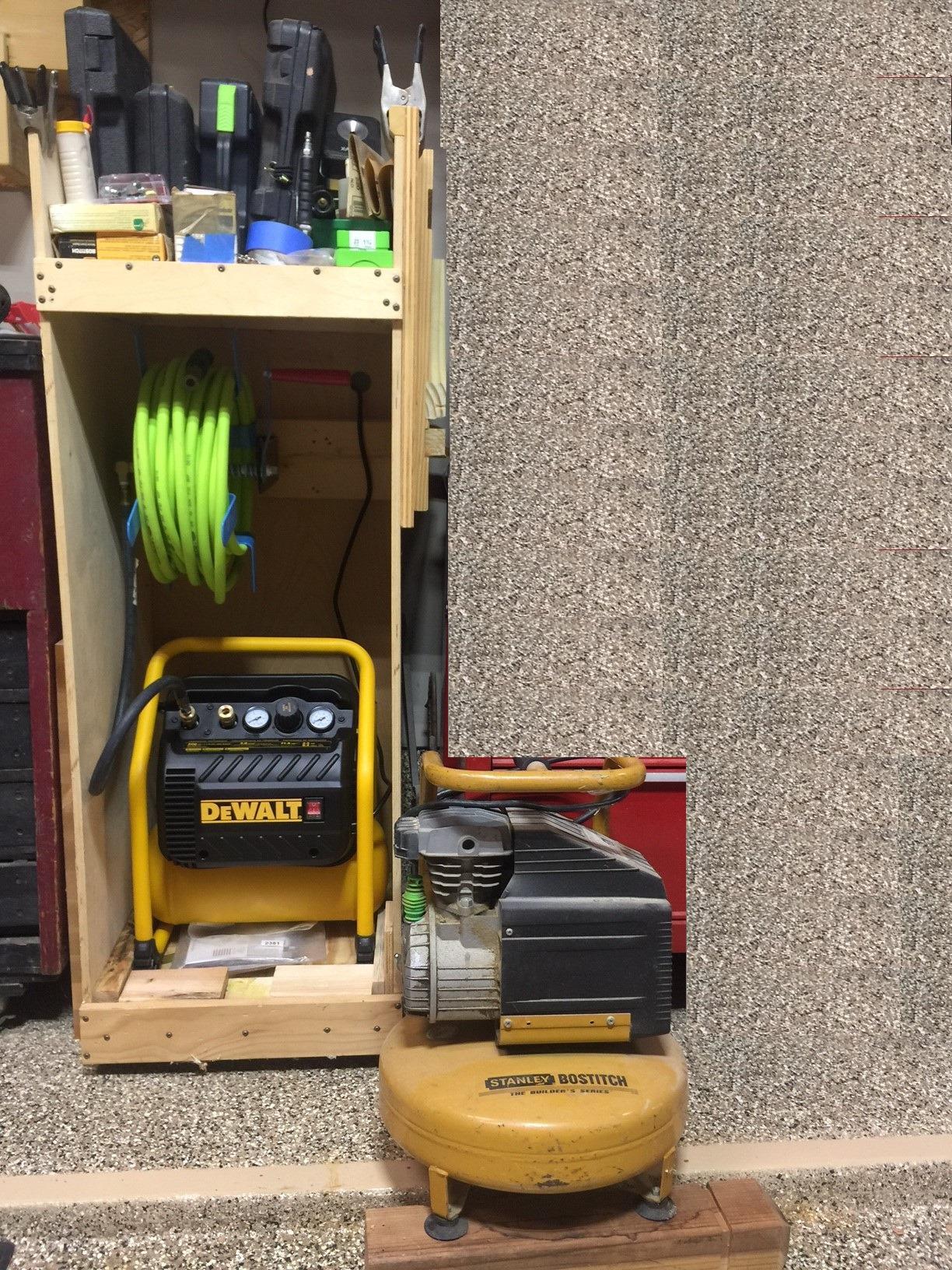
The compressor for cabinet, trim and one-car garages
This is the compressor to buy if you install crown moulding, baseboards, and cabinets, or if you own a one-car garage where floor space is the constraint. It stores against a wall in a way that no other unit here does.
It is also a reasonable second compressor for a two-car garage, dedicated to finish work while a larger tank handles the heavy framing air.
Buy this if, skip it if
Buy it if your airflow needs are modest, your electrical circuits are shared, and you need something that physically fits the space you have. The 200 PSI ceiling also gives it more pressure reserve than its 2.5-gallon size suggests.
Skip it if you run a framing nailer, any sander, or a spray gun, or if you need a unit that can hold pressure while you walk away from it. There is no version of a 2.5-gallon tank that changes that.
4. Klutch 20-Gallon Vertical – Best Airflow per Square Foot
Klutch 20-Gallon Air Compressor, 2 HP, 120V, 175 PSI, 4.2 SCFM at 90 PSI
20-gallon vertical tank
4.2 SCFM at 90 PSI
175 PSI max
80 dB
90 lb
14 amp
Pros
- 20-gallon vertical tank packs a lot of air into a small floor footprint
- Oil-free pump needs no regular maintenance
- Owners report holding pressure for days with no leaks
- Runs on standard 120V with a 14 amp draw
- 75 percent duty cycle with thermal overload protection
Cons
- 80 dB is noticeably loud
- 90 lb makes truck-bed loading a two-person job
- One verified owner reported a power switch that could not shut the unit down
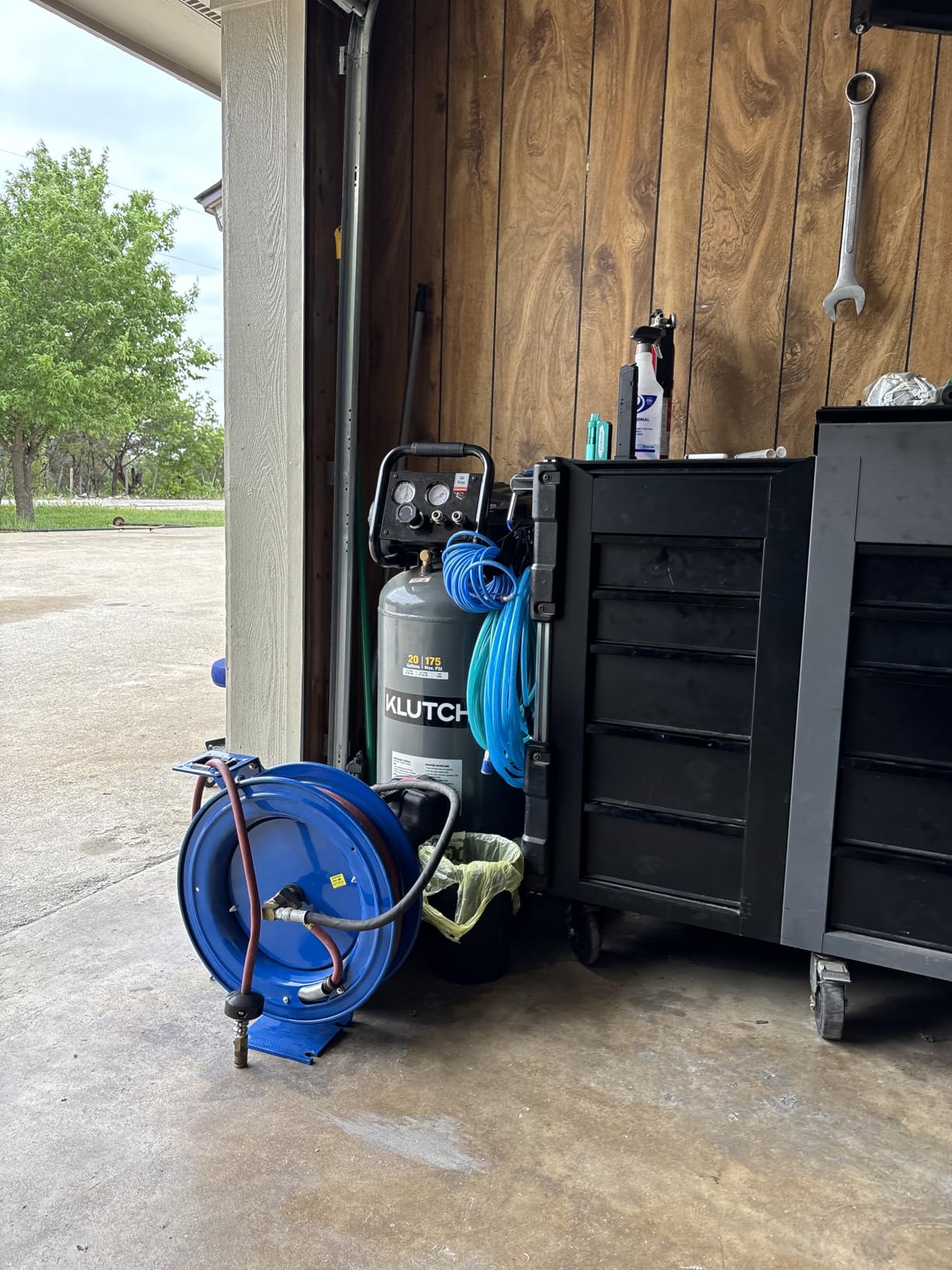
The Klutch 20-gallon is the shape answer to a common garage problem: a big tank that would not fit. Standing 41.5 inches tall and roughly 19 inches square, it holds 20 gallons in a footprint close to that of a 6-gallon pancake lying on its side.
Its 4.2 SCFM at 90 PSI on a 75 percent duty cycle is enough to run a framing nailer, an orbital sander, or a spray gun with real headroom. The 175 PSI ceiling gives it better sustained pressure behaviour than units that max out at 120 or 125 PSI, which is why it holds pressure for days without drifting, according to multiple owner reports.
Oil-free design means no scheduled maintenance, and thermal overload protection is a sensible safeguard on a unit you may leave running. An easy-access tank drain at the base is a small design decision that makes a large difference for tank corrosion.
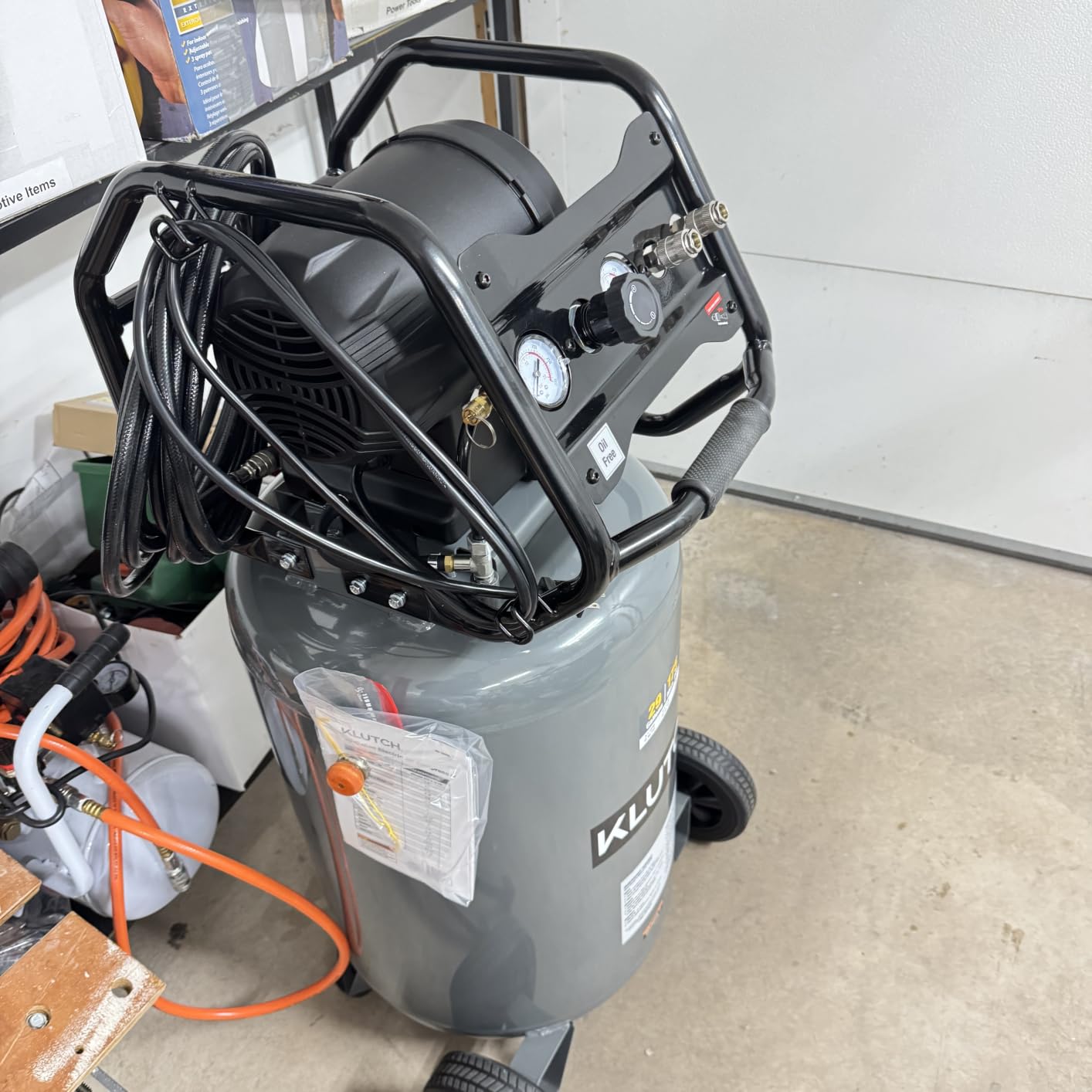
At 80 dB this is one of the louder units here, so it belongs in a detached garage, a shop, or a space where you can work with hearing protection. The large rubber wheels and ergonomic handle make moving it across a flat floor easy even at 90 lb.
One verified owner documented a power switch that was internally bypassed and would not shut the unit down. That is an isolated report in a large review base rather than a pattern, but it is the kind of electrical fault worth knowing about before you rely on the switch to stop the machine.
How much a 20-gallon vertical actually changes your work?
Tank capacity is a reserve buffer, not a flow rate. What 20 gallons buys you is the ability to run a tool for longer before the pump has to catch up, and to run a second tool while the first is still going.
For most home garages it is the difference between a compressor you wait on and one you do not. It also reduces how often the motor starts, which matters on an attached garage where cycle noise is the annoyance.
Buy this if, skip it if
Buy it if your garage is tight on floor space, you want a permanent installation, and you need enough airflow for framing or sanding. It is the best shape-to-capacity trade in this roundup.
Skip it if noise matters, if you need to move the unit regularly, or if you are not prepared to have it serviced on a dedicated 20 amp circuit. At 90 lb it is not a take-it-to-the-jobsite compressor.
5. VEVOR 15-Gallon Steel Tank – Best Value for Airflow
VEVOR Air Compressor, 15 Gallon Steel Tank, 2HP 5.3 CFM@90 PSI Oil Free Air Compressor & Max. 125PSI Pressure, 78dB Ultra Quiet Portable Compressor, for Auto Repair, Tire Inflation, Spray Painting
15-gallon steel tank
5.3 CFM at 90 PSI
125 PSI max
78 dB
81.6 lb
2 HP oil-free
Pros
- 5.3 CFM at 90 PSI is the highest verified airflow here
- Three-layer anti-rust coating on Q235B structural steel
- Large cooling fan with automatic overheating protection
- Automatic shut-off and pressure relief protection
Cons
- Power cord is only about 40 inches
- Several owners report it will not run reliably on extension cords
- Wheels and handle criticized as poor quality
- 125 PSI max is the lowest ceiling among 15-gallon units
On raw air delivery, the VEVOR 15-gallon is the strongest number in this roundup: 5.3 CFM at 90 PSI from a 2 HP oil-free motor. That figure puts it above every other unit here on the metric that decides whether tools stall, and it is paired with a 15-gallon steel tank rather than a 6-gallon one.
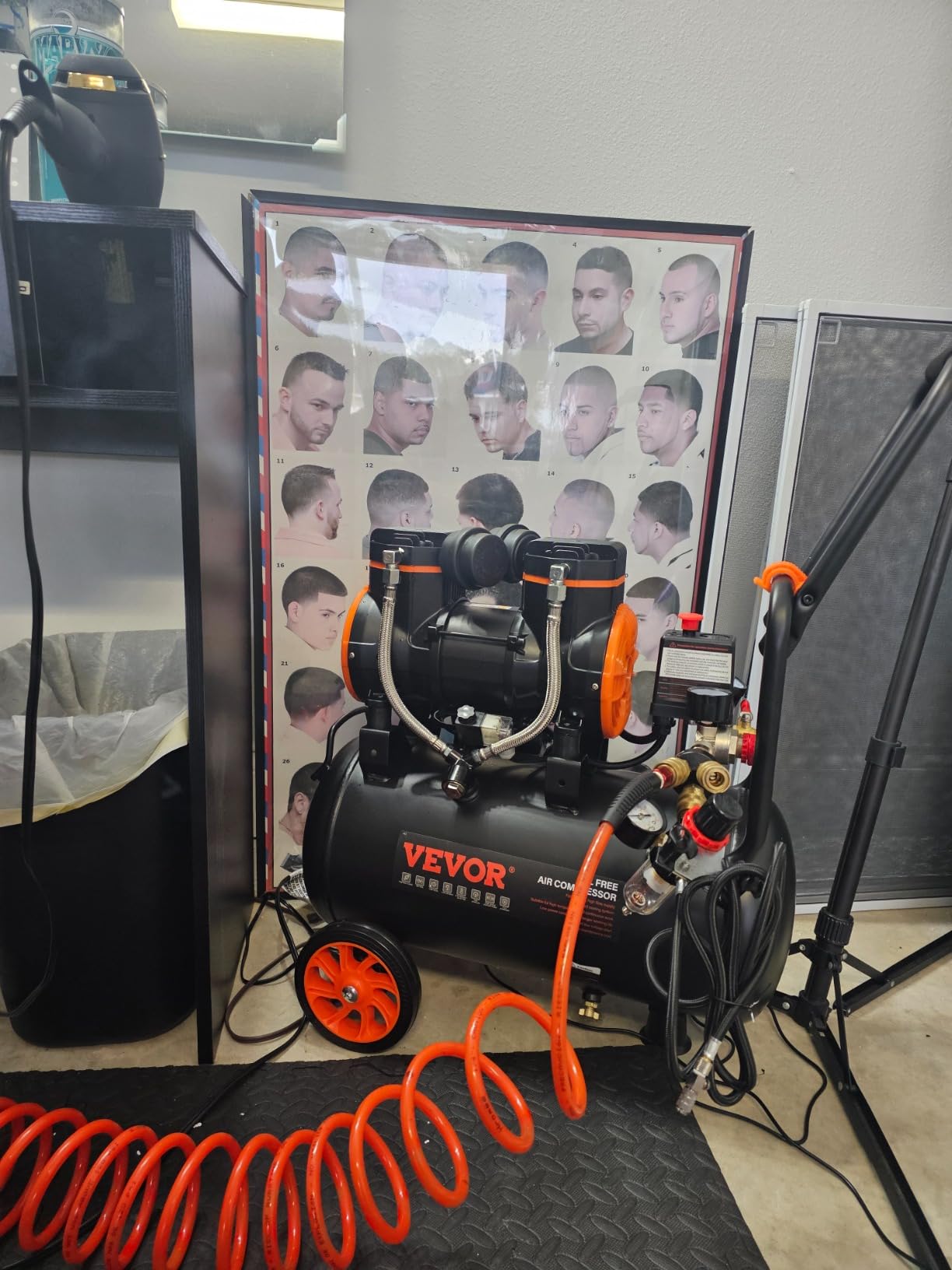
The tank is Q235B structural steel with a three-layer rust-resistant coating, and the intake plumbing uses a silicone and stainless steel braided pipe. Those are build details you normally see described on units costing considerably more, which is where the value argument comes from.
Large cooling fans with automatic overheat protection, plus automatic shut-off and pressure relief protection, are the safety trio you want on any oil-free piston compressor. Owners report no air leaks after months of use.
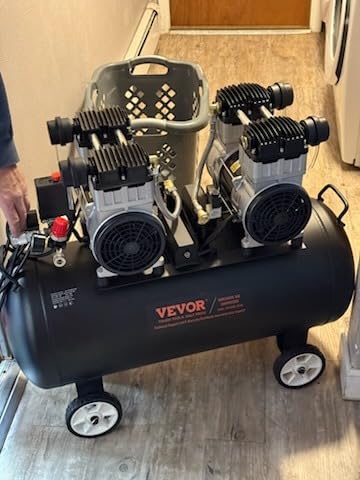
The compromises are real and worth knowing before you buy. The power cord is roughly 40 inches, which means this unit has to sit near an outlet. Several owners also report it will not run reliably on an extension cord, and that is normal for a 2 HP motor rather than a defect.
Owners also single out the wheels and handle as noticeably weaker than the pump itself, so treat it as a stationary unit rather than something to wheel around a jobsite. At 78 dB it is not a quiet machine, and 125 PSI is a modest ceiling for a 15-gallon tank.
Who this value pick suits?
This is the compressor for a home shop that wants framing, sanding and spray capability without stepping up to a premium brand, and for anyone who plans to install it in a fixed spot near a wall outlet. The airflow makes it capable where cheaper 15-gallon units are not.
It is also a reasonable pick for automotive work and tire inflation, given the tank size and the recovery rate the airflow allows.
Buy this if, skip it if
Buy it if your priority is maximum CFM for the money, you can dedicate an outlet and a 20 amp circuit, and you want a tank that will sit in one place. The steel tank and anti-rust coating are the reasons we trust it for the long term.
Skip it if you need portability, quiet operation, or a pressure ceiling above 125 PSI. The wheels and cord will frustrate you if you plan to move it.
6. Stealth 20-Gallon Ultra Quiet – Best Balance of Quiet and Capacity
Stealth 20 Gallon Ultra Quiet Air Compressor,1.8 HP Oil-Free Peak 150 PSI 68 Decibel, 5.5 CFM @ 40 PSI 5 CFM @ 90 PSI Silent Long Life Electric Air Compressor W/Wheel for Garage
20-gallon steel tank
5 CFM at 90 PSI
150 PSI max
68 dB
121.4 lb
Limited lifetime warranty
Pros
- Noticeably quieter than typical shop compressors
- 20-gallon tank outlasts a full tank of air per tire
- 5 CFM at 90 PSI gives genuinely fast recovery
- Holds pressure well when idle
- Limited lifetime warranty
Cons
- 121.4 lb is the heaviest unit here and hard to load
- 150 PSI max is below competing 20-gallon models
- One owner reports a breaker trip and failure within two weeks
- Customer service was hard to reach for warranty service
The Stealth 20-gallon is the rare unit that pairs genuine 20-gallon capacity with a 68 dB noise figure. Where most 20-gallon compressors land between 78 and 80 dB, this one is quiet enough for an attached garage where you still want a full-size reserve of air.
Its 5 CFM at 90 PSI and 5.5 CFM at 40 PSI put it in the same airflow class as the VEVOR, so it handles framing, sanding and spray work without waiting on the pump. Owners specifically note that the tank outlasts a full tank of air per tire change, which is a good indicator of how quickly it replenishes.
Two quick couplers let you switch between tools without unplugging, and the heavy duty steel tank rides on 8-inch rubber wheels.
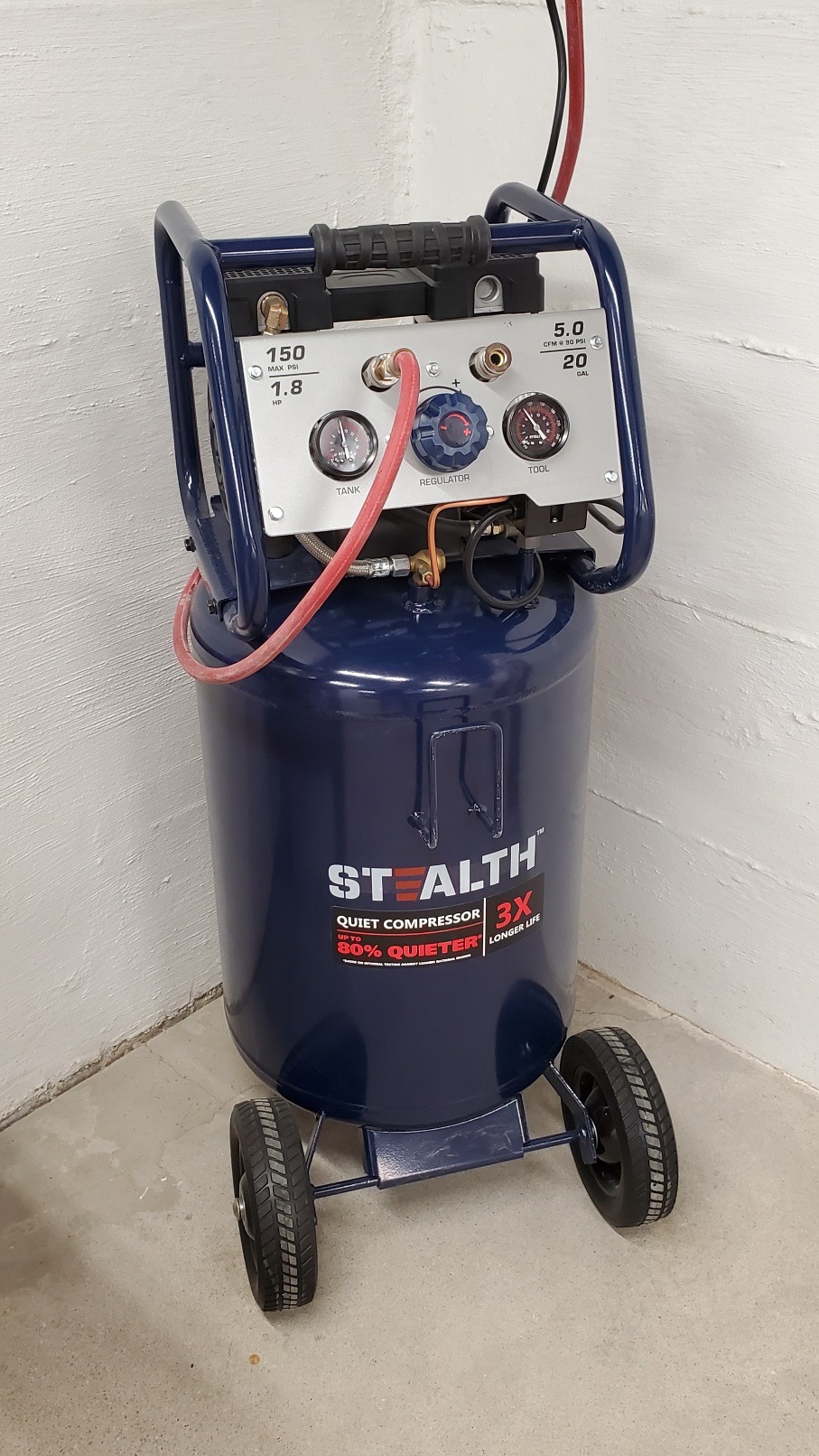
The listed limited lifetime warranty is the strongest warranty claim in this roundup, which matters for a machine you intend to keep for years. Pressure holding when the unit is idle is consistently reported as excellent.
At 121.4 lb this is the heaviest compressor here and awkward to load into a vehicle, so plan its location before you order. One owner reported a breaker trip followed by failure within two weeks of use, and another found the listed customer service contact difficult to reach for warranty work.
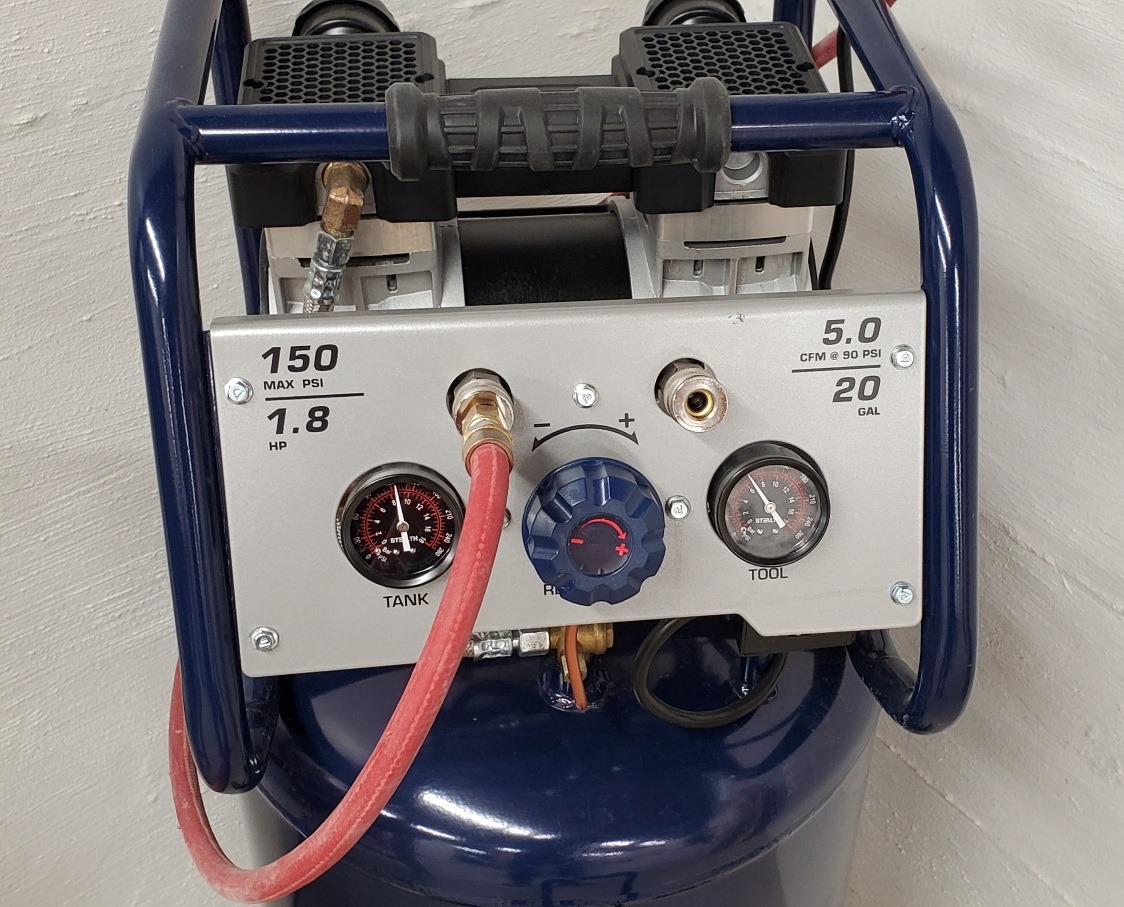
The quiet-shop compromise and what it costs you
You are paying for quiet operation and a lifetime warranty claim, and the price of that combination is weight and a lower pressure ceiling. At 150 PSI it sits below the 175 to 225 PSI offered by several competing 20-gallon models, though in practice most pneumatic tools never draw on the difference.
For a workshop that works at reasonable hours, the noise reduction is the feature you will actually notice every day. For a user running a sander or a spray gun at midnight under a bedroom, it is the feature that makes the machine usable at all.
Buy this if, skip it if
Buy it if you need 20 gallons of air and your garage is attached or shares a wall with living space. The 68 dB figure and 5 CFM at 90 PSI combination is hard to find anywhere else in this group.
Skip it if you need to move the unit between the garage and a jobsite, or if you need a pressure ceiling above 150 PSI. And if you do buy it, confirm the warranty channel with the seller before you rely on the lifetime claim.
7. DEWALT D55146 4.5-Gallon – Best Airflow per Gallon
DEWALT Air Compressor, 225-PSI Max, Hand Carry with Wheels, 4-1/2 Gallon (D55146)
4.5-gallon tank
5 CFM
225 PSI max
78 dB
88 lb
15 amp
1-year warranty
Pros
- 5 CFM from only 4.5 gallons is the best airflow per gallon here
- 225 PSI max is the highest tank pressure in this roundup
- Long-term owners report it still running after a decade
- 10-inch non-flat pneumatic tires roll over rough ground
Cons
- Draws a full 15 amps and needs a dedicated circuit
- Tank must be tilted about 45 degrees to drain properly
- Supplied 3-in-1 couplers do not accept high-flow connectors
- 88 lb with a non-locking handle is hard for one person to load
The D55146 is the odd one out in this roundup, and in the best way. It delivers 5 CFM from a tank that holds only 4.5 gallons. That combination of a small, fast-cycling pump and a high 225 PSI ceiling is why it can drive a 1/2-inch impact wrench on hard lug nuts and sandblasting accessories that would starve a larger tank running at 120 PSI.
Durability is the headline here. A long-term owner documented the unit still running strong after a decade of regular use, which is the kind of evidence the buy-it-for-longevity crowd looks for. The oil-free pump and high flow coupler are consistent with a design built to be kept.
Large 2-inch gauges sit behind a protective metal panel on the display console, which is a small quality detail that matters when you are reading pressure with gloves on.
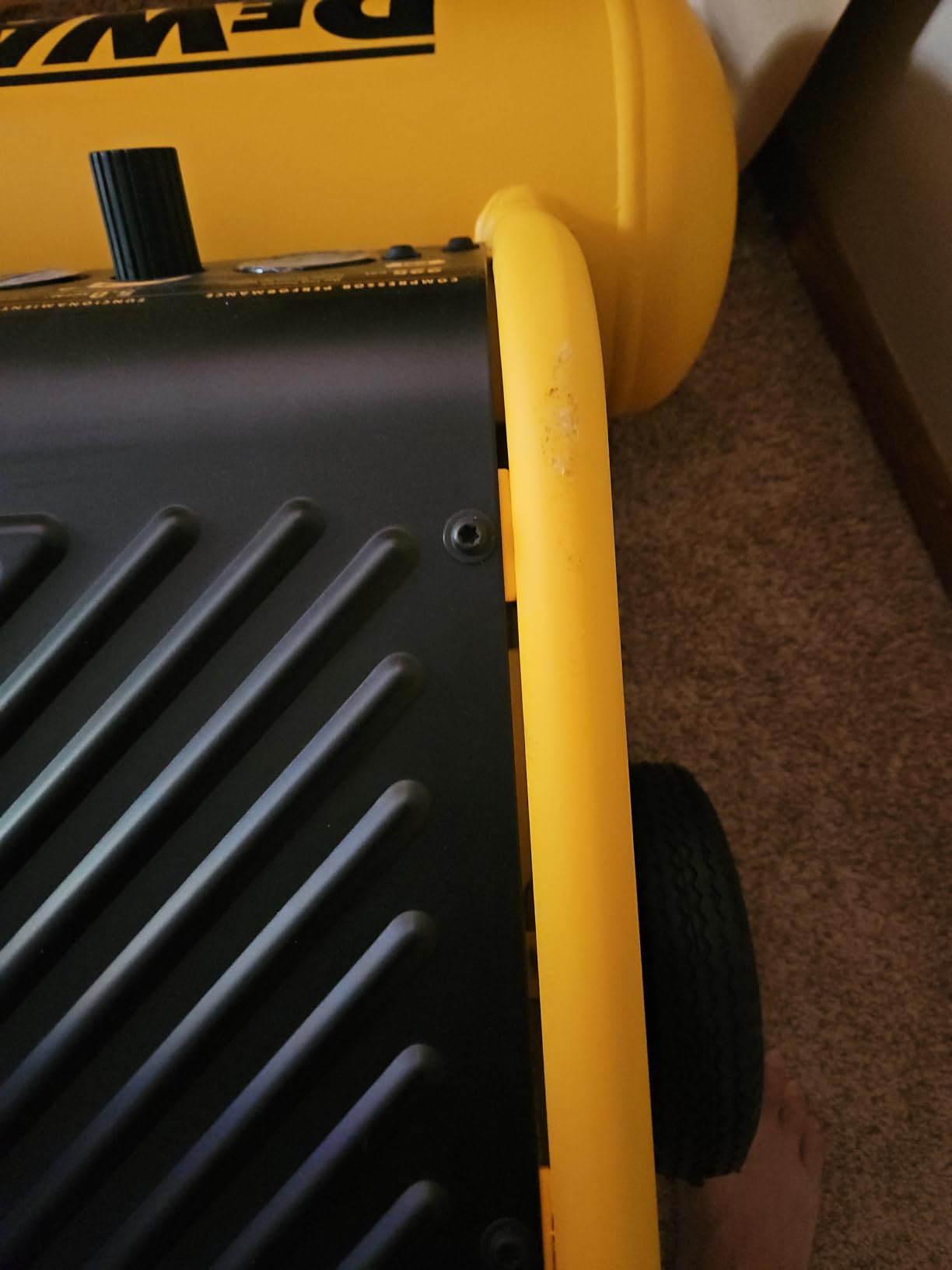
The 10-inch non-flat pneumatic tires roll over gravel and shop floors far better than the small casters most competitors ship, and the unit stores upright with the tank on top to save floor space. That wheel and tire package is what separates it from a pancake in real garage use.
There are trade-offs. It draws a full 15 amps, so it wants a dedicated household circuit. The tank has to be tilted roughly 45 degrees to drain properly, which is awkward and easy to forget. The supplied 3-in-1 couplers do not accept high-flow Milton-style connectors, so plan on replacing them if you use that standard.
What a 225 PSI ceiling actually buys you?
For a sandblaster, a paint sprayer, or a pneumatic tool with a regulator set high, the higher ceiling means the pump is not fighting against a low ceiling every time it cycles. It is also the reason this unit sustains 5 CFM while smaller compressors fall off sharply.
For nailers, air ratchets and blow guns, the extra pressure goes unused, and in that case the 20-gallon verticals are the more sensible purchase for reasons of tank reserve rather than pressure.
Buy this if, skip it if
Buy it if you run impact wrenches on stubborn fasteners, do any blasting or spraying, and want a compressor you can keep for a decade. The tire package also makes it the best small unit here for uneven garage floors.
Skip it if your electrical circuit is shared and 15 amps is too much to add, or if draining a tank by tilting it 45 degrees sounds like a habit you will not keep. That draining habit matters more than most buyers realize.
8. Craftsman 20-Gallon Oil-Free – Best Accessory Bundle
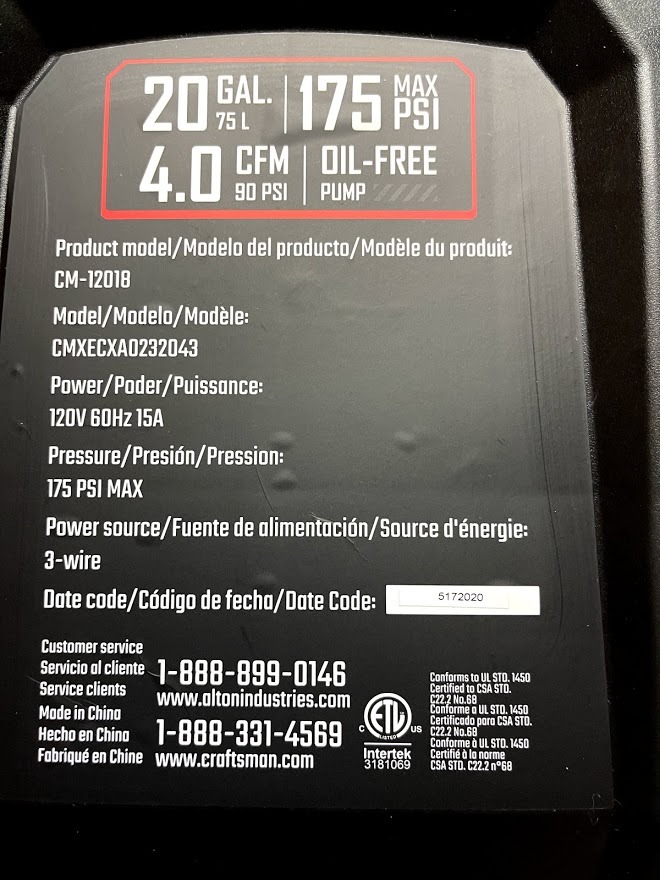
Craftsman Air Compressor, 20 Gallon Oil-Free 1.8 HP Max 175 PSI Pressure Two Quick Couplers Big Capacity, Red- CMXECXA0232043
20-gallon stainless steel tank
4 SCFM at 90 PSI
175 PSI max
1.8 HP
80 dB
1-year warranty
Pros
- 20-gallon stainless steel tank stores a lot of air for long run times
- 1.8 HP motor with 4 SCFM at 90 PSI recovers quickly
- Oil-free pump and rubber feet for long service life
- Ships with a 6-foot cord
- drain valve
- filter
- two couplers and wheels
Cons
- 80 dB is among the loudest units in this group
- Lowest five-star share among the large-tank models
- 4 SCFM is below the leaders at 90 PSI
The Craftsman 20-gallon is the pick for buyers who want a complete setup in one box. The package includes a 6-foot cord, a ball drain valve, a plastic filter, two quick couplers, and rubber wheels, which covers everything you need to connect a tool on day one.
The tank is stainless steel rather than painted carbon steel, and at 175 PSI with 4 SCFM at 90 PSI from a 1.8 HP oil-free motor, it is a competent mid-size performer. Two quick couplers means you can run two tools at once, which the two-gallon and 2.5-gallon units cannot.
Rubber feet under the vertical tank help with vibration transfer, and the oil-free pump removes the oil-change item from your maintenance list entirely.
At 80 dB this is among the loudest compressors in the roundup, and the review distribution reflects a mixed experience: 68 percent five-star is the lowest share of the large-tank models here. Owners like the capacity and the accessories, and noise is the most common complaint.
One structural note: at 4 SCFM at 90 PSI it delivers less air than the VEVOR and the Stealth at the same tank size. If airflow is your main criterion, the equivalent 20-gallon units out-deliver it.
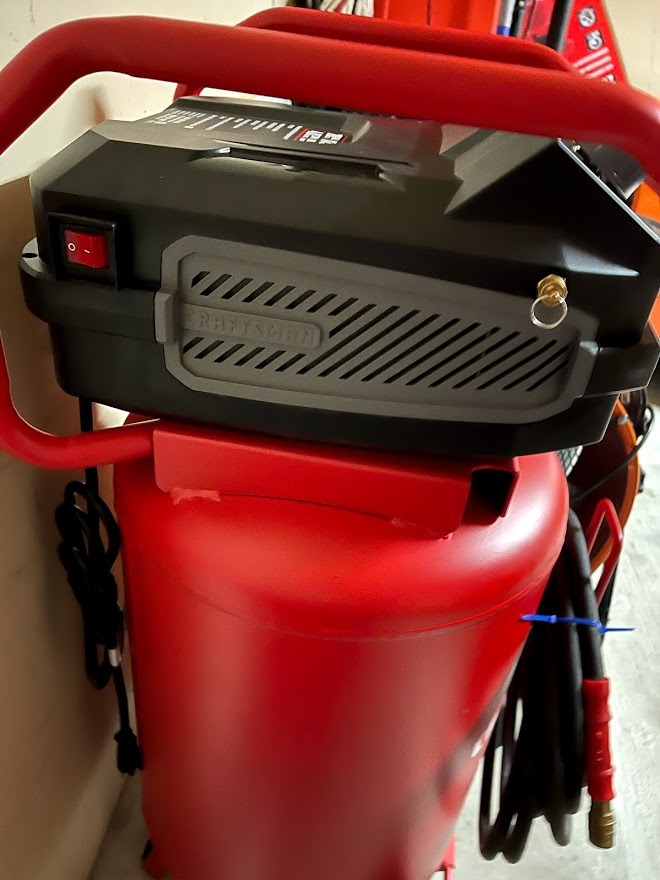
Stainless steel and the accessory question
A stainless steel tank resists internal corrosion better than a coated carbon steel tank, which is a genuine advantage in a humid garage or one where condensation is a problem. It is not immunity, though: any tank that collects water and never gets drained will eventually fail from the inside.
The accessory bundle matters more than it sounds. Most first-time buyers underestimate how much friction is created by cheap couplers and a thin hose, and having a proper coupler and a 6-foot cord included removes the first round of problems.
Buy this if, skip it if
Buy it if you want one purchase to cover the compressor, hose connection, and basic accessories, and you want a 20-gallon reserve for framing and automotive work without hunting for parts later.
Skip it if quiet operation matters in your garage, or if you need more than about 4 CFM at 90 PSI. Both are legitimate reasons to look at a different unit in this roundup.
9. ECOMAX 6-Gallon Pancake – Budget Pick with the Best Satisfaction Score
ECOMAX Air Compressor 6 Gallon 150 PSI Pancake Portable Oil-free Tank with 10 PCS Accessories Kit
6-gallon pancake tank
3 CFM at 90 PSI
150 PSI max
34.17 lb
75 dB
1.5 HP
Pros
- 4.7 average rating with only 1 percent one-star reviews
- Lightest unit here at 34.17 lb with a flip-up handle
- 10-piece accessory kit including a 25-foot hose
- Dual quick couplers and dual pressure gauges
- Best seller rank of any portable compressor listed here
Cons
- 150 PSI ceiling is modest next to 200 to 225 PSI competitors
- 3 CFM at 90 PSI suits lighter duty tools only
The ECOMAX 6-gallon has the most consistent satisfaction profile in this roundup: 4.7 out of 5 with 81 percent five-star and just 1 percent one-star reviews. On consistency of owner experience, nothing else here matches it.
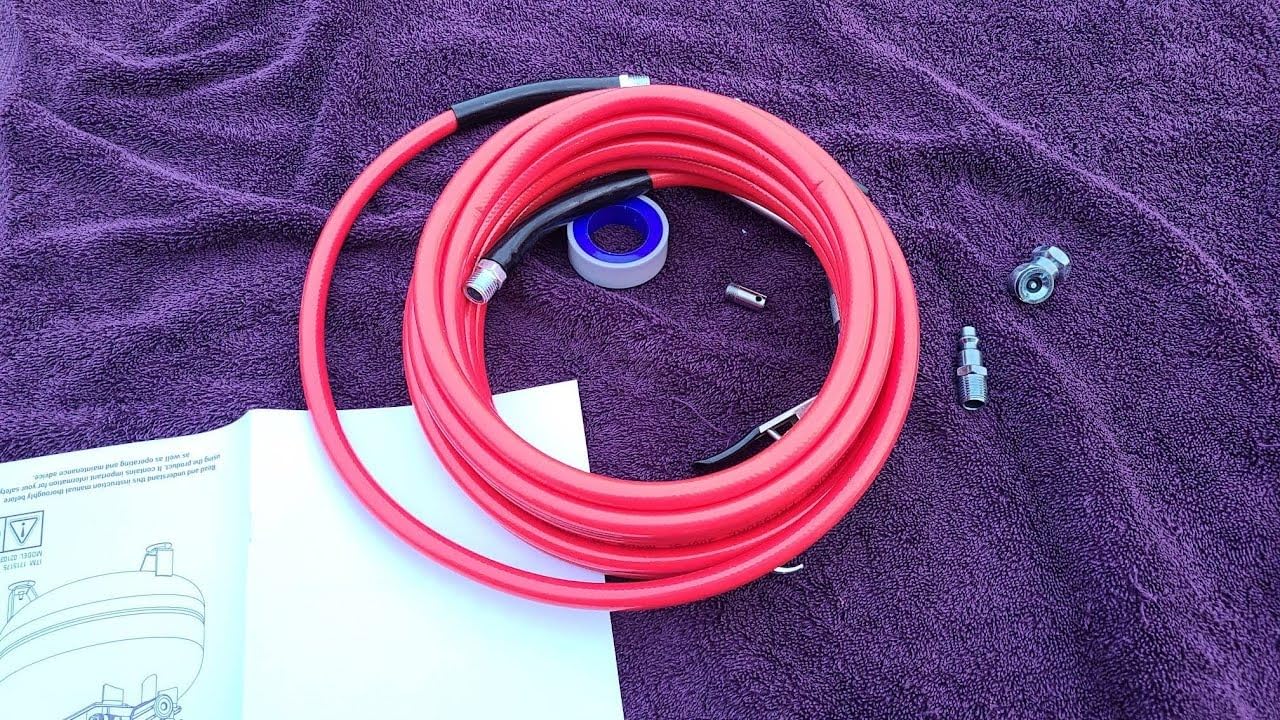
It also ships with a genuine 10-piece accessory kit, including a 25-foot PVC hose, quick couplers, a tire pressure gauge, and a blow gun. For a first compressor or a secondary unit, that bundle removes the most common follow-up purchase entirely.
Dual quick couplers and dual pressure gauges are useful features at this level, and the 1/4-inch fittings match standard air hose. Cold-weather low-voltage start capability is worth having if your garage is unheated.
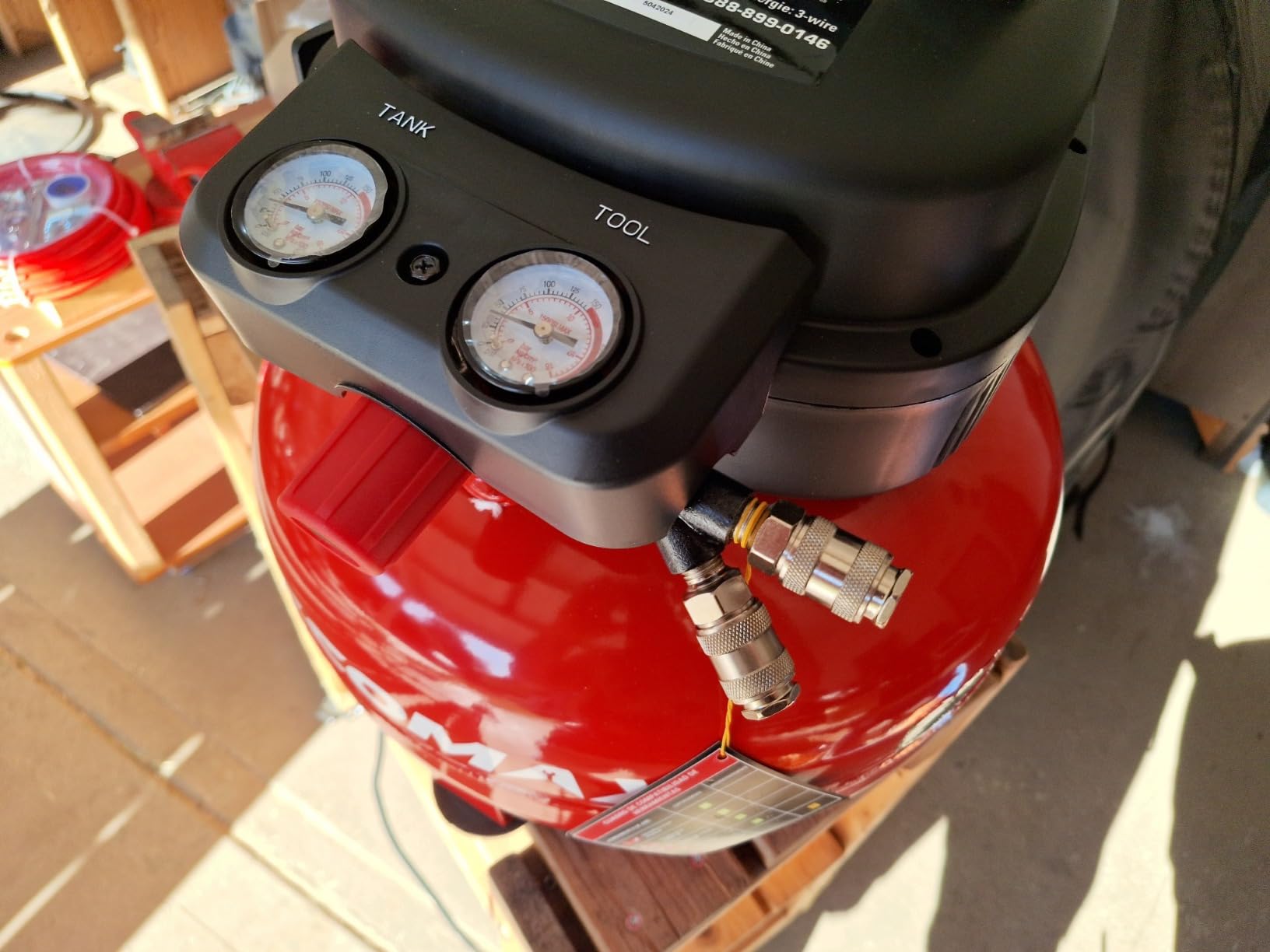
At 34.17 lb it is the lightest compressor we reviewed, and the flip-up carry handle makes it genuinely portable rather than nominally portable. A cord winding bracket keeps the lead tidy, which is a small thing that matters in a shared garage.
The limits are the same limits every 6-gallon pancake has. A 150 PSI ceiling is modest next to the 200 and 225 PSI units here, and 3 CFM at 90 PSI is enough for brad and finish nailers, an air ratchet, and tire inflation, but not for framing at speed.
A pancake compressor that is genuinely any good
The question of whether pancake compressors are any good comes down to tool demand, not form factor. At 3 CFM and 150 PSI, this one covers finish nailing, brad nailing, small assembly work, blowing debris off a bench, and inflating tires without a hitch.
For those jobs it is a competent machine with an unusually strong owner satisfaction record. The form factor is the constraint, not the quality of this particular example.
Buy this if, skip it if
Buy it if you are outfitting a first garage, need a portable unit you can carry to different parts of the property, or want a second compressor for finish work without spending much.
Skip it if you frame, sand, or spray. No amount of tank size in a pancake design changes the flow ceiling that comes with a small motor.
10. Limodot 5-Gallon Quiet – Best Compact Indoor Unit
Quiet Oil-Free Air Compressor, 68 dB, 2.8 CFM @ 90 PSI, 5 Gallon Air Tank
5-gallon steel tank
2.8 CFM at 90 PSI
120 PSI max
68 dB
1.2 HP induction motor
Pros
- 68 dB induction motor is quiet enough to run indoors
- 80-second full refill and 25-second recovery
- 13-piece accessory kit and 25-foot hose included
- Wheels kit included
- 925 reviews make it one of the most proven units here
Cons
- 120 PSI max and 2.8 CFM limit it to light-duty work
- 5-gallon tank is small next to the 20-gallon models
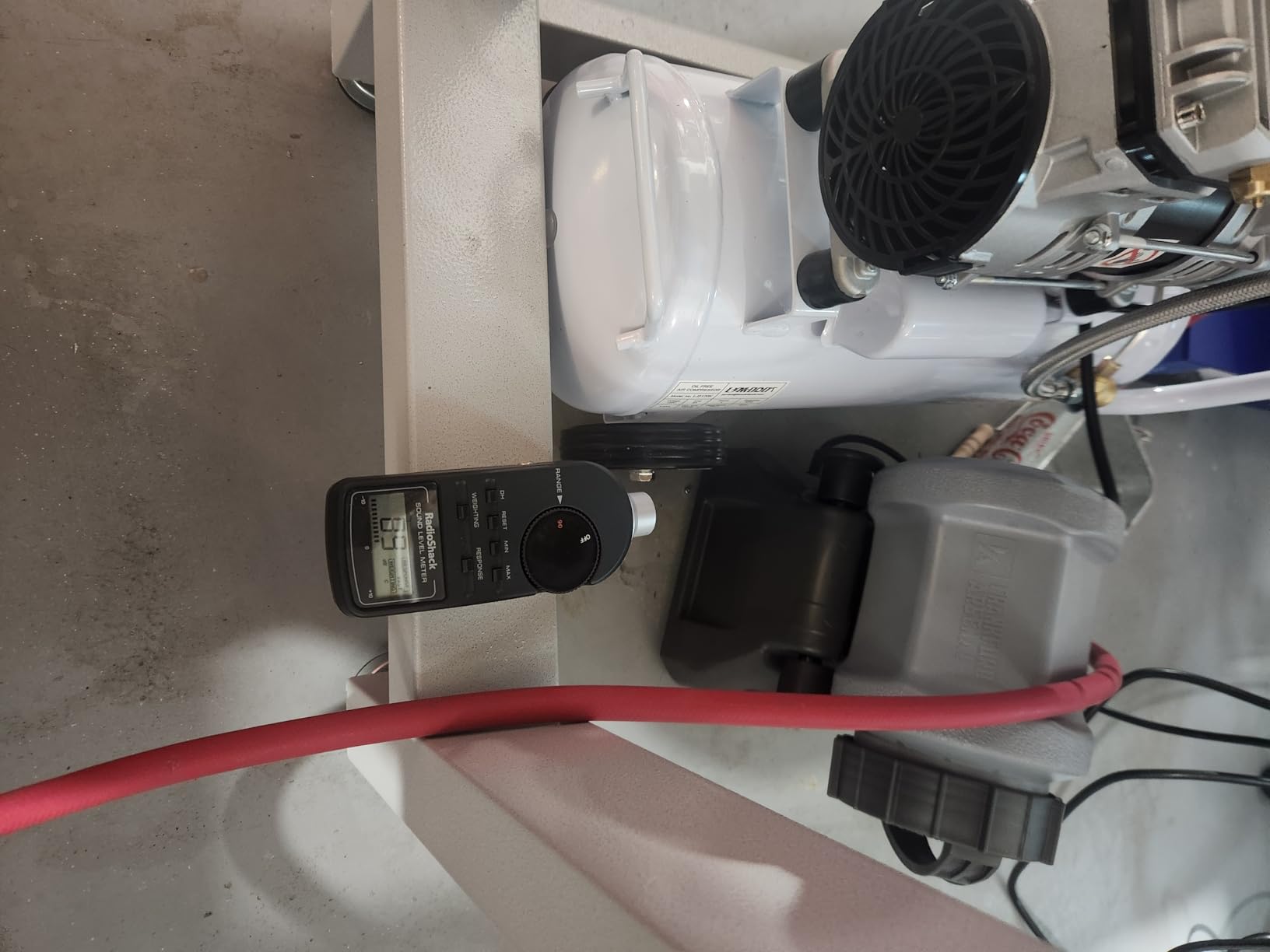
The Limodot 5-gallon is the pick for a garage, basement, or workshop space where the compressor lives indoors. The induction motor turning at just 3400 RPM is the reason for the 68 dB figure, and it is a genuinely different motor type from the universal motors used in most pancake compressors.
Refill from empty to full takes 80 seconds, with a 25-second recovery time. That is fast for a 5-gallon tank, and it means a nailer will not stutter the way small tanks typically do when the pump is slow to refill.
With 925 ratings averaging 4.5, this is one of the most reviewed units in the roundup, which makes the owner feedback unusually well established rather than anecdotal.
The 13-piece accessory kit and 25-foot PVC hose mean you can be running a tool within minutes of unboxing, and the included wheels kit makes it easy to move between a bench and a car. Oil-free construction means no pump oil maintenance at all.
Two things to weigh. At 2.8 CFM and 120 PSI max, this is a light-duty unit: staple guns, brad nailers, light finish work, blow cleaning and tire inflation. It is not a framing or sanding compressor.
Where a 5-gallon tank is genuinely enough?
Tank size stops mattering once it is large enough to bridge the gap between tool cycles. For brad and finish nailers firing in short bursts, a 5-gallon tank with a fast refill is genuinely sufficient, and the 25-second recovery figure is what makes that true.
The point where the tank stops being the limiting factor is when you run something continuous. An orbital sander or a spray gun draws air without pause, and at 2.8 CFM this unit simply does not have the output.
Buy this if, skip it if
Buy it if you work indoors, your tool needs are light, and you want something proven with a large review base. The quiet induction motor and the included kit make it a strong first compressor.
Skip it if you need sustained airflow, more than 120 PSI, or a tank that lets you walk away from a running tool for an hour. For those jobs, move up to a 15- or 20-gallon unit earlier in this list.
Pancake, Hot Dog, Twin-Stack or Vertical: Tank Style and Footprint
Tank shape is a footprint decision before it is an air delivery decision. A pancake compressor is a shallow horizontal tank, usually 6 gallons or less, that stores air close to the ground. It is the easiest to carry and the easiest to slide under a bench, but the small tank means the pump cycles constantly on sustained work.
A hot dog compressor is a horizontal cylinder with wheels and a handle, so it rolls but tips when you move it. Forum discussions about hot dogs versus pancakes tend to focus on exactly that: a hot dog holds more air and delivers more, but a pancake sits flat and stable on a shelf.
A vertical tank stands upright, roughly 40 inches tall and under 20 inches square. This is where the best space economy lives, and it is why the Klutch 20-gallon in this roundup can hold 20 gallons in the floor area of a 6-gallon pancake. The trade is a taller profile that will not fit under a low shelf, and a heavier unit overall.
For most two-car garages, a vertical stationary unit is the right default. It gives you the largest reserve of air, the smallest footprint, and the fewest reasons to reach for the tank drain. Our separate guide to best pancake air compressors for nail guns covers the small-tank case in more detail.
On vertical versus horizontal specifically: a vertical tank gives you capacity per square foot of floor and keeps the pump high enough that it stays out of floor-level dust and water. A horizontal tank stores air lower, which can help if your garage has overhead clearance problems, and it is usually lighter to move. If your constraint is floor area, vertical wins. If your constraint is headroom, horizontal wins.
Oil-Free vs Oil-Lubricated: Which One Belongs in a Garage?
Oil-free pumps run without lubricant in the crankcase, so the air leaving the tank is clean. Every one of the ten compressors in this roundup is oil-free, and for a home garage that is the right call. You can run a spray gun or an orbital sander without worrying about oil contaminating a finish, and there is no pump oil to check or change.
Oil-lubricated compressors are quieter and longer-lived because lubrication reduces friction in the pistons and bearings. They are the standard choice for continuous-duty commercial work and for heavy two-stage cast iron pumps. The cost is that the air carries a fine oil mist, which matters enormously for painting and finishing and not at all for a framing nailer.
Forum consensus leans toward oil-lubricated and belt-drive designs when people talk about repairing rather than replacing. That is a fair point for a machine you intend to run for a decade, and it is why the belt-driven, cast iron pump designs built for shops still show up as longevity examples in long-running garage threads.
For a home garage, though, an oil-free piston unit with a replaceable pump is the practical answer. Maintenance is near zero, and the failure mode when one does eventually go is a replacement rather than a rebuild. If your work is exclusively painting or fine finishing, add a moisture separator and a coalescing filter to whatever you buy, because neither removes oil aerosol.
Quiet Garage Air Compressors and What the Decibel Numbers Mean
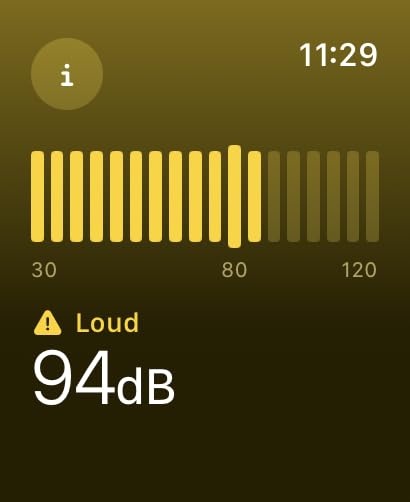
Decibel numbers on compressor listings are close to useless without a reference point, so here is the translation that matters in a garage. A normal conversation sits around 60 dB. A washing machine runs near 70 dB. A lawnmower and a chainsaw land around 100 dB.
60 dBA: normal conversation. The California Air Tools 8010A sits here and can run inside a shop.
68 to 70 dB: quiet but noticeable. The Limodot 5-gallon and Stealth 20-gallon are here, workable at night in a reasonably insulated attached garage.
71.5 to 75 dB: clearly audible in the house. The DEWALT DWFP55130 and ECOMAX 6-gallon sit here. Fine in a detached garage during the day.
78 to 80 dB: loud. The VEVOR, DEWALT D55146, and Craftsman 20-gallon are here. Expect to hear it through a closed door.
If your garage is attached to or below living space, the decision is made for you by the noise figure. Below 68 dB is the range where you can work at night without complaints. Above 78 dB, you will be running power tools anyway, so the compressor is not the limiting noise.
Two non-compressor levers help more than people expect. Rubber isolation pads under the feet stop vibration from travelling through the slab, and building a plywood enclosure around the unit on a dolly cuts the low-frequency hum that carries through framing. A sound blanket draped over the motor during a long fill is the cheapest fix of all.
Positioning matters as much as decibels. A compressor pushed into a corner bass-loads and sounds louder than its rating, while leaving clearance around the intake and discharge ports keeps airflow healthy. Our broader look at industrial air compressors covers the continuous-duty end of the market if your garage work starts looking like shop work.
Garage Electrical: 110V, 120V and the Case for 240V
Every compressor in this roundup is 110V or 120V, which is why they are all installable in a normal garage without an electrician. The draw is what separates them, and it decides which circuit you put them on.
The DEWALT DWFP55130 pulls 12 amps and the Klutch 20-gallon pulls 14 amps. The DEWALT D55146 pulls a full 15 amps, which is the ceiling for a standard 20 amp household branch circuit once you account for everything else on it. The California Air Tools 8010A is listed at 8.5 amps maximum, the lowest here.
The practical rule is simple: put any of these on a dedicated circuit with nothing else on it, and if a breaker trips when the compressor starts, you have a wiring problem rather than a compressor problem. Motors draw a large inrush current at startup, and a shared circuit with a saw or a welder is the most common cause of a compressor that will not start.
Moving to 240V is what unlocks the bigger two-stage and cast iron pump units, and it requires a 240V sub-panel or a two-pole breaker in your panel. That is an electrical project, not a purchase decision, which is why almost every home garage in the market is served by the 120V units reviewed here. If you have the panel capacity and want more airflow than 5 CFM, the 240V route is worth understanding, but for a typical home garage it is unnecessary.
Draining the Tank and Keeping Moisture Out of Your Air
Tank corrosion from standing water is the failure mode that ends most compressors, and it is entirely preventable. The routine takes about two minutes.
Turn the compressor off and unplug it, or switch it off at the breaker for a wired unit.
Open the tank drain valve at the bottom of the tank and let it run until it spits air rather than water.
Wipe the drain valve and check that it closes fully when you open it. A leaking drain valve is a slow tank killer.
Run the outlet valve on a connected hose for a few seconds to clear the line, which pushes moisture back toward the tank where you can see it.
Do this weekly if the compressor runs regularly, and monthly if it sits for weeks at a time.
Avoid the common mistake of draining while the tank is still full of pressure. Open the valve too fast and you will get a blast of air and water across the floor. Bleed the pressure down through the regulator first.
For the air lines, a moisture separator on the outlet of the tank catches water and oil before it reaches your tools, and a coalescing filter after it removes the fine aerosol that painting and finishing work is sensitive to. Neither is optional if you spray.
If your compressor short-cycles constantly, that usually points to a leaking unloader valve or a failed check valve rather than a sizing problem. If it will not shut off, that is a pressure switch or unloader failure, and it is the exact fault one owner documented on the Klutch unit in this roundup. Both are replaceable parts on most of these models.
What to Check Before You Buy a Garage Air Compressor?
Measure the space first, including where the door and a parked car will be. Vertical units need 42 inches of height, and the ceiling clearance above a horizontal tank matters more than the floor area. Leave room to open the tank drain and to pull a hose to the work area.
Confirm the voltage and the circuit before you choose a model. If your panel has no 240V capacity, every 120V unit here is a straightforward install. If you are adding a new circuit, that is an electrician’s job and it changes nothing about which compressor suits your tools.
Plan hose reach. A compressor tucked into a corner with a 25-foot hose still cannot reach the far side of a two-car garage comfortably, and a cheap hose is the main reason airflow feels lower than the spec sheet promises. A coiled reel mounted on the wall solves it cleanly.
Check the noise figure against your living situation before anything else. A 60 dBA unit is a completely different purchase decision from a 80 dBA one in an attached garage, and no amount of tank capacity compensates.
Finally, look at the warranty and the parts situation rather than the horsepower number. A longer warranty on a unit you cannot get serviced is worth less than it looks, and a compressor with a standard 1/4-inch outlet and a replaceable pump is easier to keep running for a decade than a sealed one.
Frequently Asked Questions
What size air compressor is best for a home garage?
Most home garages need 4 to 6 CFM at 90 PSI and a 20-gallon tank. That covers a framing nailer, a 1/2-inch impact wrench, an orbital sander, and a spray gun one at a time. Check CFM at 90 PSI on the spec sheet rather than peak horsepower, and add about 50 percent to cover simultaneous tool use and pump recovery pauses.
What is the quietest air compressor for a garage?
The California Air Tools 8010A is the quietest unit in our roundup at 60 dBA, and it is quiet enough to run inside a shop. For a full-size 20-gallon tank with a quieter operating figure, the Stealth 20-gallon runs at 68 dB. The Limodot 5-gallon also sits at 68 dB and suits light indoor work.
Who makes the highest quality air compressors?
Among the ten units we compared, California Air Tools, DEWALT, and Metabo HPT produced the most consistent owner satisfaction. California Air Tools leads on quiet design, DEWALT on durability with a D55146 owner reporting strong service after a decade, and Metabo HPT on airflow in a portable pancake. Build quality matters more than brand: look for a steel tank, an oil-free pump, and a replaceable motor.
What is a good compact air compressor for a garage?
For a tight or one-car garage, the DEWALT DWFP55130 at 2.5 gallons and just over 12 inches deep is the most space-efficient option here, delivering 3.0 SCFM at 90 PSI on a low 12 amp draw. The ECOMAX 6-gallon at 34.17 lb is the lightest portable pick, and the California Air Tools 8010A is the quietest compact unit.
Which air compressor is better, oil or oil-free?
For a home garage, oil-free is the better choice. It runs with no lubricant in the crankcase, so the air stays clean enough for spray guns and sanders, and there is no pump oil to check or change. Oil-lubricated units are quieter and longer-lived, which matters for continuous commercial duty, but the air carries an oil mist that will contaminate a painted finish.
Are pancake air compressors any good?
Yes, for the right jobs. A 6-gallon pancake covering brad and finish nailing, air ratchets, blow cleaning, and tire inflation is a competent machine, and the ECOMAX 6-gallon in our roundup holds a 4.7 rating with 1 percent one-star reviews. The limitation is form factor, not quality: no pancake design delivers the airflow for framing, sanding, or spraying.
What are the common problems with pancake air compressors?
The usual complaints are a small tank that runs dry mid-job, a motor that cycles constantly under sustained demand, and a limited pressure ceiling that leaves little recovery headroom. Weak wheels and handles are also frequent on low-cost models. Draining the tank weekly prevents the internal corrosion that ends most units regardless of form factor.
What is better, a vertical or horizontal air compressor?
A vertical tank gives you more capacity per square foot of floor and keeps the pump out of floor-level dust and water, which makes it the better default for a two-car garage. A horizontal tank stores air lower, is usually lighter to move, and fits better under low headroom. If floor area is your constraint, vertical wins; if ceiling height is, horizontal does.
What is the average lifespan of an air compressor tank?
A well-maintained oil-free steel tank commonly lasts a decade or more, and one DEWALT D55146 owner in our research documented the unit still running strong after ten years of regular use. The single biggest factor is whether you drain the tank. Standing water corrodes steel from the inside, and no tank coating prevents it indefinitely.
How to keep moisture out of an air compressor tank?
Drain it weekly. Turn the compressor off, bleed pressure down through the regulator, then open the tank drain valve until it spits air instead of water, and check that the valve closes fully. For the air lines, fit a moisture separator on the tank outlet and a coalescing filter after it. The Stealth 20-gallon, ECOMAX, and DEWALT DWFP55130 include an easy-access drain to make the habit easier to keep.
Conclusion: Pick by Use Case
The best air compressors for garages are not one machine, they are ten answers to ten different garage situations. The Metabo HPT EC914S is the all-rounder, giving 4 CFM at 90 PSI in a package light enough to carry between the bench and the truck bed. The California Air Tools 8010A is the one to buy when the garage is attached to living space and 60 dBA changes whether you can work at all.
For a tight floor plan, the Klutch 20-gallon vertical packs 20 gallons into a small footprint. For maximum airflow per dollar, the VEVOR 15-gallon delivers 5.3 CFM at 90 PSI. For a compressor you can keep for a decade, the DEWALT D55146 pairs 225 PSI with a documented ten-year service record. For a first garage on a budget, the ECOMAX 6-gallon holds the most consistent satisfaction score we found.
Whatever you choose, size it on CFM at 90 PSI, give it a dedicated circuit, and drain the tank once a week. Those three habits decide whether a compressor still works in year ten, and they matter more than any number printed on the box. If you also need a unit that goes where the car goes, our guide to the best 12V air compressors covers the lighter end of the market.