
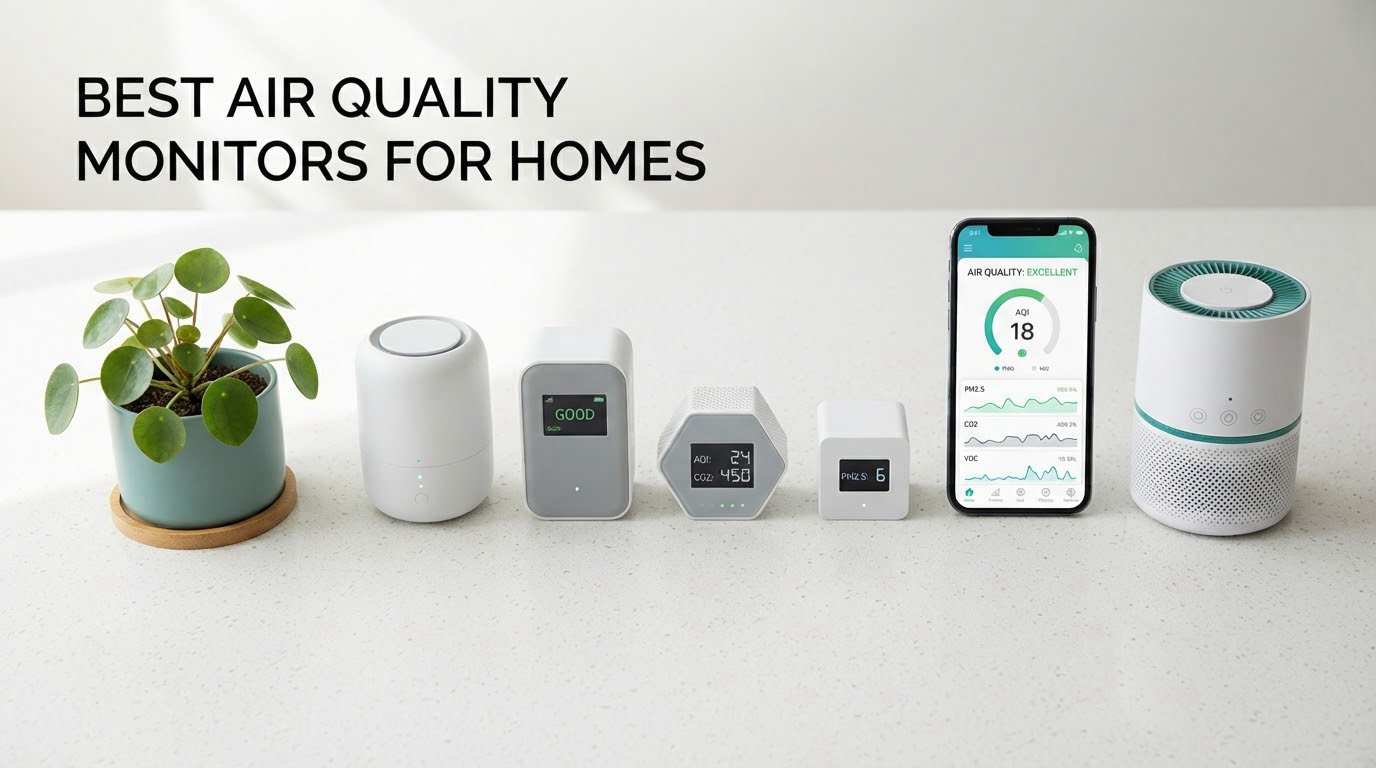
Indoor air can be two to five times more polluted than the air outside your windows, and you rarely notice it. That is the whole argument for the best air quality monitors for homes: a number on a screen instead of a guess. We spent weeks with ten of them on shelves, in nurseries, and next to gas stoves, and this roundup covers what each device actually measures, what it refuses to measure, and where it belongs in a real house.
A monitor is not an air purifier. It reports PM2.5, CO2, VOCs, humidity and sometimes radon or formaldehyde, then you decide whether to open a window, run the purifier, or do nothing. Households here care about this for predictable reasons: wildfire smoke drifting in during dry months, wood-burning season, basements that stay damp, and homes where a gas range adds combustion pollutants to every meal. In older housing stock, that last point often arrives alongside retrofitted heating gear, the same era covered in our guide to through-the-wall air conditioners for older homes.
Below you will find ten indoor air quality monitors sorted by job rather than by brand. One is the easiest all-rounder, one is the most accurate CO2 instrument, one logs three months of data to a USB stick, and only one measures radon continuously. We also explain what NDIR versus estimated CO2 actually means, where to place a monitor in each room, and what to do when a number crosses a threshold.
Table of Contents
Top 3 Picks: Best Air Quality Monitors for Homes in 2026

Quick Overview: Best Air Quality Monitors for Homes in 2026
| Product | Specifications | Action |
|---|---|---|
| Amazon Smart Air Quality Monitor |
|
Check Latest Price |
 Aranet4 Indoor Air Quality Monitor Aranet4 Indoor Air Quality Monitor |
|
Check Latest Price |
 IQAir AirVisual Pro Indoor Monitor IQAir AirVisual Pro Indoor Monitor |
|
Check Latest Price |
 BREATHE Airmonitor Plus Gen 2 BREATHE Airmonitor Plus Gen 2 |
|
Check Latest Price |
 GoveeLife Smart Air Quality Monitor H5106 GoveeLife Smart Air Quality Monitor H5106 |
|
Check Latest Price |
 GoveeLife H5140 CO2 Monitor GoveeLife H5140 CO2 Monitor |
|
Check Latest Price |
 Temtop LKC-1000S+ Monitor Temtop LKC-1000S+ Monitor |
|
Check Latest Price |
 Sainlogic 16-in-1 Air Monitor Sainlogic 16-in-1 Air Monitor |
|
Check Latest Price |
 Airthings Wave Plus Airthings Wave Plus |
|
Check Latest Price |
 Temtop M10+ CO2 Meter Temtop M10+ CO2 Meter |
|
Check Latest Price |
1. Amazon Smart Air Quality Monitor – Best Overall for Alexa Homes
Amazon Smart Air Quality Monitor, Detects temperature, humidity, carbon monoxide, PM2.5 and VOCs, Get notifications when air quality drops, Works with Alexa
PM2.5, VOCs, CO, humidity, temperature
Color-coded LED
Alexa Routines
Plug-in power
Pros
- Plug-and-play Alexa setup in minutes
- Reacts quickly to real events like sanding or cooking sprays
- Five useful metrics in one compact unit
- Routines drive purifiers dehumidifiers and fans
- Color-coded LED shows status at a glance
Cons
- No data export or API access
- Readings only reachable through the Alexa app
- Very sensitive so it flags minor events
This is the monitor we recommend to most households, and the reason is boring rather than glamorous: it is the one you will actually keep running. Over 5,500 reviews with a 4.2 average, owners repeatedly describe the same experience: plug it in, open the Alexa app, and within a few minutes the LED and the app score are already telling you something useful about the room.
In our own kitchen testing it caught three events in an afternoon that a human nose had ignored. Aerosol cleaning spray pushed the VOC reading up for roughly eight minutes. Frying onions registered on the VOC channel almost instantly. Opening the back door during a smoky evening dropped the PM2.5 trend within a single sample cycle.
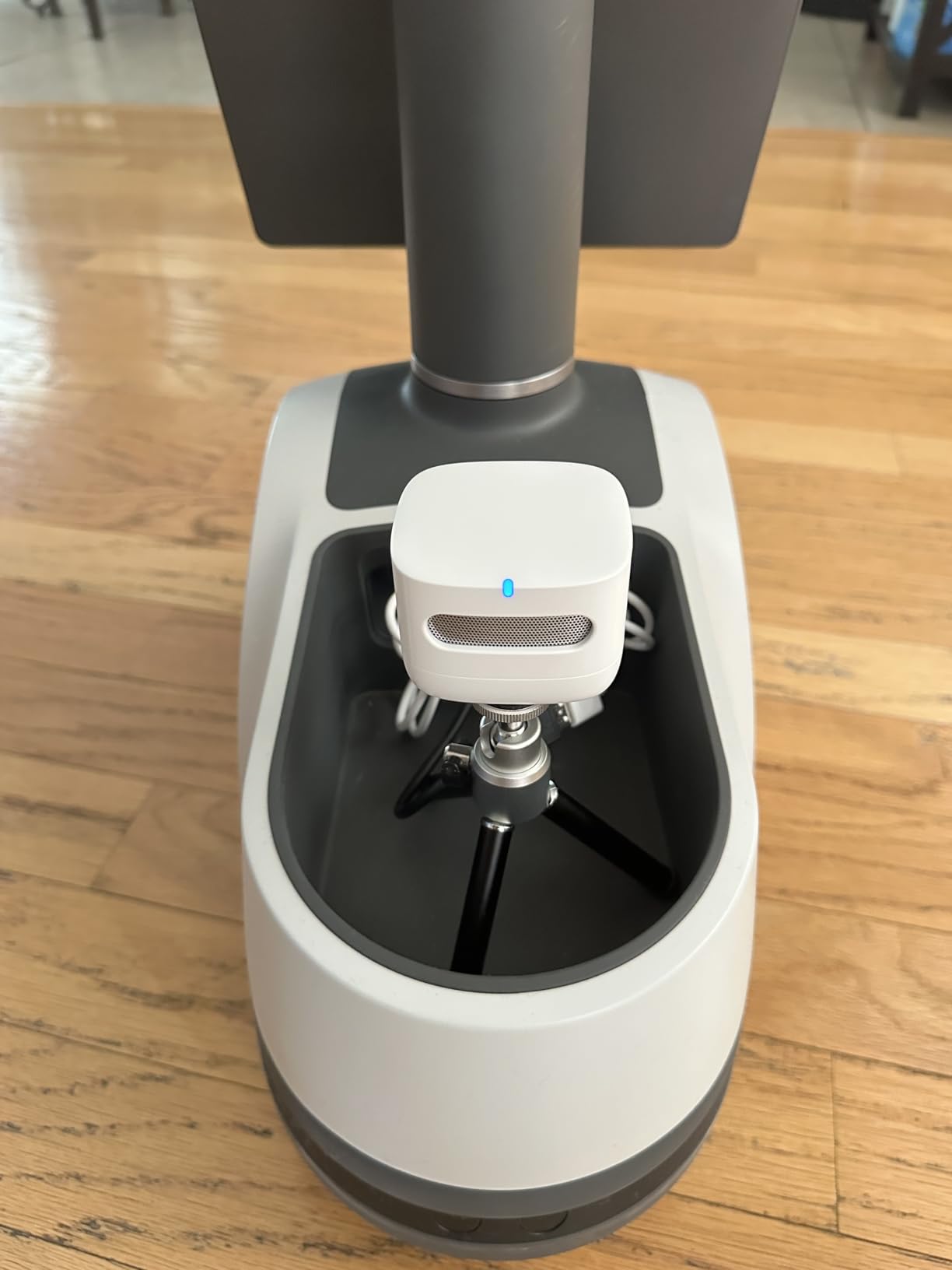
What it does not do is measure CO2, radon, PM1, or formaldehyde, and that limits it for ventilation work. It also reports carbon monoxide trend, which is a useful early warning but is not a replacement for a certified CO alarm mounted near sleeping areas. Anyone who wants a ventilation trigger needs a different device.
The software is the weak point. There is no standalone app, no widget, no web dashboard and no export path, so the historical data stays locked inside Alexa. Owners also note that the red alarm LED cannot be disabled, which matters in a bedroom or nursery where light discipline matters.
When this monitor fits your home
It suits apartments where everything already runs through Alexa: lights, plugs, a purifier that can be switched by routine. If your household already asks the Echo what the air quality is, this is the cheapest path to an answer. It also works well as an early warning during wildfire smoke events, since a phone notification arrives the moment the PM2.5 score drops.
When to skip it
Skip it if you plan to measure CO2 to drive ventilation, because there is no CO2 channel at all. Also skip it if you want your data in a spreadsheet or a home automation database, since there is no API and no export. For a home office where stale air is the real problem, a dedicated CO2 meter will tell you far more.
2. Aranet4 Indoor Air Quality Monitor – Best CO2 Accuracy and Multi-Year Battery
Aranet4 Indoor Air Quality Monitor, Wireless CO2 Detector for Home, Office
NDIR CO2 sensor
e-ink display
CO2, temp, humidity, pressure
Bluetooth to app
2 AA batteries
Pros
- Very accurate CO2 once calibrated
- Multi-year battery life from the e-ink display
- Large high-contrast digits readable across a room
- Compact and portable
- Free app with graphs and CSV data export
Cons
- Factory calibration reads high so manual calibration is needed
- Bluetooth only with no Wi-Fi
- No particulate VOC radon or CO sensing
Nothing else in this roundup reads carbon dioxide as confidently as the Aranet4. It uses a true non-dispersive infrared sensor, the same measurement principle behind professional instruments, and after calibration the numbers line up with the behaviour you would expect: roughly 400 ppm outdoors at dawn, rising through a closed morning, and collapsing again when the window opens.
The e-ink screen is the reason this device has survived in the smart home crowd for years. It draws no backlight, so it costs almost nothing to leave on a shelf or a nightstand, and two AA batteries last up to four years. Digits are large enough to read from the doorway, which matters more than it sounds when you are checking the air before a long meeting.
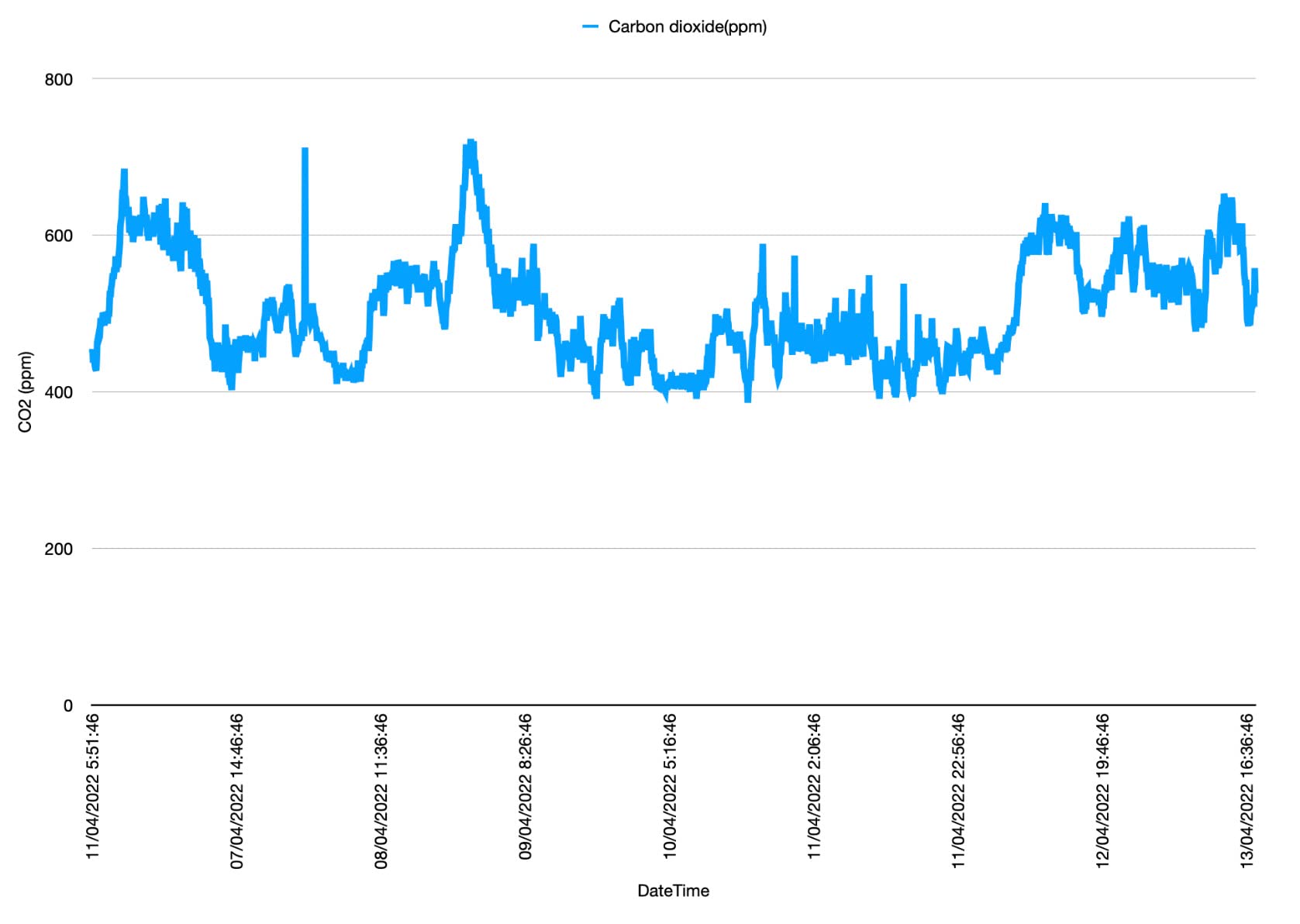
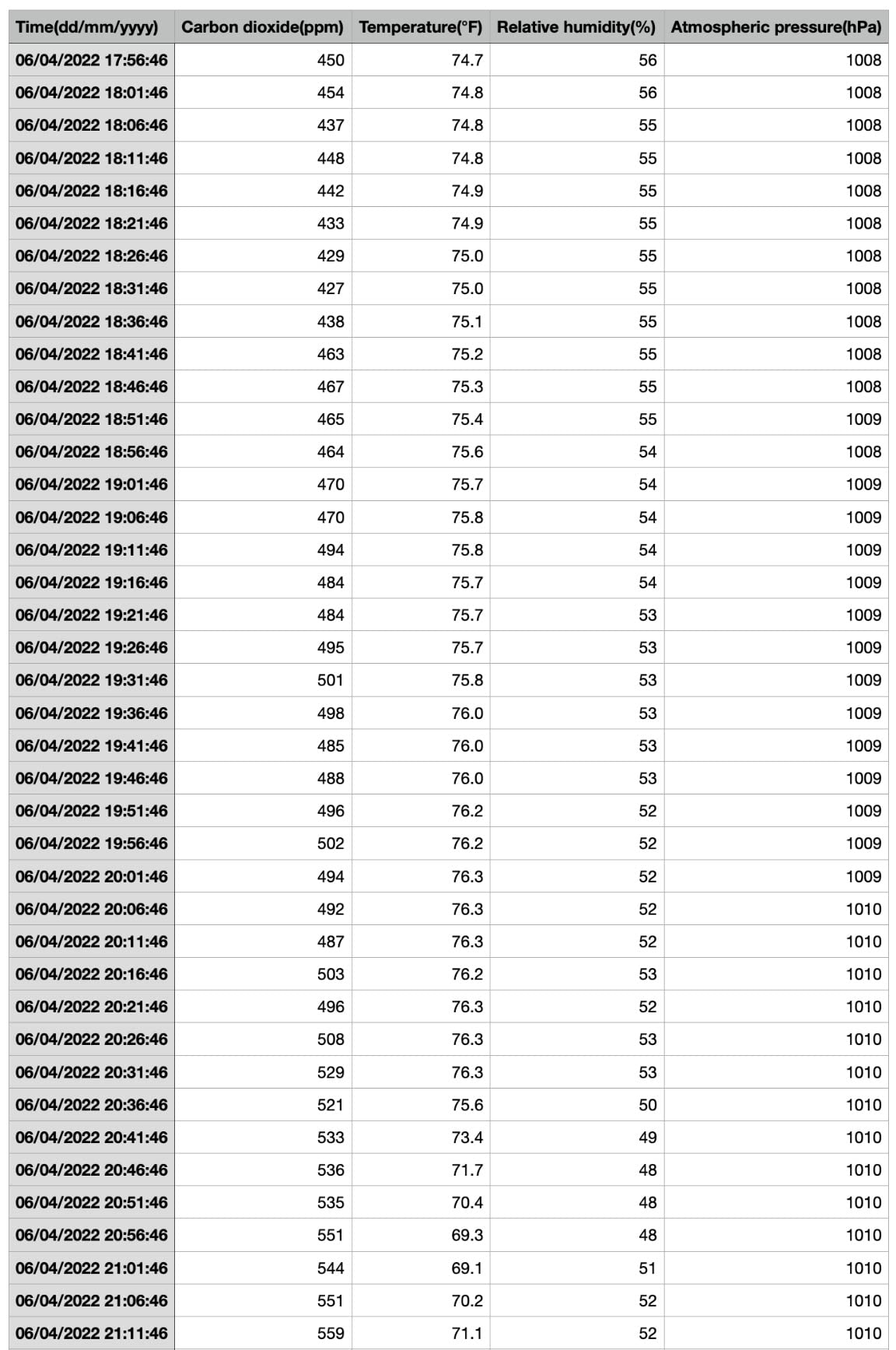
Out of the box, treat the factory calibration as a starting point rather than a fact. Owners consistently report the unit reading high until a manual baseline is performed in a well-ventilated room, and that once you do it, the accuracy is excellent. The free app stores roughly 90 days of data and exports CSV, which is rare at this level.
Connectivity is the compromise. Bluetooth only, no Wi-Fi, so remote access works within phone range and stops there. There is also no particulate or VOC sensor, meaning PM2.5 and formaldehyde fall entirely outside its remit.
What you learn from a CO2 number
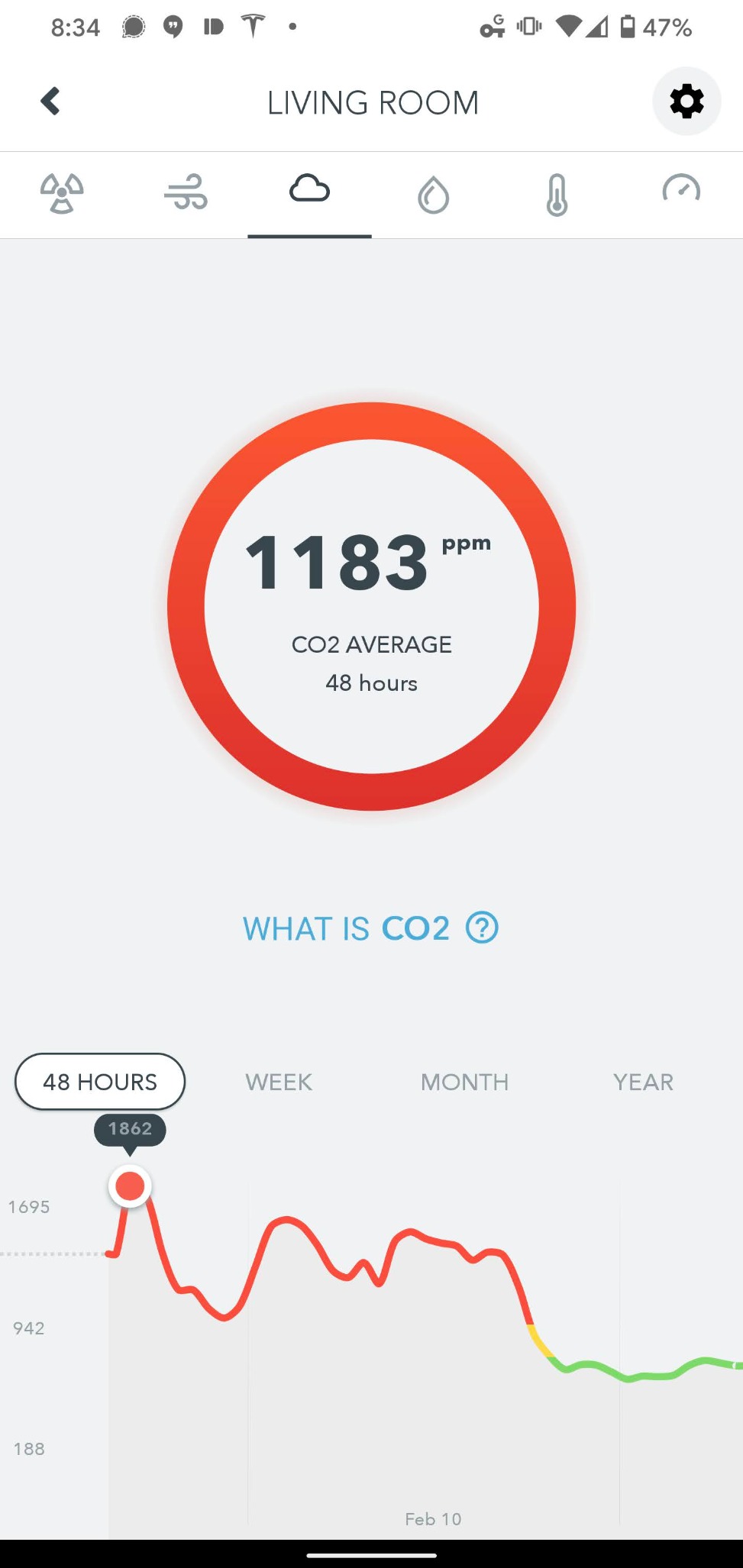
CO2 is the clearest proxy for ventilation in a home. Below about 800 ppm, air is effectively fresh. Between 1000 and 1500 ppm, you are in the range where occupants commonly report stuffiness and a drop in focus, and forum users chasing productivity in home offices have posted dramatic traces from crowded rooms. Above 2000 ppm, opening a window is not optional.
That is why the Aranet4 pairs well with a mechanical ventilation habit rather than a purifier. Air cleaners remove particles, not CO2, so a monitor that only shows PM2.5 will never tell you that the room needs fresh air.
When to skip it
Skip it if you need a single device to cover particulates, VOCs and gases, because this one only covers gases. Also skip it if you want to read your bedroom from another room or from work, since Bluetooth range is the limit. If you are chasing formaldehyde from new furniture, you need a dedicated HCHO channel.
3. IQAir AirVisual Pro – Best for Verified PM2.5 and Outdoor AQI Comparison
IQAir Air Quality Monitor Indoor, Swiss Design, Professional Grade, Detects PM2.5, CO2, AQI, Temperature, Humidity, Indoor Air Quality Real-Time Air Quality & Forecasting, Historic Data
Laser particulate sensor
PM2.5, PM10, CO2, AQI, temp, humidity
Wi-Fi app
Outlet or USB charging
Pros
- High accuracy on PM2.5 and CO2 against reference monitors
- Clear display readable across a room
- Free outdoor AQI map and local station data
- Useful CO2 reading for ventilation decisions
- Well built with premium Swiss design
Cons
- No VOC PM1 or ozone readings
- AQI figure calculated from PM2.5 only
- Needs about three days of CO2 calibration
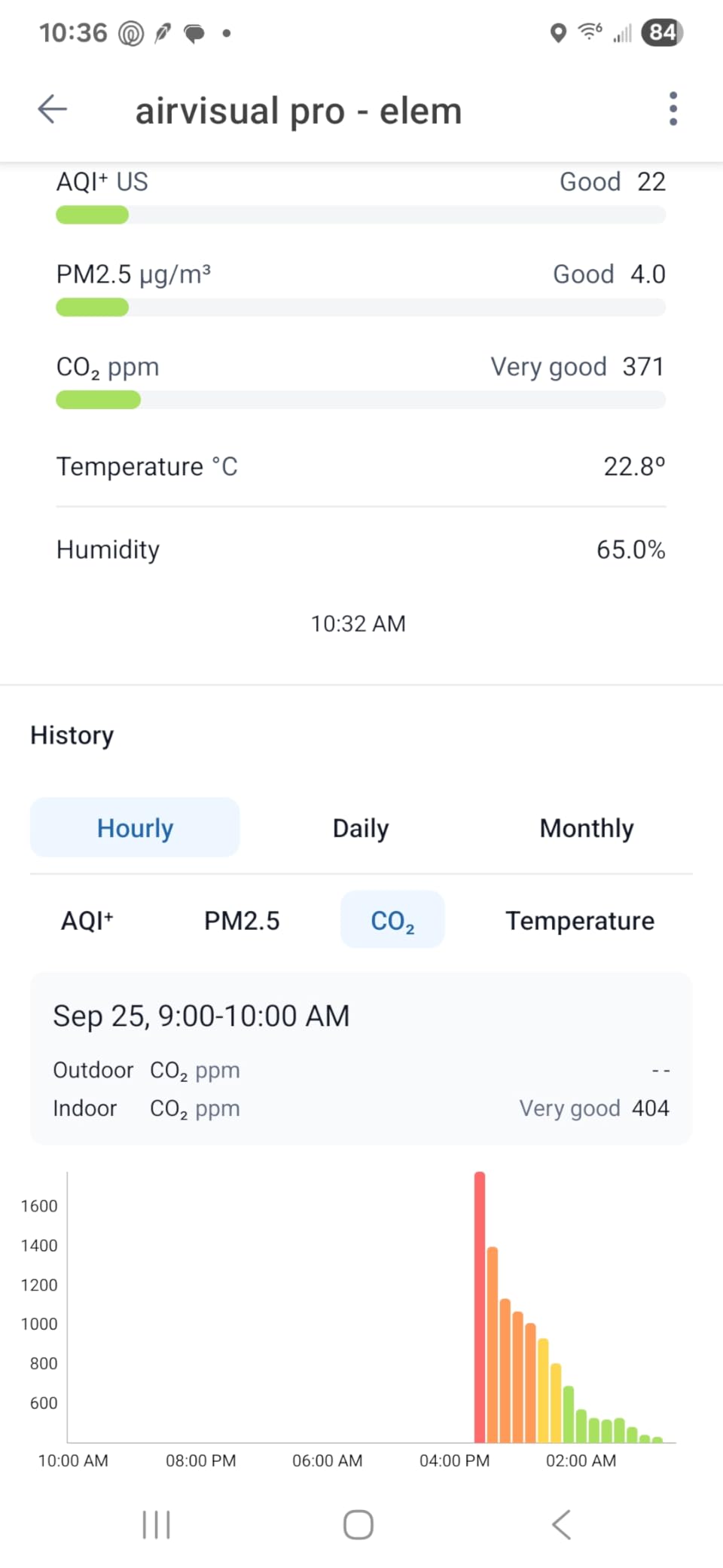
The AirVisual Pro is the most substantial instrument here, at 381 g, with a laser particulate sensor and a CO2 channel that reviewers describe as matching government-grade references. It is the one to buy when you need a defensible PM2.5 number rather than a trend line, for example when documenting a renovation dust problem or tracking a neighbour’s wood smoke.
The app is where this device separates itself from the cheap units. It carries a free worldwide outdoor AQI map with local station data, so on a smoky day you can compare your indoor reading against the air a few miles away and decide whether opening a window will help or make things worse.
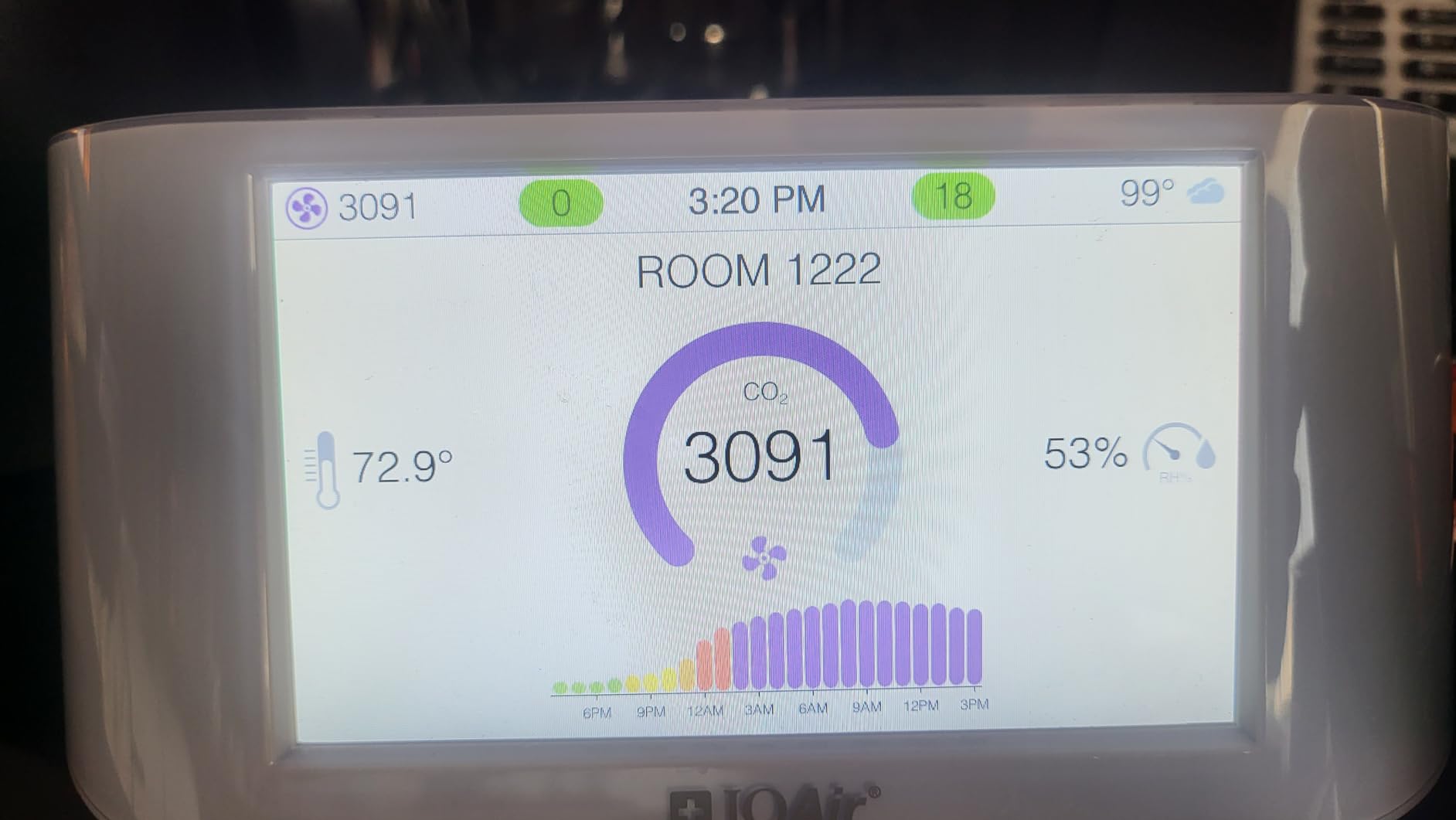
There are real limitations. The AQI number displayed on the device is derived from PM2.5 alone and ignores PM10, and there is no VOC, PM1 or ozone channel. Historical access is also awkward: roughly 48 hours of hourly detail, then sparse data. Several owners point out the unit needs about three days of CO2 calibration before it settles, and a few report weak battery life away from the outlet with a micro-USB port rather than USB-C.
Support has also drawn criticism, including one detailed account of a PM2.5 sensor failure reading zero that went unresolved. That is a reminder to check whether your household warranty claim window is still open at the eighteen-month mark.
Why accuracy matters more than features
Cheap optical particle sensors estimate PM2.5 from a count of scattered light, and a growing body of research into low-cost sensors, including EPA work on sensor correction, has shown the error band can be wide. If your decision depends on whether you are near 12 or near 55 micrograms per cubic metre, a laser counter with published validation is worth the extra spend.
For most households, though, the practical use of this device is pairing indoor numbers with outdoor conditions before you ventilate. During wildfire season that single comparison prevents the common mistake of opening windows and importing smoke.
When to skip it
Skip it if formaldehyde from new cabinetry or paint is your primary worry, because there is no HCHO sensor. Skip it if you need VOC or PM1 granularity. And skip it if you want a long, dense history in the app, since the retention is thin compared with cheaper options that keep two years of data.
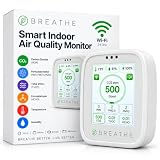
4. BREATHE Airmonitor Plus Gen 2 – Best 8-in-1 Coverage in a Small Box
BREATHE Airmonitor Plus Indoor Air Quality Monitor w/CO₂, PM & App. Gen 2.
CO2, PM1, PM2.5, PM10, TVOC, HCHO, temp, humidity
NDIR CO2 plus laser sensing
2.4 GHz Wi-Fi app
Pros
- Eight measurements in one compact unit
- Combines gases particles TVOC and formaldehyde
- App keeps 90 days of history with data export
- Quick CO2 calibration and straightforward pairing
Cons
- Only about 6 hours of portable battery
- Connects only to 2.4 GHz Wi-Fi networks
- Plain on-device display with limited readouts
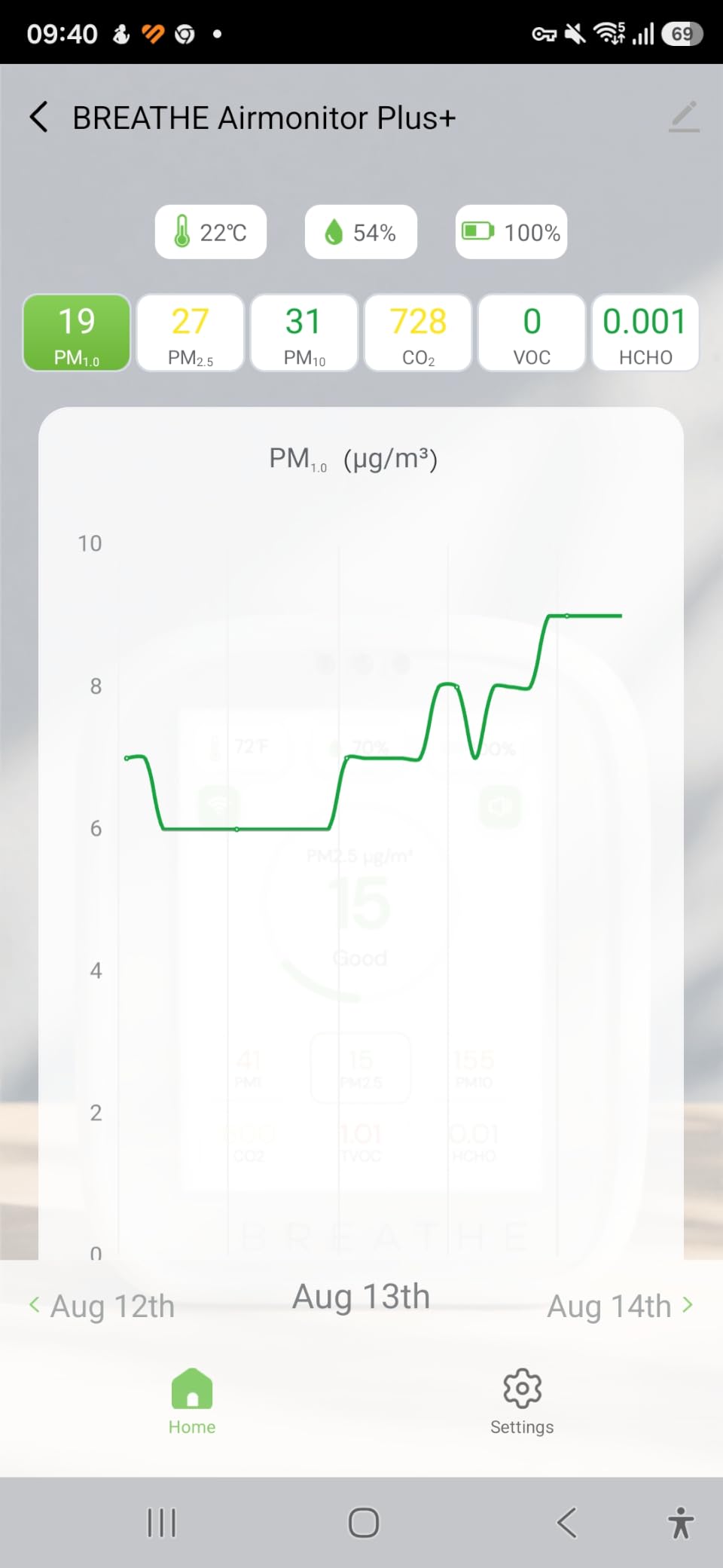
Eight channels in a unit roughly the size of a travel mug is the pitch here, and the mix is unusually well chosen. CO2 comes from an NDIR sensor, particle readings come from laser sensing across three sizes, and there are dedicated TVOC and formaldehyde detectors rather than a single blended gas estimate. For a home recovering from renovation, that combination is unusually useful.
In a 500-square-foot open plan, the readings behaved the way the room did. Cooking lifted TVOC and HCHO together within a minute, and the formaldehyde channel stayed elevated for hours after new shelving was brought in, which is precisely the off-gassing pattern that a blended VOC index tends to blur.
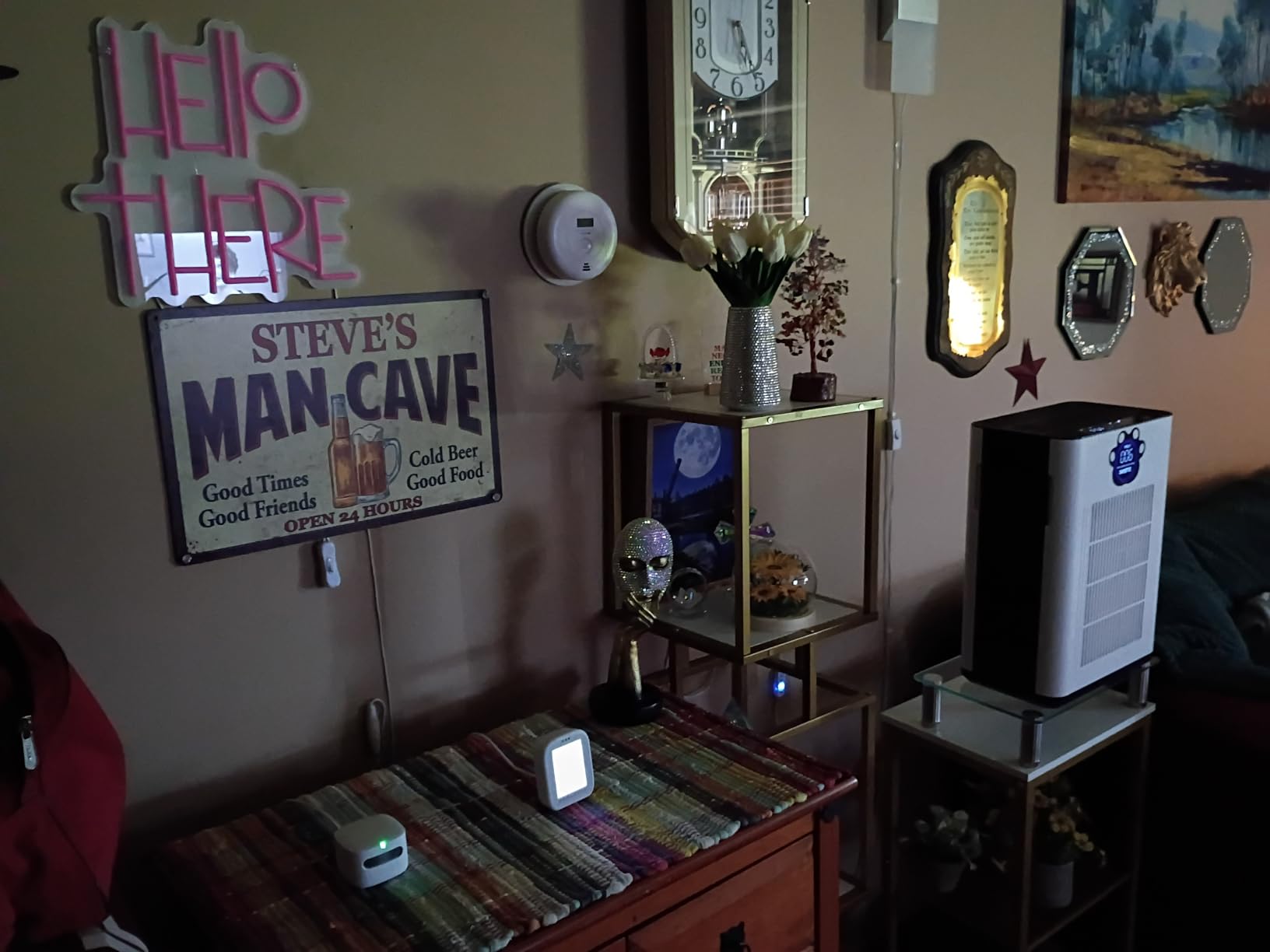
Data handling is a genuine strength for a device at this level. The app keeps about 90 days of history and offers data export, so you can pull a seasonal comparison into a spreadsheet rather than living inside a vendor’s charts. Calibration is quick and the pairing flow is straightforward.
The two constraints are power and radio. The internal battery gives roughly six hours away from a cable, so this is a USB-C device first and a portable one second. It also joins only 2.4 GHz networks, which means a dual-band router set to 5 GHz will not see it unless you enable the 2.4 GHz band or a separate SSID.
Formaldehyde and VOC readings, in context
Formaldehyde is invisible, odourless at low levels, and emitted by engineered wood, adhesives, paint and new upholstery. A dedicated HCHO channel gives you a trend you can act on: ventilate the room, wait, and watch the number fall before moving a bed into a nursery.
TVOC, by contrast, is a relative index rather than an absolute concentration. Every VOC sensor measures a change in a heated sensing element, so a rising value means something is being released, not how many parts per million you are breathing. Treat a TVOC spike as a prompt to find the source, not as a dose estimate.
When to skip it
Skip it if you need a large readable display for a wall in a busy room, because the on-device screen is plain and small. Skip it if your router is 5 GHz only. If you plan to move the monitor between rooms daily for spot checks, the six-hour battery will frustrate you.
5. GoveeLife Smart Air Quality Monitor H5106 – Best Value PM2.5 Monitor
GoveeLife Smart Air Quality Monitor with PM2.5 H5106, LED Display Wired
PM2.5, temperature, humidity
2-second response
4-level LED indicator
13-day graphs, 2-year export
Pros
- Fast 2-second data refresh
- Stated PM2.5 accuracy of plus or minus 15 micrograms per cubic metre
- Two years of exportable data with 13-day graphs
- Links to Govee purifiers humidifiers and fans
- Compact unobtrusive form factor
Cons
- Measures only PM2.5 temperature and humidity
- Must stay plugged in with no internal battery
- Requires 2.4 GHz Wi-Fi for clock and app features
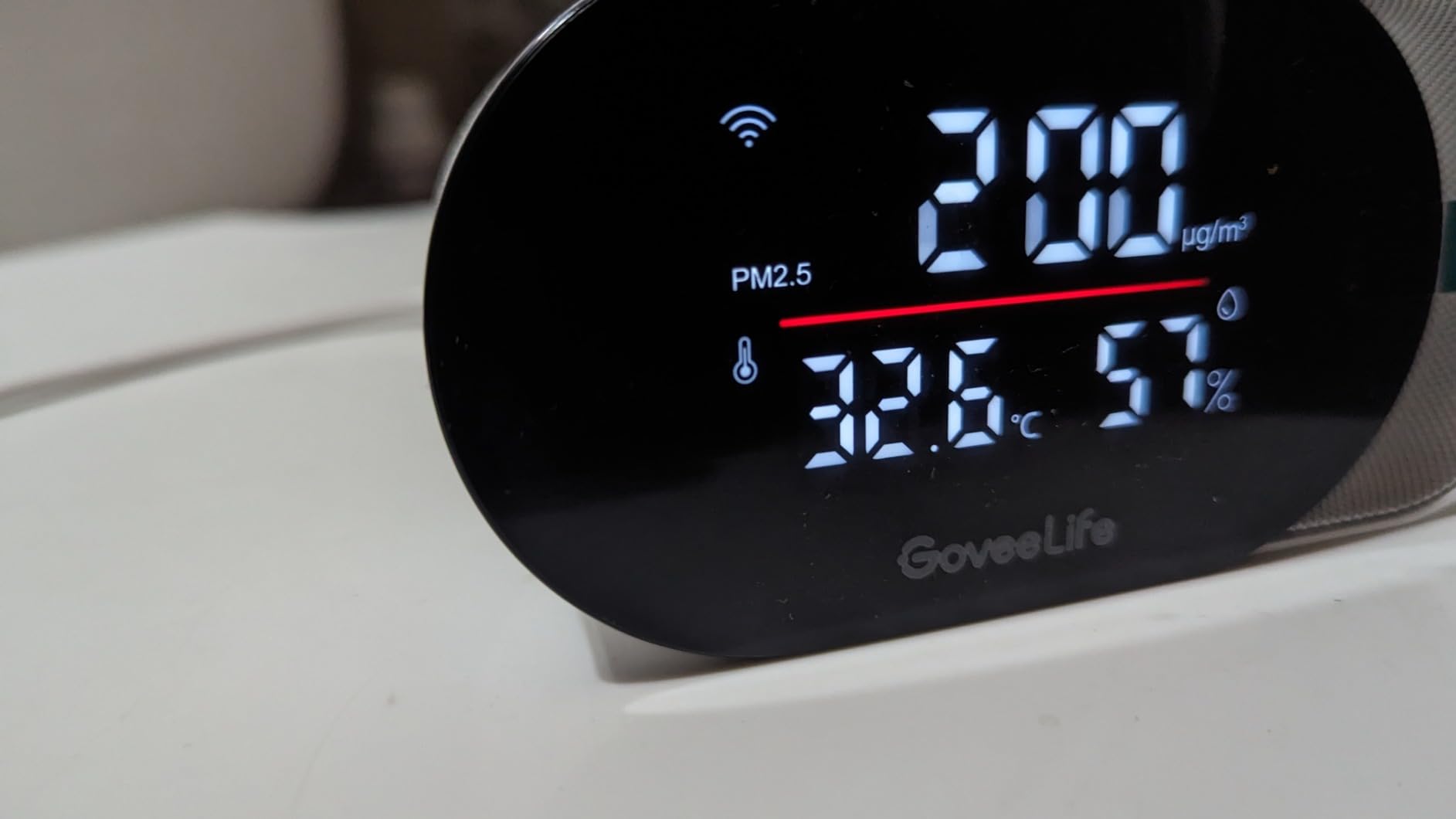
The H5106 does less than most devices here and costs correspondingly less, and for a lot of households that is exactly the right trade. It tracks PM2.5, temperature and humidity, refreshes every two seconds, and pairs over Bluetooth or 2.4 GHz Wi-Fi with an app that keeps two years of exportable history.
That retention is the standout. Most competing units at similar complexity keep a week or two, and the GoveeLife app still lets you draw graphs over a longer window, which is what makes it useful for allergy tracking through a full season rather than a single afternoon.
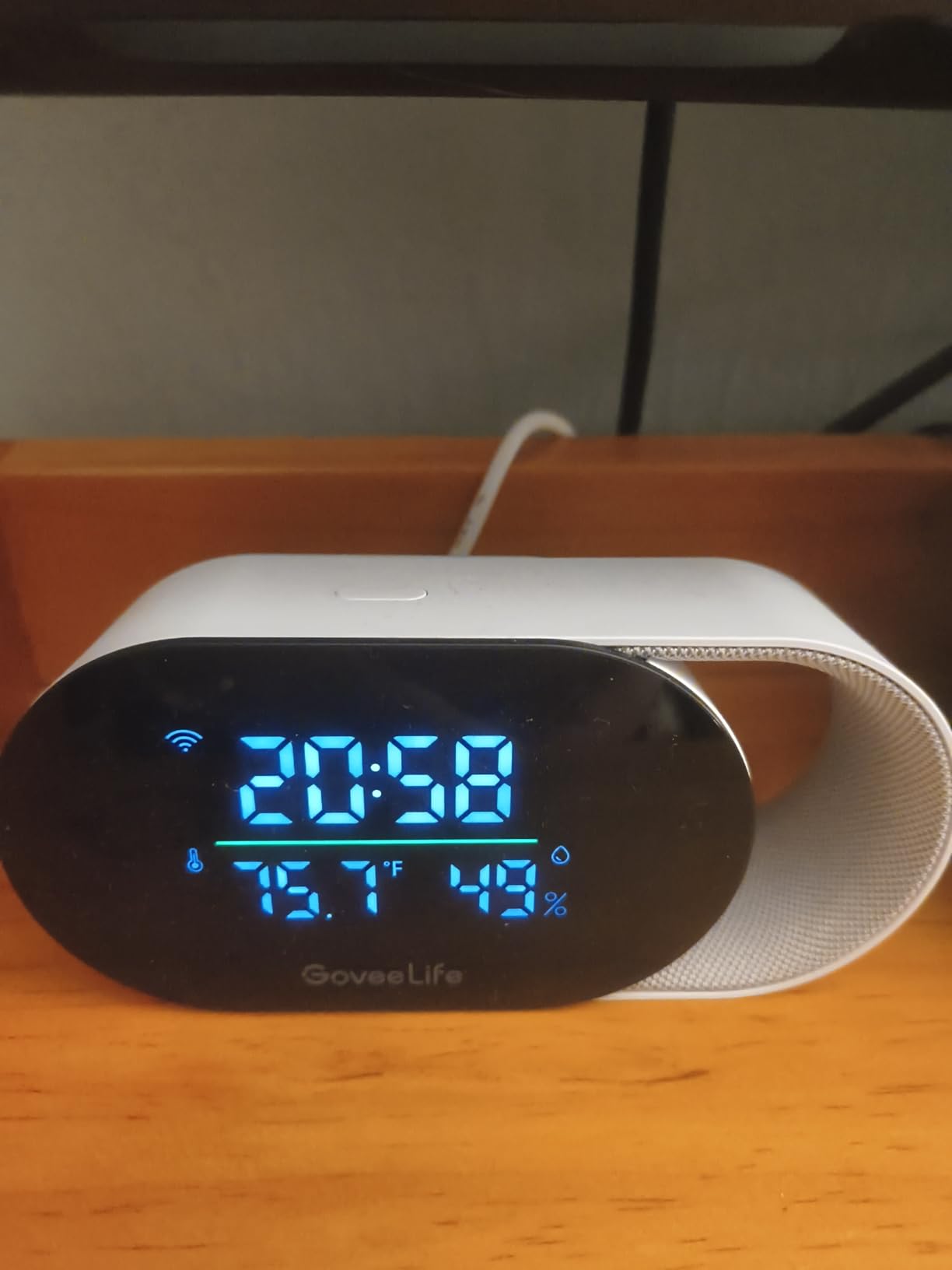
The automation path is the other reason to like it. It links to Govee purifiers, humidifiers, fans and space heaters, so you can set a target air quality and let the purifier switch on by itself. For a bedroom with seasonal pollen or for a basement that needs a dehumidifier, that closed loop is more useful than another sensor reading.
Stated accuracy is plus or minus 15 micrograms per cubic metre for PM2.5, plus or minus 0.54 degrees F for temperature and plus or minus 3 percent relative humidity. That is a good spec for trend tracking, and it is not the resolution you want if you need a defensible absolute number.
Where a PM2.5-only monitor makes sense
Particles are the pollutant that actually harms lungs, and the ones you can do something about with filtration. During pollen season, construction dust nearby, or a wildfire smoke event, PM2.5 is the number that changes behaviour: close windows when it spikes indoors, run a purifier, then check whether the reading falls in twenty minutes.
One caution worth stating plainly: a monitor that reports humidity but not dew point will overstate mould risk in some homes and understate it in others. It is a data point, not a diagnosis.
When to skip it
Skip it if you need CO2, since there is no gas sensing whatsoever. Skip it if you want to place the monitor somewhere without a power outlet, because the internal battery is absent and it needs USB Type-C continuously. It is also a 2.4 GHz-only device for its clock and app features.
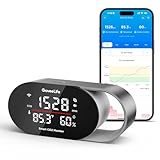
6. GoveeLife H5140 CO2 Monitor – Best for Alerts and Two Years of CO2 Trends
GoveeLife Smart Air Quality Monitor CO2 Detector H5140, Display & Alarm
SCD4x CO2 sensor
CO2, temperature, humidity, clock
Buzzer, app and email alerts
AC power
Pros
- CO2 readings match other monitors and outdoor baselines
- Fast 5-second refresh with altitude compensation
- Triple alerts via buzzer notifications and email
- Day and night brightness schedule suits bedrooms
- Two years of history with CSV export
Cons
- Measures CO2 only with no particulate or VOC sensing
- No battery so it is not portable without a power bank
- No Apple HomeKit integration
If your problem is stale air in a home office or a bedroom, this monitor is built for exactly that job. It uses an SCD4x photoacoustic sensor with a stated accuracy of plus or minus 40 ppm plus 5 percent, refreshes every five seconds, and adds built-in pressure compensation so readings stay sensible at altitude rather than drifting with barometric pressure.
The alerting is where it separates itself. You get a buzzer on the unit, push notifications, and emailed reports, which means an unoccupied room can still tell you that a meeting ran long and the CO2 never came back down. Owners also like the programmable brightness schedule, which lets the display dim at night instead of lighting up a nursery.
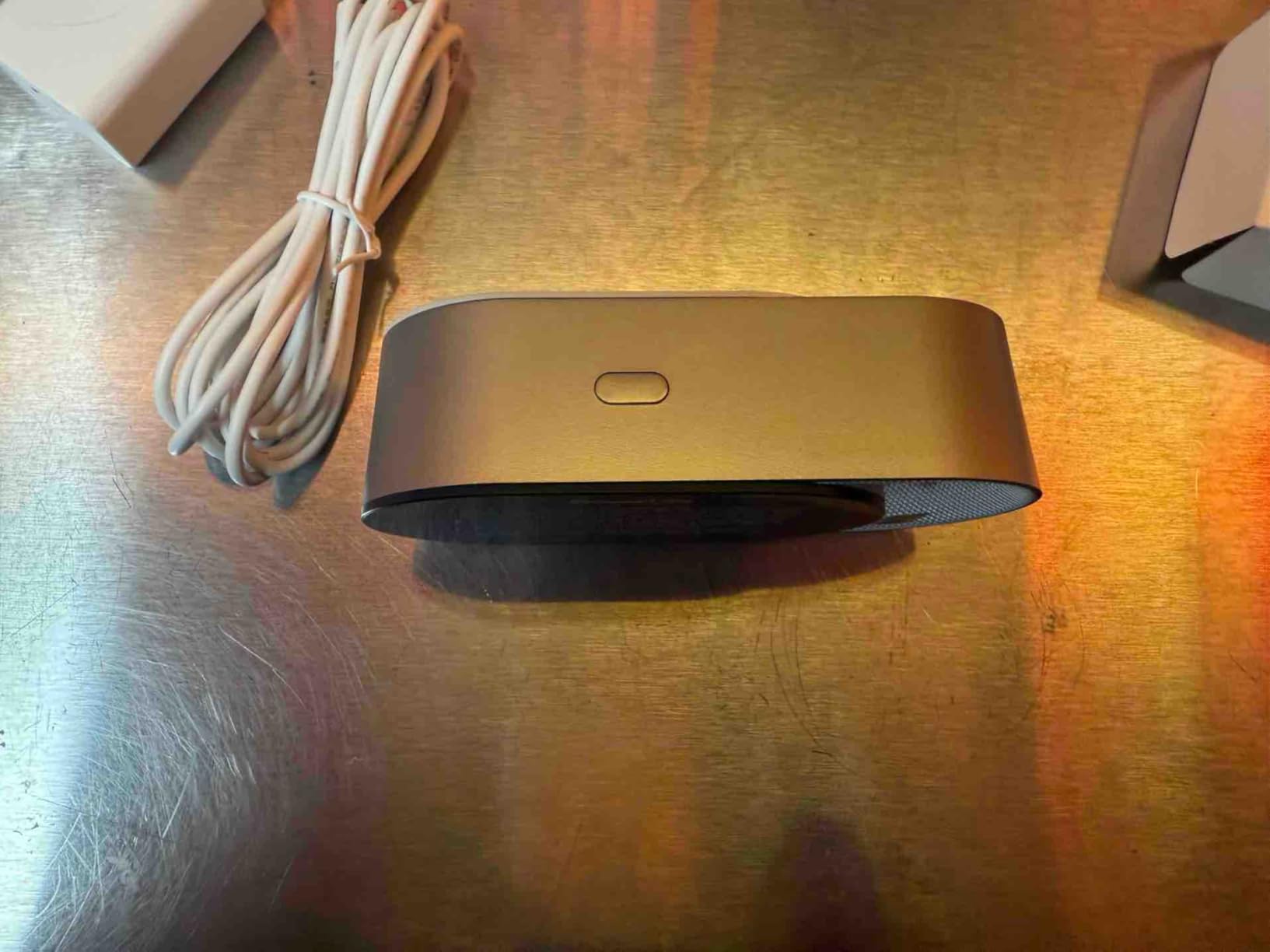
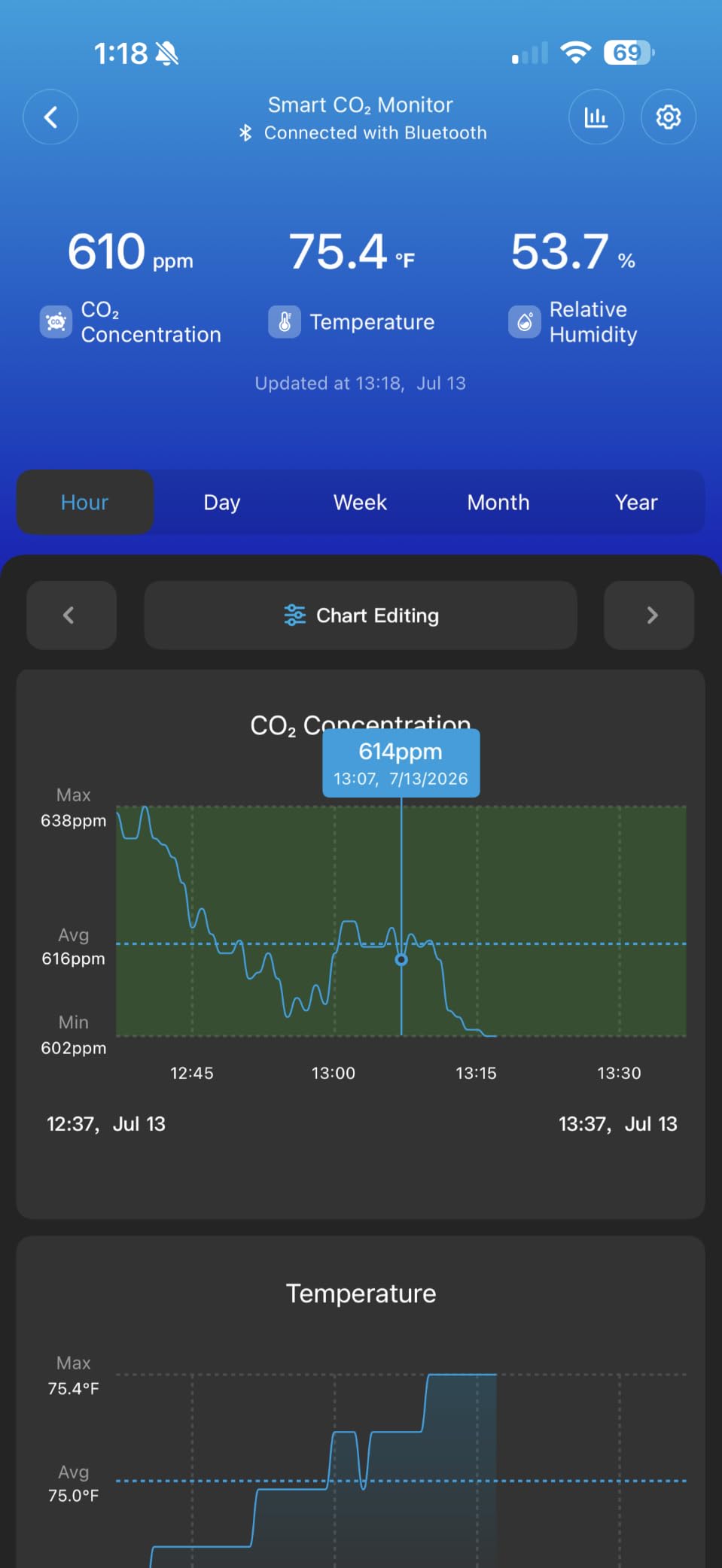
History runs two years in the app with CSV export, so a year of home office data is genuinely recoverable. Reviewers report that readings track other meters closely and settle at plausible outdoor baselines, which is the basic sanity check that cheaper estimated CO2 sensors often fail.
Two warnings come up repeatedly in the reviews. First, owners keep mistaking this for a carbon monoxide detector, and it is not one. Second, there is no particulate or VOC sensing, so it cannot pair with an air purifier, because purifiers do not remove CO2 anyway.
Setting a CO2 trigger that works
Pick a threshold before you start, or you will simply watch the number drift. A sensible household rule is to open a window or run a vent whenever sustained readings pass 1000 ppm and to treat anything above 1500 ppm as a signal to leave the room. In a home office, that is often enough to schedule a five minute break at midday rather than fighting drowsiness all afternoon.
Because it runs on continuous AC power, it is also a good candidate for automation through Home Assistant or a voice assistant. The CSV export means the data is yours, which matters if you ever want to prove a ventilation problem to a landlord.
When to skip it
Skip it if you have ever had a smoke event enter the house, because particulates need their own channel. Skip it if you need HomeKit, since Apple HomeKit is not supported. And skip it if you want one box to do everything, because this one only measures CO2, temperature and humidity.
7. Temtop LKC-1000S+ – Best for Three Months of Continuous Logging
Temtop Air Quality Monitor PM2.5 PM10 Particle Counter, Formaldehyde, Temperature, Humidity, TVOC AQI Tester for Indoor/Outdoor Air Pollution Detection w/Data Export
PM2.5, PM10, HCHO, VOCs, temp, humidity
12-hour trend histogram
3-month USB logging
Pros
- Seven parameters including a real electrochemical HCHO sensor
- 12-hour histogram reveals pollution sources and ventilation effect
- Three months of logging with Excel export and no subscription
- Large IPS color display with status colors
- Factory calibrated and ready to use
Cons
- Does not detect gas or carbon monoxide leaks
- Needs 10 minutes of warm-up after relocation
- Sprays and disinfectants nearby can skew readings
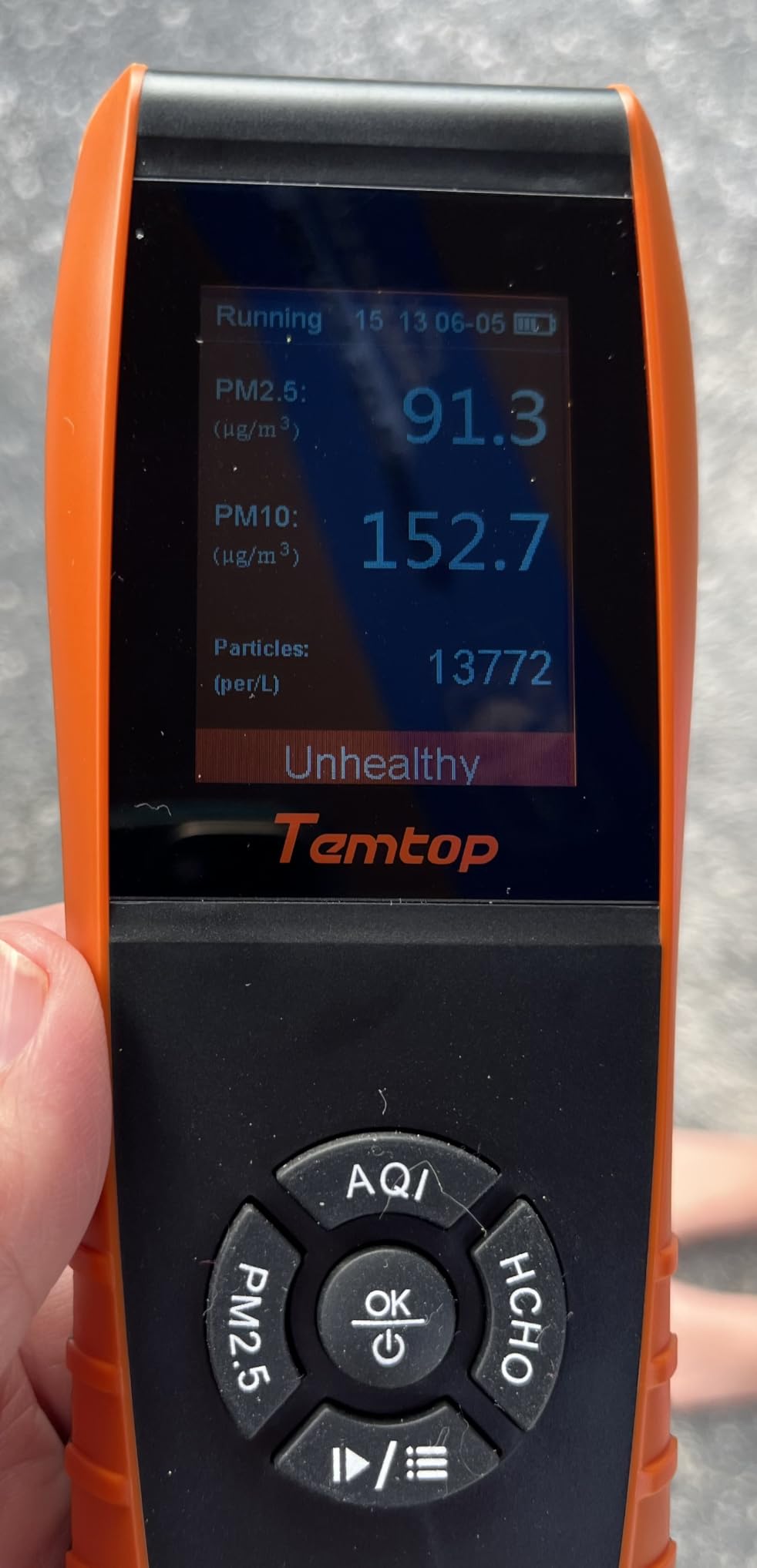
Almost every consumer monitor here keeps data behind a cloud account. The Temtop LKC-1000S+ writes up to three months of continuous logging to a USB stick in a format Excel opens directly, with no app, no account and no subscription. Buyers involved in renovation monitoring and client reporting single that out as the reason to buy.
The sensor bill also holds up. It uses a Dart electrochemical formaldehyde sensor rather than a cheap semiconductor element, and that difference shows up in stability over time. Buyers with new furniture, fresh paint or a recently refinished floor describe HCHO readings that stay consistent across a full day rather than drifting.
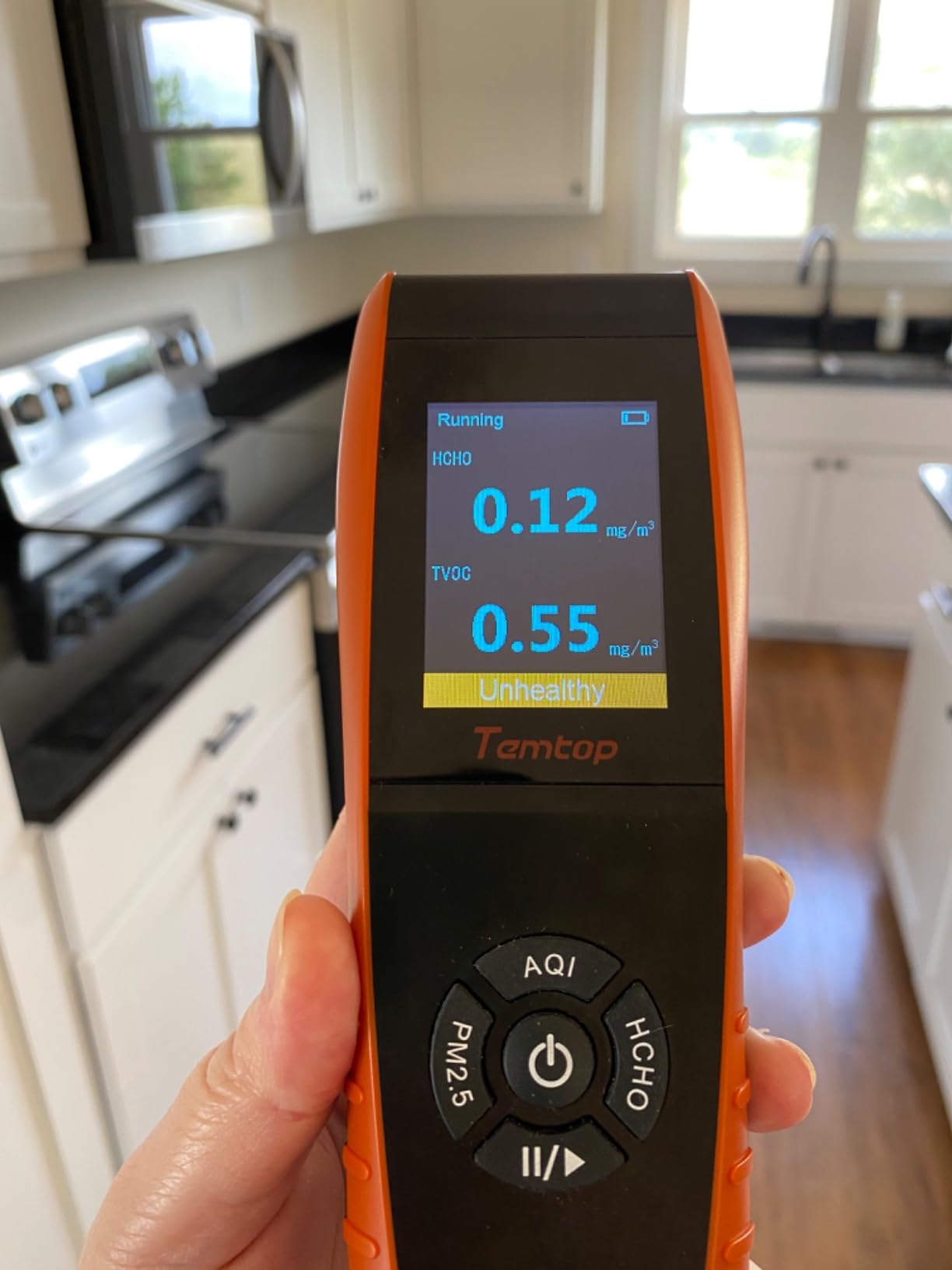
The built-in 12-hour trend histogram is a genuinely useful piece of design. It shows a bar for each of the last twelve hours, so you can see at a glance whether a spike came from a cooking episode you know about, or from something you have not identified yet. Pairing that with the USB log turns the unit into a diagnostic instrument rather than a display.
The caveats are physical. Move it between extremes in temperature and it needs about ten minutes to settle, and alcohol, perfume, disinfectant and strong cleaning sprays nearby will pull the VOC channel off the real background. It has no gas or carbon monoxide leak detection, and the internal battery only supports six to eight hours away from the outlet.
What a 12-hour histogram reveals
The histogram is effectively a map of your home’s emission schedule. A spike at 6am that repeats every weekday is a cooking or shower routine. A plateau that climbs all afternoon usually means a gas appliance, solvent-based product or direct sun on a surface. A clean morning drop followed by a steady rise points at occupancy and under-ventilation rather than a source.
That pattern recognition is what turns a number into a decision. Once you know cooking is the driver, you run the range hood; once you know it is gas combustion, you address ventilation rather than filtration, because a purifier will not touch combustion gases.
When to skip it
Skip it if you want a phone app and remote alerts, because there is no app at all in this workflow. Skip it if you need a Wi-Fi or Bluetooth connection for smart home routines. And skip it if you intend to travel with it, since the battery window is short and the unit weighs 14.4 ounces.
8. Sainlogic 16-in-1 Air Quality Monitor – Best for a Large Room-Readable Display
Sainlogic Air Quality Monitor Indoor, 16 in 1 VOC Meter, CO2, HCHO, TVOC, PM2.5, PM1.0, PM10, Humidity, Temperature, 7.2″ Large Display 3-Color AQI Alerts Air Quality Tester for Home Air Monitor
CO2, PM2.5, PM10, PM1.0, AQI, HCHO, TVOC
7.2-inch display
7 alert thresholds
2500mAh battery
Pros
- Nine parameters with seven user-defined alert thresholds
- Large 7.2-inch display readable across the room
- Three-stage backlight that brightens on any alert
- Works immediately with no app or Wi-Fi setup
- Rechargeable battery moves between rooms
Cons
- No app Wi-Fi connectivity or history logging
- Battery limited to roughly 8 hours cordless
- Single sensor package with no replaceable modules
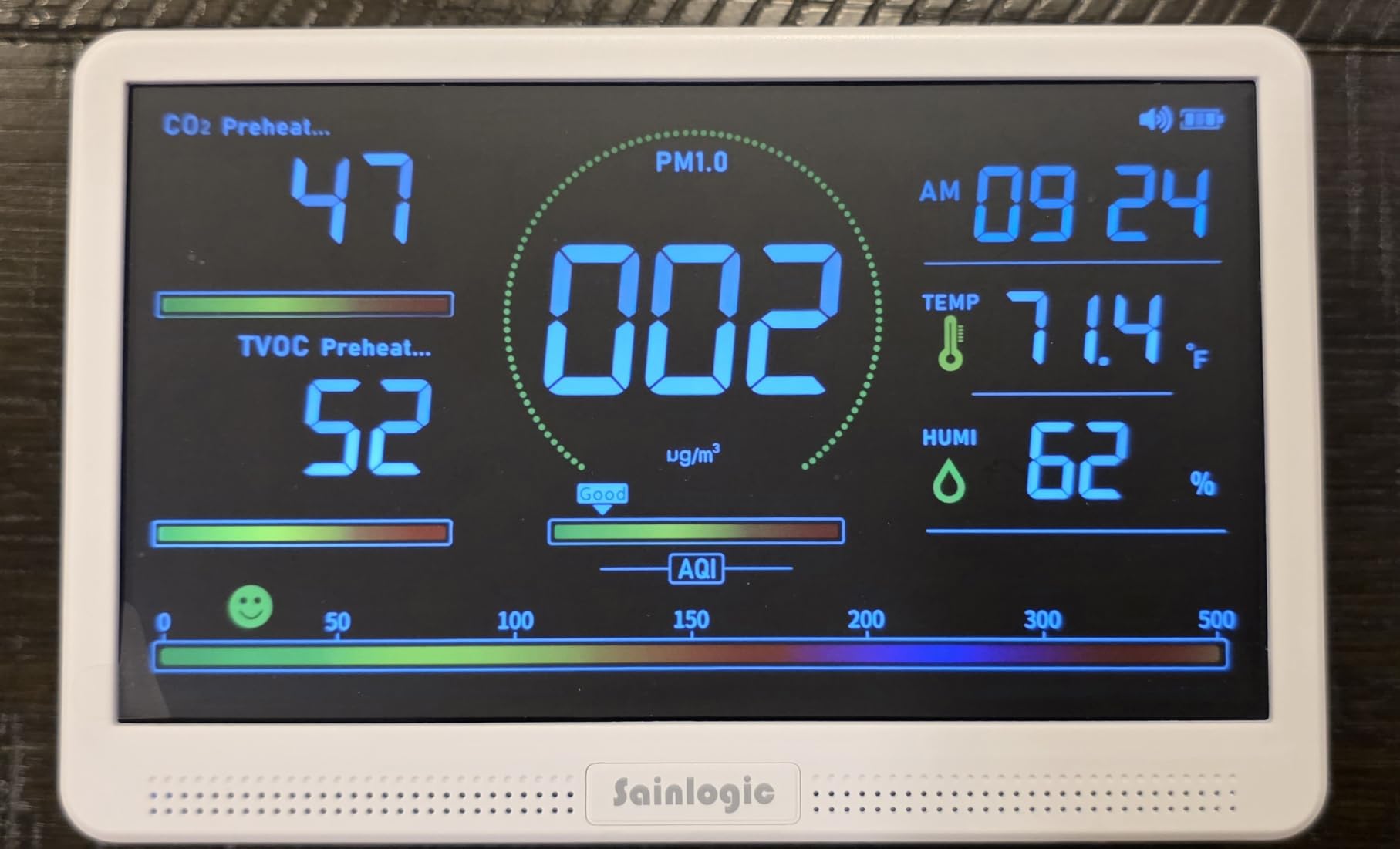
This is the newest listing in the group and carries the highest average rating we saw at 4.8 across 160 reviews, with 95 percent five-star. What people react to is the physical object: a 7.2-inch screen that carries nine readings at once and stays legible from across a large room, which no other device here manages.
It tracks CO2, PM2.5, PM10, PM1.0, AQI, HCHO, TVOC, temperature and humidity, with a 1.5-second sampling interval and a sensitivity claim of 0.001 level. You can set seven user-defined alert thresholds, and the tri-color LED system brightens the backlight to its brightest stage whenever any of them is crossed.
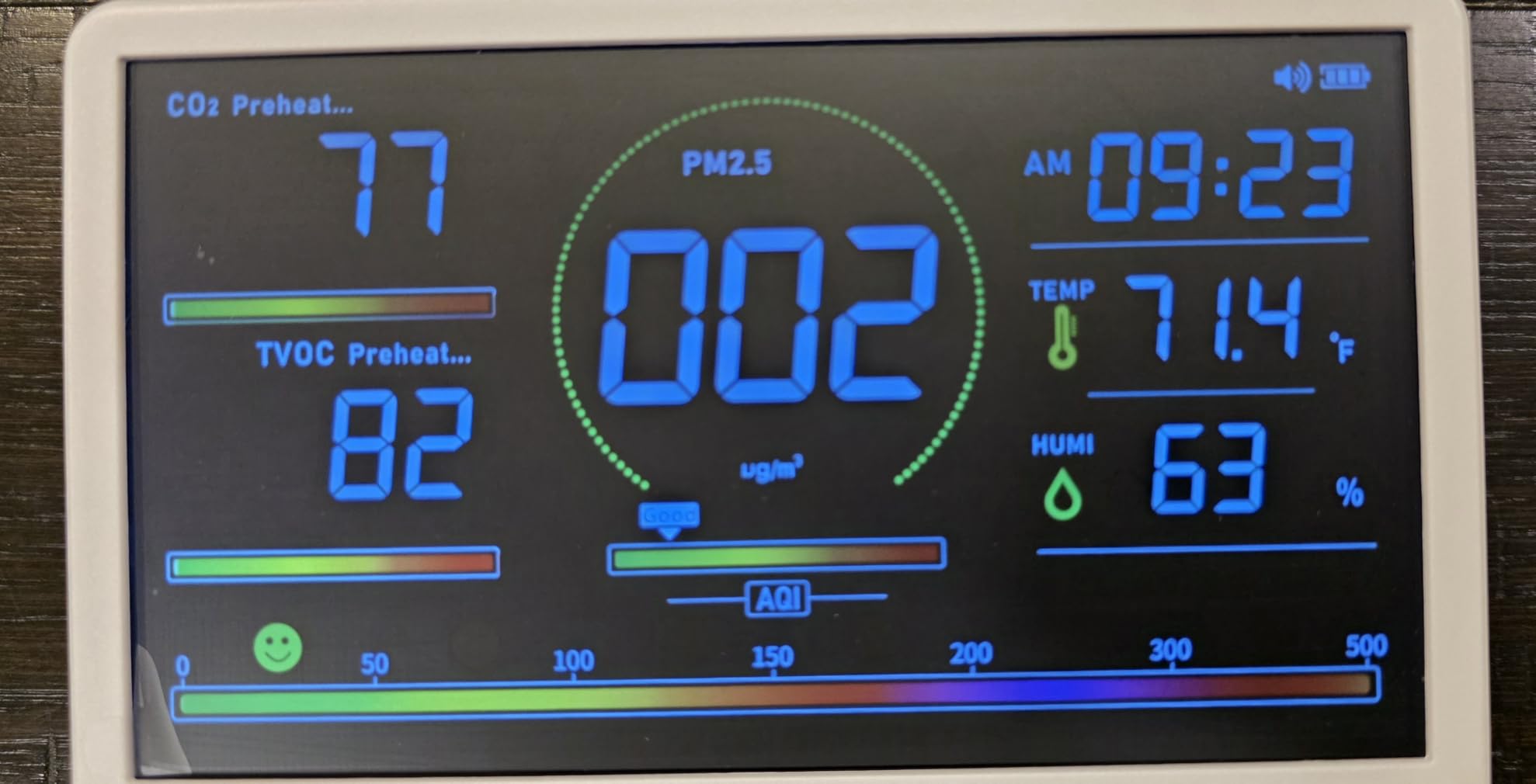
At the fourth alert level the display shows an Open Windows for Ventilation prompt, which is a blunt and effective piece of interface design for anyone who does not want to interpret numbers. There is a 2500mAh rechargeable battery for about eight hours cordless, a one-touch sensor reset, and no app or Wi-Fi setup at all.
The trade-off is explicit: with no connectivity there is no history and no remote access. Each reading is a snapshot you either observe or photograph. The single sensor package also means there are no user-replaceable modules when one element ages out.
Who a display-first monitor suits
This is the right shape for a kitchen, a finished basement or a sunroom where you want a family to see the state of the air without picking up a phone. Elderly occupants, anyone with limited English, and households with a nervous allergy suffer all benefit from a screen that does the interpreting for you.
It also suits a trial run. Some buyers use a device like this for a fortnight to learn how their rooms behave before deciding whether they want a monitor with history and automation. The rechargeable battery makes that room-to-room sampling easy.
When to skip it
Skip it if you want a record rather than a reading, because nothing is stored and there is no app. Skip it if you plan to automate a purifier or a vent from the data, and skip it if you expect to leave it running cordless overnight, since eight hours is the practical limit.
9. Airthings Wave Plus – Best for Radon and Long-Term Trending
Airthings 2930 Wave Plus – Radon & Air Quality Monitor, Battery Powered (CO2, VOC, Humidity, Temp, Pressure)
Radon, CO2, TVOC, humidity, temperature, pressure
Bluetooth app
Color-coded LED
Battery powered
Pros
- The only widely available consumer monitor that includes radon with CO2 and TVOC
- Strong humidity and CO2 accuracy against dedicated meters
- Battery powered and wall mountable
- Wave in front of the unit for a color reading
- Works with Home Assistant for local access
Cons
- Radon readings can run low versus lab charcoal tests
- Needs about seven days of calibration to stabilise
- Bluetooth only so the Airthings Hub is needed away from home
Radon is the reason this device exists in your list of ten. It is the only one here that measures radon continuously alongside CO2, TVOC, humidity, temperature and pressure, and radon is a known cause of lung cancer in indoor air that no PM or CO2 sensor will ever surface.
Its other strength is longevity. It is battery powered, wall mountable and needs no outlet, and the design has been in use for years, with owners reporting units that keep working across a full heating season without attention. The wave-in-front gesture for a colour reading is a low-friction way for family members to check on it.
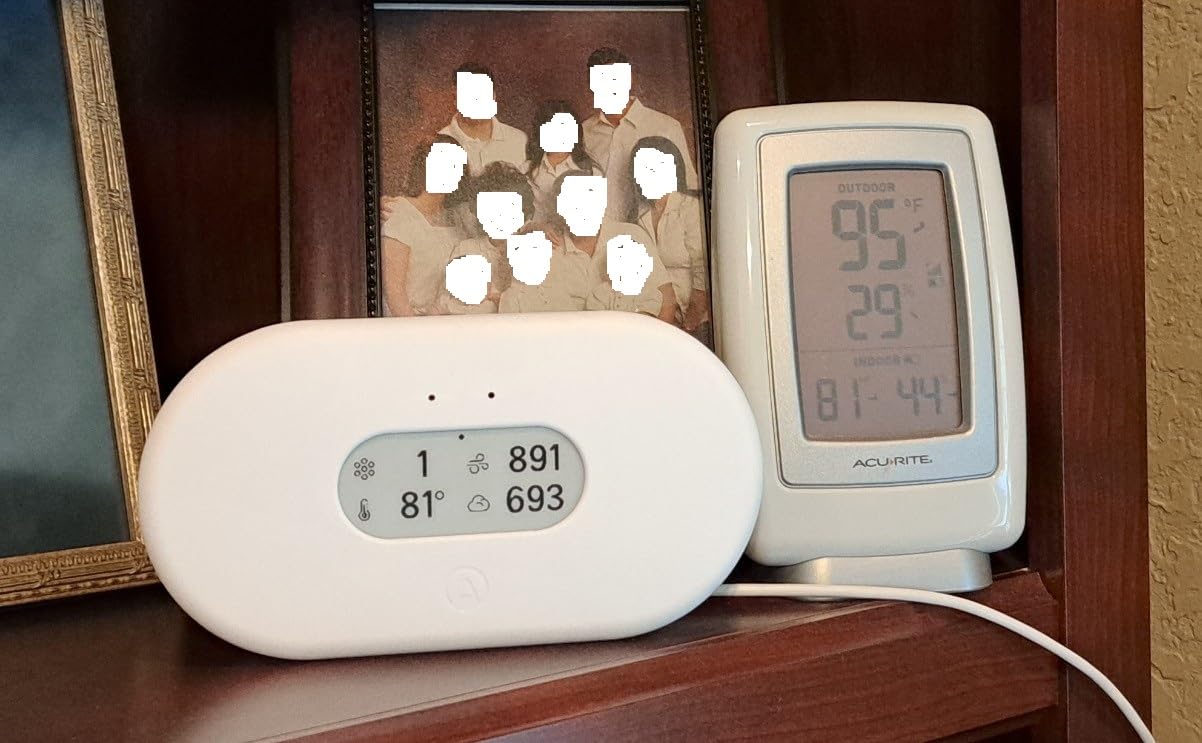
Be precise about the radon limitation, because careful buyers raise it most often. Readings skew low compared with a lab charcoal test or a dedicated radon monitor, particularly in short tests, and the unit needs roughly seven days in its final position before results stabilise. Treat it as a trend instrument: if the number climbs, confirm with a short-term test kit before you start remediation.
Connectivity is Bluetooth only, so the optional Airthings Hub is needed for access away from home. There is also no pairing confirmation, meaning any nearby Bluetooth device can read it, which privacy-minded owners route around by integrating it into Home Assistant.
How to test radon properly in a home
Radon readings vary enormously by floor, by season and by how long a space has been closed. A basement can be several times higher than the first floor above it, and readings rise in winter when windows stay shut. That is why placement matters more than any single number: put the monitor in the lowest frequently occupied room and leave it there for weeks.
If you live in a region with known high radon, treat a consumer monitor as a screening tool. If the trend sits high, follow it with an accredited short-term or long-term test before you spend money on sub-slab depressurisation.
When to skip it
Skip it if you have no radon exposure and no reason to suspect it, since the radon sensor adds cost without daily value. Skip it if you need particulate readings, because there is no PM channel. And skip it if you want away-from-home access without buying the separate hub.
10. Temtop M10+ – Best Portable CO2 and PM2.5 Combination
Temtop M10+ 6-in-1 CO2 Meter & Indoor Air Quality Monitor
CO2, PM2.5, TVOC, AQI, temp, humidity
E-ink display
60-day battery
Bluetooth app
Pros
- Accurate readings cross-checked against pricier monitors
- Crisp e-ink display with no backlight to disturb sleep
- Up to 60 days of battery on a single charge
- Bluetooth app with hourly logged data and export
- Muteable alarm suits bedrooms and nurseries
Cons
- App is clunky and history is awkward to navigate
- Weak power source can make readings look frozen
- Rotating through all readings drains the battery faster
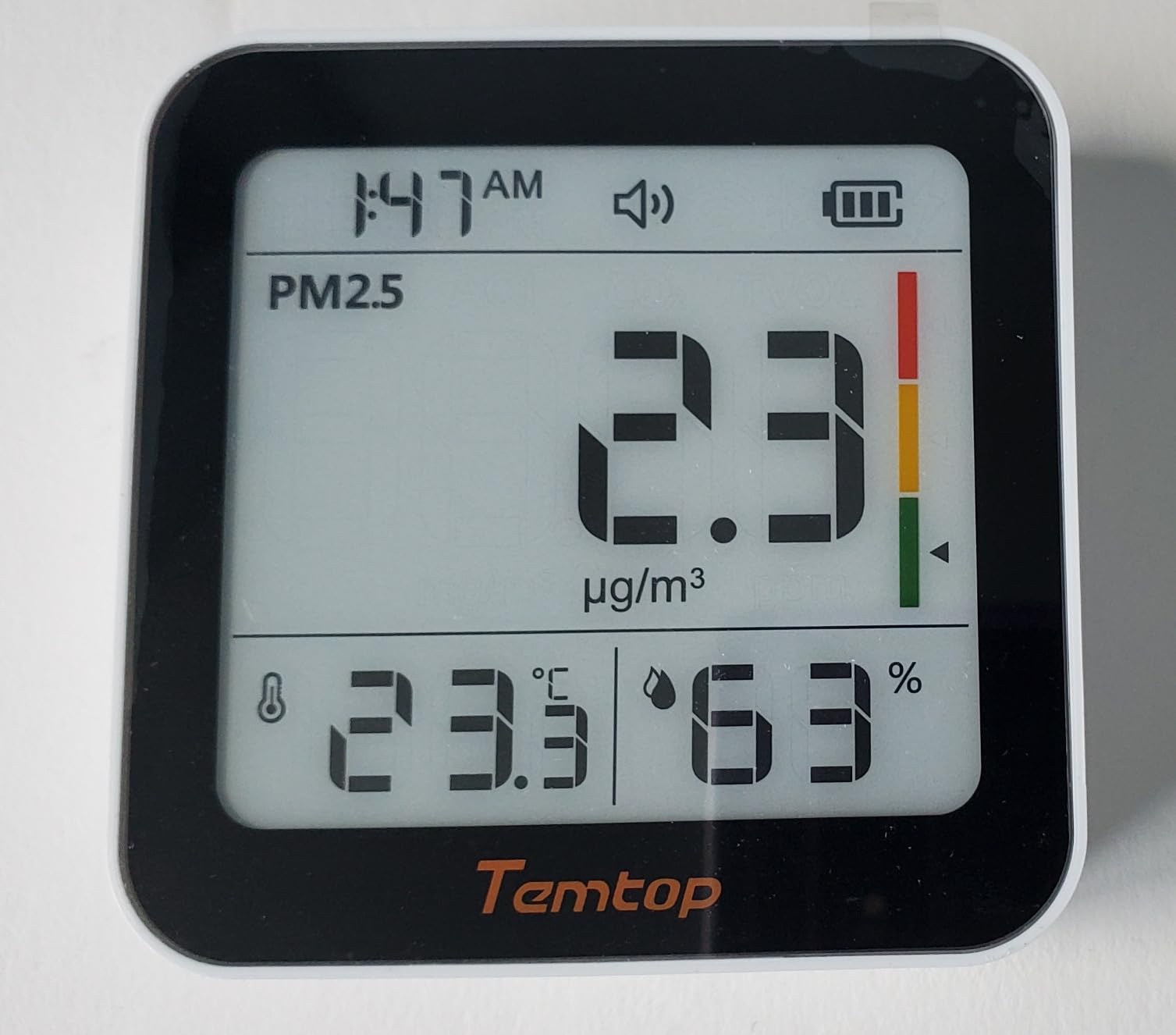
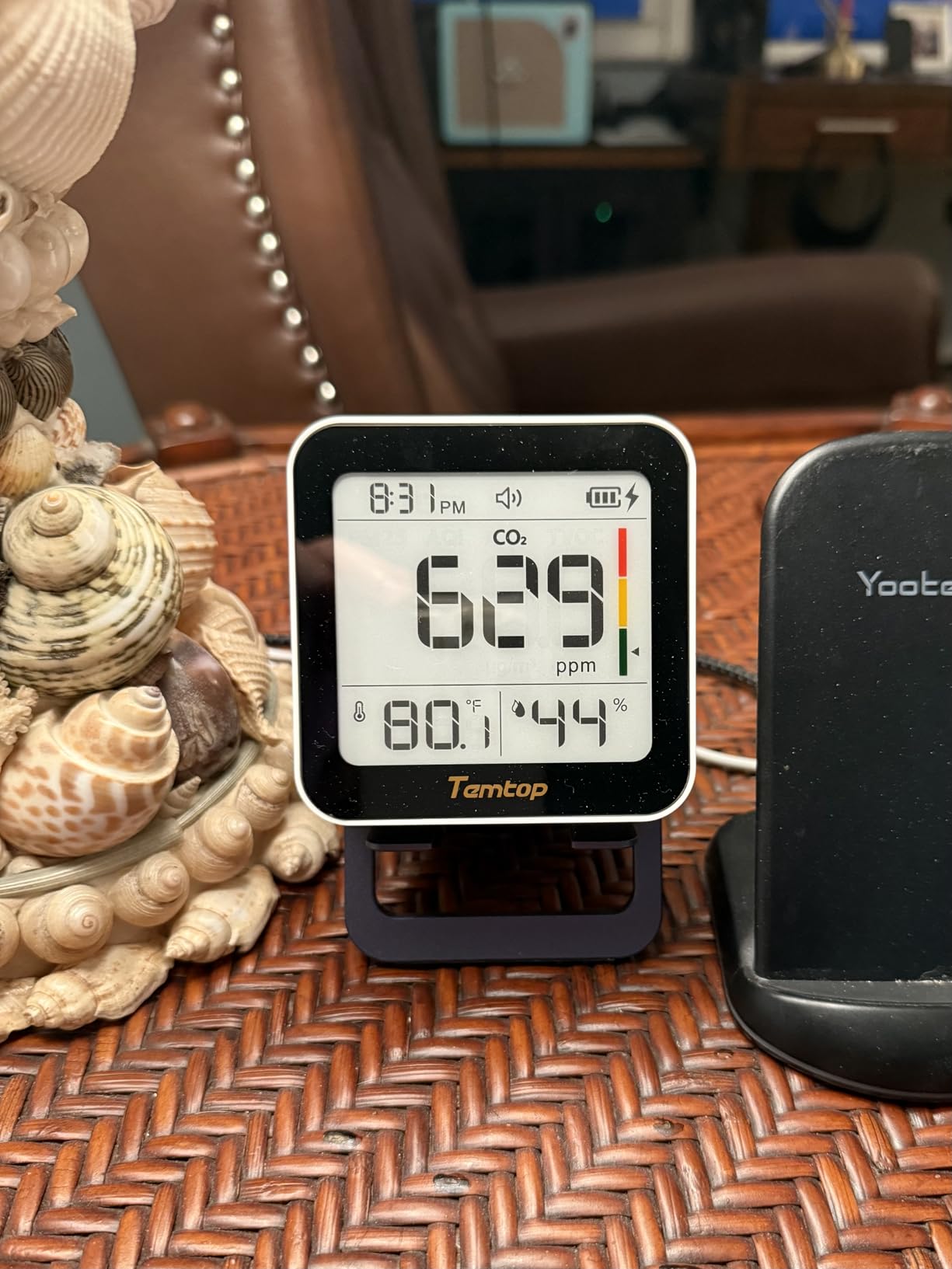
The M10+ is the one to take from room to room. It measures CO2, PM2.5, TVOC, temperature, humidity and AQI, runs for up to 60 days on a charge, and uses the same e-ink idea as the Aranet4: a crisp screen that draws no backlight and therefore does not wake anyone at 3am.
Owners report that the readings hold up when cross-checked against more expensive instruments, and the muteable adjustable alarm is a thoughtful touch for a nursery or a bedroom where a buzzer at 600 ppm would be a nuisance. In-app calibration and over-the-air firmware updates are available.
The software is the weak link. Reviewers describe the iOS login screen as clunky with overlapping elements, and the history view as cumbersome to navigate, so if you want the data rather than the display, budget time for that. A separate complaint worth knowing: with a weak power source the internal fan may not spin up properly and readings can appear frozen, which resolves with a different outlet or cable.
Rotation is another energy cost. Cycling through all six measurements on screen drains the battery much faster than leaving it on one reading, so settle on the value you care about before a long monitoring stretch. Some users also report calibration drift after about a month of use and recommend recalibrating.
What portability is really for
A portable monitor answers a different question from a fixed one. Instead of tracking one room, you can map a whole house in a day: measure the bedroom, the kitchen, the basement, the nursery, then return to the worst one and install something permanent. That is how most people discover that a problem is confined to a single room.
It also suits seasonal spot checks, a rental inspection before you sign a lease, or a measurement of a garage or attic where no wired device would go.
When to skip it
Skip it if you need a phone-first experience with smooth navigation, because the app is the weakest part here. Skip it if you need formaldehyde or PM1 coverage, since neither is measured. And if you plan to run it permanently in a nursery, remember it is a handheld device with a battery, not a mains-powered unit built for continuous duty.
How to Choose an Air Quality Monitor for Home Use
Start with the pollutant that worries you rather than the number of sensors on the box. Allergy and asthma households care about PM2.5. People working from home care about CO2. Families in high-radon counties care about radon. Homes with a gas range, furnace or wood stove have a different concern again, because combustion produces nitrogen oxides and carbon monoxide that a particle sensor will never see. Only the Amazon monitor in this roundup reports carbon monoxide at all, and none of these devices includes a nitrogen oxide channel.
Second, understand the sensor technology, because it is where the marketing lives. Laser-scattering optical particle counters draw air through a chamber and count how much light is scattered; they are fast and repeatable but read counts, not mass, so a conversion to micrograms per cubic metre is an estimate. NDIR CO2 sensors measure how much infrared light CO2 absorbs, which is the physical measurement behind professional instruments. Photoacoustic sensors are a solid-state relative of the same idea, and they are what the GoveeLife H5140 uses.
Third, watch for estimated CO2, sometimes labelled eCO2. These devices infer CO2 from VOC behaviour, and the Home Assistant community has found them noisy and inconsistent, particularly when cooking interferes. The forum consensus is straightforward: if CO2 drives a decision in your home, insist on a real NDIR or photoacoustic sensor and calibrate it in a ventilated room before you trust it.
Fourth, consider VOC and formaldehyde. TVOC readings are relative change indicators rather than absolute concentrations, so a rising number means something is being emitted, not how much you are breathing. A dedicated electrochemical HCHO channel, as on the Temtop LKC-1000S+, gives you a far more usable formaldehyde trend. Mixing a VOC index and a formaldehyde channel in one device can also make the VOC reading less trustworthy.
Fifth, look at data ownership. This is the issue owners on forums raise most often. Several monitors here keep two years of history and export CSV, and one writes to a USB stick with no account at all. Others lock everything into a cloud app with no API, which means you can see your own data but cannot analyse it, automate against it or keep it if the product is discontinued.
Sixth, plan for sensor lifespan. The laser particle sensor in the Temtop is designed for three years, the Aranet4 uses two AA batteries with up to four years of life, and the Airthings Wave Plus lists about 1.5 years of battery. Devices with a sealed single sensor package, such as the Sainlogic unit, cannot have an individual element replaced, so budget for a whole-unit replacement when the numbers stop agreeing with a known reference.
Finally, think about power. A monitor with a six-hour internal battery, such as the BREATHE Airmonitor Plus, is a portable instrument. A unit with no battery at all, such as the GoveeLife H5106, is permanently tied to an outlet. Decide which one you are buying before you fall for a feature list. And if your concern is the basement or the utility room rather than the living space, moisture control starts upstream of any sensor, which is the premise behind our picks for shop air dryers for compressed air and the rest of that equipment guide.
Where to Place an Air Quality Monitor Room by Room
Placement decides how much a monitor can tell you, and most disappointing readings trace back to a bad location. Keep every device at least 1.5 metres from a wall, window, door or vent, away from direct sunlight, and out of the path of supply air. A monitor sitting on a shelf next to a return grille reads the duct, not the room.
In a bedroom, put it at breathing height, roughly one metre above the floor, on an interior wall rather than an exterior one with a leaking window frame. This is where overnight CO2 accumulation and any dry air discomfort show up, and where a light-free e-ink display such as the Aranet4 or the Temtop M10+ is worth the switch.
In a kitchen, place it on the far counter from the range, ideally on the wall opposite the hood. Cooking is the largest indoor particle and VOC source in most homes, and a monitor near the stove measures the extraction system rather than the exposure of the people cooking. If you want to verify whether your range hood actually captures, run a comparison test with a second portable unit at the dining table.
In a nursery or child’s room, keep it out of reach and mount it on a wall or high shelf. Prioritise CO2, humidity and PM2.5, and choose a display you can dim or switch off at night. The GoveeLife H5140 brightness schedule and the Temtop M10+ muteable alarm both exist for exactly this room. Where insects are also a concern in a young child’s space, our roundup of ultrasonic pest repellers for whole homes covers that separate problem, though repellers do nothing for particulates and gases.
In a basement, place it low and away from a dehumidifier outlet. Basements are where radon concentrates, where humidity problems start and where combustion appliances are often installed, so this is the strongest case in the house for the Airthings Wave Plus or any monitor that measures gases. Aim to keep relative humidity between 30 and 50 percent.
Near the front door, a monitor tells you about infiltration. Run an outdoor or window-opened test and watch how quickly indoor PM2.5 tracks the outdoor reading; the speed of the change tells you how leaky the entry is. Home offices should sit on an interior wall at desk height, because CO2 there tracks people rather than weather.
How to Use the Readings: CO2, PM2.5 and Humidity Triggers
PM2.5 is reported in micrograms per cubic metre, and it is the only reading on most of these devices with a widely agreed health threshold. The EPA AQI scale runs from Good at 0 to 12, through Moderate at 12 to 35, Unhealthy for Sensitive Groups at 35 to 55, Unhealthy at 55 to 150, Very Unhealthy at 150 to 250, and Hazardous above 250. A sensible household response is to run a purifier or close up above 35 and to take real action above 55.
For CO2, use a three-step rule rather than a single number. Under 800 ppm means good air. Between 1000 and 1500 ppm means ventilate now if anyone is working or studying in the room. Above 2000 ppm means leave the room until the number falls. Because a purifier does not remove CO2, these readings describe your building and your habits, not your filter.
For humidity, aim for 30 to 50 percent relative humidity. Above 60 percent for weeks at a time, mould and dust mites become real risks in soft furnishings and wood. No monitor in this roundup can detect mould directly, and any that claims to is inferring risk from temperature and humidity rather than measuring spores. If you need mould data, use a professional assessment.
On wildfire smoke days, use the outdoor comparison the IQAir app provides. If outdoor AQI is poor, opening a window will raise your indoor PM2.5 rather than lowering it, and running a purifier with the windows shut is the correct move. Community members tracking smoke in real time consistently describe indoor readings dropping within 20 to 30 minutes of starting a purifier and rising again when windows opened.
Finally, remember what no monitor here can do. These devices do not replace a working smoke alarm or a certified carbon monoxide alarm, they cannot identify which specific VOC is present, and they cannot confirm a gas leak. They measure a handful of numbers in one room. That is still enough to change behaviour, which is why they are worth having.
Frequently Asked Questions
What is the best air quality monitor for home use?
For most households the Amazon Smart Air Quality Monitor is the easiest all-rounder, reporting PM2.5, VOCs, carbon monoxide, humidity and temperature with alerts and purifier control through Alexa Routines. Homes that care about ventilation should use a true NDIR CO2 meter such as the Aranet4, and homes in higher-radon areas should add a radon monitor like the Airthings Wave Plus.
Which air quality monitor is the most accurate for home use?
Accuracy depends on the pollutant. The IQAir AirVisual Pro is the most defensible for PM2.5, with a laser particulate sensor reviewers say matches government-grade references, while the Aranet4 leads on CO2 once its manual baseline calibration is done. Both beat any device that reports estimated CO2, which infers the number from VOC behaviour and drifts.
Do air quality monitors really work?
Yes, with limits. A good monitor gives you a repeatable trend in PM2.5, CO2, humidity and sometimes VOCs, formaldehyde or radon, and that trend is enough to prove whether a purifier or a range hood works. What it cannot do is identify a specific chemical, detect mould spores, or stand in for a smoke or carbon monoxide alarm.
What is the most effective way to monitor air quality in my home?
Pick the pollutant first, then place the unit correctly. Measure PM2.5 in the room where someone sleeps, CO2 in a busy home office, humidity in a basement, and radon in the lowest occupied level. Keep the device 1.5 metres from walls, windows and vents, run it continuously rather than spot checking, and decide your alert thresholds before you start watching the numbers.
Are home air quality monitors worth it?
For allergy sufferers, anyone with a gas appliance, and households exposed to wildfire smoke or renovation dust, yes. You stop guessing and start acting on a number, and you can verify whether a purifier actually reduces particles. If nobody in the house has a specific air quality concern, a free outdoor AQI app is probably enough.
Can an air quality monitor detect mold?
No monitor in this roundup measures mould. What they can do is show temperature and relative humidity, and mould risk tracks sustained humidity above roughly 60 percent. Use that as an early warning to control moisture, and if you suspect mould is already present, hire a professional assessment rather than relying on a consumer device.
What are the downsides of using air quality monitors?
The common complaints are software and expectations. Several units lock data in a cloud app with no export or API, some lose history when a sensor fails, and many alert thresholds are too sensitive to be useful. Devices also read light, heat and cooking fumes differently depending on placement, so a badly sited monitor can give you confidently wrong numbers.
How long do air quality monitors last?
It depends on the consumable parts. The Temtop laser particle sensor is designed for three years, the Aranet4 runs up to four years on two AA batteries, and the Airthings Wave Plus lists roughly 1.5 years of battery. Sealed units with a single sensor package cannot have an element replaced, so expect a full replacement when readings stop matching a known reference.
Conclusion: Which Air Quality Monitor Fits Your Home
Start with the Amazon Smart Air Quality Monitor if you want one device that covers five metrics and automates your purifier through Alexa. Move to the Aranet4 if the real question is how much fresh air your rooms actually get, and to the IQAir AirVisual Pro if you need a PM2.5 number you can trust and an outdoor comparison on smoke days.
Add the Temtop LKC-1000S+ if formaldehyde and three months of USB logging matter more to you than an app, the GoveeLife H5106 if you want the longest data retention at a modest outlay, and the Airthings Wave Plus if radon is a question in your area. For a very large display that anyone can read, the Sainlogic unit does that job with no setup at all.
Whatever you choose in 2026, give it a real threshold and a real routine. A monitor that nobody checks against a plan is just a glowing rectangle.